Interventions to Support Individuals with ADHD in Workplace Settings: A Scoping Review

Journal title PSICOLOGIA DELLA SALUTE
Author/s Alessia Emanueli, Silvia Iacomini, Francesca Cavallini
Publishing Year 2026 Issue 2026/1
Language Italian Pages 19 P. 38-56 File size 187 KB
DOI 10.3280/PDS2026-001004
DOI is like a bar code for intellectual property: to have more infomation click here

Below, you can see the article first page

If you want to buy this article in PDF format, you can do it, following the instructions to buy download credits
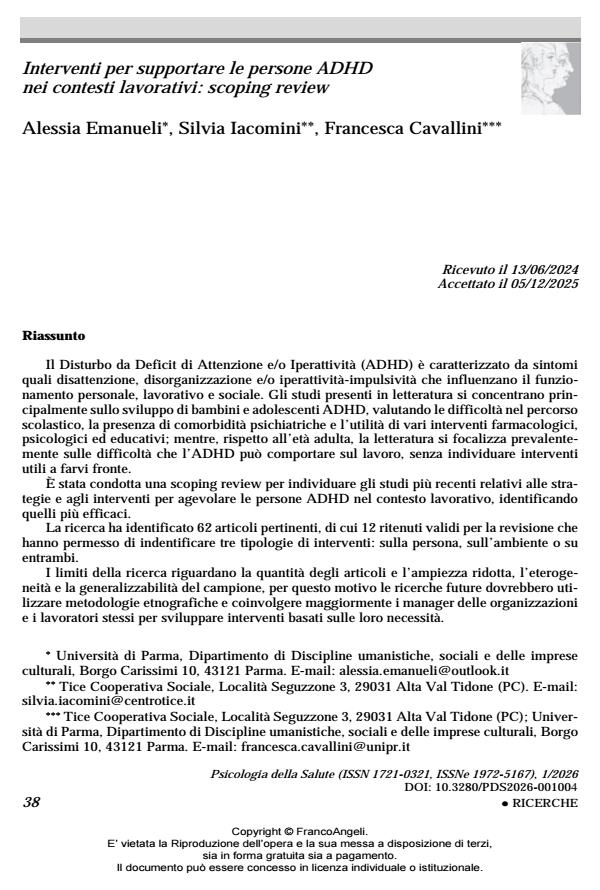
Article preview

FrancoAngeli is member of Publishers International Linking Association, Inc (PILA), a not-for-profit association which run the CrossRef service enabling links to and from online scholarly content.

Attention Deficit Hyperactivity Disorder (ADHD) is characterized by symptoms such as inattention, disorganization, and/or hyperactivity-impulsivity that affect personal, work, and social functioning. Literature mainly focuses on the development of children and adolescents with ADHD, assessing difficulties in the educational path, the presence of psychiatric comorbidities, and the usefulness of various pharmacological, psychological, and educational interventions. Regarding adulthood, literature primarily focuses on the challenges ADHD can pose in the workplace without identifying useful interventions to address them. A scoping review was conducted to identify the most recent studies regarding strategies and interventions to facilitate individuals with ADHD in the workplace, identifying the most effective ones. The search identified 62 relevant articles, of which 12 were considered valid for review, allowing the identification of three types of interventions: individual-focused, environment-focused, or a combination of both. Limitations of the research include the quantity of articles and the small size, heterogeneity and generalizability of the sample; therefore, future research should use ethnographic methodologies and involve organization managers and workers themselves more to develop interventions based on their needs. In conclusion, the scoping review identified effective interventions to improve conditions for ADHD workers and increase their psychosocial well-being

Keywords: ADHD, Scoping review, adulthood, workplace, interventions

  1. Adamou, M., Asherson, P., Arif, M., Buckenham, L., Cubbin, S., Dancza, K., Gorman, K., Gudjonsson, G., Gutman, S., Kustow, J., Mabbott, K., May-Benson, T., Muller-Sedgwick, U., Pell, E., Pitts, M., Rastrick, S., Sedgwick, J., Smith, K., Taylor, C., . . . Young, S. (2021). Recommendations for occupational therapy interventions for adults with ADHD: a consensus statement from the UK adult ADHD network. BMC Psychiatry, 21(1): 72.
  2. Ahlberg, R., Du Rietz, E., Ahnemark, E., Andersson, L. M., Werner-Kiechle, T., Lichtenstein, P., Larsson, H. & Garcia-Argibay, M. (2023). Real-life instability in ADHD from young to middle adulthood: A nationwide register-based study of social and occupational problems. BMC Psychiatry, 23(1): 336.
  3. American Psychiatric Association (2013). Diagnostic and statistical manual of mental disorders: DSM-5 (5th ed.). Washington: American Psychiatric Publishing.
  4. Dahl, V., Ramakrishnan, A., Spears, A., Jorge, A., Lu, J., Bigio, N. & Chacko, A. (2020). Psychoeducation Interventions for Parents and Teachers of Children and Adolescents with ADHD: a Systematic Review of the Literature. Journal of Developmental & Physical Disabilities, 32: 257-292.
  5. Delisle, J. & Braun, C. (2011). A Context for Normalizing Impulsiveness at Work for Adults with Attention Deficit/Hyperactivity Disorder (Combined Type). Archives of Clinical Neuropsychology, 26: 602-613.
  6. Doyle, N. (2020). Neurodiversity at work: A biopsychosocial model and the impact on working adults. British Medical Bulletin, 135: 108-125.
  7. DuPaul, G. J., Evans, S., Owens, J., Cleminshaw, C., Kipperman, K., Fu, Q. & Benson, K. (2021). School-based intervention for adolescents with attention-deficit/hyperactivity disorder: Effects on academic functioning. Journal of School Psychology, 87: 48-63.
  8. Erskine, H. E., Norman, R. E., Ferrari, A. J., Chan, G. C., Copeland, W. E., Whiteford, H. A., Scott, J. G. (2016). Long-Term Outcomes of Attention-Deficit/Hyperactivity Disorder and Conduct Disorder: A Systematic Review and Meta-Analysis. Journal of the American Academy of Child and Adolescent Psychiatry, 55(10): 841-50.
  9. Evans, S. W., Langberg, J., Raggi, V., Allen, J. & Buvinger, E. (2005). Development of a school-based treatment program for middle school youth with ADHD. Journal of Attention Disorders, 9: 343-353. DOI: 10.1177/1087054705279305
  10. Ferrin, M., Moreno-Granados, J. M., Salcedo-Marin, M. D., Ruiz-Veguilla, M., Perez-Ayala, V. & Taylor, E. (2014). Evaluation of a psychoeducation programme for parents of children and adolescents with ADHD: Immediate and long-term effects using a blind randomized controlled trial. European Child & Adolescent Psychiatry, 23: 637-647.
  11. Fletcher, J. M. (2014). The effects of childhood ADHD on adult labor market outcomes. Health Economics, 23(2): 159-81.
  12. Hammerness, P., Geller, D., Petty, C., Lamb, A., Bristol, E. & Biederman, J. (2010). Does ADHD moderate the manifestation of anxiety disorders in children? European Child & Adolescent Psychiatry, 19(2): 107-112.
  13. Harris, J. L. (2020). The Experience of Adults with Attention-Deficit/Hyperactivity Disorder in the Workplace. Walden Dissertations and Doctoral Studies, 8052. https://scholarworks.waldenu.edu/dissertations/8052
  14. Isaksson, G. (2013). How adults with ADHD get engaged in and perform everyday activities. Scandinavian Journal of Occupational Therapy, 20(4): 282-291. DOI: 10.3109/11038128.2013.799226
  15. Jangmo, A., Kuja-Halkola, R., Pérez-Vigil, A., Almqvist, C., Bulik, C. M., D’Onofrio, B., Lichtenstein, P., Ahnemark, E., Werner-Kiechle, T., Larsson, H. (2021). Attention-deficit/hyperactivity disorder and occupational outcomes: The role of educational attainment, comorbid developmental disorders, and intellectual disability. PLOS ONE 16(3): e0247724.
  16. Jašcenoka, J., Schwörer, M., Petermann, F. & Petermann, U. (2019). The relationship between working memory performance and specific executive functions in children with ADHD: A contribution to the criterion validity of the ADHS-KJ. Kindheit und Entwicklung: Zeitschrift für Klinische Kinderpsychologie, 28: 114-122.
  17. Johnston-Tyler, J. & Analla, Y. (2015). ADDRESSING NEURODIVERSE EMPLOYMENT NEEDS: Working with Autism Spectrum Disorder I, NVLD, ADHD, Learning and Mood Disordered Clients. Career Planning & Adult Development Journal, 31(4): 172-178.
  18. Kanarik, M., Grimm, O., Mota, N., Reif, A. & Harro, J. (2022). ADHD co-morbidities: A review of implication of gene × environment effects with dopamine-related genes. Neuroscience and Biobehavioral Reviews, 139: 104757.
  19. Kent, B. N. (2017). Exploring factors that contribute to occupational success of individuals with ADHD. Northcentral University ProQuest Dissertation & Theses. 10606600
  20. Khemakhem, K., Ayadi, H., Moalla, Y., Yaich, S., Hadjkacem, I., Walha, A., Damak, J. & Ghribi, F. (2015). Psychiatric comorbidity related to children with attention deficit hyperactivity disorder at schools in Sfax, Tunisia. L’Encéphale: Revue de psychiatrie clinique biologique et thérapeutique, 41: 56-61.
  21. Lauder, K., McDowall, A. & Tenenbaum, H. (2022). A systematic review of interventions to support adults with ADHD at work—Implications from the paucity of context-specific research for theory and practice. Frontiers in Psychology, 13: 893469. DOI 10.3389/fpsyg.2022.893469
  22. Layachi, A., Douglas, G. & Reraki, M. (2023). Drama-based intervention to support social inclusion: Evaluation of an approach to include students with ADHD in Algeria. Educational Psychology in Practice, 40(1): 36-58. DOI: 10.1080/02667363.2023.225878
  23. Leib, S., Miller, S. & Chin, E. (2023). Latent structure of working memory and emotion regulation in pediatric ADHD. Child Neuropsychology, 29: 644-665. DOI: 10.1080/09297049.2022.210762
  24. Liebel, G., Langlois, N., & Gama, K. (2024). “Challenges, strengths, and strategies of software engineers with ADHD: A case study”. In Proceedings of the 46th International Conference on Software Engineering: Software Engineering in Society (pp. 57-68).
  25. Lindstedt, H. & Umb-Carlsson, Õ. (2013). Cognitive assistive technology and professional support in everyday life for adults with ADHD. Disability & Rehabilitation: Assistive Technology, 8(5): 402-408. DOI: 10.3109/17483107.2013.76912
  26. Lux, S., Rosen, H., Aslan, B. & Philipsen, A. (2020). Nonpharmacological treatment options for attention deficit hyperactivity disorder in adulthood: An update. Der Nervenarzt, 91: 591-598.
  27. Man, K. C., Häge, A., Banaschewski, T., Inglis, S. K., Buitelaar, J., Carucci, S., Danckaerts, M., Dittmann, R. W., Falissard, B., Garas, P., Hollis, C., Konrad, K., Kovshoff, H., Liddle, E., McCarthy, S., Neubert, A., Nagy, P., Rosenthal, E., Sonuga-Barke, E. J. S., . . . ADDUCE Consortium (2023). Long-term safety of methylphenidate in children and adolescents with ADHD: 2-year outcomes of the attention deficit hyperactivity disorder drugs use chronic effects (ADDUCE) study. The Lancet Psychiatry, 10: 323-333. DOI: 10.1016/S2215-0366(23)00042-
  28. Moher, D., Liberati, A., Tetzlaff, J., Douglas, G. A. & The PRISMA Group. (2015). Linee guida per il reporting di revisioni sistematiche e meta-analisi: il PRISMA Statement. Evidence, 7.
  29. Moody, S. (2015). DYSLEXIA, DYSPRAXIA and ADHD in EMPLOYMENT: A View from the United Kingdom. Career Planning & Adult Development Journal, 31: 142-150.
  30. Müller, M., Turner, D., Barra, S., Ro¨sler, M. & Retz, W. (2023). ADHD and associated psychopathology in older adults in a German community sample. Journal of Neural Transmission, 130: 313-323.
  31. Nadeau, K. G., Normandeau, S. & Massé, L. (2012). Efficacite´ d’un programme de consultation pour les enseignants du primaire visant a` favoriser l’inclusion scolaire des enfants ayant un TDAH. Canadian Journal of Behavioural Science, 44: 146-157.
  32. Nagata, M., Nagata, T., Inoue, A., Mori, K. & Matsuda, S. (2019). Effect Modification by Attention Deficit Hyperactivity Disorder (ADHD) Symptoms on the Association of Psychosocial Work Environments with Psychological Distress and Work Engagement. Frontiers in Psychiatry, 10: 166.
  33. Oscarsson, M., Nelson, M., Rozental, A., Gingsberg, Y., Carlbring, P. & Jönsson, F. (2022). Stress and work-related mental illness among working adults with ADHD: a qualitative study. BMC Psychiatry, 22(1): 751.
  34. Parker, D. R., & Boutelle, K. (2009). Executive function coaching for college students with learning disabilities and ADHD: A new approach for fostering self–determination. Learning disabilities research & practice, 24(4): 204-215.
  35. Poissant, H. & Montgomery, C. (2003). Attention Deficit and Hyperactivity Disorder (ADHD) and Depression in Children and Adolescents: Implications for Practitioners and Educators. Journal of Cognitive Education and Psychology, 3: 323-341. DOI: 10.1891/19458950478738302
  36. Rief, S. (2001). ADHD and the schools. Drug Benefit Trends, 13: 17-20.
  37. Robello, J. E. (2019). School and Work Experiences of Adults with ADHD: A Qualitative Case Study (Thesis, Concordia University, St. Paul). Retrieved from https://digitalcommons.csp.edu/cup_commons_grad_edd/283
  38. Safren, S. A., Sprich, S., Mimiaga, M. J., Surman, C., Knouse, L., Groves, M., & Otto, M. W. (2010). Cognitive behavioral therapy vs relaxation with educational support for medication-treated adults with ADHD and persistent symptoms: a randomized controlled trial. Jama, 304(8): 875-880.
  39. Schreuer, N., & Dorot, R. (2017). Experiences of employed women with attention deficit hyperactive disorder: A phenomenological study. WORK: A Journal of Prevention, Assessment & Rehabilitation, 56(3): 429-441.
  40. Shinaver, C. (2015). IMPROVING WORKING MEMORY for ADULTS WITH ATTENTION DEFICIT HYPERACTIVITY DISORDER to ENHANCE THE CAREER COUNSELING PROCESS. Career Planning & Adult Development Journal, 31: 89-98.
  41. Sjöwall, D. & Thorell, L. (2022). Neuropsychological deficits in relation to ADHD symptoms, quality of life, and daily life functioning in young adulthood. Applied Neuropsychology: Adult, 29: 32-40. DOI: 10.1080/23279095.2019.1704287
  42. Solanto, M. V., Marks, D. J., Wasserstein, J., Mitchell, K., Abikoff, H., Alvir, J. M. J., & Kofman, M. D. (2010). Efficacy of metacognitive therapy for adult ADHD. American Journal of Psychiatry, 167(8): 958-968.
  43. Sundar, V. & Brucker, D. (2021). “Today I felt like my work meant something”: A pilot study on job crafting, a coaching-based intervention for people with work limitations and disabilities. Work: Journal of Prevention, Assessment & Rehabilitation, 69: 423-438.
  44. Tamkeen Ashraf, M. & Naeem, T. (2014). Parent training in reduction of attention-deficit/hyperactivity disorder and oppositional defiant disorder symptoms in children. Pakistan Journal of Psychological Research, 29: 151-169.
  45. Torgersen, T., Krokstad, S. & Vaaler, A. (2014). Factors associated with a positive occupational outcome during long-term central stimulant treatment in adult ADHD. ADHD Attention Deficit and Hyperactivity Disorders, 6: 281-290.
  46. Vaughan, B. S., March, J. & Kratochvil, C. (2012). The evidence-based pharmacological treatment of paediatric ADHD. International Journal of Neuropsychopharmacology, 15: 27-39. DOI: 10.1017/S1461145711000095
  47. Veitch, J. A. (2011). Workplace Design Contributions to Mental Health and Well-Being. Healthcare Papers, 11: 38-46.
  48. Weber, C., Krieger, B., Häne, E., Yarker, J. & McDowall, A. (2022). Physical workplace adjustments to support neurodivergent workers: A systematic review. Applied Psychology, 73: 910-962.
  49. Wigal, T., Brams, M., Gasior, M., Gao, J., Squires, L., Giblin, J. & 316 Study Group. (2010). Randomized, double-blind, placebo-controlled, crossover study of the efficacy and safety of lisdexamfetamine dimesylate in adults with attention-deficit/hyperactivity disorder: novel findings using a simulated adult workplace environment design. Behavioral and Brain Functions, 6(1): 34.
  50. Wong, D. F., Ng, T., Ip, P., Chung, M. & Choi, J. (2018). Evaluating the Effectiveness of a Group CBT for Parents of ADHD Children. Journal of Child & Family Studies, 27(1): 227-239.
  51. Young, S., Khondoker, M., Emilsson, B., Sigurdsson, J. F., Philipp-Wiegmann, F., Baldursson, G., ... & Gudjonsson, G. (2015). Cognitive–behavioural therapy in medication-treated adults with attention-deficit/hyperactivity disorder and co-morbid psychopathology: a randomized controlled trial using multi-level analysis. Psychological medicine, 45(13): 2793-2804.

Alessia Emanueli, Silvia Iacomini, Francesca Cavallini, Interventi per supportare le persone ADHD nei contesti lavorativi: scoping review in "PSICOLOGIA DELLA SALUTE" 1/2026, pp 38-56, DOI: 10.3280/PDS2026-001004