Professionalisation, recognition and identity redefinition: Tattoo Artists between subculture and standardisation
Journal title SOCIOLOGIA DEL LAVORO
Author/s Norma Baldino, Margherita Sabrina Perra
Publishing Year 2026 Issue 2025/173
Language Italian Pages 24 P. 129-152 File size 392 KB
DOI 10.3280/SL2025-173007
DOI is like a bar code for intellectual property: to have more infomation
click here
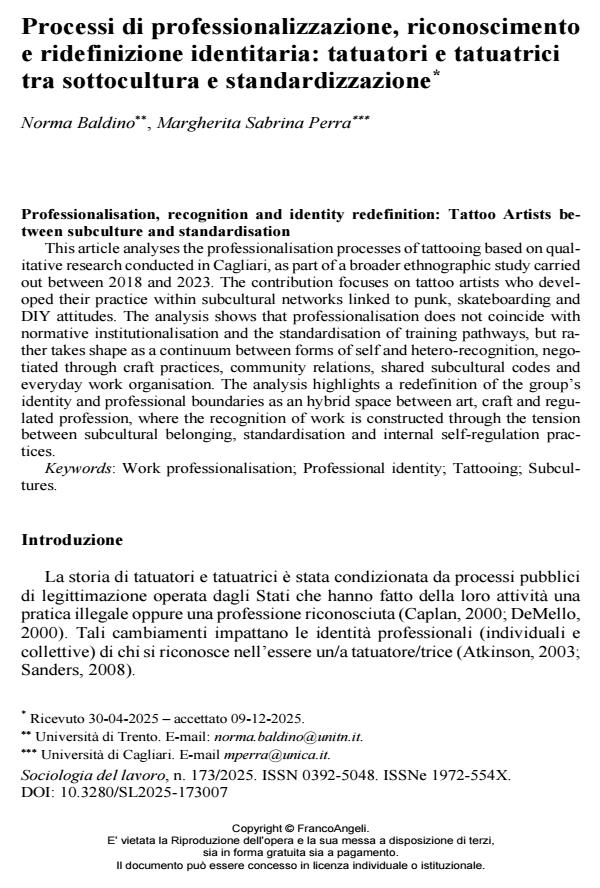
Below, you can see the article first page
If you want to buy this article in PDF format, you can do it, following the instructions to buy download credits
FrancoAngeli is member of Publishers International Linking Association, Inc (PILA), a not-for-profit association which run the CrossRef service enabling links to and from online scholarly content.
This article analyses the professionalisation processes of tattooing based on qual-itative research conducted in Cagliari, as part of a broader ethnographic study carried out between 2018 and 2023. The contribution focuses on tattoo artists who devel-oped their practice within subcultural networks linked to punk, skateboarding and DIY attitudes. The analysis shows that professionalisation does not coincide with normative institutionalisation and the standardisation of training pathways, but ra-ther takes shape as a continuum between forms of self and hetero-recognition, nego-tiated through craft practices, community relations, shared subcultural codes and everyday work organisation. The analysis highlights a redefinition of the group’s identity and professional boundaries as an hybrid space between art, craft and regu-lated profession, where the recognition of work is constructed through the tension between subcultural belonging, standardisation and internal self-regulation prac-tices.
Keywords: Work professionalisation; Professional identity; Tattooing; Subcul-tures.
- Coleman, J. S. (1988). Social capital in the creation of human capital. American Journal of Sociology, 94 (Supplement), 95–120.
- Abbott, A. (1988). The system of professions: An essay on the division of expert labor. Chi-cago, University of Chicago Press.
- Agenzia europea per le sostanze chimiche (ECHA). (2022). Restrizione delle sostanze peri-colose negli inchiostri per tatuaggi e nel trucco permanente. https://echa.europa.eu/it/-/reach-restriction-of-hazardous-substances-in-tattoo-inks-and-permanent-make-up Alvesson, M. e A.W. Johansson (2002). Professionalism and politics in management consultancy work, in T. Clark and R. Fincham (eds.) Critical consulting. Oxford, Blackwell.
- Atkinson, M. (2003). Tattooed: The Sociogenesis of a Body Art. Toronto, University of To-ronto Press.
- Becker, H. S. (1963). Outsiders: Studies in the sociology of deviance. Free Press. Becker, H. S. (1982). Art worlds. University of California Press.
- Blumer, H. (1969). Symbolic interactionism: Perspective and method. University of Califor-nia Press.
- Bourdieu, P. (1980). Le sens pratique. Paris, Les Éditions de Minuit.
- Brint, S. (2001). Professionals and the knowledge economy: Rethinking the theory of post-industrial society. Current Sociology, 49(4), 101-132. DOI: 10.1177/0011392101049004
- Butler, J. (1993). Bodies that matter: On the discursive limits of “sex”. Routledge.
- Caplan, J. (ed.). (2000b). Written on the body: The tattoo in European and American history. Princeton University Press.
- Cereda, A. (2006). Il racconto del corpo: Il tatuaggio tra autobiografia e narrazione collettiva. Studi di Sociologia, 44(1), 131–162. DOI: 10.1400/7722
- Clarke, A. E. (1991). Missionary positioning in sociology: The politics of fieldwork. Journal of Contemporary Ethnography, 20(1), 3–39.
- Conferenza Stato-Regioni. (2011, 21 dicembre). Accordo tra il Governo, le Regioni e le Pro-vince autonome di Trento e di Bolzano sul documento recante: Linee guida per l’esercizio delle attività di tatuaggio e piercing (Rep. atti n. 211/CSR). Gazzetta Ufficiale, Serie Ge-nerale n. 32 del 8 febbraio 2012.
- Consiglio d'Europa. (2008). Risoluzione ResAP(2008)1 sui requisiti e i criteri di sicurezza per tatuaggi e trucco permanente Strasbourg: Council of Europe. https://search.coe.int/cm?i=09000016805d3dc4
- Davenport, T. H. (2005). The coming commoditization of processes. Harvard business re-view, 83(6), 100-108.
- DeMello, M. (1993). Body studies: A review of the literature. Social Science & Medicine, 37(3), 275–284. DOI: 10.4324/978020351960
- DeMello, M. (2000). Bodies of inscription: A cultural history of the modern tattoo community. Duke University Press.
- Dewe, B., e Stüwe, G. (2016). Basiswissen Profession. Zur Aktualität und kritischen Substanz des Professionalisierungskonzeptes für die Soziale Arbeit. Weinheim: Juventa, Beltz.
- Dinovitzer, R., Gunz, H., and Gunz, S. (2014). Unpacking Client Capture: Evidence from Corporate Law Firms. Journal of Professions and Organization, 1/2, 99–117.
- Drucker, P. F. (2002). The discipline of innovation. Harvard business review, 80(8), 95-102.
- European Chemicals Agency (ECHA). (2020). Annex XVII to REACH – Restriction of haz-ardous substances in tattoo inks and permanent make-up. Helsinki: ECHA.
- Freedman, S. (1976). The sociology of the tattooed body: A case study. Social Problems, 23(2), 142–157.
- Friedson, E. (1982). Professionals and the organization of work. University of Chicago Press. Friedson, E. (1994). Professionalism reborn: Theory, prophecy, and policy. University of Chicago Press.
- Fournier V. (1999), The Appeal to “Professionalism” as a Disciplinary Mechanism. Social Review, 47(2): 280- 307. DOI: 10.1111/1467-954X.0017
- Gallie, D. (ed.) (2013) Economic crisis, quality of work and social integration. Oxford: Ox-ford University Press.
- Ghigi, R. e Sassatelli R. (2018). Body Projects: Fashion, Aesthetic Modification and Stylized Selves, in O. Kravets, P. Maclaran, S. Miles, A. Venkatesh (eds), The SAGE Handbook of Consumer Culture, London-Thousand Oaks (CA): SAGE.
- Govenar, A. B. (1982). The changing image of tattooing in American culture. Journal of American Culture, 5(1), 30-37.
- Granovetter, M. (1985). Economic action and social structure: The problem of embeddedness. American journal of sociology, 91(3), 481-510.
- Gunz, H. P., and Gunz, S. P. (2008) ‘Client Capture and the Professional Service Firm’, Amer-ican Business Law Journal, 45/4, 685–721.
- Honneth, A. (1995). The Struggle for Recognition: The Moral Grammar of Social Conflicts. Cambridge: Polity Press.
- Hughes, E. (1958). Men and their Work, London: Free Press.
- Kalkowski, P., Paul G. (2012), Professionalisierungstendenzen im Wellness-Bereich?. SOFI-Working Paper 2012-8.
- Kipping, M., Kirkpatrick, I., e Muzio, D. (2006). Overly controlled or out of control? Man-agement consultants and the new corporate professionalism. In J. Craig (Ed.), Production values: Futures for professionalism (pp. 153–165). Demos.
- Kipping, M. e Kirkpatrick, I. (2013). Alternative Pathways of Change in Professional Services Firms: The Case of Management Consulting. Journal of Management Studies, 50/5, 777–807.
- Kiskaddon, D. (2024). Blood and Lightning: On Becoming a Tattooer, Stanford, CA: Stanford University Press.
- Kosut, M. (2013). The artification of tattoo: Transformations within a cultural field. Cultural Sociology, 7(2), 150–165. DOI: 10.1177/174997551349487
- Istituto Superiore di Sanità. (2015). Tatuaggi e piercing: Un'indagine sulla popolazione ita-liana. Istituto Superiore di Sanità.
- Jenkins, R. (2014). Social Identity (4th ed.). London: Routledge.
- Leicht, K. T., e Fennell, M. L. (2001). Professional Work. A Sociological Approach. Malden, MA: Blackwell.
- Liebold, R., Böhrer A., Röbenack S., Steckdaub-Muller I. (2018). Arbeit am Körper anderer. Darstellung und Inszenierungvon Expertenschaft, in A. Poferl, M. Pfadenhauer (eds), Wissensrelationen. Beiträge und Debatten zum2. Sektionskongress der Wissenssoziologie, Weinheim, Basel: Beltz Juventa.
- Macchia, P. e Nannizzi, M. E. (2019). Sulla nostra pelle: Geografia culturale del tatuaggio. Pisa University Press.
- Maestripieri, L. (2016). Professionalization at Work: The Case of Italian Management Con-sultants. Ephemera,16(2), 31-52.
- Malatesta, M. (2006). Professionisti e gentiluomini. Storia degli ordini professionali nell’Europa moderna. Torino: Giulio Einaudi Editore.
- Maroto M. (2011), Professionalizing Body Art: A Marginalized Occupational Group’s Use of Informal and Formal Strategies of Control. Work and Occupations, 38(1): 101-138. DOI: 10.1177/073088841038540
- Mieg H. (2016), Profession: Begriff, Merkmale, gesellschaftliche Bedeutung, in M. Dick, W. Marotzki, H. Mieg (eds), Handbuch Professionsentwicklung, Bad Heilbronn: Julius Klinkhardt.
- Ministero della Sanità. (1998). Linee guida per l'esecuzione di procedure di tatuaggio e pier-cing in condizioni di sicurezza (Circolare n. 2.9/156). Ministero della Salute. https://www.indicenormativa.it/norma/urn%3Anir%3Aministero.sanita%3Acirco-lare%3A1998-02-05%3B2.9-156
- Ministero della Sanità. (1998). Chiarimenti sulla circolare n. 2.9/156 del 5 febbraio 1998 (Circolaren.2.8/633).:https://www.indicenormativa.it/norma/urn%3Anir%3Amini-stero.sanita%3Acircolare%3A1998-07-16%3B2.8-633
- Ministero dello Sviluppo Economico. (2005). Decreto legislativo n. 206 del 6 settembre 2005, codice del consumo. Gazzetta Ufficiale della Repubblica Italiana, Supplemento Ordinario
- n. 162. https://www.gazzettaufficiale.it/atto/serie_generale/caricaDettaglioAtto/origina-rio?atto.codiceRedazionale=005G0232&atto.dataPubblicazioneGazzetta=2005-10-08
- Mora, E. (2001). Sociologia della moda. Bologna: Il Mulino.
- Muzio D. and Ackroyd, S. (2005) On the Consequences of Defensive Professionalism: The Transformation of the Legal Labour Process. Journal of Law and Society, 32/4, 615–42.
- Muzio D., S. Ackroyd, S. e Chanlat J.F. (2008). Redirections in the study of expert labour. Basingstoke: Palgrave Macmillan.
- Neal, M. and Morgan J. (2000). The professionalization of everyone? A comparative study of the development of the professions in the United Kingdom and Germany’. European So-ciological Review, 16(1), 9-26.
- Noordegraaf, M., e Schinkel, W. (2011). Professionalism as symbolic capital: Materials for a Bourdieusian theory of professionalism. Comparative Sociology, 10(1), 67-96. DOI: 10.1163/156913310X51408
- Pfadenhauer, M. (2005), Die Definition des Problems aus der Verwaltung der Lösung, in Id. (ed.), Professionelles Handeln, Wiesbaden: VS.
- Pink, S. (2009). Urban social movements and small places: Slow cities as sites of activism. City, 13(4), 451-465. DOI: 10.1080/1360481090329855
- Regione Autonoma della Sardegna. (2023). Linee guida regionali contenenti gli standard formativi per il profilo professionale dell'operatore di tatuaggio e piercing (Delibera n. 41/21). https://delibere.regione.sardegna.it/it/visualizza_delibera.page?conten-tId=DBR68083
- Renzoni A, Pirrera A, Novello F, Diamante MS, Guarino C. (2015). Implementation of Euro-pean Council resolution ResAP(2008)1 in Italy. National and regional regulation of tattoo practices: diversity and challenges. Curr Probl Dermatol. 2015;48:201-5. DOI: 10.1159/000369228
- Sacks, M. (2012). Defining a profession: The role of knowledge and expertise’, Professions & Professionalism, 2(1), 1-10.
- Salman, S. (2019) Towards a ‘client professionalization’ process? The case of the institution-alization of executive coaching in France. Journal of Professions and Organization, 6, 3, 286–303.
- Sanders, C. R. (1988). Marks of Mischief: becoming and being a tattooed person, Journal of Contemporary Ethnography, 16: 395–432. DOI: 10.1177/089124168816400
- Sanders, C. R. (2000). Tattooing and body piercing. In C. Faupel e P. Roman (Eds.), Ency-clopedia of criminology and deviant behavior 4, Taylor & Francis, 531–534.
- Sanders C., Vail A. (2009). Customizing the Body: The Art and Culture of Tattooing, Phila-delphia: Temple University
- Sennett, R. (2008). L’uomo artigiano. Edizioni Feltrinelli.
- Simmel, G. (1989). La metropoli e la vita mentale. In G. Simmel, Filosofia della cultura. Milano: Feltrinelli, 487-497.
- Simpson, R., e Pullen, A. (2018). ‘Cool’ Meanings: Tattoo Artists, Body Work and Organi-zational ‘Bodyscape’. Work, Employment and Society, 32(1), 169-185.
- Slay, H., Smith, D. (2011). Professional Identity Construction: Using Narrative to Understand the Negotiation of Professional and Stigmatized Cultural Identities. Human Relations, 64(1): 85-107. DOI: 10.1177/001872671038
- Steckdaub-Muller, I. (2018). You've Got to Do This like a Professional–Not like One of These Scratchers!: Reconstructing the Professional Self-Understanding of Tattoo Artists. Cam-bio: rivista sulle trasformazioni sociali: 16, 2, 2018, 43-54. sailors and street-corner punks 1950-1965. Harrington park.
- Strauss, A. (1978). A social world perspective. Studies in symbolic interaction, 1(1), 119-128.
- Strauss, A. L. e Corbin, J. (1990). Discovery of grounded theory: Strategies for qualitative research. Aldine Publishing Company.
- Svenson, N. (2015). The United Nations as a knowledge system. London: Routledge.
- Timmermans, S. (2008). The transformation of medical work: From hands-on care to the management of technology. University of Chicago Press.
- Unioncamere. (2022). Rapporto annuale sulle attività e i servizi della rete delle Camere di commercio.https://www.unioncamere.gov.it/sites/default/files/articoli/2022-12/Si-stema%20Camerale%202022_0.pdf
- Veblen, T. (1949). La teoria della classe agiata: Studio economico sulle istituzioni. Torino: Einaudi.
- Vail, D. (1999). The commodification of time in two art worlds. Symbolic Interaction, 22(4), 325-344 DOI: 10.1016/S0195-6086(00)87400-
- Vail, D. (2000). The tattoos we deserve: Producing culture and constructing elitism. Univer-sity of Connecticut.
- Wilensky, H.L. (1964). The professionalization of everyone’. American journal of Sociology, 70(2): 137-158. DOI: 10.1086/22379
- Weber, M. (1961). Sociology of religion: The sociology of world religions. Beacon Press.
Norma Baldino, Margherita Sabrina Perra, Processi di professionalizzazione, riconoscimento e ridefinizione identitaria: tatuatori e tatuatrici tra sottocultura e standardizzazione in "SOCIOLOGIA DEL LAVORO " 173/2025, pp 129-152, DOI: 10.3280/SL2025-173007