Just a few and marginal: professional community and gender disparity in videogame industry
Journal title SOCIOLOGIA DEL LAVORO
Author/s Luigi Burroni, Giulia Cavallini
Publishing Year 2026 Issue 2025/173
Language Italian Pages 20 P. 175-194 File size 319 KB
DOI 10.3280/SL2025-173009
DOI is like a bar code for intellectual property: to have more infomation
click here
Below, you can see the article first page
If you want to buy this article in PDF format, you can do it, following the instructions to buy download credits
FrancoAngeli is member of Publishers International Linking Association, Inc (PILA), a not-for-profit association which run the CrossRef service enabling links to and from online scholarly content.
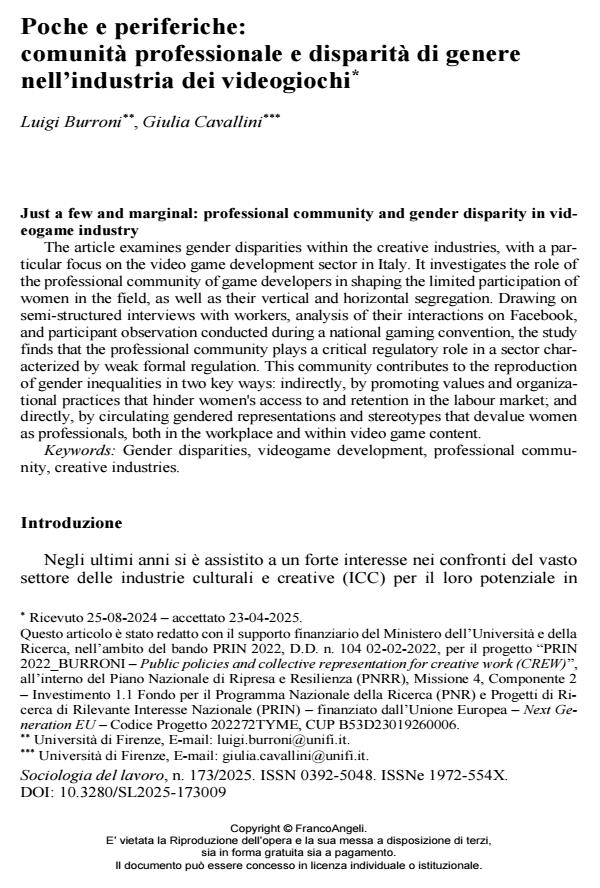
The article examines gender disparities within the creative industries, with a par-ticular focus on the video game development sector in Italy. It investigates the role of the professional community of game developers in shaping the limited participation of women in the field, as well as their vertical and horizontal segregation. Drawing on semi-structured interviews with workers, analysis of their interactions on Facebook, and participant observation conducted during a national gaming convention, the study finds that the professional community plays a critical regulatory role in a sector char-acterized by weak formal regulation. This community contributes to the reproduction of gender inequalities in two key ways: indirectly, by promoting values and organiza-tional practices that hinder women's access to and retention in the labour market; and directly, by circulating gendered representations and stereotypes that devalue women as professionals, both in the workplace and within video game content.
Keywords: Gender disparities, videogame development, professional commu-nity, creative industries.
- Johnson R.S. (2013). Toward greater production diversity: Examining social boundaries at a video game studio. Games and Culture, 8, 3: 136-160.
- Adams T.L. (2010). Gender and Feminization in Health Care Professions. Sociology Com-pass, 4: 454-465.
- Alacevich F., Bellini A., Tonarelli A., (2017). Una professione plurale. Il caso dell’avvocatura Fiorentina. Firenze; Firenze University Press.
- Bailey E.N., Miyata K., Yoshida T. (2021). Gender composition of teams and studios in video game development. Games and Culture, 16, 1: 42–64.
- Bell E., Bryman A., Harley B. (2019). Business research methods. Oxford: Oxford university press.
- Bellini A., Burroni L., Dorigatti L. (2018). Strategic but vulnerable. Industrial relations and creative workers – Country Report: Italy. IR-CREA Project, Research Report.
- Bertaux D., Bichi R. (1999). Racconti di vita. La prospettiva etnosociologica. Milano: Fran-coAngeli.
- Burawoy, M., Burton. A., Ferguson, A., Fox, K.J., Gamson, J., Gartrell, N. (1991). Ethnog-raphy unbound: power and resistance in the modern metropolis, Berkeley, CA: Univer-sity of California Press.
- Carbone M.B., Fassone R., a cura di (2020). Il videogioco in Italia: Storie, rappresentazioni, contesti. Milano: Mimesis.
- Cavallini G., Raspanti D. (2024). Carriere, condizioni e sensi del lavoro nel videogame deve-lopment in Italia. In: Paraciani R., Cattani L., Forme di produzione nelle industrie creative e culturali. Confini e significati. WriteUp Books, pp. 35-84.
- Chung H. (2022). The flexibility paradox: why flexible working leads to (self)exploitation. Bristol: Policy Press.
- Conor B., Gill R., Taylor S. (2015). Gender and creative labour. The Sociological Review, 63, 1: 1-22.
- Consalvo M. (2008). Crunched by passion: women game developers and the workplace chal-lenges. In: Kafai B.Y., Heeter C., Denner J., Sun Y.J., a cura di, Beyond Barbie and Mortal Kombat. New Perspectives on Gender and Gaming. Cambridge, MA: MIT Press.
- Contin A. (2022). Women in Games, una guida per costruire un campo da gioco equo, urly.it/314dy_. [Consultato 2/02/2024].
- Cote A.C., Harris B.C. (2021). ‘Weekends became something other people did’: Understanding and intervening in the habitus of video game crunch. Convergence, 27, 1: 161-176. Croson, R., Gneezy, U. (2009). Gender differences in preferences, in Journal of Economic Literature, vol. 47, n. 2, pp. 1-27.
- DCMS (2008). Creative Britain: New Talents for the New Economy. London: DCMS.
- Deloitte (2022). Rethink STE(A)M education. A sustainable future through scientific, tech and humanistic skills, urly.it/314dxm. [Consultato 23/01/2024].
- Dent T. (2020). Devalued women, valued men: motherhood, class and neoliberal feminism in the creative media industries. Media, Culture & Society, 42, 4: 537-553.
- Derks B., Van Laar C., Ellemers N. (2016). The queen bee phenomenon: Why women leaders distance themselves from junior women. The Leadership Quarterly, 27, 3: 456-469.
- Dorigatti L., Been W.M., Burroni L., Keune M., Larsen T.P., Mailand M. (2022). Playing alone? Interest representation in the videogame industry in Denmark, Italy and the Neth-erlands. Economic and Industrial Democracy: 1-23.
- Duffy B.E. (2017). (Not) getting paid to do what you love. New Haven, CT: Yale University Press.
- Esposito M. (2023). Tra produzione e riproduzione: l’onere del lavoro non retribuito sulle disparità di genere. Roma: Report Inapp.
- EUIPO (2023). Women in Design. European Union Intellectual Property Office.
- Evetts J. (2013). Professionalism: Value and ideology. Current sociology, 61, 5-6: 778-796. Florida R. (2002). The rise of the creative class: And how it’s transforming work, leisure, community and everyday life. New York, NY: Basic Books.
- Freidson E. (2002). Professionalismo. La terza logica, Bari: Dedalo.
- Fusulier B. (2011). Le concept d’éthos: de ses usages classiques à un usage renouvelé. Re-cherche sociologiques et anthropologiques, 42, 1: 97-109.
- Gaiaschi C. (2022). Doppio Standard. Donne e carriere scientifiche nell’Italia contemporanea. Milano: Carocci.
- Gill R. (2002). Cool, creative and egalitarian? Exploring gender in project-based new media work in Euro. Information, communication & society, 5, 1: 70-89.
- Harvey A. (2022). Making the grade: Feminine lack, inclusion, and coping strategies in digital games higher education. New Media & Society, 24, 9: 1986–2002.
- Harvey A., Shepherd T. (2017). When passion isn’t enough: gender, affect and credibility in digital games design. International Journal of Cultural Studies, 20, 5: 492–508.
- Hesmondhalgh D., Baker S. (2015). Sex, gender and work segregation in the cultural indus-tries. The Sociological Review, 63, 1: 23-6.
- IGDA (2022). Developer Satisfaction Survey 2021. Diversity in the Game Industry Report, https://urly.it/314dyk. [Consultato 4/03/2024].
- IIDEA (2023). I videogiochi in Italia nel 2022. Mercato, consumatori, industria, urly.it/314dys. [Consultato 4/03/2024].
- VGE-EGDF (2023). All About Video Games – European Key Facts 2022, urly.it/314dyw. [Consultato 15/04/2024].
- Kozinets R. (2020). Netnography: The essential guide to qualitative social media research. London: Sage.
- Kulavuz-Onal D., Vásquez C. (2013). Reconceptualising fieldwork in a netnography of an online community of English language teachers. Ethnography and Education, 8, 2: 224-238.
- Legault M-J., Weststar J. (2017). Videogame developers among 'extreme workers': Are death marches over?. E-Journal of International and Comparative Labour Studies, 6, 3: 1-29.
- Lombardo E., Naldini M., Poggio B. (2024). Gender Inequalities in Academia: Multiple Ap-proaches to Closing the Gap. Sociologia del Lavoro, 68: 9-27.
- Murphy R. (1984). The structure of closure: A critique and development of the theories of Weber, Collins, and Parkin. British Journal of Sociology, 547-567.
- O’Brien A. (2019). Women, inequality and media work. London: Routledge.
- Naldini M., Poggio B., a cura di (2023). Genere e accademia. Carriere, culture e politiche. Bologna: Il Mulino.
- Prescott J., Bogg J. (2013). The Gendered Identity of Women in the Games Industry, Eludamos: Journal for Computer Game Culture, 7, 1: 55-67.
- Ruffino P., a cura di (2021). Independent videogames: Cultures, networks, techniques and politics. Oxfordshire: Routledge.
- Salaman G. (1974). Community and occupations: An exploration of work/leisure relation-ships. Cambridge, MA: Cambridge University Press.
- Saraceno C. (2020). Politiche per le famiglie e disuguaglianze. Politiche Sociali/Social Poli-cies, 1: 103-124.
- Scott A.J. (2006). Creative cities: Conceptual issues and policy questions. Journal of urban affairs, 28, 1: 1-17.
- Shapiro J.R., Williams A.M. (2012). The role of stereotype threats in undermining girls’ and women’s performance and interest in STEM fields. Sex Roles, 66, 3-4: 175-183.
- Singh T. (2020). Gendered barriers in the gaming industry. Journal of Sports Law, Policy and Governance, 2, 1: 1-22.
- Sotamaa O., Svelch J., a cura di (2021). Game production studies. Amsterdam: Amsterdam University Press.
- Staines G., Tavris C., Jayaratne T.E. (1974). The queen bee syndrome. Psychology Today, 7, 8: 55-60.
- Styhre A., (2020). Indie Video Game Development Work: Innovation in the Creative Econ-omy. Cham: Springer Nature.
- Storper M., Scott A.J. (2009). Rethinking human capital, creativity and urban growth. Journal of Economic Geography, 9, 2: 147–167.
- Tattarini G., Carriero R., Solera C. (2024). You have to work more than men to succeed! Gender differences in workaholism among Italian academics. Sociologia del Lavoro, 168: 28-49.
- Van Maanen J., Barley S. (1984). Occupational Communities: Culture and control in organi-zations. Research in Organizational Behavior, 6: 287-365.
- Vossen E. (2018). On the cultural inaccessibility of gaming: Invading, creating, and reclaim-ing the cultural clubhouse, PhD thesis. ON, Canada: University of Waterloo.
- Weststar J. (2015). Understanding video game developers as an occupational community. In-formation, Communication & Society, 18, 10: 1238-1252.
- Weststar J., Legault M.J. (2018). Women’s experiences on the path to a career in game devel-opment. In: Gray K.L., Voorhees G., Vossen E., a cura di, Feminism in play. Cham: Pal-grave Macmillan.
- Witz A. (1990). Patriarchy and Professions: The Gendered Politics of Occupational Closure. Sociology, 24: 675-90.
- Wolf M.J.P., Perron B., a cura di (2023). The Routledge companion to video game studies. New York: Routledge.
- Woodcock J. (2019). Marx at the arcade: Consoles, controllers, and class struggle. Chicago: Haymarket Books.
- Yin R.K. (2018). Case study research and applications. Los Angeles: Sage.
Luigi Burroni, Giulia Cavallini, Poche e periferiche: comunità professionale e disparità di genere nell’industria dei videogiochi in "SOCIOLOGIA DEL LAVORO " 173/2025, pp 175-194, DOI: 10.3280/SL2025-173009