Public real estate assets in a context of austerity. Valorisation policies and care infrastructure in Grenoble
Journal title SOCIOLOGIA URBANA E RURALE
Author/s Federica Gatta, Cécile Léonardi, Ines Ramirez-Cobo
Publishing Year 2026 Issue 2026/139
Language French Pages 24 P. 48-71 File size 691 KB
DOI 10.3280/SUR2026-139003
DOI is like a bar code for intellectual property: to have more infomation
click here
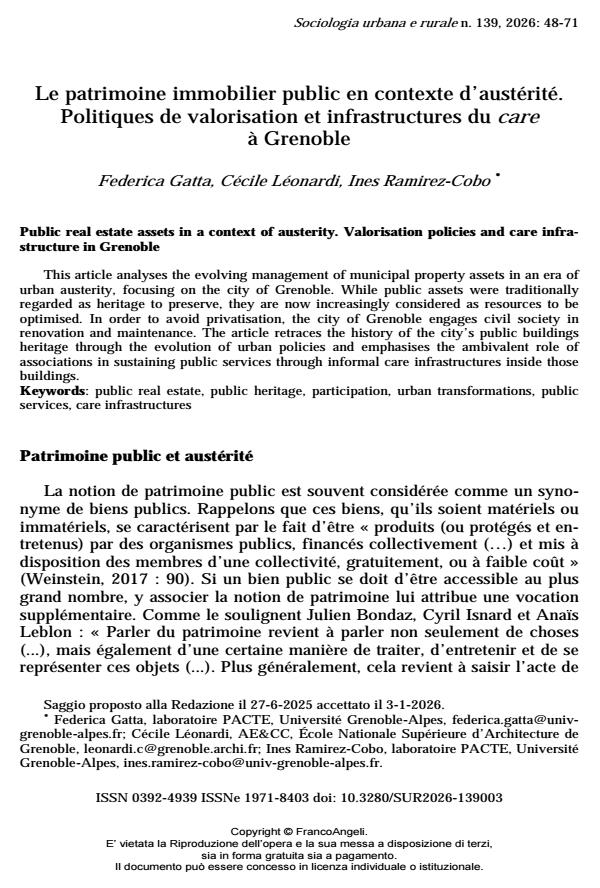
Below, you can see the article first page
If you want to buy this article in PDF format, you can do it, following the instructions to buy download credits
FrancoAngeli is member of Publishers International Linking Association, Inc (PILA), a not-for-profit association which run the CrossRef service enabling links to and from online scholarly content.
This article analyses the evolving management of municipal property assets in an era of urban austerity, focusing on the city of Grenoble. While public assets were traditionally regarded as heritage to preserve, they are now increasingly considered as resources to be optimised. In order to avoid privatisation, the city of Grenoble engages civil society in renovation and maintenance. The article retraces the history of the city’s public buildings heritage through the evolution of urban policies and emphasises the ambivalent role of associations in sustaining public services through informal care infrastructures inside those buildings.
Keywords: public real estate, public heritage, participation, urban transformations, public services, care infrastructures
- Adisson F., Artioli F. (2019). Four Types of Urban Austerity: Public Land Privatisations in French and Italian Cities. Urban Studies, 57(1): 72-92. DOI: 10.1177/0042098019827517
- Adisson F., Halbert L. (2022). State financialization: Permanent austerity, financialized real estate and the politics of public assets in Italy. Economy and Society, 51(3): 489-513. DOI: 10.1080/03085147.2022.2073064
- Binet A., Houston-Read R., Gavin V., Baty C., Abreu D., Genty J., Tulloch A., Reid A., Arcaya M. (2022). The Urban Infrastructure of Care. Journal of the American Planning Association, 89(3): 282-294. DOI: 10.1080/01944363.2022.2099955
- Bondaz J., Isnart C., Leblon A. (2012). Au-delà du consensus patrimonial. Civilisations, 61-1: 9-22.
- Chalas Y., Soubeyran O. (2009). Incertitude, environnement et aménagement. Quelle rupture ? In Chalas Y., Gilbert C., Vinck D. (eds.). Comment les acteurs s’arrangent avec l’incertitude. Paris: Éditions des archives contemporaines.
- CNRTL (s.d.). Patrimoine. In Centre National des Ressources Textuelles et Lexicales [online]. https://www.cnrtl.fr/definition/patrimoine#:~:text=Ensemble%20des%20biens%20h%C3%A9rit%C3%A9s%20des,%2C%20transmettre%20un%2Fson%20patrimoine.
- Collectif Isaure Périer (2025). Sociologie de Grenoble. Paris: La Découverte.
- Davies J.S., Blanco I. (2017). Austerity urbanism: Patterns of neo-liberalisation and resistance in six cities of Spain and the UK. Environment and Planning A: Economy and Space, 49(7): 1517-1536.
- DeVerteuil J. (2016). Resilience in the post-welfare inner city. Bristol: Policy Press.
- Diaconu A., Duran y Gonin M. (2022). L’habitat intercalaire à la croisée de l’urbanisme tactique et de l’action sociale : les cas de Grenoble, Rennes et Villeurbanne. L’Espace Politique [online], 47-48.
- Dubedout H. (1971), Démocratie locale : le test de Grenoble. Preuves, 6: 7-15.
- Gatta F., Léonardi C. (à paraître). Ouverture du patrimoine municipal. Ambitions et paradoxes d’un appel à projets urbains innovants en contexte d’austérité. In Boissonade J. Landy F., Zetlaoui-Léger J. (eds.). Contradictions urbaines de la participation. Paris: Le Manuscrit.
- Gatta F., Léonardi C., Garcia P.O., D’Orazio A., Manola T., Tallec J., Tribout S., Bataille N. (2023). De nouvelles formes de partenariat public-privé ? Un appel à projet innovant à Grenoble. Métropolitiques [online]. Disponible en ligne : https://metropolitiques.eu/De-nouvelles-formes-de-partenariat-public-prive.html.
- Gatta F., Montesano M.G. (2024). Experimenting with austerity urbanism through public asset management. The case of Grenoble and Bologna. Métropoles [online], 35. Disponible en ligne : http://journals.openedition.org.sid2nomade-2.grenet.fr/metropoles/11891.
- Joly J. (1995). Formes urbaines et pouvoir local. Le cas Grenoble des années 60 et 70. Toulouse: Presses Universitaires du Mirail.
- Joly J., Parent J-F. (1988). Grenoble de 1965 à 1985. Paysage et politique de la ville. Grenoble: Presses universitaires de Grenoble.
- Kolytcheff B. (2017). Le budget participatif grenoblois. Gestion & Finances Publiques, 5: 63-66.
- Landau B. (2019). La maîtrise d’ouvrage urbaine en question, portée et limites des APUI. Tous urbains, 25: 39-45.
- Mallet S., Mège A., Fleury A. (2013). Le temporaire comme instrument de la fabrique urbaine : émergence et ancrage dans la métropole de Bordeaux. Riurba [online], 14. Disponible en ligne: https://www.riurba.review/article/14-habitat/temporaire/.
- Novarina G. (1997). Du quartier à la ville ; trente années d’urbanisme dans l’agglomération grenobloise 1965-1995. Géocarrefour, 72(2): 131-141.
- Novarina G., Seigneuret N. (2015). De la technopole à la métropole? L’exemple de Grenoble. Paris: Le Moniteur.
- Peck J. (2012). Austerity Urbanism. City: Analysis of Urban Change, Theory, Action, 16(6): 626-655. doi 10.1080/13604813.2012.734071.
- Piganiol M. (2022). The Contested Commodification of State-Owned Land. French Politics, 20: 226-243.
- Power E.R., Wiesel I., Mitchell E., Mee K.J. (2022). Shadow care infrastructures: Sustaining life in post-welfare cities. Progress in Human Geography, 46(5): 1165-1184. DOI: 10.1177/03091325221109837
- Ramirez-Cobo I. (2016). L’incertitude comme levier de co-construction au prisme du projet urbain : L’émergence d’un mode de conception « transitionnel » des espaces urbains : entre pratiques institutionnelles et pratiques alternatives. PhD Architecture, aménagement de l’espace. Grenoble: Université Grenoble Alpes.
- Russell B., Milburn K., Heron K. (2023). Strategies for a new municipalism: Public–common partnerships against the new enclosures. Urban Studies, 60(11): 2133-2157. DOI: 10.1177/00420980221094700
- Sintomer Y., Herzberg C., Röcke A. (2008). Les budgets participatifs en Europe : Des services publics au service du public. Paris: La Découverte.
- Theodore N. (2020). Governing through Austerity: (Il)logics of Neoliberal Urbanism after the Global Financial Crisis. Journal of Urban Affairs, 42(1): 1-17. DOI: 10.1080/07352166.2019.1623683
- Traill H., Anderson S., Shaw D., Cumbers A., McMaster R. (2024). Caring at the edges: Infrastructures of care and repair in urban deprivation. EPD: Society and Space, 42(2): 190-210. DOI: 10.1177/02637758241231106
- Ville de Grenoble (2021, 17 mai). Communiqué de presse du Conseil municipal du 17 mai 2021. Grenoble : Service Presse. Disponible en ligne: https://www.grenoble.fr/uploads/Presse/pse_fichier/71/1167_840_CP-CM-170521.pdf.
- Weinstein O. (2017). Bien public. In Cornu M., Orsi F., Rochfeld J. Dictionnaire des biens communs. Paris: PUF.
- Wolch J. (1990). The shadow state: transformations in the voluntary sector. In Wolch J., Dear M. (eds.). The power of geography. How territory shapes social life. Boston: Unwin Hyman.
Federica Gatta, Cécile Léonardi, Ines Ramirez-Cobo, Le patrimoine immobilier public en contexte d’austérité. Politiques de valorisation et infrastructures du care à Grenoble in "SOCIOLOGIA URBANA E RURALE" 139/2026, pp 48-71, DOI: 10.3280/SUR2026-139003