Loving hands. Care practices in revitalizing and valuing rustic Italian wool
Journal title SOCIOLOGIA URBANA E RURALE
Author/s Elena Pagliarino
Publishing Year 2026 Issue 2026/139
Language Italian Pages 19 P. 107-125 File size 160 KB
DOI 10.3280/SUR2026-139006
DOI is like a bar code for intellectual property: to have more infomation
click here
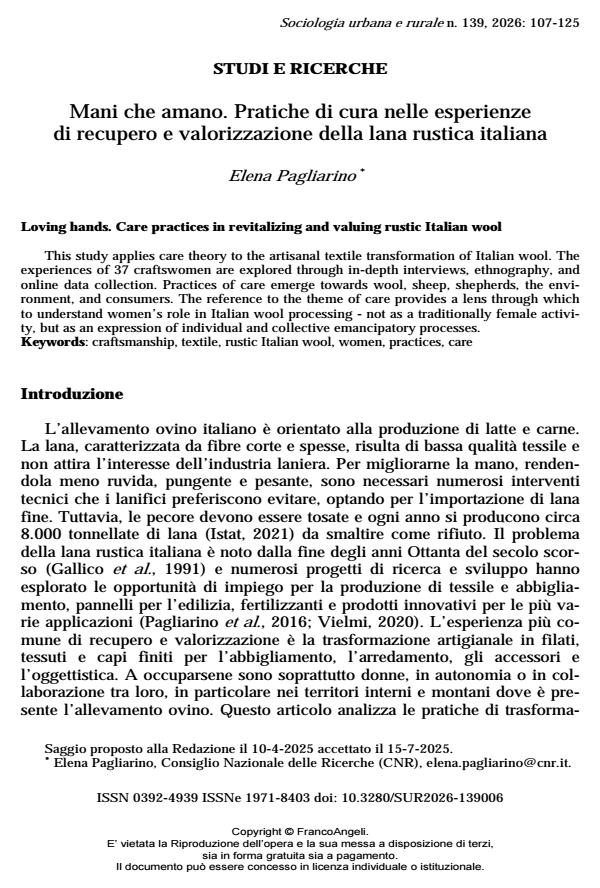
Below, you can see the article first page
If you want to buy this article in PDF format, you can do it, following the instructions to buy download credits
FrancoAngeli is member of Publishers International Linking Association, Inc (PILA), a not-for-profit association which run the CrossRef service enabling links to and from online scholarly content.
This study applies care theory to the artisanal textile transformation of Italian wool. The experiences of 37 craftswomen are explored through in-depth interviews, ethnography, and online data collection. Practices of care emerge towards wool, sheep, shepherds, the environment, and consumers. The reference to the theme of care provides a lens through which to understand women’s role in Italian wool processing - not as a traditionally female activity, but as an expression of individual and collective emancipatory processes.
Keywords: craftsmanship, textile, rustic Italian wool, women, practices, care
- Adam B., Groves C. (2007). Future matters: Action, knowledge, ethics. Leiden: Brill.
- Amarilla R., Gardetti M.Á., Gabriel M. (2020). Sustainable Luxury, Craftsmanship and Vicuna Poncho. In Gardetti M., Coste-Manière I. (eds.). Sustainable Luxury and Craftsmanship. Singapore: Springer.
- Becker H.S. (1978). Arts and crafts. American Journal of Sociology, 83(4): 862-889.
- Bell E., Toraldo M.L., Taylor S., Mangia, G. (2018). Introduction. Understanding Contemporary Craft Work. In Bell E., Mangia G., Taylor S., Toraldo M.L. (eds.). The Organization of Craft Work. Identities, Meanings, and Materiality. New York: Routledge.
- Bell E., Vachhani S. (2020). Relational encounters and vital materiality in the practice of craft work. Organization Studies, 41(5): 681-701. DOI: 10.1177/0170840619866482
- Bennett J. (2010). Vibrant matter. A political ecology of things. Durham: Duke University Press.
- Campbell C. (2005). The craft consumer: Culture, craft and consumption in a postmodern society. Journal of Consumer Culture, 5(1): 23-42. DOI: 10.1177/1469540505049843
- Charmaz K. (2014). Constructing grounded theory. 2nd Edition. London: Sage.
- Corbin J., Strauss, A. (2015). Basics of qualitative research. London: Sage.
- Fele G. (2007). L’analisi della conversazione. Bologna: il Mulino.
- Floris M. (2021). «Mani che pensano». L’artigianato generat(t)ivo in Sardegna. Quaderni di ricerca sull’artigianato, 1: 61-78. DOI: 10.12830/100761
- Fisher B., Tronto J.C. (1990). Toward a Feminist Theory of Care. In Abel E.K., Nelson M.K. (eds.). Circles of Care: Work and Identity in Women’s Lives. New York: SUNY Press.
- Gallico L., Pozzo P.D., Ramella Pollone F., Zoccola M. (1991). Lane d’Italia. Biella: Istituto di Ricerche e Sperimentazione laniera “O. Rivetti”.
- Grace M., Gandolfo E. (2014). Narrating complex identities: Contemporary women and craft. Women’s Studies International Forum, 47: 56-62.
- Grace M., Gandolfo E., Candy C. (2009). Crafting Quality of Life: Creativity and Well-Being. Journal of the Motherhood Initiative for Research and Community Involvement, 11(1): 239-250.
- Greer B. (2008). Knitting for Good! A Guide to Creating Personal, Social, and Political Change Stitch by Stitch. Boston, London: Trumpeter.
- Greer B. (ed). (2014). Craftivism: The art of craft and activism. Vancouver: Arsenal Pulp Press.
- Gualtieri M. (2019). Quando non morivo. Torino: Einaudi.
- Held V. (2006). The ethics of care. Personal, political, and global. Oxford: Oxford University Press.
- Hollenbach J. (2019). Moving beyond a modern craft: Thoughts on white entitlement and cultural appropriation in professional craft in Canada. Studio Magazine. Testo disponibile al sito: https://www.studiomagazine.ca/articles/2019/moving-beyond-a-modern-craft (consultato il 08/04/2025).
- Istat (2021). Stime della consistenza del bestiame e della produzione di latte e lana, Roma: Istat.
- Johnson J.S., Wilson L.E. (2005). “It Says You Really Care”: Motivational Factors of Contemporary Female Handcrafters. Clothing and Textiles Research Journal, 23(2): 115-130. DOI: 10.1177/0887302X0502300205
- Klepp I.G., Burgess R., Ehrnström-Fuentes M., Pacheco M., Philbrick J., Tobiasson T.S. (2022). Setting a New Stage: Small Scale as a Way Forward. In Klepp I.G., Tobiasson T.S. (eds.). Local, Slow and Sustainable Fashion. Cham: Palgrave Macmillan.
- Klepp I.G., Tobiasson T.S. (eds.). (2022). Local, Slow and Sustainable Fashion. Wool as a Fabric for Change. Cham: Palgrave Macmillan.
- Koggel C., Orme J. (2010). Care ethics: new theories and applications. Ethics and Social Welfare, 4(2): 109-114. DOI: 10.1080/17496535.2010.484255
- Kvale S. (2007). Doing Interviews. London: Sage.
- Luckman S. (2015). Craft and the creative economy. London: Palgrave Macmillan.
- Miller L., Isaksen K., Burgess R., Klepp I.G., Tobiasson T.S. (2022). Slow and Indigenous Approaches to Textiles Arts. In Klepp I.G., Tobiasson T.S. (eds.). Local, Slow and Sustainable Fashion. Wool as a Fabric for Change. Cham: Palgrave Macmillan.
- Minahan, S., Cox J.W. (2007). Stitch’n bitch: Cyberfeminism, a third place and the new materiality. Journal of Material Culture, 12(1): 5-21. DOI: 10.1177/1359183507074559
- Moriggi A., Soini K., Franklin A., Roep D. (2020). A Care-Based Approach to Transformative Change: Ethically-Informed Practices, Relational Response-Ability & Emotional Awareness. Ethics, Policy & Environment, 23(3): 281-298. DOI: 10.1080/21550085.2020.1848186
- Morucci B. (2025). Che magnifica impresa, Le inarrestabili - 14/01/2025, Rai Play, da 25’40’’. Disponibile al sito: https://www.raiplay.it/video/2025/01/Che-magnifica-impresa---Le-inarrestabili---14012025-f434fd2f-23db-4281-b01d-ea0e1f6c251a.html (consultato il 08/04/2025).
- Naudin A., Patel K. (eds.). (2020). Craft entrepreneurship. Lanham: Rowman & Littlefield.
- Noddings N. (2013). Why care about caring? In Noddings N. (ed). Caring: A feminine approach to ethics and moral education. Berkeley: University of California Press.
- Pagliarino E., Cariola M., Moiso V. (eds.). (2016). Economia del tessile sostenibile: la lana italiana. Milano: FrancoAngeli.
- Parker R. (1984). The Subversive Stitch: Embroidery and the Making of the Feminine. London: The Women’s Press.
- Piotto B., De Falco E., Francioni E., Lombardo A., Pagliarino E., Silli V., Vicari V.U. (2018). Filare, tessere, colorare, creare. Storie di sostenibilità, passione ed eccellenza. Quaderni Ispra Ambiente e Società, 18. Testo disponibile al sito: https://www.isprambiente.gov.it/it/pubblicazioni/quaderni/ambiente-e-societa/filare-tessere-colorare-creare.-storie-di-sostenibilita-passione-ed-eccellenza (consultato il 08/04/2025).
- Plumwood V. (1991). Nature, Self, and Gender: Feminism, Environmental Philosophy, and the Critique of Rationalism. Hypatia, 6(1): 3-27.
- Praetorius I. (2016). L’economia è cura. La riscoperta dell’ovvio. Napoli: IOD Edizioni.
- Puig de la Bellacasa M. (2011). Matters of care in technoscience: Assembling neglected things. Social Studies of Science, 41(1): 85-106. DOI: 10.1177/0306312710380301
- Puig de la Bellacasa M. (2017). Matters of care Speculative ethics in more than human worlds. Minneapolis: University of Minnesota Press.
- Rapley T. (2007). Doing Conversation, Discourse and Document Analysis. London: Sage.
- Ratten V. (2022). Artisan Entrepreneurship: An Overview. In Ratten V., Jones P., Braga V., Parra-López E. (eds.). Artisan Entrepreneurship. Leeds: Emerald Publishing.
- Robertson K. (2011). Rebellious Doilies and Subversive Stitches: Writing a Craftivist History. In Buszek M. (ed.). Extra/Ordinary: Craft and Contemporary Art. Durham: Duke University Press.
- Rowley S (1997). ‘There once lived’: craft and narrative traditions. In Rowley S. (ed.). Craft and Contemporary Theory. Sydney: Allen & Unwin.
- Salvatore R., Osti G., Corradini G., Carrosio G. (2024) Conoscenza, riconoscimento, gratitudine. Le donne nelle aree rurali fragili XX convegno aree fragili, Italia Position paper. Testo disponibile al sito: https://www.areefragili.it/wp-content/uploads/2024/09/Conoscenza-riconoscimento-gratitudine_position-paper-AF-2025.pdf (consultato il 08/04/2025).
- Sennett R. (2024 [2008]). L’uomo artigiano. Milano: Feltrinelli.
- Sentuti A., Chamochumbi Diaz G.D., Cesaroni F.M. (2022). Imprenditrici italiane tra crisi pandemica e interventi pubblici di sostegno. Quaderni di ricerca sull’artigianato, 3(92): 295-320. DOI: 10.12830/106460
- Smith T. (1997). Craft, modernity and postmodernity. In Rowley S. (ed.). Craft and Contemporary Theory. Sydney: Allen & Unwin.
- Srhoj S., Škrinjaric B., Radas S., Walde J. (2022). Small matching grants for women entrepreneurs: lessons from the past recession. Small Business Economics, 59: 117-142.
- Toraldo M.L., Mangia G., Consiglio S. (2018). Crafting social memory for international recognition: The role of place and tradition in an Italian silk-tie maker. In Bell E., Mangia G., Taylor S., Toraldo M.L. (eds.). The organization of craft work. New York: Routledge.
- Tronto J.C. (1993). Moral Boundaries: A Political Argument for an Ethic of Care. New York: Routledge.
- Tronto J.C. (2013). Caring Democracy: Markets, Equality, and Justice. New York: New York University Press.
- Twain (2021). Lanatura: intervista con una filatura singolare. Testo disponibile al sito: https://www.maglia-uncinetto.it/lanatura-filatura-singolare/ (consultato il 08/04/2025).
- Ullrich P. (2004). Workmanship: the hand and body as perceptual tools. In Fariello A.M., Owen P. (eds.). Objects and Meaning: New Perspectives on Art and craft. Lanham: Scarecrow Press.
- Vielmi L. (2020). Lana: che fare? Indagine preliminare del contesto del comparto laniero nell’area di progetto italiana in vista della realizzazione di azioni concrete di recupero e valorizzazione. Testo disponibile al sito: https://www.lifewolfalps.eu/wp-content/uploads/2021/02/C7_Relazione-tecnica_lana_2020_12.pdf (consultato il 13/10/2022).
Elena Pagliarino, Mani che amano. Pratiche di cura nelle esperienze di recupero e valorizzazione della lana rustica italiana in "SOCIOLOGIA URBANA E RURALE" 139/2026, pp 107-125, DOI: 10.3280/SUR2026-139006