The fraternal complex. Aspects of its specificity
Journal title INTERAZIONI
Author/s René Kaës
Publishing Year 2026 Issue 2026/1
Language Italian Pages 41 P. 52-92 File size 156 KB
DOI 10.3280/INT2026-001004
DOI is like a bar code for intellectual property: to have more infomation
click here
Below, you can see the article first page
If you want to buy this article in PDF format, you can do it, following the instructions to buy download credits
FrancoAngeli is member of Publishers International Linking Association, Inc (PILA), a not-for-profit association which run the CrossRef service enabling links to and from online scholarly content.
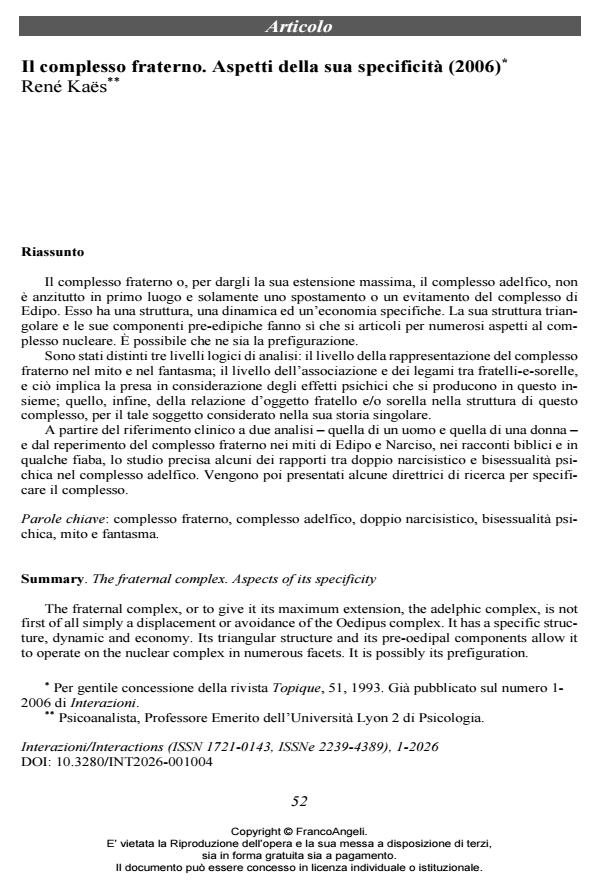
The fraternal complex, or to give it its maximum extension, the adelphic complex, is not first of all simply a displacement or avoidance of the Oedipus complex. It has a specific structure, dynamic and economy. Its triangular structure and its pre-oedipal components allow it to operate on the nuclear complex in numerous facets. It is possibly its prefiguration. Three logical levels of analysis have been distinguished: the level of the representation of the fraternal complex in myth and phantasm; the level of association and links between brothers-and-sisters which implies the taking into consideration of the psychic effects produced within the ensemble; and finally the level of the relation of the object brother and/or sister in the structure of this complex, for such a subject within its singular history. From the clinical reference of two analyses – of a man and a woman – and a locating of the fraternal complex in the myths of Oedipus and Narcissus, in bible stories and popular tales, the study outlines certain relation between the narcissistic double and psychic bisexuality in the adelphic complex. Several research orientations are then proposed to specify the complex.
Keywords: fraternal complex, adelphic complex, narcissistic double, psychic bisexuality, myth and phantasm.
- Anzieu D. (1973). La bisexualité dans l’auto-analyse de Freud. Nouvelle Revue de Psychanalyse, 7: 179-191.
- Bellemin-Noël J. (1953). Les contes et leurs fantasmes. Paris: PUF.
- Boureau A. (1992). Hyménée philadelphe. Le mariage égyptien entre frère et sœur et son oubli occidental. In Bannour W., Berthier Ph. (sous la direction de), Eros Philadelphe, Frère et Sœur, passion secrète. Paris: éditions du Felin.
- Brusset B. (1987). Le lien fraternel et la psychanalyse. Psychanalyse à l’Université, 12: 5-43.
- Dadoun R. (1978). Frère ennemis, la violence fondatrice. In Dadoun R., Psychanalyse entre chien et loup. Paris: Imago, 1984.
- David C. (1992). La bisessualità psichica. Saggi psicoanalitici. Roma: Borla, 1996.
- De Mijolla-Mellor S. (1992). Le plaisir de pensée. Paris: PUF.
- Doolittle H. (1945-1946). Ecrit sur le mur. Réminiscence d’une analyse avec Freud. Etudes Freudiennes, 3-4: 157-271.
- Fedida P. (1973). D’une essentielle dissymétrie dans la psychanalyse. Nouvelle Revue de Psychanalyse, 7: 159-166.
- Freud S. (1908). Il poeta e la fantasia. OSF, vol. 5. Torino: Bollati Boringhieri.
- Freud S. (1909). Analisi della fobia di un bambino di cinque anni (Il piccolo Hans). OSF, vol. 5. Torino: Bollati Boringhieri.
- Freud S. (1910). Un ricordo d’infanzia di Leonardo da Vinci. OSF, vol. 6. Torino: Bollati Boringhieri.
- Freud S. (1912-13). Totem e tabù. OSF, vol. 7. Torino: Bollati Boringhieri.
- Freud S. (1913). Il motivo della scelta degli scrigni. OSF, vol. 7. Torino: Bollati Boringhieri.
- Freud S. (1914). Dalla storia di una nevrosi infantile (caso clinico dell’Uomo dei Lupi). OSF, vol. 7. Torino: Bollati Boringhieri.
- Freud S. (1915). Trasformazioni pulsionali, particolarmente dell’erotismo anale. OSF, vol. 8. Torino: Bollati Boringhieri.
- Freud S. (1920). Al di là del principio di piacere. OSF, vol. 9. Torino: Bollati Boringhieri.
- Freud S. (1921). Alcuni meccanismi nevrotici nella gelosia, paranoia e omosessualità. OSF, vol. 9. Torino: Bollati Boringhieri.
- Freud S. (1923). L’Io e l’Es. OSF, vol. 9. Torino: Bollati Boringhieri.
- Green A. (1973). Le genre neutre. Nouvelle Revue de Psychanalyse, 7: 251-262.
- Holland N. (1969). H.-D et Freud. Etudes Freudiennes, 3-4: 142-156.
- Kaës R. (1984), Il racconto e il gruppo. In Kaës R., Perrot J. et al., Fiabe e racconti nella vita psichica. Roma: Borla, 1997.
- Kaës R. (1986). Figures des images fraternelles dans quelques contes des frères Grimm. Le Groupe Familial, 111: 25-32.
- Kaës R. (1993). Il gruppo e il soggetto del gruppo. Elementi per una teoria psicoanalitica del gruppo. Roma: Borla, 1994.
- Lacan J. (1938). I complessi familiari nella formazione dell’individuo. Torino: Einaudi, 2005.
- Lacan J. (1948). L’aggressività in psicoanalisi. In Lacan J., Scritti. Torino: Einaudi, 1974.
- Lacan J. (1956-1957). La relation d’objet et les structures freudiennes. Bulletin de Psychologie, 516, 6: 503-518.
- Laplanche J. (1970). Vita e morte in psicoanalisi. Roma-Bari: Laterza, 1972.
- Mac Dougall J. (1973). L’idéal hermaphrodite et ses avatars. Nouvelle Revue de Psychanalyse, 7: 263-275.
- Nunziante Cesàro A., Scippa M. (1976). “Hansel e Grethel”: il mondo interno infantile riflesso nelle fiabe. Neuropsichiatria Infantile, 175: 19-34.
- Racamier P.-C. (1992). Il genio delle origini. Milano: Cortina, 1993.
- Rigaud C. (1992). Figures animales et pulsions fratricides. Psychanalyse à l’Université, 17: 135-148.
- Roheim G. (1950). Psychanalyse et anthropologie. Paris: Gallimard, 1967.
- Roheim G. (1953). The wolf in the seven kids. Psychoanalitic Quarterly, XXII, 2: 253-256.
- Rosolato G. (1978). La relation d’inconnu. Paris: Gallimard.
- Steiner G. (1984). Les Antigones. Paris: Gallimard, 1986.
- Zaltzman N. (1977). Un mot primitif: la chimère du sexe. Topique, 20: 19-39.
- Zaltzman N. (1989). Le transfert hystérique: orfèvre et vermine. Topique, 43: 114-139.
René Kaës, Il complesso fraterno. Aspetti della sua specificità (2006) in "INTERAZIONI" 1/2026, pp 52-92, DOI: 10.3280/INT2026-001004