Writing in psychoanalysis as an exercise in critical theory

Journal title PSICOTERAPIA PSICOANALITICA
Author/s Giuseppe Civitarese
Publishing Year 2026 Issue 2026/1
Language Italian Pages 18 P. 21-38 File size 194 KB
DOI 10.3280/PSP2026-001002
DOI is like a bar code for intellectual property: to have more infomation click here

Below, you can see the article first page

If you want to buy this article in PDF format, you can do it, following the instructions to buy download credits
Article preview

FrancoAngeli is member of Publishers International Linking Association, Inc (PILA), a not-for-profit association which run the CrossRef service enabling links to and from online scholarly content.

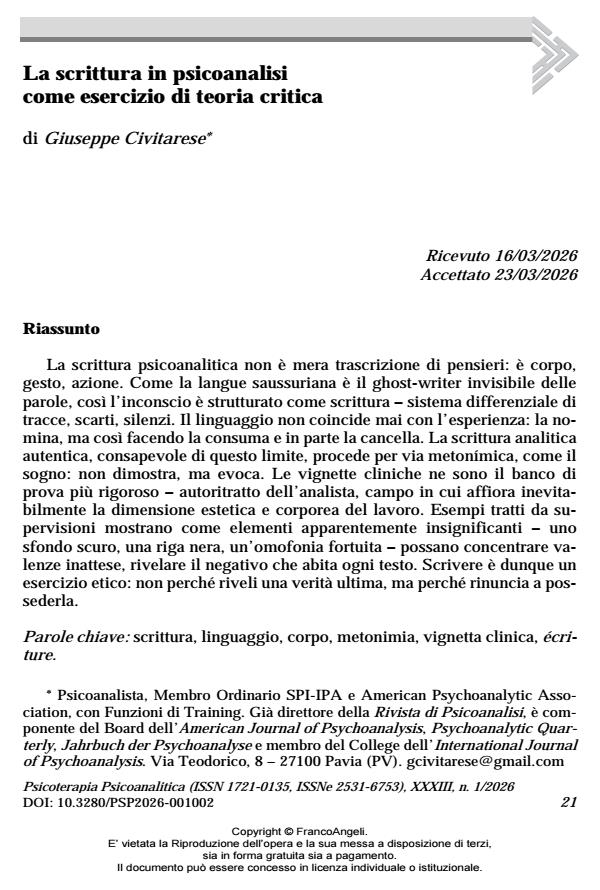
Psychoanalytic writing is not mere transcription of thoughts: it is body, gesture, action. Just as the Saussurean langue is the invisible ghost-writer of parole, so the unconscious is structured like writing – a differential system of traces, gaps, silences. Language never coincides with experience: it names it, but in doing so consumes and partly erases it. Authentic analytic writing, aware of this limit, proceeds by way of metonymy, like a dream: it does not demonstrate, but evokes. Clinical vignettes are its most rigorous test – the analyst’s self-portrait, a field in which the aesthetic and bodily dimension of the work inevitably surfaces. Examples drawn from supervision sessions show how apparently insignificant elements – a dark background, a black line, a chance homophony – can concentrate unexpected layers of meaning, revealing the negative that inhabits every text. Writing is therefore an ethical exercise: not because it reveals an ultimate truth, but because it renounces possessing one.

Keywords: writing, language, body, metonymy, clinical vignette, écriture.

  1. Barthes R. (2003). La preparazione del romanzo. Corsi (I e II) e seminari al Collège de France (1978-1979 e 1979-1980). Milano: Mimesis, 2025.
  2. Barthes R. (2002). Il neutro. Corso al Collège de France (1977-1978). Milano: Mimesis, 2022.
  3. Blanchot M. (1943). Passi falsi. Milano: Il Saggiatore, 2020.
  4. Blanchot M. (1955). Lo spazio letterario. Torino: Einaudi, 1975.
  5. Blanchot M. (1969). La conversazione infinita. Scritti sull’«insensato gioco di scrivere». Torino: Einaudi, 2015.
  6. Bottiroli G. (2015). Introduzione. In: Blanchot M., La conversazione infinita. Scritti sull’«insensato gioco di scrivere». Torino: Einaudi.
  7. Capote T. (1966). A sangue freddo. Milano: Garzanti, 2020.
  8. Civitarese G. (2008). Più affetti… più occhi. Temi del post-moderno e de/costruzioni in analisi. In: L’intima stanza. Teoria e tecnica del campo analitico. Roma: Borla, pp. 187-209.
  9. Civitarese G. (2010). Le parentesi di Ogden ovvero della continuità dell’espe¬rienza cosciente e inconscia: A proposito di… Thomas Ogden (2009) Riscoprire la psicoanalisi. Pensare e sognare, imparare e dimenticare. Rivista di Psicoanalisi, 56: 771-780.
  10. Civitarese G. (2011). Dal notes magico alla funzione a: metafore del testo e della traduzione in Freud e Bion. In: La violenza delle emozioni. Bion e la psicoanalisi postbioniana. Milano: Raffaello Cortina, pp. 167-183.
  11. Civitarese G. (2015). I poscritti di Dora. Rivista di Psicoanalisi, 61: 665-683. DOI: 10.4324/9781315146461-
  12. Civitarese G. (2017). Estetica e scrittura in psicoanalisi. Rivista di Psicoanalisi, 63: 179-191
  13. Civitarese G. (2022). On the Word’s Work. Journal of the American Psychoanalytic Association, 70 (6): 1235-1238. DOI: 10.1177/00030651221140587
  14. Freud S. (1920). Al di là del principio di piacere. OSF, 9.
  15. Hegel GWF. (1807). La fenomenologia dello spirito. Torino: Einaudi, 2008.
  16. Heidegger M. (1927). Essere e Tempo. Milano: Longanesi, 2006.
  17. Heidegger M. (1950). Sentieri interrotti. Firenze: La Nuova Italia, 1968.
  18. Merleau-Ponty M. (1964). Il visibile e l’invisibile. Milano: Bompiani, 2003.
  19. Nancy J-L. (1992). Corpus, Napoli: Cronopio, 2007.
  20. Nietzsche F. (2016). Su verità e menzogna in senso extramorale. In: La filosofia nell’epoca tragica dei Greci e scritti 1870-1873. Milano: Adelphi.
  21. Proust M. (2015). Saggi. Milano: Il Saggiatore.
  22. Sartre J-P. (1944). Porta chiusa. In: Le mosche – Porta chiusa. Milano: Bompiani, 2013.
  23. Valery P. (1958). Cahiers, IV, 1906-1913. Paris: Centre national de la recherche scientifique.
  24. Wenders W. regista (2011). Pina. Germania, Francia, UK.

Giuseppe Civitarese, La scrittura in psicoanalisi come esercizio di teoria critica in "PSICOTERAPIA PSICOANALITICA" 1/2026, pp 21-38, DOI: 10.3280/PSP2026-001002