I read you, you read yourself
Journal title PSICOTERAPIA PSICOANALITICA
Author/s Costanza Buttinelli
Publishing Year 2026 Issue 2026/1
Language Italian Pages 10 P. 145-154 File size 59 KB
DOI 10.3280/PSP2026-001010
DOI is like a bar code for intellectual property: to have more infomation
click here
Below, you can see the article first page
If you want to buy this article in PDF format, you can do it, following the instructions to buy download credits
FrancoAngeli is member of Publishers International Linking Association, Inc (PILA), a not-for-profit association which run the CrossRef service enabling links to and from online scholarly content.
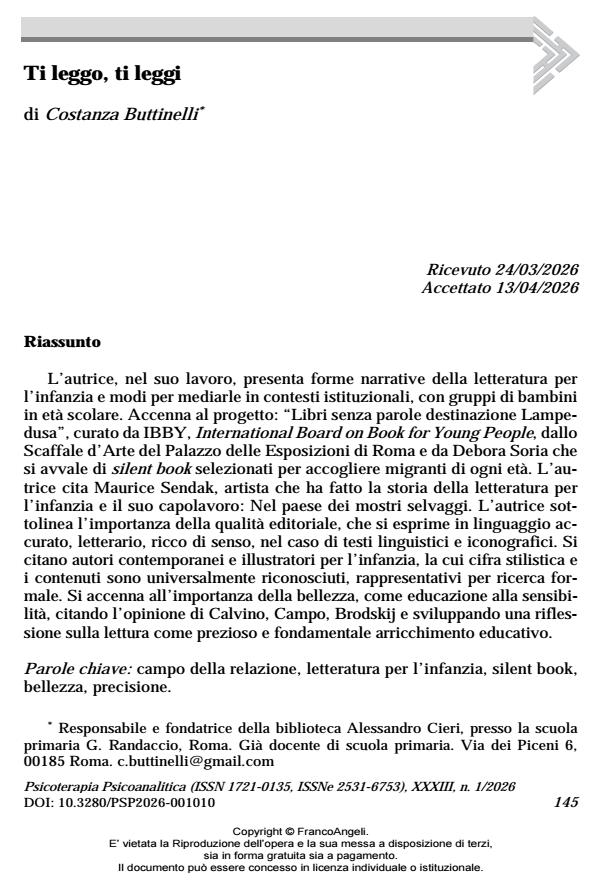
The author, in her paper, presents narrative forms of children’s literature and ways of using them in institutional settings with groups of school-age children. She mentions the project “Libri senza parole destinazione Lampedusa”, organized by IBBY (the International Board on Books for Young People), the Scaffale d’Arte at the Palazzo delle Esposizioni in Rome, and Debora Soria, which uses selected silent books to welcome migrants of all ages. The author quotes Maurice Sendak, an artist who made history in children’s literature, and his masterpiece, Where the Wild Things Are. The author emphasizes the importance of editorial quality, which, in the case of linguistic and iconographic texts, is expressed through language that is precise, literary and rich in meaning. The text mentions contemporary children’s authors and illustrators whose stylistic signature and content are universally recognized and representative of formal research. The author mentions the importance of beauty as a way of teaching sensitivity, citing the views of Calvino, Campo, Brodskij and developing a reflection on reading as a precious and fundamental educational enrichment.
Keywords: Fields of Relationship, children’s literature, silent books, beauty, precision.
- Bompiani G. (1978). Lo spazio narrante. Milano: Et Al. Edizioni, 2012.
- Brodskij I. (1987). Dall’esilio. Milano: Adelphi.
- Calvino I. (1956). Zio Lupo. In: Fiabe Italiane Milano: Oscar Mondadori, 2007.
- Calvino I. (1988). Lezioni americane. Milano: Garzanti, 1992.
- Campo C. (1987). Gli imperdonabili. Milano: Adelphi, 2012.
- Gardini N. (2014). Lacuna. Torino: Einaudi.
- Negri M. (2017). Dell’indugiare: elogio dell’infanzia. Hamelin, 17(44): 20-37.
- Ogden T. (2021). Essere vivi. Milano: Raffaello Cortina, 2025.
- Perrault C. (1967). Barbablù. Milano: Rizzoli, 2014.
- Scholes R., Kellogg R. (1966). La natura della narrativa. Bologna: il Mulino, 1970.
- Sendak M. (1963). Nel paese dei mostri selvaggi. Milano: Adelphi, 2018.
- Sendak M. (2021). Caldecott & Co. Note su libri e immagini. Parma: Junior.
- Shaun T. (2014). Preface. In: Visual Journeys Through Wordless Narratives. An International Inquiry with Immigrant Children and the Arrival. London: Bloomsbury Publishing, pp. 11-15.
- Tan S. (2006). L’Approdo. Latina: Tunuè Edizioni, 2008.
- Wiesner D. (2013). Mr. Ubik. Roma: Orecchio Acerbo, 2015.
Costanza Buttinelli, Ti leggo, ti leggi in "PSICOTERAPIA PSICOANALITICA" 1/2026, pp 145-154, DOI: 10.3280/PSP2026-001010