When voices meet words. Associativism and interdiscursivity
Journal title PSICOTERAPIA PSICOANALITICA
Author/s Azzurra Aloisi, Simone Pilia, Giuditta Sestu
Publishing Year 2026 Issue 2026/1
Language Italian Pages 16 P. 157-172 File size 82 KB
DOI 10.3280/PSP2026-001011
DOI is like a bar code for intellectual property: to have more infomation
click here
Below, you can see the article first page
If you want to buy this article in PDF format, you can do it, following the instructions to buy download credits
FrancoAngeli is member of Publishers International Linking Association, Inc (PILA), a not-for-profit association which run the CrossRef service enabling links to and from online scholarly content.
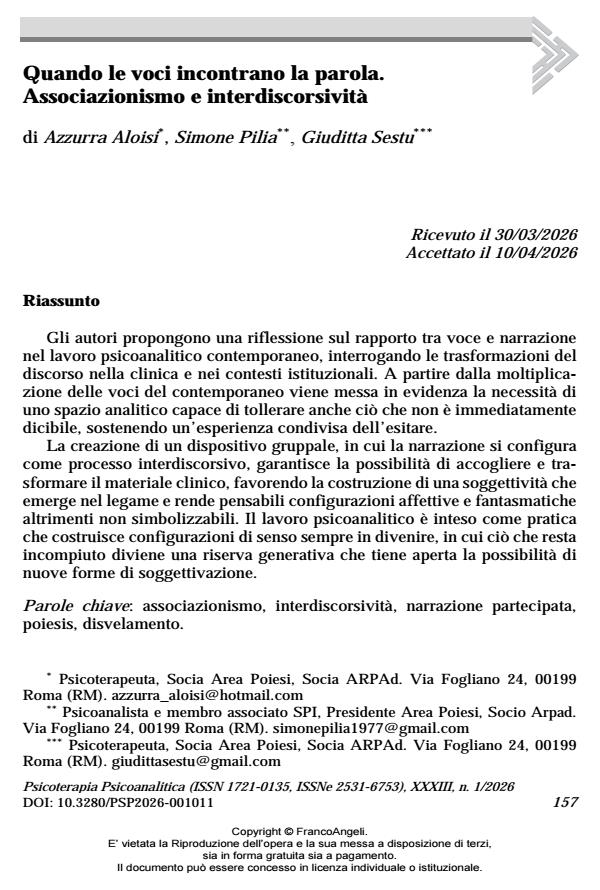
The authors explore the relationship between voice and narration in contemporary psychoanalytic work, examining transformations in discourse within both clinical and institutional contexts. Starting from the proliferation of voices in the social field – ranging from subjective expressions to the solicitations of the digital era – they highlight the need for an analytic space capable of tolerating what is not immediately representable, sustaining a shared experience of hesitation and thinking. The group setting, described as a group-based dispositive, is the place where narration functions as an interdiscursive process, allows clinical material to be received and transformed, fostering forms of subjectivity that emerge within the bond and render otherwise unsymbolizable affective and fantasmatic configurations thinkable. Psychoanalytic work is understood as a practice of meaning-making in which the unfinished becomes a generative reserve, opening the possibility of new forms of subjectivation.
Keywords: associativism, interdiscursivity, participatory narration, poiesis, unveiling.
- Aulagnier P. (1975). La violenza dell’interpretazione. Roma: Borla, 1977.
- Bion W.R. (1961). Esperienze nei gruppi. Roma: Armando, 1971.
- Bion W.R. (1962). Apprendere dall’esperienza. Roma: Armando, 1972.
- Bleger J. (1967). Psicoigiene e psicologia istituzionale. In: Bauleo A. (a cura di). L’istituzione e le istituzioni. Milano: Feltrinelli.
- Corrao F. (1981). Struttura poliadica e funzione gamma. In: Orme, vol. II, Milano: Raffaello Cortina, 1998.
- Corrao F. (1985). Funzione analitica del piccolo gruppo. In: Orme, vol.II. Milano: Raffaello Cortina, 1998.
- Freud S. (1914). Ricordare, ripetere e rielaborare. OSF, 7.
- Freud S. (1937). Costruzioni nell’analisi. OSF, 11.
- Giuffrida A. (2017). Psicoterapia nell’istituzione e aspetti controtransferali dell’analista. Idee in Psicoterapia, 2-3: 25-45.
- Green A. (1982). La riserva dell’increabile. In: Green A. Narcisismo di vita, narcisismo di morte. Roma: Borla, 1985.
- Heidegger M. (1954). Saggi e discorsi. Milano: Mursia, 1976.
- Kaës R. (1976). L’apparato psichico gruppale. Roma: Borla, 1985.
- Kaës R. (1993). Il gruppo e il soggetto del gruppo. Roma: Borla, 1994.
- Kaës R. (1999). Le teorie psicoanalitiche del gruppo. Roma: Borla, 2005.
- Kaës R. (2009). Le alleanze inconsce. Roma: Borla, 2010.
- Lavagetto M. (1985). Freud, la letteratura e altro. Torino: Einaudi.
- Pasolini P. P. (1974). “Il fiore delle Mille e una notte” [Film].
- Pilia S., Aloisi A., Giallorezo A., Sestu G. (2017). Poiesi e privato sociale. Libero associazionismo (ugualmente fluttuante). Koinos, anno V.
- Pilia S. (2026). Forme e deformazioni nella costruzione dell’analisi. Lavoro presentato al Seminario intercentri del CPdR e CVP, Roma, 18 Aprile 2026.
- Pirandello L. Sei personaggi in cerca d’autore. Torino: Einaudi, 1993.
- Ricoeur P. (1983). Tempo e racconto. Milano: Jaca Book, 1986.
- Sandars N. K. (a cura di). L’epopea di Gilgameš. Traduzione di Alessandro Passi. Milano: Adelphi, 1986.
- Touraine A. (1992). Critica della modernità. Milano: Il Saggiatore, 1993.
Azzurra Aloisi, Simone Pilia, Giuditta Sestu, Quando le voci incontrano la parola. Associazionismo e interdiscorsività in "PSICOTERAPIA PSICOANALITICA" 1/2026, pp 157-172, DOI: 10.3280/PSP2026-001011