Labour, Performance and Technological Innovation in Processes of Organizational Change and Development
Journal title QUADERNI DI ECONOMIA DEL LAVORO
Author/s Azio Barani
Publishing Year 2026 Issue 2022/116
Language Italian Pages 66 P. 149-214 File size 285 KB
DOI 10.3280/QUA2022-116008
DOI is like a bar code for intellectual property: to have more infomation
click here
Below, you can see the article first page
If you want to buy this article in PDF format, you can do it, following the instructions to buy download credits
FrancoAngeli is member of Publishers International Linking Association, Inc (PILA), a not-for-profit association which run the CrossRef service enabling links to and from online scholarly content.
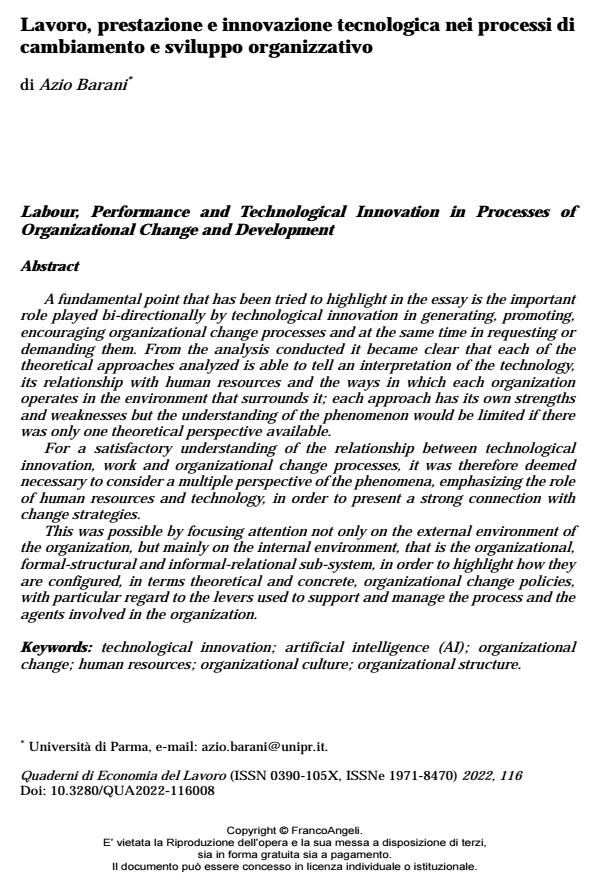
A fundamental point that has been tried to highlight in the essay is the important role played bi-directionally by technological innovation in generating, promoting, encouraging organizational change processes and at the same time in requesting or demanding them. From the analysis conducted it became clear that each of the theoretical approaches analyzed is able to tell an interpretation of the technology, its relationship with human resources and the ways in which each organization operates in the environment that surrounds it; each approach has its own strengths and weaknesses but the understanding of the phenomenon would be limited if there was only one theoretical perspective available. For a satisfactory understanding of the relationship between technological innovation, work and organizational change processes, it was therefore deemed necessary to consider a multiple perspective of the phenomena, emphasizing the role of human resources and technology, in order to present a strong connection with change strategies. This was possible by focusing attention not only on the external environment of the organization, but mainly on the internal environment, that is the organizational, formal-structural and informal-relational sub-system, in order to highlight how they are configured, in terms theoretical and concrete, organizational change policies, with particular regard to the levers used to support and manage the process and the agents involved in the organization.
Keywords: technological innovation; artificial intelligence (AI); organizational change; human resources; organizational culture; organizational structure.
- Adler S.P., Forbes C.L., Willmott H. (2007). Critical Management Studies. Roma: Lawrence Erlbaum Associates.
- Antomarini B., Tagliagambe S., a cura di (2007). La tecnica e il corpo. Riflessioni su uno scritto di Pavel Florenskij. Milano: FrancoAngeli.
- Argyris C., Schon D. (1998). Apprendimento organizzativo. Teoria, metodo e pratiche. Milano: Guerini.
- Argyris C. e Schön D. A. (1996). Organizational learning II: Theory, method, and practice. Addison-Wesley.
- Ansoff H.I. (1968). Strategia aziendale. Milano: Etas Libri.
- Barnett H.G. (1953). Innovation: the Basis of Cultural Change. New York: Mc-Graw Hill.
- Bigliardi B., Ferraro G., Filippelli S., Galati F. (2020). The past, present and future of open innovation. European Journal of Innovation Management, 24(4): 1130-1161.
- Bodega D. (1996). Organizzazione e cultura. Teoria e metodo della prospettiva culturale nell’organizzazione di azienda. Bologna: il Mulino.
- Bostrom N. (2014). Superintelligence: Paths, dangers, strategies. Oxford University Press.
- Bruni L. e Zamagni S. (2004). Economia civile. Efficienza, equità, felicità pubblica. Bologna: il Mulino.
- Brynjolfsson E. e McAfee A. (2017). Machine, Platform, Crowd: Harnessing Our Digital Future. New York: W. W. Norton & Company.
- Butera F. (2003). Tecnologia e organizzazione per l’uomo e per l’impresa. Milano: FrancoAngeli.
- Cenciarini R.A. (1998). Ristrutturazione e crescita. Le strategie adottate dalle imprese di successo. Milano: Giuffrè.
- Crozier M., Friedberg E. (1995). Organizzazioni e azione collettiva: il nostro contributo all’analisi organizzativa. Milano: Guerini.
- Davenport T.H. (1997). Innovazione dei processi. Riprogettare il lavoro attraverso l’Information technology. Milano: FrancoAngeli.
- Davenport T.H. e Ronanki R. (2018). Artificial Intelligence for the Real World. Harvard Business Review, 96(1): 108-116.
- Duck J.D. (1993). Managing change: the art of balancing. Harvard Business Review.
- Floridi L. (2019). The Logic of Information: A Theory of Philosophy as Conceptual Design. Oxford University Press.
- Floridi L. (2022). Etica dell’intelligenza artificiale. Sviluppi, opportunità, rischi. Milano: Raffaello Cortina Editore.
- Foglio A. (2011). Change management come strategia d’impresa. Governare futuro e cambiamenti e tramutarli in opportunità. Milano: FrancoAngeli.
- Frankl V. E. (1959). Man’s search for meaning. Beacon Press.
- Frassetto G.F. (2003). Organizzare per competere: cambiamento e apprendimento. Torino: Giappichelli.
- Freeman R.E. (1984). Strategic management. A stakeholder approach. New York: Pitman.
- Fumagalli L., Limone F., Papagni U., a cura di (2008). Quaderni di Knowledge Management, Vol. 1. Milano: FrancoAngeli.
- Garzella S. (2005). Il sistema d’azienda e la valorizzazione delle “potenzialità inespresse”. Una visione strategica per il risanamento. Torino: Giappichelli.
- Gilardoni A., Danovi A. (2000). Cambiamento, ristrutturazione e sviluppo dell’impresa. Milano: Egea.
- Han B.-C. (2015). Psicopolitica. Il neoliberismo e le nuove tecniche del potere. Milano: Nottetempo.
- Hiatt J. (2006). ADKAR: A Model for Change in Business, Government and the Community. Loveland: Learning Center Publications.
- Knights D., Willmott H. (2009). Il comportamento organizzativo. Torino: ISEDI.
- Kotter J.P. (1998). Guidare il cambiamento. Milano: Etas libri.
- Kreitner R., Kinicki A. (2013). Comportamento organizzativo. Milano: Apogeo.
- Lanzalaco L. (1995). Istituzioni, organizzazione, potere. Roma: La Nuova Italia Scientifica.
- Luhmann N. (2005). Organizzazione e decisione. Milano: Bruno Mondadori.
- Mari G. (2018). Il lavoro 4.0 come atto linguistico performativo. Per una svolta linguistica nell’analisi delle trasformazioni del lavoro. In A. Cipriani, A. Gramolati, & G. Mari (a cura di), Il lavoro 4.0. La quarta rivoluzione industriale e le trasformazioni delle attività lavorative (pp. 315-340). Firenze: Firenze University Press.
- Montgomery C. (2006). Corporate Strategy. Milano: McGraw Hill.
- Morgan G. (1986). Images of Organization. Beverly Hills: Sage. (trad. it.: Images. Le metafore dell’organizzazione, Milano: FrancoAngeli, 2002, 5a edizione.)
- Piccardo C., Colombo L. (2007). Governare il cambiamento. Milano: Cortina.
- Pilati M., Tosi H. (2003). Management. Organizzazione e gestione delle risorse umane. Milano: Il Sole 24 ore – Università Bocconi – La Repubblica.
- Porter M.E. (1991). Il vantaggio competitivo delle nazioni. Milano: Mondadori.
- Quaglino G.P. (1990). Appunti sul comportamento organizzativo. Torino: Tirrenia Stampatori.
- Quaglino G.P. (2007). Leadership e cambiamento. Scritti di formazione, Vol. 4. Milano: Hoepli.
- Rajola F. (2006). Manuale dell’innovazione: strategia, organizzazione e tecnologia. Milano: Il Sole 24 ore.
- Rebora G., Minelli E. (2007). Il Change Management. Un modello di lettura e interpretazione. Studi Organizzativi.
- Rogers E.M., Shoemaker F. (1971). Communication of Innovation: A Cross-Cultural Approach. New York: The Free Press.
- Rosa H. (2015). Accelerazione e alienazione. Per una teoria critica del tempo nella tarda modernità. Torino: Einaudi.
- Russell S. e Norvig P. (2021). Artificial Intelligence: A Modern Approach (4th ed.). Londra: Pearson.
- Schein E.H. (1985). Organizational Culture and Leadership. San Francisco: Jossey-Bass.
- Schermerhorn J.R., Hunt J.G., Osborn R.N. (1997). Organizational behaviour. New York: Wiley.
- Schilling M.A. (2005). Gestione dell’innovazione. Milano: Mc Graw-Hill, Edizione Italiana.
- Susskind R. e Susskind D. (2015). The Future of the Professions: How Technology Will Transform the Work of Human Experts. Oxford: Oxford University Press.
- Sen A. (1999). Development as freedom. Oxford: Oxford University Press.
- Senge P. M. (1990). The fifth discipline: The art and practice of the learning organization. New York, NY: Doubleday.
- Sennett R. (1999). The corrosion of character: The personal consequences of work in the new capitalism. New York, NY: W. W. Norton & Company.
- Tanese A. (1999). Attraverso le riforme. Percorso di cambiamento nella pubblica amministrazione. Roma: Aracne.
- Tanese A. (2006). Managerialità, innovazione e governance nella pubblica amministrazione. Roma: Aracne.
- Tosi H., Pilati M. (2008). Comportamento Organizzativo. Attori, relazioni, organizzazione e management. Milano: Egea.
- Totaro F. (1998). Non di solo lavoro. Ontologia della persona ed etica del lavoro nel passaggio di civiltà. Milano: Vita e Pensiero.
- Totaro F. (2009). Il lavoro come questione di senso. Macerata: EUM.
- Totaro F. (2018). Lavoro 4.0 e persona: intrecci e distinzioni. In: Cipriani A., Gramolati A., Mari G., a cura di, Il lavoro 4.0: la Quarta Rivoluzione industriale e le trasformazioni delle attività lavorative. Firenze: Firenze University Press.
- Van Dijkum C. (2001). A methodology for conducting interdisciplinary social research. European journal of operational research, 12: 290-299.
- Verganti R., Calderini M., Garrone P., Palmieri S. (2004). L’impresa dell’innovazione. Milano: Il Sole 24 ore.
- Zuboff S. (2019). The age of surveillance capitalism: The fight for a human future at the new frontier of power. New York, NY: PublicAffairs.
Azio Barani, Lavoro, prestazione e innovazione tecnologica nei processi di cambiamento e sviluppo organizzativo in "QUADERNI DI ECONOMIA DEL LAVORO" 116/2022, pp 149-214, DOI: 10.3280/QUA2022-116008