Beyond NFRD compliance: Is social tone associated with better corporate social performance?
Journal title FINANCIAL REPORTING
Author/s Eleonora Monaco, Luca Galati, Matteo Merlo
Publishing Year 2026 Issue 2026/1
Language English Pages 28 P. 57-84 File size 203 KB
DOI 10.3280/fr202518147
DOI is like a bar code for intellectual property: to have more infomation
click here
Below, you can see the article first page
If you want to buy this article in PDF format, you can do it, following the instructions to buy download credits
FrancoAngeli is member of Publishers International Linking Association, Inc (PILA), a not-for-profit association which run the CrossRef service enabling links to and from online scholarly content.
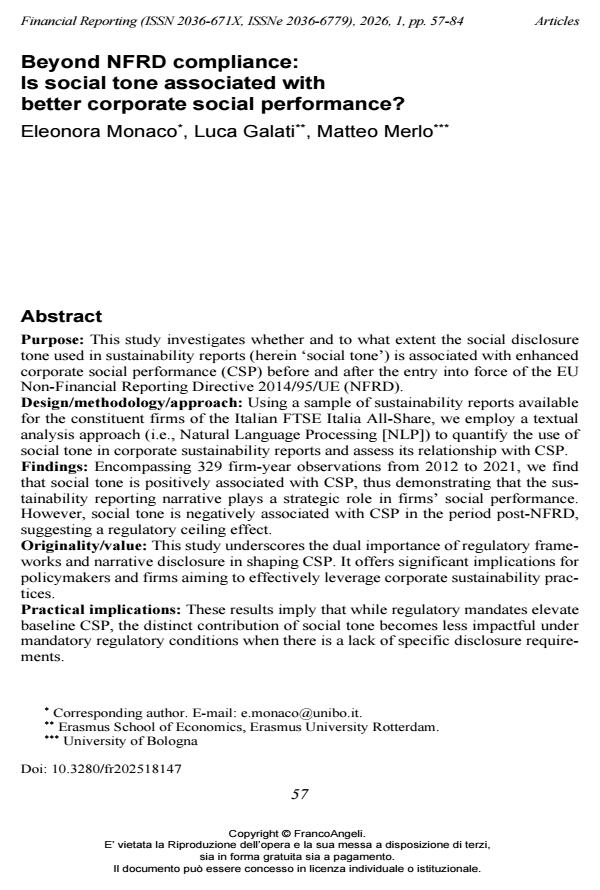
Purpose: This study investigates whether and to what extent the social disclosure tone used in sustainability reports (herein ‘social tone’) is associated with enhanced corporate social performance (CSP) before and after the entry into force of the EU Non-Financial Reporting Directive 2014/95/UE (NFRD). Design/methodology/approach: Using a sample of sustainability reports available for the constituent firms of the Italian FTSE Italia All-Share, we employ a textual analysis approach (i.e., Natural Language Processing [NLP]) to quantify the use of social tone in corporate sustainability reports and assess its relationship with CSP. Findings: Encompassing 329 firm-year observations from 2012 to 2021, we find that social tone is positively associated with CSP, thus demonstrating that the sustainability reporting narrative plays a strategic role in firms’ social performance. However, social tone is negatively associated with CSP in the period post-NFRD, suggesting a regulatory ceiling effect. Originality/value: This study underscores the dual importance of regulatory frameworks and narrative disclosure in shaping CSP. It offers significant implications for policymakers and firms aiming to effectively leverage corporate sustainability practices. Practical implications: These results imply that while regulatory mandates elevate baseline CSP, the distinct contribution of social tone becomes less impactful under mandatory regulatory conditions when there is a lack of specific disclosure requirements.
Keywords: mandatory disclosure, non-financial reporting, social performance, social tone
Jel codes: G38, M14, M41, M48, Q56
- Agostini, M., Costa, E., & Korca, B. (2022). Non-Financial Disclosure and Corporate Financial Performance Under Directive 2014/95/EU: Evidence from Italian Listed Companies. Accounting in Europe, 19(1), 78-109.17449480.2021.1979610.
- Aluchna, M., Roszkowska-Menkes, M., & Kaminski, B. (2022). From talk to action: The effects of the non-financial reporting directive on ESG performance. Meditari Accountancy Research, 31(7), 1-25. DOI: 10.1108/MEDAR-12-2021-1530
- Arena, C., Bozzolan, S., & Michelon, G. (2015). Environmental Reporting: Transparency to Stakeholders or Stakeholder Manipulation? An Analysis of Disclosure Tone and the Role of the Board of Directors. Corporate Social Responsibility and Environmental Management, 22(6), 346-361.
- Baier, P., Berninger, M., & Kiesel, F. (2020). Environmental, social and governance reporting in annual reports: A textual analysis. Financial Markets, Institutions & Instruments, 29(3), 93-118.
- Beattie, V., McInnes, B., & Fearnley, S. (2004). A methodology for analysing and evaluating narratives in annual reports: A comprehensive descriptive profile and metrics for disclosure quality attributes. Accounting Forum, 28(3), 205-236.
- Bebbington, J., Kirk, E. A., & Larrinaga, C. (2012). The production of normativity: A comparison of reporting regimes in Spain and the UK. Accounting, Organizations and Society, 37(2), 78-94.
- Bennear, L. S., & Olmstead, S. M. (2008). The impacts of the “right to know”: Information disclosure and the violation of drinking water standards. Journal of Environmental Economics and Management, 56(2), 117-130.j.jeem.2008.03.002.
- Berrone, P., Cruz, C., Gomez-Mejia, L. R., & Larraza-Kintana, M. (2010). Socioemotional wealth and corporate responses to institutional pressures: Do family-controlled firms pollute less?. Administrative Science Quarterly, 55(1), 82-113.
- Bertoni, M., Candio, P., & Rossi, P. (2024). Revisiting the impact of ESG on financial performance: Empirical evidence from the Italian Stock Exchange. Financial Reporting, 2, 163-191. DOI: 10.3280/FR2024-002007
- Bigelli, M., Mengoli, S., & Sandri, S. (2023). ESG score, board structure and the impact of the non-financial reporting directive on European firms. Journal of Economics and Business, 127, 106133.
- Bingler, J. A., Kraus, M., Leippold, M., & Webersinke, N. (2024). How cheap talk in climate disclosures relates to climate initiatives, corporate emissions, and reputation risk. Journal of Banking & Finance, 164, 107191.
- Boesso, G., & Kumar, K. (2007). Drivers of corporate voluntary disclosure. Accounting, Auditing & Accountability Journal, 20(2), 269-296. DOI: 10.1108/09513570710741028
- Chen, Y.-C., Hung, M., & Wang, Y. (2018). The effect of mandatory CSR disclosure on firm profitability and social externalities: Evidence from China. Journal of Accounting and Economics, 65(1), 169-190. 11.009.
- Christensen, H. B., Floyd, E., Liu, L. Y., & Maffett, M. (2017). The real effects of mandated information on social responsibility in financial reports: Evidence from mine-safety records. Journal of Accounting and Economics, 64(2), 284-304.
- Coppola, G., Ghitti, M., & Fabrizi, M. (2024). Corporate social responsibility disclosure and cash holdings. Financial Reporting, 2024(1), 127-157. DOI: 10.3280/FR2024-001006
- Cormier, D., Magnan, M., & Van Velthoven, B. (2005). Environmental disclosure quality in large German companies: Economic incentives, public pressures or institutional conditions? European Accounting Review, 14(1), 3-39. DOI: 10.1080/0963818042000339617
- Cosma, S., Leopizzi, R., Nobile, L., & Schwizer, P. (2021). Revising the Non-Financial Reporting Directive and the role of board of directors: A lost opportunity?. Journal of Applied Accounting Research, 23(1), 207-226. DOI: 10.1108/JAAR-04-2021-0102
- Cuomo, F., Gaia, S., Girardone, C., & Piserà, S. (2024). The effects of the EU non-financial reporting directive on corporate social responsibility. The European Journal of Finance, 30(7), 726-752. DOI: 10.1080/1351847X.2022.2113812
- Dal Maso, L., Basco, R., Bassetti, T., & Lattanzi, N. (2020). Family ownership and environmental performance: The mediation effect of human resource practices. Business Strategy and the Environment, 29(3), 1548-1562.2452.
- Darrough, M. N. (1993). Disclosure Policy and Competition: Cournot vs. Bertrand. The Accounting Review, 68(3), 534-561.
- King, R., & Threlfall, A. (2021). The time has come - KPMG Global. -- https://kpmg.com/xx/en/home/insights/2020/11/the-time-has-come-survey-of-sustainability-reporting.html.
- de Villiers, C., Dumay, J., Farneti, F., Jia, J., & Li, Z. (2024). Does Mandating Corporate Social and Environmental Disclosure Improve Social and Environmental Performance?: Broad-based Evidence Regarding the Effectiveness of Directive 2014/95/EU (SSRN Scholarly Paper 4889566).
- Delmas, M., Montes-Sancho, M. J., & Shimshack, J. P. (2010). Information Disclosure Policies: Evidence from the Electricity Industry. Economic Inquiry, 48(2), 483-498.
- Dumitru, M., Dyduch, J., Gu?e, R.-G., & Krasodomska, J. (2017). Corporate Reporting Practices in Poland and Romania – An Ex-ante Study to the New Non-financial Reporting European Directive. Accounting in Europe, 14(3), 279-304. DOI: 10.1080/17449480.2017.1378427
- Dye, R. A. (1986). Proprietary and Nonproprietary Disclosures. The Journal of Business, 59(2), 331-366.
- Easterbrook, F. H., & Fischel, D. R. (1984). Mandatory Disclosure and the Protection of Investors. Virginia Law Review, 70(4), 669-715.
- European Commission. (2014). Non-financial reporting [Online post]. -- https://finance.ec.europa.eu/capital-markets-union-and-financial-markets/company-reporting-and-auditing/company-reporting/corporate-sustainability-reporting_en.
- Fiechter, P., Hitz, J.-M., & Lehmann, N. (2022). Real Effects of a Widespread CSR Reporting Mandate: Evidence from the European Union’s CSR Directive. Journal of Accounting Research, 60(4), 1499-1549. DOI: 10.1111/1475-679X.12424
- Freeman, R. E. (1984). Strategic Management: A Stakeholder Approach. Cambridge University Press. DOI: 10.1017/CBO9781139192675
- Gjergji, R., Vena, L., Sciascia, S., & Cortesi, A. (2021). The effects of environmental, social and governance disclosure on the cost of capital in small and medium enterprises: The role of family business status. Business Strategy and the Environment, 30(1), 683-693.
- Grewal, J., Riedl, E. J., & Serafeim, G. (2019). Market Reaction to Mandatory Nonfinancial Disclosure. Management Science, 65(7), 3061-3084.
- Harjoto, M. A., & Rossi, F. (2019). Religiosity, female directors, and corporate social responsibility for Italian listed companies. Journal of Business Research, 95, 338-346.
- Herbohn, K., Walker, J., & Loo, H. Y. M. (2014). Corporate Social Responsibility: The Link Between Sustainability Disclosure and Sustainability Performance. Abacus, 50(4), 422-459.
- Higgins, C., & Larrinaga, C. (2014). Sustainability reporting: Insights from institutional theory. In Sustainability Accounting and Accountability (2nd ed.). Routledge.
- Hillman, A. J., & Keim, G. D. (2001). Shareholder value, stakeholder management, and social issues: What’s the bottom line? Strategic Management Journal, 22(2), 125-139.
- Hofstede, G. (1984). Culture’s Consequences: International Differences in Work-Related Values. SAGE.
- Ioannou, I., & Serafeim, G. (2015). The impact of corporate social responsibility on investment recommendations: Analysts’ perceptions and shifting institutional logics. Strategic Management Journal, 36(7), 1053-1081.2268.
- Ioannou, I., & Serafeim, G. (2019). The Consequences of Mandatory Corporate Sustainability Reporting. In A. McWilliams, D. E. Rupp, D. S. Siegel, G. K. Stahl, & D. A. Waldman (Eds.), The Oxford Handbook of Corporate Social Responsibility: Psychological and Organizational Perspectives. Oxford University Press.
- Jouvenot, V., & Krueger, P. (2019). Mandatory Corporate Carbon Disclosure: Evidence from a Natural Experiment (SSRN Scholarly Paper 3434490). Social Science Research Network.
- La Porta, R., Lopez-de-Silanes, F., & Shleifer, A. (2008). The Economic Consequences of Legal Origins. Journal of Economic Literature, 46(2), 285-332. Doi. 10.1257/jel.46.2.285.
- Leong, S., & Hazelton, J. (2019). Under what conditions is mandatory disclosure most likely to cause organisational change?. Accounting, Auditing & Accountability Journal, 32(3), 811-835. DOI: 10.1108/AAAJ-12-2015-2361
- Li, F. (2010). Textual analysis of corporate disclosures: A survey of the literature. Journal of Accounting Literature, 29, 143-165.
- Liang, H., & Renneboog, L. (2017). On the foundations of corporate social responsibility. The Journal of Finance, 72(2), 853-910.
- Matten, D., & Moon, J. (2008). ‘Implicit’ and ‘Explicit’ CSR: A conceptual framework for a comparative understanding of Corporate Social Responsibility. The Academy of Management Review, 33(2), 404-424.
- Meng, X. H., Zeng, S. X., & Tam, C. M. (2013). From voluntarism to regulation: A study on ownership, economic performance and corporate environmental information disclosure in China. Journal of Business Ethics, 116(1), 217-232.
- Merkley, K. J. (2014). Narrative disclosure and earnings performance: Evidence from R&D disclosures. The Accounting Review, 89(2), 725-757.
- Meyer, J. W., & Rowan, B. (1977). Institutionalized organizations: Formal structure as myth and ceremony. American Journal of Sociology, 83(2), 340-363.
- Michelon, G., Pilonato, S., & Ricceri, F. (2015). CSR reporting practices and the quality of disclosure: An empirical analysis. Critical Perspectives on Accounting, 33, 59-78.
- Mittelbach-Hörmanseder, S., Hummel, K., & Rammerstorfer, M. (2021). The information content of corporate social responsibility disclosure in Europe: An institutional perspective. European Accounting Review, 30(2), 309-348. DOI: 10.1080/09638180.2020.1763818
- OECD (2024). Social Expenditure Database (SOCX) [Dataset]. -- https://www.oecd.org/en/data/datasets/social-expenditure-database-socx.html.
- Patten, D. M. (2002). The relation between environmental performance and environmental disclosure: A research note. Accounting, Organizations and Society, 27(8), 763-773. DOI: 10.1016/S0361-3682(02)00028-4
- Rees, W., & Rodionova, T. (2015). The Influence of family ownership on corporate social responsibility: An international analysis of publicly listed companies. Corporate Governance: An International Review, 23(3), 184-202.corg.12086.
- Roberts, R. W. (1992). Determinants of corporate social responsibility disclosure: An application of stakeholder theory. Accounting, Organizations and Society, 17(6), 595-612. DOI: 10.1016/0361-3682(92)90015-K
- Russo, A., & Tencati, A. (2009). Formal vs. informal CSR strategies: Evidence from Italian micro, small, medium-sized, and large firms. Journal of Business Ethics, 85(2), 339-353.
- Russo-Spena, T., Tregua, M., & de Chiara, A. (2016). Trends and drivers in CSR disclosure: A focus on reporting practices in the automotive industry. Journal of Business Ethics, 151(2), 1-16.
- Scalet, S., & Kelly, T. F. (2010). CSR rating agencies: What is their global impact?. Journal of Business Ethics, 94(1), 69-88.
- Tang, S., & Demeritt, D. (2018). Climate change and mandatory carbon reporting: Impacts on business process and performance. Business Strategy and the Environment, 27(4), 437-455.
- Tomar, S. (2023). Greenhouse Gas Disclosure and Emissions Benchmarking (SSRN Scholarly Paper 3448904).
- Ullmann, A. A. (1985). Data in search of a theory: A critical examination of the relationships among social performance, social disclosure, and economic performance of U. S. firms. The Academy of Management Review, 10(3), 540-557. DOI: 10.2307/258135
- Verrecchia, R. E. (2001). Essays on disclosure. Journal of Accounting and Economics, 32(1), 97-180. DOI: 10.1016/S0165-4101(01)00025-8
- Vishnu Nampoothiri, M., Entrop, O., & Annamalai, T. R. (2024). Effect of mandatory sustainability performance disclosures on firm value: Evidence from listed European firms. Corporate Social Responsibility and Environmental Management, 31(6), 5220-5235.
Eleonora Monaco, Luca Galati, Matteo Merlo, Beyond NFRD compliance: Is social tone associated with better corporate social performance? in "FINANCIAL REPORTING" 1/2026, pp 57-84, DOI: 10.3280/fr202518147