IFRS 9, calendar provisioning and bank behaviour in Europe: The role of judicial efficiency
Journal title FINANCIAL REPORTING
Author/s Mauro Romano, Antonio Netti, Marika Intenza, Christian Favino
Publishing Year 2026 Issue 2026/1
Language English Pages 34 P. 171-204 File size 345 KB
DOI 10.3280/fr202618174
DOI is like a bar code for intellectual property: to have more infomation
click here
Below, you can see the article first page
If you want to buy this article in PDF format, you can do it, following the instructions to buy download credits
FrancoAngeli is member of Publishers International Linking Association, Inc (PILA), a not-for-profit association which run the CrossRef service enabling links to and from online scholarly content.
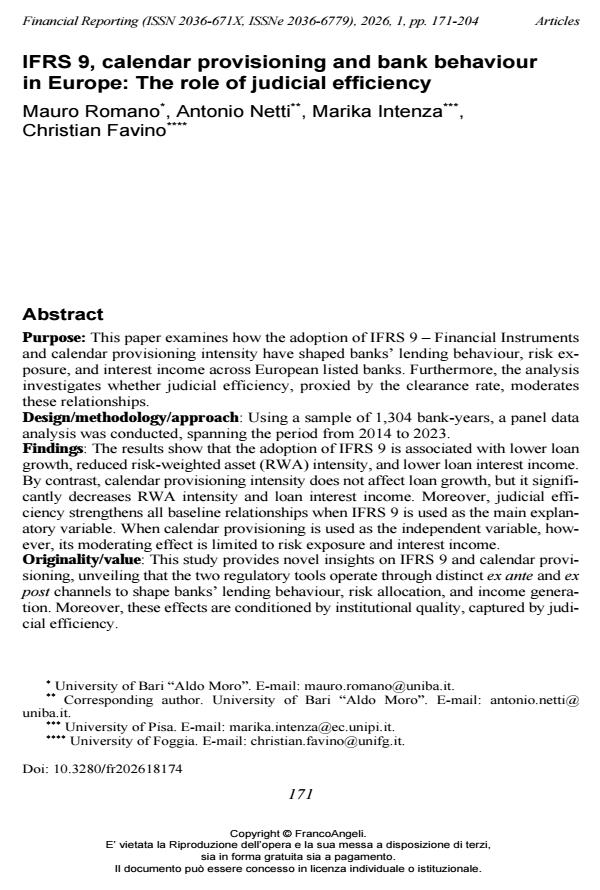
Purpose: This paper examines how the adoption of IFRS 9 – Financial Instruments and calendar provisioning intensity have shaped banks’ lending behaviour, risk exposure, and interest income across European listed banks. Furthermore, the analysis investigates whether judicial efficiency, proxied by the clearance rate, moderates these relationships. Design/methodology/approach: Using a sample of 1,304 bank-years, a panel data analysis was conducted, spanning the period from 2014 to 2023. Findings: The results show that the adoption of IFRS 9 is associated with lower loan growth, reduced risk-weighted asset (RWA) intensity, and lower loan interest income. By contrast, calendar provisioning intensity does not affect loan growth, but it significantly decreases RWA intensity and loan interest income. Moreover, judicial efficiency strengthens all baseline relationships when IFRS 9 is used as the main explanatory variable. When calendar provisioning is used as the independent variable, however, its moderating effect is limited to risk exposure and interest income. Originality/value: This study provides novel insights on IFRS 9 and calendar provisioning, unveiling that the two regulatory tools operate through distinct ex ante and ex post channels to shape banks’ lending behaviour, risk allocation, and income generation. Moreover, these effects are conditioned by institutional quality, captured by judicial efficiency. Practical implications: For banks, the findings underscore the relevance of aligning credit-risk strategies not only with accounting standards but also with institutional conditions, particularly in terms of risk allocation and income generation. For policymakers, the results hint that enhancing judicial efficiency can reinforce the regulatory role of accounting and prudential measures, thus strengthening their impact on banks’ strategic decisions and interest income, rather than on lending volumes.
Keywords: IFRS 9, calendar provisioning, loan growth, RWA intensity, loan interest income, judicial efficiency, clearance rate
Jel codes: G21, G28, M41, M48, K41, C23
- Abad, J., & Suarez, J. (2017). Assessing the cyclical implications of IFRS 9 - A recursive model (No. 12). ESRB Occasional Paper Series.
- Ahmed, A. S., Takeda, C., & Thomas, S. (1999). Bank loan loss provisions: A reexamination of capital management, earnings management and signaling effects. Journal of Accounting and Economics, 28(1), 1-25. DOI: 10.1016/S0165-4101(99)00017-8
- Allini, A., Meucci, F., Spagnuolo, F., & Zampella, A. (2023). What drives discretionary loan loss provisions? The role of banks’ business model, listing status and COVID-19 crisis in the European banking sector. Financial Reporting, 2. DOI: 10.3280/FR2023-002003
- Awuye, I. S., & Taylor, D. (2024). Over half a decade into the adoption of IFRS 9: A systematic literature review. Journal of Accounting Literature. DOI: 10.1108/JAL-11-2023-0204.
- Ball, R., & Shivakumar, L. (2005). Earnings quality in UK private firms: Comparative loss recognition timeliness. Journal of Accounting and Economics, 39(1), 83-128.
- Ball, R., Kothari, S. P., & Robin, A. (2000). The effect of international institutional factors on properties of accounting earnings. Journal of Accounting and Economics, 29(1), 1-51. DOI: 10.1016/S0165-4101(00)00012-4.
- Baltagi, B. H. (2021). Econometric Analysis of Panel Data. Springer International Publishing. DOI: 10.1007/978-3-030-53953-5.
- Basu, S. (1997). The conservatism principle and the asymmetric timeliness of earnings. Journal of Accounting and Economics, 24(1), 3-37. DOI: 10.1016/S0165-4101(97)00014-1.
- Beatty, A., & Liao, S. (2014). Financial accounting in the banking industry: A review of the empirical literature. Journal of Accounting and Economics, 58(2-3), 339-383.
- Beatty, A., & Weber, J. (2006). Accounting discretion in fair value estimates: An examination of SFAS 142 goodwill impairments. Journal of Accounting Research, 44(2), 257-288.
- Ben Ltaief, K., & Moalla, H. (2023). The impact of financial assets’ classification according to IFRS 9 on firm value: The case of MENA region’s banks. Journal of Financial Reporting and Accounting. DOI: 10.1108/JFRA-01-2023-0035.
- Bhagat, S., Bolton, B., & Lu, J. (2015). Size, leverage, and risk-taking of financial institutions. Journal of Banking & Finance, 59, 520-537.
- Bholat, D., Lastra, R. M., Markose, S. M., Miglionico, A., & Sen, K. (2018). Non-performing loans at the dawn of IFRS 9: Regulatory and accounting treatment of asset quality. Journal of Banking Regulation, 19(1), 33-54.
- Bischof, J., & Daske, H. (2016). Interpreting the European Union’s IFRS Endorsement Criteria: The Case of IFRS 9. Accounting in Europe, 13(2), 129-168. DOI: 10.1080/17449480.2016.1210181.
- Born, B., & Breitung, J. (2016). Testing for Serial Correlation in Fixed-Effects Panel Data Models. Econometric Reviews, 35(7), 1290-1316. DOI: 10.1080/07474938.2014.976524.
- Božovic, M. (2021). Judicial efficiency and loan performance: Micro evidence from Serbia. European Journal of Law and Economics, 52(1), 33-56.
- Breed, D. G., Hurter, J., Marimo, M., Raletjene, M., Raubenheimer, H., Tomar, V., & Verster, T. (2023). A Forward-Looking IFRS 9 Methodology, Focussing on the Incorporation of Macroeconomic and Macroprudential Information into Expected Credit Loss Calculation. Risks, 11(3).
- Burgstahler, D. C., Hail, L., & Leuz, C. (2006). The importance of reporting incentives: Earnings management in European private and public firms. The Accounting Review, 81(5), 983-1016.
- Burns, J., & Scapens, R. W. (2000). Conceptualizing management accounting change: An institutional framework. Management Accounting Research, 11(1), 3-25.
- Bushman, R. M., & Williams, C. D. (2015). Delayed Expected Loss Recognition and the Risk Profile of Banks. Journal of Accounting Research, 53(3), 511-553. DOI: 10.1111/1475-679X.12079.
- Carbó-Valverde, S., Cuadros-Solas, P. J., & Rodríguez-Fernández, F. (2021). The effects of negative interest rates: a literature review and additional evidence on the performance of the European banking sector. The European Journal of Finance, 27(18), 1908-1938. DOI: 10.1080/1351847X.2021.1927784
- Casciello, R., Maffei, M. & Ziebart, D. A. (2024). Regulatory and contextual factors influencing earnings and capital management decisions: evidence from the European banking sector. Review of Quantitative Finance and Accounting, 63, 87-146.
- Chen, Z., Li, K., & He, L. Y. (2020). Has internet finance decreased the profitability of commercial banks?: evidence from China. Emerging Markets Finance and Trade, 56(13), 3015-3032. DOI: 10.1080/1540496X.2019.1624159
- Chow, G. C. (1960). Tests of equality between sets of coefficients in two linear regressions. Econometrica: Journal of the Econometric Society, 591-605. DOI: 10.2307/1910133.
- Clark, W. R., & Golder, M. (2023). Interaction Models: Specification and Interpretation. Cambridge University Press.
- Cohen, B. H., & Edwards Jr, G. A. (2017). La nuova era degli accantonamenti per perdite attese su crediti. Rassegna trimestrale BRI, 1-20.
- Council of Europe. (2024). European Judicial Systems - CEPEJ Evaluation Report - Part 1: General Analyses (1st edition). -- Retrieved from: https://rm.coe.int/cepej-evaluation-report-2024-general-analyses/1680b1e91d.
- Dai, Z., & Zhang, X. (2023). Climate policy uncertainty and risks taken by the bank: evidence from China. International Review of Financial Analysis, 87, 102579.
- Daske, H., Hail, L., Leuz, C., & Verdi, R. (2008). Mandatory IFRS reporting around the world: Early evidence on the economic consequences. Journal of Accounting Research, 46(5), 1085-1142.
- Djankov, S., Mcliesh, C., & Shleifer, A. (2007). Private credit in 129 countries. Journal of Financial Economics, 84(2), 299-329.
- Dong, M., & Oberson, R. (2022). Moving toward the expected credit loss model under IFRS 9: Capital transitional arrangement and bank systematic risk. Accounting and Business Research, 52(6), 641-679.1952060. DOI: 10.1080/00014788.2021
- Doni, F., Corvino, A., & Bianchi Martini, S. (2021). Corporate governance model, stakeholder engagement and social issues: Evidence from European oil and gas industry. Social Responsibility Journal, 18(1), 636-662. DOI: 10.1108/SRJ-09-2020-0377.
- Du, N., Allini, A., & Maffei, M. (2023). How do bank managers forecast the future in the shadow of the past? An examination of expected credit losses under IFRS 9. Accounting and Business Research, 53(6), 699-722. DOI: 10.1080/00014788.20222063104.
- EBA (2017). Guidelines on credit risk management practices and accounting for expected credit losses. -- Retrieved from: https://eba.europa.eu/guidelines-credit-risk-management-practices-and-accounting-expected-credit-losses.
- EBA (2018). EBA publishes final Guidelines on credit institutions credit risk management practices and accounting for expected credit losses. -- Retrieved from: https://eba.europa.eu/publications-and-media/press-releases/eba-publishes-final-guidelines-credit-institutions-credit.
- Elashmawy, S., & Kallunki, J. P. (2025). Does Forward-Looking Accounting Improve Bank Asset Quality?. Accounting in Europe, 1-30. DOI: 10.1080/17449480.2025.2470719.
- ElKelish, W. W. (2021). The International Financial Reporting Standards 9 financial instruments, information quality and stock returns in the modern technology era. Journal of Applied Accounting Research, 22(3), 465-483. DOI: 10.1108/JAAR-12-2019-0164.
- Engelmann, B. (2021). Calculating lifetime expected loss for IFRS 9: Which formula is measuring what?. Journal of Risk Finance, 22(3-4), 193-208. DOI: 10.1108/JRF-05-2020-0113.
- ESRB (2017). Financial stability implications of IFRS 9. -- Retrieved from: https://data.europa.eu/doi/10.2849/597293.
- European Central Bank (ECB) (2017). Guidance to banks on non-performing loans. European Central Bank.
- European Central Bank (ECB) (2018). Addendum to the ECB Guidance to banks on non-performing loans: Supervisory expectations for prudential provisioning of non-performing exposures. European Central Bank.
- Fatouh, M., & Giansante, S. (2023). The cyclicality of bank credit losses and capital ratios under expected loss model. Annals of Operations Research, 330(1-2), 807-840.
- Fatouh, M., Bock, R., & Ouenniche, J. (2023). Impact of IFRS 9 on the cost of funding of banks in Europe. Journal of Banking Regulation, 24(2), 115-145.
- Freedman, J. (2004). Aligning Taxable Profits and Accounting Profits: Accounting Standards, Legislators and Judges. eJournal of Tax Research, 2(1), 71-99.
- Galletta, S., & Mazzù, S. (2023). ESG controversies and bank risk taking. Business Strategy and the Environment, 32(1), 274-288.
- Gambacorta, L., & Shin, H. S. (2018). Why bank capital matters for monetary policy. Journal of Financial Intermediation, 35, 17-29.
- Gebhardt, G. (2016). Impairments of Greek Government Bonds under IAS 39 and IFRS 9: A Case Study. Accounting in Europe, 13(2), 169-196. DOI: 10.1080/17449480.2016.1208833.
- Gebhardt, G., & Novotny-Farkas, Z. (2011). Mandatory IFRS Adoption and Accounting Quality of European Banks. Journal of Business Finance & Accounting, 38(3-4), 289-333.
- Ghosh, S. (2024). IFRS-9, expected loan loss provisioning and bank liquidity creation: Early evidence. Accounting Research Journal, 37(4), 436-452. DOI: 10.1108/ARJ-03-2024-0086.
- Giovannini, F., & Schifino, A. (2023). Evidence on IFRS 9 implementation from a sample of Italian banks and other financial intermediaries. Bank of Italy Occasional Paper, 784.
- Gómez-Ortega, A., Gelashvili, V., Delgado Jalón, M. L., & Rivero Menéndez, J. Á. (2022). Impact of the application of IFRS 9 on listed Spanish credit institutions: Implications from the regulatory, supervisory and auditing point of view. The Journal of Risk Finance, 23(4), 437-455. DOI: 10.1108/JRF-01-2022-0023.
- Hair, J. F. (Ed.). (2014). Multivariate data analysis (7th edition). Pearson. Harlow, England.
- Haselmann, R., Pistor, K., & Vig, V. (2010). How Law Affects Lending. Review of Financial Studies, 23(2), 549-580.
- Hashim, N., Li, W., & O’Hanlon, J. (2016). Expected-loss-based Accounting for Impairment of Financial Instruments: The FASB and IASB Proposals 2009-2016. Accounting in Europe, 13(2), 229-267. DOI: 10.1080/17449480.2016.1210179.
- Hausman, J. A. (1978). Specification Tests in Econometrics. Econometrica, 46(6), 1251. DOI: 10.2307/1913827.
- Hu, B., Schclarek, A., Xu, J., & Yan, J. (2022). Long-term finance provision: National development banks vs commercial banks. World Development, 158, 105973.
- IASB (2014). IFRS 9 Financial Instruments. -- Retrieved from: https://www.ifrs.org/content/dam/ifrs/publications/pdf-standards/english/2021/issued/part-a/ifrs-9-financial-instruments.pdf.
- Kaufmann, D., Kraay, A., & Mastruzzi, M. (2011). The Worldwide Governance Indicators: Methodology and Analytical Issues. Hague Journal on the Rule of Law, 3(02), 220-246. DOI: 10.1017/S1876404511200046.
- Kund, A. G., & Rugilo, D. (2023). Does IFRS 9 increase banks’ resilience? (No. 2792). ECB Working Paper.
- Kyiu, A., & Tawiah, V. (2023). IFRS 9 implementation and bank risk. Accounting Forum. DOI: 10.1080/01559982.2023.2233861.
- La Porta, R., López-de-Silanes, F., Pop-Eleches, C., & Shleifer, A. (2004). Judicial Checks and Balances. Journal of Political Economy, 112(2), 445-470. DOI: 10.1086/381480.
- Laeven, L., & Majnoni, G. (2005). Does judicial efficiency lower the cost of credit? Journal of Banking & Finance, 29(7), 1791-1812.
- LaFond, R., & Watts, R. L. (2008). The Information Role of Conservatism. The Accounting Review, 83(2), 447-478.
- Lepore, L., Paolone, F., Pisano, S., & Alvino, F. (2017). A cross-country comparison of the relationship between ownership concentration and firm performance: does judicial system efficiency matter?. Corporate Governance: The International Journal of Business in Society, 17(2), 321-340. DOI: 10.1108/CG-03-2016-0049
- Marton, J., & Runesson, E. (2017). The predictive ability of loan loss provisions in banks – Effects of accounting standards, enforcement and incentives. British Accounting Review, 49(2), 162-180.
- Mascia, D. V. (2023). Internally-assessed bank capital requirements and loan portfolio spreads. British Journal of Management, 34(4), 2334-2353. DOI: 10.1111/1467-8551.12708
- Mechelli, A., Sforza, V., & Cimini, R. (2020). Is IFRS 9 better than IAS 39 for investors’ decisions? Evidence from the European context at the beginning of the transition year. Financial Reporting, 1. DOI: 10.3280/FR2020-001004.
- Meyer, J. W., & Rowan, B. (1977). Institutionalized Organizations: Formal Structure as Myth and Ceremony. American Journal of Sociology, 83(2), 340-363.
- Mills, P. A. (1993). The courts, accounting evolution and freedom of contract: A comment of the case law research. Accounting, Organizations and Society, 18(7-8), 765-781. DOI: 10.1016/0361-3682(93)90051-7.
- Mooneeapen, O., & de Jager, P. (2025). A global snapshot on the cyclicality of provisions: unveiling IFRS 9’s impact. Journal of Banking Regulation, 1-13.
- Mora, A. (2022). Discussion of ‘Moving toward the expected credit loss model under IFRS 9: Capital Transitional Arrangement and bank systematic risk’. Accounting and Business Research. DOI: 10.1080/00014788.2022.2027078.
- North, D. C. (1990). Institutions, Institutional Change and Economic Performance. Cambridge University Press.
- Novotny-Farkas, Z. (2016). The Interaction of the IFRS 9 Expected Loss Approach with Supervisory Rules and Implications for Financial Stability. Accounting in Europe, 13(2), 197-227. DOI: 10.1080/17449480.2016.1210180
- Onorato, G., Pampurini, F., & Quaranta, A. G. (2024). Lending activity efficiency. A comparison between fintech firms and the banking sector. Research in International Business and Finance, 68, 102185.
- Ozili, P. K. (2019). Non-performing loans and financial development: New evidence. The Journal of Risk Finance, 20(1), 59-81. DOI: 10.1108/JRF-07-2017-0112.
- Paltrinieri, A., Dreassi, A., Rossi, S., & Khan, A. (2021). Risk-adjusted profitability and stability of Islamic and conventional banks: does revenue diversification matter?. Global Finance Journal, 50, 100517.
- Pathan, S., & Faff, R. (2013). Does board structure in banks really affect their performance?. Journal of Banking & Finance, 37(5), 1573-1589.
- Powell, W. W., & DiMaggio, P. J. (2012). The New Institutionalism in Organizational Analysis. University of Chicago Press.
- Quagli, A., Ramassa, P., & Venuti, M. (2025). How do global crises impact accounting regulation? 2008 financial crisis and COVID-19 in the EU IFRS regulatory space. Journal of Management and Governance, 29(2), 281-317. s10997-024-09729-5.
- Radcliffe, G. W. (1990). Accounting Standards and the Judiciary. Accounting and Business Research, 20(80), 329-336. DOI: 10.1080/00014788.1990.9728891.
- Rodrigues Boscia, M., Alves Dantas, J., Leone, V., & Kimura, H. (2022). Expected Credit Losses and Regulatory Capital: Effects of IFRS 9 in European Banks. Journal of Finance and Accounting, 10(1), 49-59.
- Salazar, Y., Merello, P., & Zorio-Grima, A. (2023). IFRS 9, banking risk and COVID-19: Evidence from Europe. Finance Research Letters, 56.
- Sánchez Serrano, A. (2022). Expected credit losses under imperfect foresight: Insights from a partial equilibrium model. Revista Espanola de Financiacion y Contabilidad, 51(4), 444-483. DOI: 10.1080/02102412.2021.2006028
- Schutte, W. D., Verster, T., Doody, D., Raubenheimer, H., & Coetzee, P. J. (2020). A proposed benchmark model using a modularised approach to calculate IFRS 9 expected credit loss. Cogent Economics and Finance, 8(1). DOI: 10.1080/23322039.2020.1735681
- Sironi, A., & Zazzara, C. (2003). The Basel Committee proposals for a new capital accord: Implications for Italian banks. Review of Financial Economics, 12(1), 99-126. DOI: 10.1016/S1058-3300(03)00009-0.
- Szücs, T., & Márkus, G. (2020). The impact of IFRS 9 impairment calculation on European banks’ market rating. Economy & Finance, 7(3), 326-351. DOI: 10.33908/EF.2020.3.5.
- Watts, R. L. (2003). Conservatism in Accounting Part I: Explanations and Implications. Accounting Horizons, 17(3), 207-221.
- Wursten, J. (2018). Testing for serial correlation in fixed-effects panel models. The Stata Journal, 18(1), 76-100. DOI: 10.1177/1536867X1801800106.
- Zampella, A., & Ferri, L. (2024). Value relevance of IFRS 9: The influence of country factors and heterogeneous strengths in the European banking sector. Journal of International Financial Management and Accounting, 35(1), 115-139.
Mauro Romano, Antonio Netti, Marika Intenza, Christian Favino, IFRS 9, calendar provisioning and bank behaviour in Europe: The role of judicial efficiency in "FINANCIAL REPORTING" 1/2026, pp 171-204, DOI: 10.3280/fr202618174