The Italian Debate on Urban Design in the 1980s. The Case Study of the Extraordinary Residential Building Program in Naples, 1981-1985
Journal title STORIA URBANA
Author/s Aurora Riviezzo
Publishing Year 2026 Issue 2025/182
Language Italian Pages 19 P. 87-105 File size 2102 KB
DOI 10.3280/SU2025-182005
DOI is like a bar code for intellectual property: to have more infomation
click here
Below, you can see the article first page
If you want to buy this article in PDF format, you can do it, following the instructions to buy download credits
FrancoAngeli is member of Publishers International Linking Association, Inc (PILA), a not-for-profit association which run the CrossRef service enabling links to and from online scholarly content.
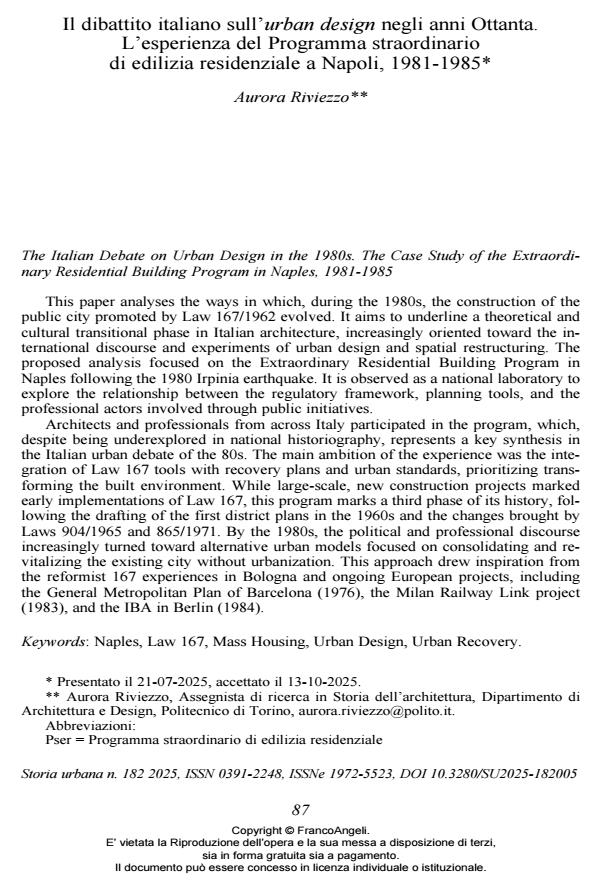
This paper analyses the ways in which, during the 1980s, the construction of the public city promoted by Law 167/1962 evolved. It aims to underline a theoretical and cultural transitional phase in Italian architecture, increasingly oriented toward the in-ternational discourse and experiments of urban design and spatial restructuring. The proposed analysis focused on the Extraordinary Residential Building Program in Naples following the 1980 Irpinia earthquake. It is observed as a national laboratory to explore the relationship between the regulatory framework, planning tools, and the professional actors involved through public initiatives. Architects and professionals from across Italy participated in the program, which, despite being underexplored in national historiography, represents a key synthesis in the Italian urban debate of the 80s. The main ambition of the experience was the inte-gration of Law 167 tools with recovery plans and urban standards, prioritizing trans-forming the built environment. While large-scale, new construction projects marked early implementations of Law 167, this program marks a third phase of its history, fol-lowing the drafting of the first district plans in the 1960s and the changes brought by Laws 904/1965 and 865/1971. By the 1980s, the political and professional discourse increasingly turned toward alternative urban models focused on consolidating and re-vitalizing the existing city without urbanization. This approach drew inspiration from the reformist 167 experiences in Bologna and ongoing European projects, including the General Metropolitan Plan of Barcelona (1976), the Milan Railway Link project (1983), and the IBA in Berlin (1984).
Keywords: Naples, Law 167, Mass Housing, Urban Design, Urban Recovery.
Aurora Riviezzo, Il dibattito italiano sull’urban design negli anni Ottanta. L’esperienza del Programma straordinario di edilizia residenziale a Napoli, 1981-1985 in "STORIA URBANA " 182/2025, pp 87-105, DOI: 10.3280/SU2025-182005