The Current Role of the United Nations in Conflict Resolution
Journal title WELFARE E ERGONOMIA
Author/s Valentina Della Fina
Publishing Year 2026 Issue 2026/1
Language Italian Pages 17 P. 17-33 File size 128 KB
DOI 10.3280/WE2026-001002
DOI is like a bar code for intellectual property: to have more infomation
click here
Below, you can see the article first page
If you want to buy this article in PDF format, you can do it, following the instructions to buy download credits
FrancoAngeli is member of Publishers International Linking Association, Inc (PILA), a not-for-profit association which run the CrossRef service enabling links to and from online scholarly content.
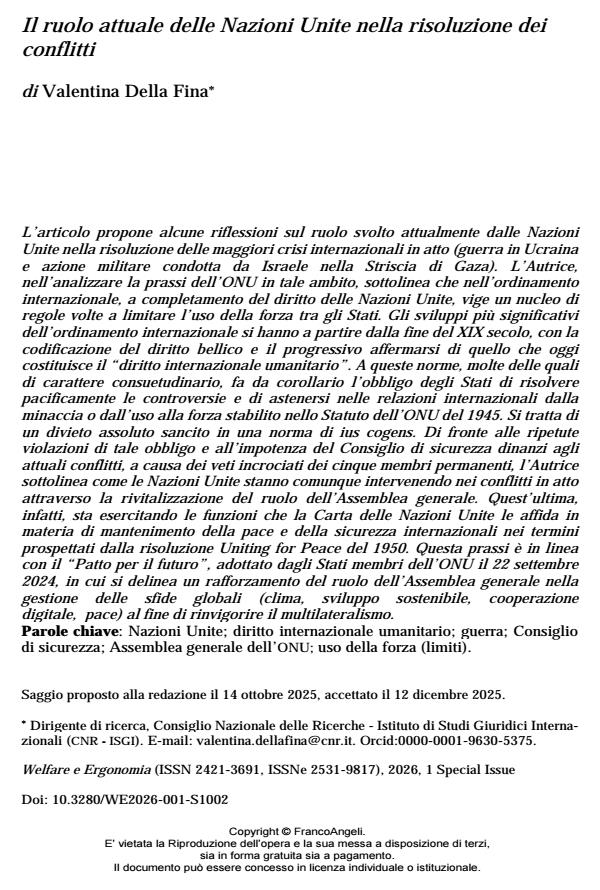
The article offers some reflections on the current role played by the United Nations (UN) in resolving major ongoing international crises (the war in Ukraine and Israel’s military action in the Gaza Strip). Analyzing the UN practice in this area, the Author underlines that, in addition to the UN law, there is a core set of rules in the international legal system aimed at limiting the use of force among States. The most significant development of these rules occurred at the end of the 19th century with the codification of the law of war and later with the gradual affirmation of the “international humanitarian law”. Corollary to these norms, many of which are customary rules, there is the obligation of States to peacefully settle international disputes and to refrain from the threat or the use of force in their international relations as established in the 1945 UN Statute. This is an absolute prohibition enshrined in a rule of ius cogens. In the face of repeated violations of this obligation and the impotence of the Security Council to intervene in the current conflicts due to cross vetoes of the five permanent members, the Author highlights that the UN is nevertheless intervening through the revitalization of the role of the General Assembly which is exercising the functions in the maintenance of international peace and security entrusted to it by the UN Charter, as set out in the 1950 Uniting for Peace resolution. This practice is in line with the ‘Pact for the Future’, adopted by UN Member States on 22 September 2024, which outlines a strengthening of the role of the General Assembly in tackling global challenges (climate, sustainable development, digital cooperation, peace) in order to reinforce multilateralism.
Keywords: United Nations; international humanitarian law; war; Security Council; UN General Assembly; use of force (limits).
Valentina Della Fina, Il ruolo attuale delle Nazioni Unite nella risoluzione dei conflitti in "WELFARE E ERGONOMIA" 1/2026, pp 17-33, DOI: 10.3280/WE2026-001002