Il contributo della Scienza Aperta per la promozione di una cultura di pace
Journal title WELFARE E ERGONOMIA
Author/s Luciana Taddei, Claudia Pennacchiotti
Publishing Year 2026 Issue 2026/1
Language Italian Pages 40 P. 115-140 File size 205 KB
DOI 10.3280/WE2026-001008
DOI is like a bar code for intellectual property: to have more infomation
click here
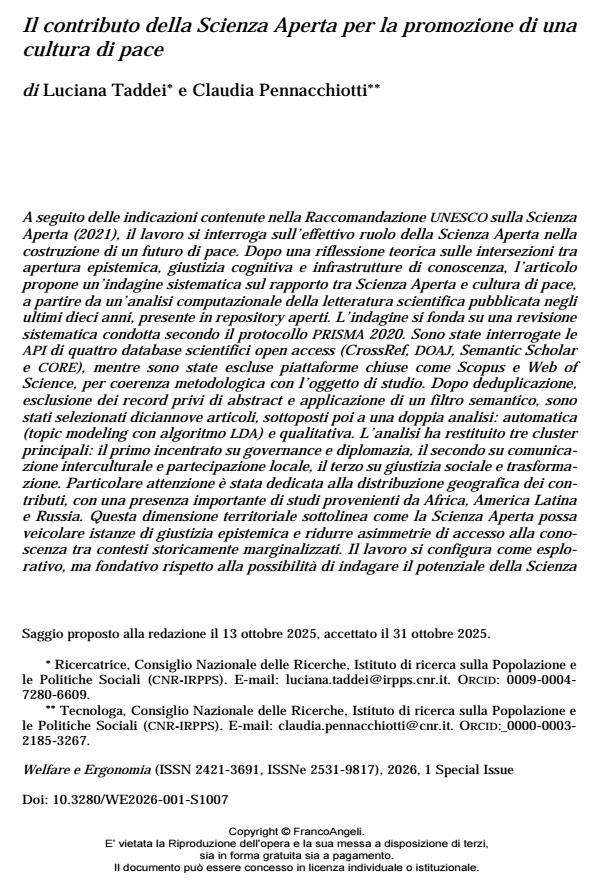
Below, you can see the article first page
If you want to buy this article in PDF format, you can do it, following the instructions to buy download credits
FrancoAngeli is member of Publishers International Linking Association, Inc (PILA), a not-for-profit association which run the CrossRef service enabling links to and from online scholarly content.
This study, drawing from the main UN documents related to education and the culture of peace, as well as from the reflections of theorists such as Galtung ‒ one of the founders of peace studies ‒ aims to identify and highlight the relationships between the culture of peace, the dynamics of education and the production of scientific and educational knowledge. Based on Johan Galtung’s concept of positive peace, the study explores to what extent the foundational elements of modern educational and scientific theories and practices can be interpreted as pathways toward positive peace and thus be embedded in the processes of building peaceful societies. The premise is that peace is not merely “negative”– as in the absence of war and violence – but, as Galtung notably emphasized, it should primarily be understood as a process aimed at building peaceful societies. Hence, the study questions the role that science, which has often acted as vehicle, thinking force or agent in the pursuit of war-related processes and products, might play. Similarly, it examines education, which, while aimed at societal continuity and individual development, can also serve as a tool to reinforce non-inclusive societies and perpetuate social class divisions. Among the factors considered, particular emphasis is placed on dialogical and relational aspects, as well as on the concept of transformation. The culture of peace is in fact inextricably linked to dialogue, exchange, collaboration, and the recognition of the diversity of perspectives, with a view to overcoming particularisms. Modern science, for its part, has defined its epistemological paradigms by rejecting secrecy and the principle of authority, favoring instead the initiation of dialogical processes-continually negotiated-among disciplines and with society. Morin’s idea of “dialogical consciousness,” proposed in opposition to the “delusion” of viewing reality from a single perspective, opens the way – on an educational level – to a vision of social transformation. This is a concept variously interpreted by philosophers, sociologists, and pedagogues, and particularly effectively expressed by Bertoni Jovine. The analysis of research and experimental practices focused on various dimensions of transformative education and participatory approaches in social research contributes to outlining the role of the human and social sciences in building a culture of peace.
Keywords: positive peace, education, science, peace studies, dialogue, science and society.
Luciana Taddei, Claudia Pennacchiotti, Il contributo della Scienza Aperta per la promozione di una cultura di pace in "WELFARE E ERGONOMIA" 1/2026, pp 115-140, DOI: 10.3280/WE2026-001008