Resisting fast food: practices of misbehaviour against organizational standardization
Journal title SOCIOLOGIA DEL LAVORO
Author/s Manuel Trevisan
Publishing Year 2026 Issue 2026/174
Language English Pages 22 P. 52-73 File size 271 KB
DOI
DOI is like a bar code for intellectual property: to have more infomation
click here
Below, you can see the article first page
If you want to buy this article in PDF format, you can do it, following the instructions to buy download credits
FrancoAngeli is member of Publishers International Linking Association, Inc (PILA), a not-for-profit association which run the CrossRef service enabling links to and from online scholarly content.
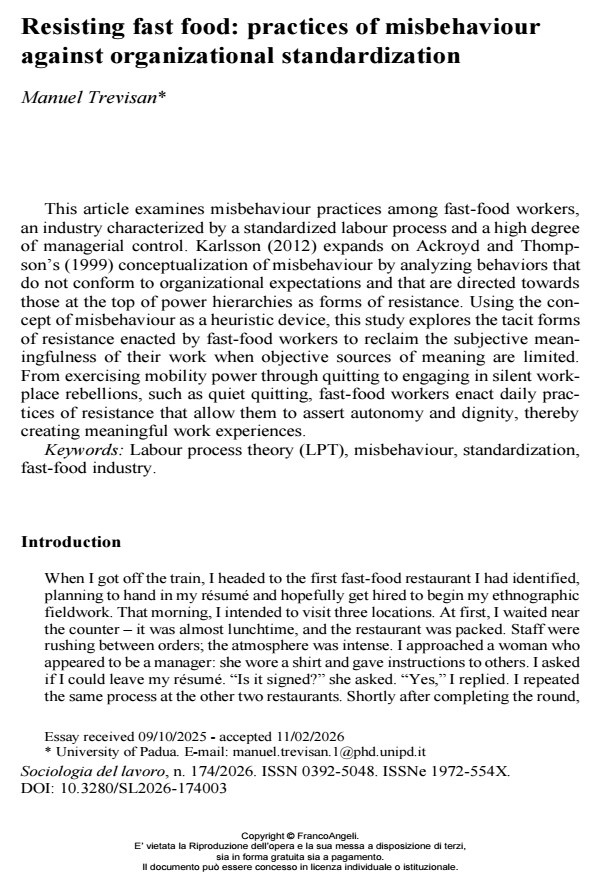
This article examines misbehaviour practices among fast-food workers, an industry characterized by a standardized labour process and a high degree of managerial control. Karlsson (2012) expands on Ackroyd and Thompson’s (1999) conceptualization of misbehaviour by analyzing behaviors that do not conform to organizational expectations and that are directed towards those at the top of power hierarchies as forms of resistance. Using the concept of misbehaviour as a heuristic device, this study explores the tacit forms of resistance enacted by fast-food workers to reclaim the subjective meaningfulness of their work when objective sources of meaning are limited. From exercising mobility power through quitting to engaging in silent workplace rebellions, such as quiet quitting, fast-food workers enact daily practices of resistance that allow them to assert autonomy and dignity, thereby creating meaningful work experiences.
Keywords: Labour process theory (LPT), misbehaviour, standardization, fast-food industry.
- Alberti G., Però D. (2018). Migrating industrial relations: migrant workers’ initiative within and outside trade unions. British Journal of Industrial Relations, 56 (4), 693-715.
- Alberti G., Sacchetto D. (2024). The politics of migrant labour: Exit, voice, and social reproduction. Bristol: Bristol University Press.
- Ackroyd S., Thompson P. (1999). Organizational Misbehaviour. London: Sage. Ackroyd S., Thompson P. (2022). Organizational Misbehaviour, (2nd ed). London: Sage.
- Allan C., Bamber G. J., and Timo N. (2006). Fast-food work: Are McJobs satisfying? Employee Relations, 28(5), 402–420. DOI: 10.1108/01425450610683627
- Barbieri P., Scherer S. (2009). Labour Market Flexibilization and Its Consequences in Italy. European Sociological Review, 26, 677–92.
- Beynon H. (1992). The end of the industrial worker? In: Gilbert N., Burrows R., Pollert A. (eds.). Social change in contemporary Britain, 167–183. Macmillan.
- Bailey C., Madden A. (2017). Time reclaimed: temporality and meaningful work. Work, Employment and Society, 31(1), 3-18. DOI: 10.1177/0950017015604100
- Bolton S.C., Boyd C. (2003). Trolley Dolly or Skilled Emotion Manager? Moving on from Hochschild’s Managed Heart. Work, Employment and Society, 17(2), 289–308. DOI: 10.1177/0950017003017002004
- Braverman H. (1974). Labour and Monopoly Capital, The Degradation of Work in the Twentieth Century. New York: Monthly Review Press.
- Brown D., McIntosh S. (2000). ‘Job satisfaction and labour turnover in the retail and hotel sectors’. In: Salverda W., Lucifora C., and Nolan B. (eds) Policy Measures for Low-Wage Employment in Europe. Cheltenham: Edward Elgar, 218–37.
- Cini L. (2025). Misbehaving for Deliveroo. How couriers’ digital manipulation boosts the platform’s business. Organization. DOI: 10.1177/13505084251334994
- Clegg S., Dunkerley D. (1980). Organisation, Class and Control. London: Routledge and Kegan Paul.
- Collison D., Ackroyd S. (2006). ‘Resistance, Misbehaviour, and Dissent’. In: Ackroyd S., Batt R., Thompson P., Tolbert P.S. (eds). The Oxford Handbook of Work and Organization, 305-26. Oxford: Oxford University Press.
- Ditton J. (1972). Absent at Work: How to Manage Monotony. New Society, 21, 679-81.
- Edwards R. (1979). Contested Terrain: The Transformation of Industry in the Twenti-eth Century. London: Heinemann.
- Edwards P.K., Scullion H. (1982). The Social Organization of Industrial Conflict. Ox-ford: Blackwell.
- Ehrenreich B. (2002). Nickel and dimed: Undercover in low-wage America. London: Granta Books.
- Fineman S. (1995). Stress, Emotion and Intervention. In: Newton T., Handy J., and Fineman S. (eds). Managing Stress: Emotion and Power at Work. London: Sage.
- Flick U. (2014). An Introduction to Qualitative Research. London: Sage.
- Flick U. (2018). The SAGE Handbook of Qualitative Data Collection. London: Sage. Gould A.M. (2010). Working at McDonald’s: Some redeeming features of McJobs. Work, Employment and Society, 24(4), 780–802.
- 10.1177/0950017010380644.
- Fullin G. (2023). I clienti siamo noi. Il lavoro nella società dei servizi. Bologna: il Mulino.
- Giesecke J., Groß, M. (2004). External Labour Market Flexibility and Social Inequal-ity: Temporary Employment in Germany and the UK. European Societies, 6(3), 347-82. DOI: 10.1080/1461669042000231456
- Hackman R., Oldham G. (1975). Development of the job diagnostic survey. Journal of Applied Psychology, 60(2), 159-170.
- Hill S. (1981). Competition and Control at Work. London: Heinemann.
- Hirschman A.D. (1970). Exit, Voice and Loyalty. Cambridge, MA: Harvard University Press.
- Hodson R. (2001). Dignity at Work. Cambridge: Cambridge University Press.
- Hodson R. (1995). Worker resistance: An underdeveloped concept in the sociology of work. Economic and industrial democracy, 16(1), 79-110. DOI: 10.1177/0143831X9501600104
- Hochschild A.R. (1983). The Managed Heart: Commercialization of Human Feeling. Los Angeles: University of California Press.
- Honneth A. (2012). The I in We: Studies in the Theory of Recognition. Cambridge: Polity.
- Kallemberg A.L. (2011). Good Jobs, Bad Jobs: The Rise of Polarized and Precarious Employment Systems in the United States, 1970s to 2000s. New York: Russell Sage Foundation.
- Kojima S. (2015). Why do temp workers work as hard as they do?: The commitment and suffering of factory temp workers in Japan. The Sociological Quarterly, 56(2), 355-385.
- Laaser K., Karlsson J.C. (2022). Towards a sociology of meaningful work. Work, Em-ployment and Society, 36(5), 798-815. DOI: 10.1177/09500170211055998
- Leidner R. (1993). Fast Food, Fast Talk: Service Work and the Routinization of Eve-ryday Life. Berkeley, CA: University of California Press.
- Love J.F. (1995). McDonald’s Behind the Arches. New York, NY: Bantam. Luthans F. (1972). Organization Behavior. New York: McGraw-Hill.
- Lysova E., Allan B., Dik B., Duffy R., Steger, M. (2019). Fostering meaningful work in organizatios: a multi-level review. Journal of Vacational Behaviour, 110, 374-389.
- Morgan G. (1990). Organisations in Society. London: Macmillan.
- Karlsson J.C. (2012). Organizational misbehaviour in the workplace: Narratives of dignity and resistance. Dordrecht: Springer.
- Però D. (2024). Resisting outsourcing: learning from migrant workers’ power-building strategies in the British service sector. Sociologia del Lavoro, (2023/167). DOI: 10.3280/SL2023-167005
- Reed M. (1985). Redirections in Organisational Analyses. London: Tavistock. Riessman C.K. (2008). Narrative Methods for the Human Sciences. London: Sage. Ritzer G. (1997). Il mondo alla McDonald’s. Bologna: il Mulino.
- Ritzer G. (2017). La McDonaldizzazione della produzione. Roma: Lit Edizioni Srl. Roethlisberger F.J., Dickson W.L. (1964). Management and the Worker. Cambridge,
- MA: Harvard University Press. (First published in 1939).
- Roy D. (1958). ‘Banana Time: Job Satisfaction and Informal Interaction’. Human Or-ganisation, 18(1), 158-61.
- Royle T. (2010). ‘Low-road Americanization’ and the global ‘McJob’: A longitudinal analysis of work, pay and unionization in the international fast-food industry. La-bor History, 51(2), 249–270. DOI: 10.1080/00236561003729693
- Royle T. (1999). Recruiting the acquiescent workforce: a comparative analysis of McDonald’s in Germany and the UK. Employee Relations, 21(6), 540-55. DOI: 10.1108/01425459910299857
- Royle T. (2000). Working for McDonald’s in Europe: The Unequal Struggle. London: Routledge.
- Royle T., Urano E. (2012). A new form of union organizing in Japan? Community unions and the case of the McDonald’s ‘McUnion’. Work, Employment and Soci-ety, 26 (4), 606-622. DOI: 10.1177/0950017012445093
- Salaman G. (1979). Work Organisation: Resistance and Control. London: Longman. Schlosser E. (2002). Fast Food Nation. London: Penguin.
- Schwartz A. (1982). Meaningful Work. Ethics, 92(4), 634–646.
- Scott J.C. (1990). Domination and the arts of resistance. New Haven: Yale University Press.
- Scott J.C. (1985), Weapon of the Weak: Everyday Forms of Peasant Resistance. New Haven: Yale University Press.
- Silver B.J. (2003). Forces of Labor: Workers’ Movements and Globalization since 1870. Cambridge: Cambridge University Press.
- Smith C. (2006). The double indeterminacy of labour power: Labour effort and labour mobility. Work, Employment and Society, 20(2), 389–402. DOI: 10.1177/0950017006065109
- Smith C., Daskalaki M., Elger T., and Brown D. (2004). Labour turnover and manage-ment retention strategies in new manufacturing plants. The International Journal of Human Resource Management, 15(2), 371–396. DOI: 10.1080/0958519032000158563
- Supiot, A. (2021). Labour Is Not a Commodity: The Content and Meaning of Work in the Twenty-first Century. International Labour Review, 160(1), 1–20.
- Taylor F.W. (1947). Scientific Management. New York: Harper and Row. (First pub-lished 1911).
- Thompson P. (1983). The Nature of Work: An Introduction to the Debates on the La-bour Process. London: Macmillan.
- Thompson P., McHugh D. (1995). Work Organisations, 2nd ed. London: Macmillan. Vallas S. (2006). Empowerment redux: structure, agency, and the remaking of mana-
- gerial authority. American Journal of Sociology, 111(6), 1677-1717. DOI: 10.1086/499909
- Watson, C.W. (1999). Being there: Fieldwork in anthropology. London: Pluto Press. Wilson F.M. (2018). Organizational behaviour and work: a critical introduction. Oxford University Press.
Manuel Trevisan, Resisting fast food: practices of misbehaviour against organizational standardization in "SOCIOLOGIA DEL LAVORO " 174/2026, pp 52-73, DOI: