Lost in remotization. Aspirations and attitudes toward work after the COVID-19 pandemic
Journal title SOCIOLOGIA DEL LAVORO
Author/s Francesco Gentilini
Publishing Year 2026 Issue 2026/174
Language English Pages 17 P. 74-90 File size 266 KB
DOI
DOI is like a bar code for intellectual property: to have more infomation
click here
Below, you can see the article first page
If you want to buy this article in PDF format, you can do it, following the instructions to buy download credits
FrancoAngeli is member of Publishers International Linking Association, Inc (PILA), a not-for-profit association which run the CrossRef service enabling links to and from online scholarly content.
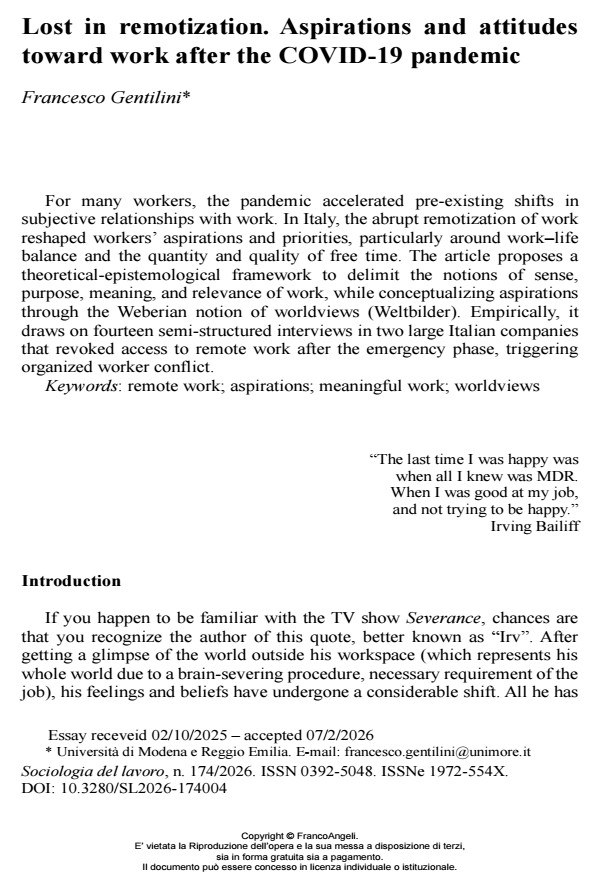
For many workers, the pandemic accelerated pre-existing shifts in subjective relationships with work. In Italy, the abrupt remotization of work reshaped workers’ aspirations and priorities, particularly around work–life balance and the quantity and quality of free time. The article proposes a theoretical-epistemological framework to delimit the notions of sense, purpose, meaning, and relevance of work, while conceptualizing aspirations through the Weberian notion of worldviews (Weltbilder). Empirically, it draws on fourteen semi-structured interviews in two large Italian companies that revoked access to remote work after the emergency phase, triggering organized worker conflict.
Keywords: remote work; aspirations; meaningful work; worldviews
- Bellini F., Lomazzi V. (2024). Changing Work Values: Beyond Hustle Culture. Sociológia, 56(6): 555-580.
- Alagna M. (2018). Atlanti: immagini del mondo e forme della politica in Max Weber. Roma: Donzelli Editore.
- Appadurai A. (2004). The capacity to aspire: culture and the terms of recognition. In: Rao V., Walton M. (eds.), Culture and public action: 59–84. Stanford: Stanford University Press.
- Bertolini S., Fullin G., Goglio V., Pacetti V., Tosi S., Vercelli M. (2021). Il lavoro da remoto alla prova dell’emergenza. Implicazioni sociali e organizzative. Cambio. Rivista sulle Trasformazioni Sociali, 11(22): 69-82.
- Bertolini S., Vercelli M. (2023). Remote work and the hybridisation of work relations: blurring the boundaries between subordination and self-employment?. Rassegna Italiana di Sociologia, 65 (1): 127-152. DOI: 10.1423/109017
- Brunetta R., Tiraboschi M. (2021). Lavoro agile: alcune conferme dalle prime rilevazioni empiriche. Working Paper Adapt, 4-9. Testo disponibile al sito https://iris.unimore.it/handle/11380/1288447 (data di consultazione: 12/09/2025).
- Butera F. (2020). Le condizioni organizzative e professionali dello smart working dopo l’emergenza: progettare il lavoro ubiquo fatto di ruoli aperti e di professioni a larga banda. Studi organizzativi, 1: 141-65. DOI: 10.3280/SO2020-001006
- Canal T., Gosetti G., Luppi M. (2024). Qualità del lavoro e digitalizzazione. Riflessioni aperte sul caso italiano. Sinappsi, 2: 66-92.
- Carreri A., Gosetti G., Mattei A. (2024). Il “caso” Lamborghini: contrattazione continua e tempi di lavoro. Lavoro e diritto, (4): 663-690. DOI: 10.1441/115069
- Cavallini G., D’Andrea D. (2024). Senso, significato e rilevanza del lavoro: una prospettiva weberiana. Cambio. Rivista sulle trasformazioni sociali, 14 (27): 125-147.
- Coin F. (2023). Le grandi dimissioni. Il nuovo rifiuto del lavoro e il tempo di riprenderci la vita. Torino: Einaudi.
- Coutrot T., Perez C. (2022). Redonner du sens au travail: Une aspiration révolutionnaire. Paris: Seuil..
- D’Andrea D. (2016). Pensare la soggettività senza natura umana. Materialità e immagini del mondo in Max Weber. Cosmopolis, 13. https://hdl.handle.net/2158/1082119 (data di consultazione: 12/09/2025).
- D’Andrea D. (2024). Lavoro e senso della vita in Max Weber. In: Mari G. et al., a cura di, Idee di lavoro e di ozio per la nostra civiltà: 733-746. Firenze: Firenze University Press.
- della Ratta-Rinaldi F., Gentilini F., Rinaldini M., Mattioli F., Caria S. (2025). La rivoluzione del lavoro da remoto nel settore pubblico. Quali prospettive?. Sociologia del lavoro, 172(2): 139-166. DOI: 10.3280/SL2025-172007
- Dingel J., Neiman B. (2020). How many jobs can be done at home?. Journal of Public Economics, 189 (104235).
- Gallie D. (2017). The quality of work in a changing labour market. Social Policy & Administration, 51(2): 226-243.
- Gandini A., Garavaglia E. (2023). Another work routine is possible: everyday experiences of (unexpected) remote work in Italy. Culture and Organization, 29(5): 397-415. DOI: 10.1080/14759551.2023.2201003
- Gosetti G. (2021). Aspirazioni, capacità di aspirare e qualità della vita lavorativa. Rassegna Italiana di Sociologia, 62(3): 577-607. DOI: 10.1423/100825
- Gosetti G. (2022). La qualità della vita lavorativa. Lineamenti per uno studio sociologico. Milano: FrancoAngeli.
- Gorz A. (2004). Métamorphoses du travail: Critique de la raison économique. Paris: Editions Gallimard.
- Graeber D. (2018). Bullshit Jobs: A Theory. New York: Simon & Schuster.
- Guazzo C., Gandini A., Garavaglia E. (2024). Indietro non si torna. Un’analisi longitudinale delle esperienze di lavoro da remoto tra i knowledge worker in Italia durante e dopo la pandemia. Rassegna Italiana di Sociologia, 65(1): 153-176. DOI: 10.1423/112994
- Guazzo C., Gandini A. (2024). Work is not working anymore?: the rise of anti-work demands across online spaces in the coronavirus pandemic. Cambio. Rivista sulle Trasformazioni Sociali, 27(1): 33-50.
- Hipp L., Krzywdzinski M. (2023). Remote Work: New Fields and Challenges for Labor Activism. Work and Occupations, 50 (3): 445-451. DOI: 10.1177/07308884231163135
- Honneth A. (2010). Lavoro e riconoscimento. In: Solinas M., a cura di, Capitalismo e riconoscimento. Firenze: Firenze University Press.
- International Labour Organization (2021). Working from home: From invisibility to decent work. Geneva: ILO.
- INAPP, Zucaro R. (2022). Verso lo smart working? Un’analisi multidisciplinare di una sperimentazione naturale. Roma: INAPP.
- Laaser K., Karlsson J.C. (2022). Towards a Sociology of Meaningful Work. Work, Employment and Society, 36(5): 798–815. DOI: 10.1177/09500170211055998
- Maslow A.H. (1954). Motivation and personality. New York: Harper and Row.
- Osservatorio Smart Working (2020). Lo Smart Working ai tempi del Covid-19: come cambia il lavoro dopo l’emergenza. Politecnico di Milano, School of Management. https://www.osservatori.net/ (data di consultazione: 11/09/2025).
- Poli S. (2008). La sindrome di Gondrano. Senso e significati del lavoro nella società postmoderna. Milano: FrancoAngeli.
- Romens A.I., Piro V., Iannuzzi F.E. (2022). The variable geometry of bargaining: implementing unions’ strategies on remote work in Italy. Studi organizzativi, 1: 129-153. DOI: 10.3280/SO2022-001006
- Sbalchiero S. (2021). Dal metodo all’esperienza. Fare ricerca con la sociologia comprendente. Padova: Padova University Press.
- Schwartz A. (1982). Meaningful Work. Ethics, 92(4): 634–646. DOI: 10.1086/292380
- Sen A. (1992). Inequality Reexamined. Oxford: Clarendon Press.
- Sostero M., Milasi S., Hurley J., Fernandez-Macías E., Bisello M. (2020). Teleworkability and the COVID-19 crisis: a new digital divide? JRC working papers series on labour, education and technology, 2020/05. https://hdl.handle.net/10419/231337 (data di consultazione: 11/09/2025).
- Weber M. (1919). Politik als Beruf. München und Leipzig: Duncker & Humblot. Weber M. (1922a). Soziologische Kategorienlehre. In: Weber M., Wirtschaft und Gesellschaft, Tübingen: Mohr.
- Weber M. (1922b). Religionssoziologie (Typen religiöser Vergemeinschaftung). In: Weber M., Wirtschaft und Gesellschaft. Tübingen: Mohr.
- Weber M. (2003). Il metodo delle scienze storico-sociali. Torino: Einaudi.
- Yeoman R. (2014). Meaningful work and workplace democracy: A philosophy of work and a politics of meaningfulness. London: Palgrave Macmillan.
Francesco Gentilini, Lost in remotization. Aspirations and attitudes toward work after the COVID-19 pandemic in "SOCIOLOGIA DEL LAVORO " 174/2026, pp 74-90, DOI: