Online trading between a hobby and work. An empirical study on the ‘professionalism’ of Italian retail investors in the gig economy era
Journal title SOCIOLOGIA DEL LAVORO
Author/s Niccolò Casnici, Marco Castellani
Publishing Year 2026 Issue 2026/174
Language Italian Pages 30 P. 179-208 File size 370 KB
DOI
DOI is like a bar code for intellectual property: to have more infomation
click here
Below, you can see the article first page
If you want to buy this article in PDF format, you can do it, following the instructions to buy download credits
FrancoAngeli is member of Publishers International Linking Association, Inc (PILA), a not-for-profit association which run the CrossRef service enabling links to and from online scholarly content.
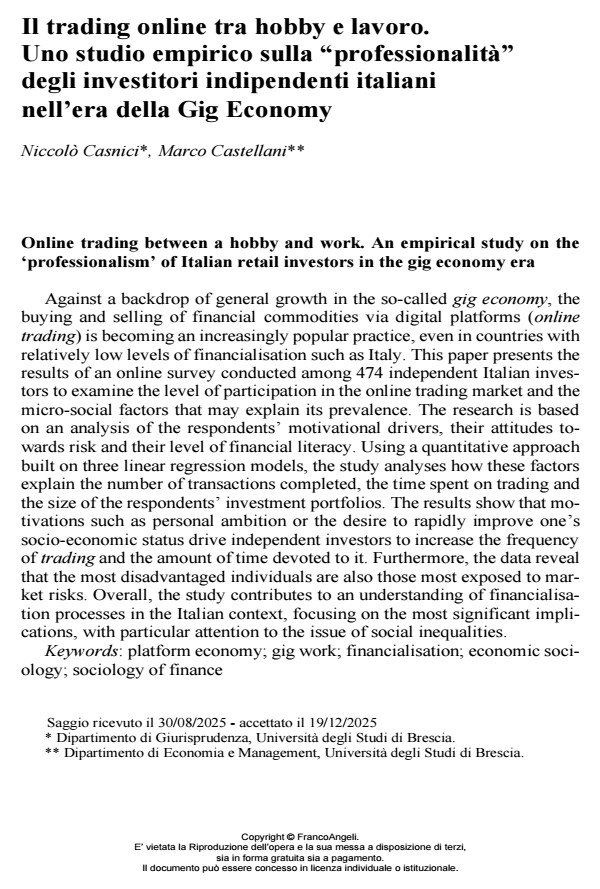
Against a backdrop of general growth in the so-called gig economy, the buying and selling of financial commodities via digital platforms (online trading) is becoming an increasingly popular practice, even in countries with relatively low levels of financialisation such as Italy. This paper presents the results of an online survey conducted among 474 independent Italian investors to examine the level of participation in the online trading market and the micro-social factors that may explain its prevalence. The research is based on an analysis of the respondents’ motivational drivers, their attitudes towards risk and their level of financial literacy. Using a quantitative approach built on three linear regression models, the study analyses how these factors explain the number of transactions completed, the time spent on trading and the size of the respondents’ investment portfolios. The results show that motivations such as personal ambition or the desire to rapidly improve one’s socio-economic status drive independent investors to increase the frequency of trading and the amount of time devoted to it. Furthermore, the data reveal that the most disadvantaged individuals are also those most exposed to market risks. Overall, the study contributes to an understanding of financialisation processes in the Italian context, focusing on the most significant implications, with particular attention to the issue of social inequalities.
Keywords: platform economy; gig work; financialisation; economic sociology; sociology of finance
- Fiorillo L. (2018). Un diritto del lavoro per il lavoro che cambia: primi spunti di riflessione.
- Fligstein N. (1990). The transformation of corporate control. Harvard University Press.
- Formenti C. (2011). Felici e sfruttati. Capitalismo digitale ed eclissi del lavoro (EGEA).
- Aramonte S., Avalos F. (2021). The rising influence of retail investors. https://www.bis.org/publ/qtrpdf/r_qt2103v.htm.
- Arcidiacono D., Gandini A., and Pais I. (2018). Sharing what? The ‘sharing economy’ in the sociological debate. The Sociological Review, 66(2), 275–288. DOI: 10.1177/0038026118758529
- Ba S., Pavlou P. A. (2002). Evidence of the Effect of Trust Building Technology in Electronic Markets: Price Premiums and Buyer Behavior. MIS Quarterly, 26(3), 243–268. https://misq.org/evidence-of-the-effect-of-trust-building-technology-in-electronic-markets-price-premiums-and-buyer-behavior.html.
- Barber B. M., Odean T. (2013). The Behavior of Individual Investors. Handbook of the Economics of Finance, 2, 1533–1570.
- Barbera F., Dagnes J., Salento A., and Spina F. (2016). Il capitale quotidiano : un manifesto per l’economia fondamentale. Donzelli editore.
- Barrios J. M., Hochberg Y. V., and Yi H. (2020). Launching with a Parachute: The Gig Economy and Entrepreneurial Entry.
- Bertolini S., Moiso V. (2020). Lavoro atipico, discontinuità di reddito, welfare e accesso al credito: il modello italiano in Europa. Stato e Mercato, XL(2/2020), 359–384.
- Bhatia A., Chandani A., Atiq R., Mehta M., and Divekar, R. (2021). Artificial intelligence in financial services: a qualitative research to discover robo-advisory services. Qualitative Research in Financial Markets, 13(5), 632–654.
- Birgillito G., Birgillito M. (2018). Algorithms and ratings: tools to manage labour relations. Proposals to renegotiate labour conditions for platform drivers. Labour & Law Issues, 4(2), C. 25-50. DOI: 10.6092/ISSN.2421-2695/8798
- Bolonin A., Balykin V. (2021). Payment Systems in Digital Economy. 97–108. DOI: 10.1007/978-3-030-71337-9_7
- Boyer R. (2004). The´orie de la re´gulation. Les fondamentaux. La Découverte. https://www.cairn.info/theorie-de-la-regulation-1-les-fondamentaux--9782707132161.htm#.
- Brescia Morra C., Colonnello D., Gargantini M., Sandrelli G., and Trovatore G. (2025). La gamification degli investimenti finanziari (Quaderni Giuridici). https://www.consob.it/web/area-pubblica/abs-qg/-/asset_publisher/pWAo8NyvjOZ1/content/qg32/11973.
- Casarin R., Casnici N., Dondio P., and Squazzoni F. (2015). Back to Basics! The Educational Gap of Online Investors and the Conundrum of Virtual Communities. Journal of Financial Management Markets and Institutions, 3(1), 51–68. https://iris.unibs.it/retrieve/handle/11379/462127/17980/CasarinCasniciDondioSq uazzoni2015BackToBasics.pdf.
- Casnici N. (2019). Investitori in rete - Finanza non professionale nell’era del Web. Aracne editore.
- Casnici N. (2022). A portata di click. Uno studio sociologico sul trading online in Italia negli anni della pandemia. Cambio. Rivista Sulle Trasformazioni Sociali, 12(23), 65–83.
- Casnici N., Castellani M. (2021). Finanza in azienda e azienda in finanza: il caso del distretto manifatturiero bresciano. Stato e Mercato, 2/2021, 271–307.
- Casnici N., Castellani M., Squazzoni F., Testa M., and Dondio P. (2019). Adaptive Heuristics That (Could) Fit. Social Science Computer Review, 37(6), 734–749. DOI: 10.1177/0894439318794412
- Casnici N., Dondio P., Casarin R., and Squazzoni F. (2015). Decrypting Financial Markets through E-Joint Attention Efforts: On-Line Adaptive Networks of Investors in Periods of Market Uncertainty. PLOS ONE, 10(8), e0133712.
- Casnici N., Zuccolotto P., amd Castellani M. (2025). No one can do it for me; only I can change my life! A taxonomy of online independent investors in the field of digital finance. Information, Communication & Society, 1–32. DOI: 10.1080/1369118X.2025.2565325
- Chen G., Kim K. A., Nofsinger J. R., and Rui O. M. (2007). Trading performance, disposition effect, overconfidence, representativeness bias, and experience of emerging market investors. Journal of Behavioral Decision Making, 20(4), 425–451. DOI: 10.1002/BDM.561
- Chen Y.-H., Roscoe P. (2017). Practices and meanings of non-professional stock-trading in Taiwan: a case of relational work. Economy and Society, 46(3–4), 576–600. DOI: 10.1080/03085147.2017.1408214
- Cherry M. A., Aloisi A. (2017). “Dependent Contractors” in the Gig Economy: A Comparative Approach. American Univ. L. Rev., 66(3), 635–689. DOI: 10.2139/SSRN.2847869
- Ciocca P. (2000). La nuova finanza in Italia : una difficile metamorfosi. Bollati Boringhieri.
- Codeluppi, V. (2020). L’ideologia neoliberista e il capitalismo digitale. Sociologia Della Comunicazione, 59(1).
- Collins D. (2003). Pretesting survey instruments: an overview of cognitive methods. Quality of Life Research : An International Journal of Quality of Life Aspects of Treatment, Care and Rehabilitation, 12(3), 229–238. DOI: 10.1023/A:1023254226592
- Conn C., Campbell L. (2021). The Ethics of Worker Classification in a Gig Economy. Research on Professional Responsibility and Ethics in Accounting, 24, 191–205. DOI: 10.1108/S1574-07652023009
- Cunha M., Caldieraro F. (2009). Sunk-cost effects on purely behavioral investments. Cognitive Science, 33(1), 105–113. DOI: 10.1111/J.1551-6709.2008.01005.X
- Dagnes J. (2018). Finanza e vita quotidiana: la finanziarizzazione delle famiglie italiane. Quaderni Di Sociologia, 76, 35–56.
- Dal Maso G. (2015). The Financialization Rush: Responding to Precarious Labor and Social Security by Investing in the Chinese Stock Market. South Atlantic Quarterly, 114(1), 47–64. DOI: 10.1215/00382876-2831279
- De Stefano V. (2015). The Rise of the Just-in-Time Workforce: On-Demand Work, Crowdwork, and Labor Protection in the Gig-Economy. Comparative Labor Law & Policy Journal, 37, 471–504. https://heinonline.org/HOL/Page? handle=hein.journals/cllpj37&id=507&div=&collection=.
- Donini A. (2015). Il lavoro digitale su piattaforma. Labour & Law Issues, 1(1), 49–71. DOI: 10.6092/ISSN.2421-2695/4932
- Donini A. (2022). Alcune riflessioni sulla presunzione di subordinazione della Direttiva Piattaforme. Labour & Law Issues, 8(1), 42. DOI: 10.6092/ISSN.2421-2695/15107
- Duggan J., Sherman U., Carbery R., & McDonnell A. (2020). Algorithmic management and app-work in the gig economy: A research agenda for employment relations and HRM. Human Resource Management Journal, 30(1), 114–132. DOI: 10.1111/1748-8583.12258
- Dunn M., Munoz I., and Jarrahi M. H. (2023). Dynamics of flexible work and digital platforms: Task and spatial flexibility in the platform economy. Digital Business, 3(1), 100052. DOI: 10.1016/J.DIGBUS.2022.100052
- Epstein G. A. (2005). Financialization and the world economy. Edward Elgar. Erlich M. (2021). Misclassification in Construction: The Original Gig Economy. ILR Review, 74(5), 1202–1230. DOI: 10.1177/0019793920972321/SUPPL_FILE/SJ-PDF-1-ILR-10.1177_0019793920972321.PDF
- Erturk I., Froud J., Johal S., Leaver A., and Williams K. (2007). The democratization of finance? Promises, outcomes and conditions. Review of International Political Economy, 14(4), 553–575.
- Erturk I., Froud J., Sukhdev J., Leaver A., and Williams K. (2008). Financialization at work : key texts and commentary. Routledge. https://www.routledge.com/
- Financialization-At-Work-Key-Texts-and-Commentary/Erturk-Froud-Johal-Leaver-Williams/p/book/9780415417310.
- Farinella D., & Arcidiacono D. (2022). Beyond formality the informalisation and tertiarisation of labour in the gig economy. In I. Ness (Ed.), The Routledge Handbook of the Gig Economy (pp. 116–130). Routledge. DOI: 10.4324/9781003161875-10/BEYOND-FORMALITY-DOMENICA-FARINELLA-DAVIDE-ARCIDIACONO
- French S., and Leyshon A. (2004). The new, new financial system? Towards a conceptualization of financial reintermediation. Review of International Political Economy, 11(2), 263–288.
- Friedman H. L., Zeng Z. (2024). Retail Investor Trading and Market Reactions to Earnings Announcements. SSRN Electronic Journal. DOI: 10.2139/SSRN.3817979
- Gallino L. (2013). Finanzcapitalismo : la civilta` del denaro in crisi. Einaudi. Gandini A. (2018). Labour process theory and the gig economy. Human Relations, 72(6), 1039–1056. DOI: 10.1177/0018726718790002
- Gemayel R., Preda A. (2017). Does a scopic regime produce conformism? Herding behavior among trade leaders on social trading platforms. The European Journal of Finance, 24(14), 1144–1175.
- Golinelli G. M., Barile S., La Sala A., and Esposito De Falco S. (2023). Dal capitalismo materiale al capitalismo digitale. Discontinuità e metamorfosi paradigmatiche. In Strategie e governo dell’impresa. Scritti in onore di Pietro Genco.
- Grable J. (1999). Financial risk tolerance revisited: the development of a risk assessment instrument. Financial Services Review, 8(3), 163–181. DOI: 10.1016/S1057-0810(99)00041-4
- Greenwood R., Shleifer A., and You Y. (2019). Bubbles for Fama. Journal of Financial Economics, 131(1), 20–43. DOI: 10.1016/J.JFINECO.2018.09.002
- Haita-Falah C. (2017). Sunk-cost fallacy and cognitive ability in individual decision-making. Journal of Economic Psychology, 58, 44–59. DOI: 10.1016/J.JOEP.2016.12.001
- Hastings J., Madrian, B., and Skimmyhorn, W. (2013). Financial literacy, financial education and economic outcomes. Annu Rev Econom., 5, 347–373.
- Hayes A. (2021). The active construction of passive investors: roboadvisors and algorithmic ‘low-finance.’ Socio-Economic Review, 19(1), 83–110. DOI: 10.1093/SER/MWZ046
- Jain R., Jain P., and Jain C. (2015). Behavioral Biases in the Decision Making of Individual Investors. IUP Journal of Knowledge Management, 13(3), 7–27.
- Jallat F., Capek M. J. (2001). Disintermediation in question: New economy, new networks, new middlemen. Business Horizons, 44(2), 55–60. DOI: 10.1016/S0007-6813(01)80023-9
- Joyce S., Stuart M., Forde C., and Valizade D. (2019). Work and social protection in the platform economy in europe. Advances in Industrial and Labor Relations, 25, 153–184. DOI: 10.1108/S0742-618620190000025009/FULL/XML
- Kadolkar I., Kepes S., and Subramony M. (2024). Algorithmic management in the gig economy: A systematic review and research integration. Journal of Organizational Behavior. DOI: 10.1002/JOB.2831;WGROUP:STRING:PUBLICATION
- Kourtidis D., Ševic Ž., and Chatzoglou P. (2011). Investors’ trading activity: A behavioural perspective and empirical results. Journal of Socio-Economics, 40(5), 548–557. DOI: 10.1016/J.SOCEC.2011.04.008
- Langley P., Leyshon A. (2021). The Platform Political Economy of FinTech: Reintermediation, Consolidation and Capitalisation. New Political Economy, 26(3), 376–388. DOI: 10.1080/13563467.2020.1766432
- Leccese V. S. (2021). La disciplina dell’orario di lavoro nell’accordo integrativo aziendale per i ciclo-fattorini di Takeaway.com Express Italy (gruppo Just Eat). Labour & Law Issues, 7(1), 162. DOI: 10.6092/ISSN.2421-2695/13192
- Lehdonvirta V. (2018). Flexibility in the gig economy: managing time on three online piecework platforms. New Technology, Work and Employment, 33(1), 13–29. DOI: 10.1111/NTWE.12102
- Maccarrone V., Cini L., and Tassinari A. (2023). Resistance and struggle in the gig economy. In M. Atzeni, D. Azzellini, A. Mezzadri, P. Moore, & U. Apitzsch (Eds.), Handbook of Research on the Global Political Economy of Work (pp. 360–370). Edward Elgar Publishing.
- Maffie M. D. (2020). Are we ‘sharing’ or ‘gig-ing’? A classification system for online platforms. Industrial Relations Journal, 51(6), 536–555. DOI: 10.1111/IRJ.12312;WGROUP:STRING:PUBLICATION
- Mao M., Zhang L., Li, J., and Rivkin W. (2024). My job is a game, and I am the owner: How gamification facilitates self-leadership for gig workers. Journal of Business Research, 183, 114877. DOI: 10.1016/J.JBUSRES.2024.114877
- Martin R. (2002). Financialization of daily life. Temple University Press.
- Mayall M. (2006). “Seeing the Market”: Technical Analysis in Trading Styles. Journal for the Theory of Social Behaviour, 36(2), 119–140.
- Mazurek S. (2020). The professionalization of crowdsourcing: a process transforming shared economy. Transformations in Business & Economics, 19(2A).
- Mazzucato M. (2018). Il valore di tutto. Chi lo produce e chi lo sottrae nell’economia globale. Laterza.
- Nair P. S., Shiva A., Yadav N., and Tandon P. (2022). Determinants of mobile apps adoption by retail investors for online trading in emerging financial markets. Benchmarking, 30(5), 1623–1648. DOI: 10.1108/BIJ-01-2022-0019/FULL/PDF
- Najaf K., Subramaniam R. K., and Atayah O. F. (2021). Understanding the implications of FinTech Peer-to-Peer (P2P) lending during the COVID-19 pandemic. Journal of Sustainable Finance & Investment, 12(1), 87–102.
- Nichols R. (2021). This is Gig Leisure : Games, Gamification, and Gig Labor. The Gig Economy, 177–189. DOI: 10.4324/9781003140054-16
- Pais I. (2019). La platform economy: aspetti metodologici e prospettive di ricerca. Polis, XXXIII(1/2019), 143–162. DOI: 10.1424/92922
- Pais I. (2020). L’economia di piattaforma e l’economia collaborativa durante l’emergenza Covid-19. L’economia Di Piattaforma e l’economia Collaborativa Durante l’emergenza Covid-19, 2, 85–90.
- Pellandini-Simányi L. (2020). The Financialization of Everyday Life. In C. Borch & R. Wosnitzer (Eds.), The Routledge Handbook of Critical Finance Studies (pp. 278–299). Routledge.
- Peterlongo G. (2023). Nella trama dell’algoritmo. Lavoro e circuiti informali nella gig-economy. Rosenberg e Sellier.
- Preda A. (2017). Noise. Living and Trading in Electronic Finance. The University of Chicago Press.
- Rani U., Gobel N. (2022). Job instability, precarity, informality, and inequality: Labour in the gig economy. In I. Ness (Ed.), The Routledge Handbook of the Gig Economy (pp. 15–32). Taylor and Francis. DOI: 10.4324/9781003161875-3/JOB-INSTABILITY-PRECARITY-INFORMALITY-INEQUALITY-UMA-RANI-NORA-GOBEL
- Salento A., Masino G. (2012). L’impresa della crisi: Finanziarizzazione e trasformazioni organizzative. Rassegna Italiana Di Sociologia, 53(1), 43–65. DOI: 10.1423/37031
- Salento A., Masino G. (2013). La fabbrica della crisi. Finanziarizzazione delle imprese e declino del lavoro. Carocci.
- Sarkar M., Butler B., and Steinfield C. (1998). Cybermediaries in Electronic Marketspace: Toward Theory Building. Journal of Business Research, 41(3), 215–221. DOI: 10.1016/S0148-2963(97)00064-7
- Sassen S. (2005). The embeddedness of electronic markets: The case of global capital markets. In K. Knorr Cerina & A. Preda (Eds.), The Sociology of Financial Markets. Oxford University press. https://research.vu.nl/en/ publications/the-embeddedness-of-electronic-markets-the-case-of-global-capital.
- Somma A. (2019). Lavoro alla spina, welfare à la carte Lavoro e Stato sociale ai tempi della gig economy. In Politiche Sociali (Issue 1). Meltemi editore. https://www.meltemieditore.it/catalogo/lavoro-alla-spina-welfare-la-carte/.
- Uchida K. (2016). The Characteristics of Online Investors. Behavioral Economics of Preferences, Choices, and Happiness, 667–685. DOI: 10.1007/978-4-431-55402-8_25
- van der Zwan N. (2014). Making sense of financialization. Socio-Economic Review, 12(1), 99–129.
- Vasudevan K., and Chan, N. K. (2022). Gamification and work games: Examining consent and resistance among Uber drivers. New Media & Society, 24(4), 866–886. DOI: 10.1177/14614448221079028
- Voza R. (2018). Nuove sfide per il welfare: la tutela del lavoro nella gig economy. Rivista Del Diritto Della Sicurezza Sociale, XVIII(4/2018), 657–686. DOI: 10.3241/92019
- Williams R. (2016). Understanding and interpreting generalized ordered logit models. The Journal of Mathematical Sociology, 40(1), 7–20. DOI: 10.1080/0022250X.2015.1112384
Niccolò Casnici, Marco Castellani, Il trading online tra hobby e lavoro. Uno studio empirico sulla “professionalità” degli investitori indipendenti italiani nell’era della Gig Economy in "SOCIOLOGIA DEL LAVORO " 174/2026, pp 179-208, DOI: