The training path: a journey to wonderland
Journal title RIVISTA DI PSICOTERAPIA RELAZIONALE
Author/s Federica Spoto
Publishing Year 2026 Issue 2026/63
Language Italian Pages 17 P. 59-75 File size 108 KB
DOI 10.3280/PR2026-063004
DOI is like a bar code for intellectual property: to have more infomation
click here
Below, you can see the article first page
If you want to buy this article in PDF format, you can do it, following the instructions to buy download credits
FrancoAngeli is member of Publishers International Linking Association, Inc (PILA), a not-for-profit association which run the CrossRef service enabling links to and from online scholarly content.
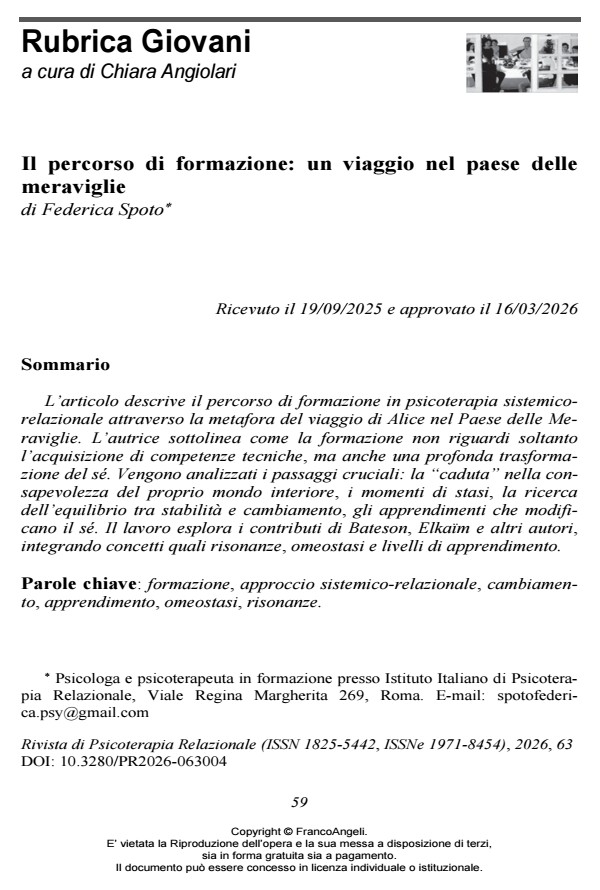
The article describes the training path in systemic-relational psychotherapy through the metaphor of Alice’s journey in Wonderland. The author emphasizes how training is not only about acquiring technical skills, but also about a profound transformation of the self. The crucial steps are analyzed: the “fall” into awareness of one’s inner world, moments of stasis, the search for balance between stability and change, the learning processes that modify the self. The paper explores the contributions of Bateson, Elkaïm and other authors, integrating concepts such as resonances, homeostasis and levels of learning.
Keywords: training, systemic-relational approach, change, learning, homeostasis, resonance.
- Alva M.H., Antony S.P., Kataria K. (2024). Exploring the Use of the Therapist’s Self in Therapy: A Systematic Review. Indian Journal of Psychological Medicine, 47: 17-24. DOI: 10.1177/0253717624125236
- Bateson G. (1972). Steps to an Ecology of Mind. Chandler Publishing Company (trad. it.: Verso un’ecologia della mente. Milano: Adelphi, 1976).
- Bateson G. (1979). Mind and Nature. New York: E.P. Dutton (trad. it.: Mente e natura. Milano: Adelphi, 1984).
- Bateson G., Bateson M.C. (1987). Angels Fear. New York: Macmillan (trad. it.: Dove gli angeli esitano. Milano: Adelphi, 1989).
- Bompiani G. (1993). L’orologio nel taschino. In: Tempora. Milano: Anabasi.
- Canevaro A., Ackermans A. (2013). La nascita di un terapeuta sistemico. Il lavoro diretto con le famiglie d’origine dei terapeuti in formazione. Roma: Borla.
- Cannon W.B. (1929). Organization for physiological homeostasis. Physiological Reviews, 9: 399-431.
- Carroll L. (1865). Alice’s Adventures in Wonderland. London: Macmillan (trad. it.: Alice nel paese delle meraviglie. Roma: Newton Compton, 2021).
- Carroll L. (1871). Through the Looking-Glass. London: Macmillan (trad. it.: Attraverso lo specchio. Roma: Newton Compton, 2021).
- Colombara A. (2022). Attraversare la paura. Caleidoscopio Relazionale, 12: 19-37.
- Dell P.F. (1982). Al di là dell’omeostasi: verso un concetto di coerenza. Terapia Familiare, 12: 85-113.
- Doglio M. (2002). Kairos, ovvero il tempo debito. Seminario nazionale del Circolo Bateson: Il tempo: variazioni sul tema, Roma, 1-2 giugno.
- Elkaïm M. (1992). Se mi ami, non amarmi: orientamento sistemico e psicoterapia. Torino: Bollati Boringhieri.
- Keeney B.P. (1985). L’estetica del cambiamento. Roma: Astrolabio.
- Loriedo C. (1978). Terapia relazionale. Le tecniche e i terapeuti. Roma: Astrolabio.
- Madonna G. (2002). Il tempo della metafora. Seminario nazionale del Circolo Bateson: Il tempo: variazioni sul tema, Roma, 1-2 giugno.
- Madonna G. (2003). La psicoterapia attraverso Bateson. Verso un’estetica della cura. Torino: Bollati Boringhieri.
- Mariotti G., Loriedo C., Saba G., Sluzki C., Stratton J. (2024). Evidenze e creatività in psicoterapia sistemica e relazionale. Milano: FrancoAngeli.
- Morin E. (1993). Introduzione al pensiero complesso. Milano: Sperling & Kupfer.
- Norcross J.C., Lambert M.J. (2019). Psychotherapy relationships that work. New York: Oxford University Press.
- Romano E., Chaltiel P., Destal D. (2010). I terapeuti anche hanno una famiglia. International Congress of EFTA, Parigi, 29-31 ottobre.
- Varela F.J. (1976). Not one, not two. CoEvolution Quarterly, 11: 62-67.
- Von Foerster H. (1987). Sistemi che osservano. Roma: Astrolabio.
- Watzlawick P., Beavin J.H., Jackson D.D. (1971). Pragmatica della comunicazione umana. Roma: Astrolabio.
- Wiener N. (1948). Cybernetics. Scientific American, 179: 14-19.
Federica Spoto, Il percorso di formazione: un viaggio nel paese delle meraviglie in "RIVISTA DI PSICOTERAPIA RELAZIONALE " 63/2026, pp 59-75, DOI: 10.3280/PR2026-063004