Climate crisis in the Italian newscasts and newspapers. A longitudinal analysis
Journal title SOCIOLOGIA DELLA COMUNICAZIONE
Author/s Mirella Marchese, Monia Azzalini
Publishing Year 2026 Issue 2026/71
Language Italian Pages 19 P. 27-45 File size 257 KB
DOI 10.3280/SC2026-071002
DOI is like a bar code for intellectual property: to have more infomation
click here
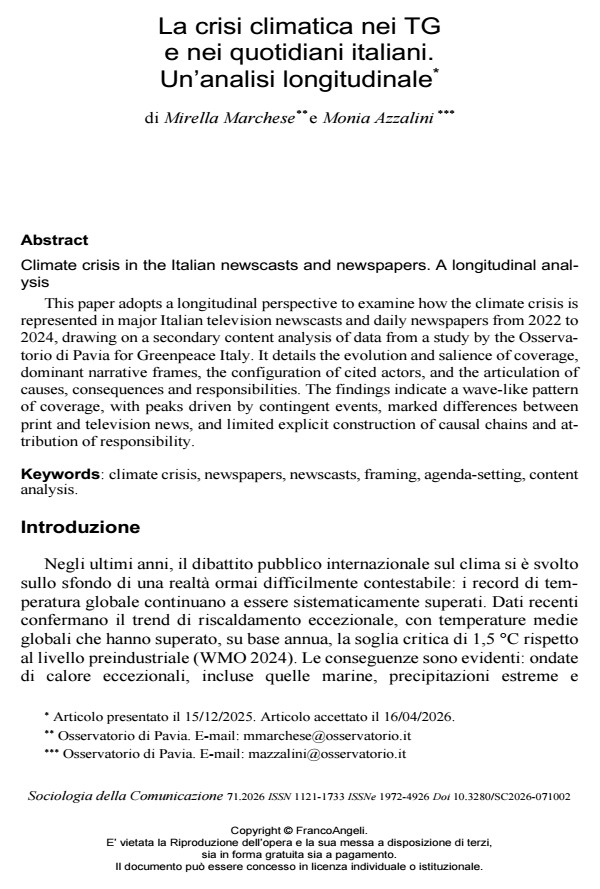
Below, you can see the article first page
If you want to buy this article in PDF format, you can do it, following the instructions to buy download credits
FrancoAngeli is member of Publishers International Linking Association, Inc (PILA), a not-for-profit association which run the CrossRef service enabling links to and from online scholarly content.
This paper adopts a longitudinal perspective to examine how the climate crisis is represented in major Italian television newscasts and daily newspapers from 2022 to 2024, drawing on a secondary content analysis of data from a study by the Osservatorio di Pavia for Greenpeace Italy. It details the evolution and salience of coverage, dominant narrative frames, the configuration of cited actors, and the articulation of causes, consequences and responsibilities. The findings indicate a wave-like pattern of coverage, with peaks driven by contingent events, marked differences between print and television news, and limited explicit construction of causal chains and attribution of responsibility.
Keywords: climate crisis, newspapers, newscasts, framing, agenda-setting, content analysis.
- Azzalini M., Marchese M. (a cura di) (2022), L’informazione sulla crisi climatica in Italia 2022 Rapporto di ricerca Osservatorio di Pavia per Greenpeace Italia, [online] testo disponibile in: https://www.greenpeace.org/static/planet4-italy-stateless/2023/04/3eac43b3-report-2022-linformazione-sulla-crisi-climatica-in-italia-odp-gp-def.pdf.
- Azzalini M., Marchese M. (a cura di) (2023), L’informazione sulla crisi climatica in Italia 2023 Rapporto di ricerca Osservatorio di Pavia per Greenpeace Italia, [online] testo disponibile in: https://www.osservatorio.it/wp-content/uploads/2016/07/GP_2023_Report_Annuale_Definitivo.pdf.
- Azzalini M., Marchese M. (a cura di) (2024), L’informazione sulla crisi climatica e la transizione ecologica in Italia Rapporto annuale dell’Osservatorio di Pavia per Greenpeace Italia Anno 2024, [online] testo disponibile in: https://www.osservatorio.it/wp-content/uploads/2016/07/OssPV_Report-media-e-clima_anno-2024.pdf.
- Baumgartner F.R., Jones B.D. (1993), Agendas and Instability in American Politics, University of Chicago Press, Chicago.
- Boydstun A.E. (2013), Making the News: Politics, Data, and Deviance in the Newsroom, University of Chicago Press, Chicago.
- Boykoff M.T. (2011), Who Speaks for the Climate? Making Sense of Media Coverage of Climate Change, Cambridge University Press, Cambridge.
- Boykoff M.T., Boykoff J.M. (2004), Balance as bias: global warming and the US prestige press, in «Global Environmental Change», 14(2), pp. 125–136.
- Boykoff M.T., Roberts J.T. (2007), Media Coverage of Climate Change: Current Trends, Channels, Progress, and Public Understanding. Human Development Report Office Occasional Paper, [online] testo disponibile in: https://hdr.undp.org/system/files/documents/boykoffmaxwellandrobertsjtimmons.pdf.
- Dearing J.W., Rogers E.M. (1996), Agenda-Setting, Sage, Thousand Oaks.
- Downs A. (1972), Up and down with ecology: The “issue-attention cycle”, in «The Public Interest», 28(1), pp. 38–50.
- Friedlingstein P., O’Sullivan M., Jones M.W. et al. (2025), Global Carbon Budget 2024, in «Earth System Science Data», 17(3), pp. 965-1039.
- Kellstedt P.M., Zahran S., Vedlitz A. (2008), Personal efficacy, the information environment, and attitudes toward global warming and climate change in the United States, in «Risk Analysis», 28(1), pp. 113–126.
- Krippendorff K. (2019), Content Analysis: An Introduction to Its Methodology, Sage, Thousand Oaks.
- Lamb W.F., Mattioli G., Levi S., Roberts J.T., Capstick S., Creutzig F., Minx J.C., Müller-Hansen F., Culhane T., Steinberger J.K. (2020), Discourses of climate delay, in «Global Sustainability», 3, e17.
- McCombs M.E., Shaw D.L. (1972), The agenda-setting function of mass media, in «Public Opinion Quarterly», 36(2), pp. 176–187. DOI: 10.1086/267990
- Nisbet M.C. (2009), Communicating Climate Change: Why Frames Matter for Public Engagement, in «Environment: Science and Policy for Sustainable Development», 51(2), pp. 12-23. DOI: 10.3200/ENVT.51.2.12-23
- Riffe D., Lacy S., Fico F. (2013), Analyzing Media Messages. Using Quantitative Content Analysis in Research, Routledge, New York.
- Sampei Y., Aoyagi-Usui M. (2009), Mass-media coverage, its influence on public awareness of climate-change issues, and implications for Japan’s national campaign to reduce greenhouse gas emissions, in «Global Environmental Change», 19(2), pp. 203-212.
- Treen K.M., Williams H.T., O’Neill S.J. (2020), Online misinformation about climate change, in «WIREs Climate Change», 11(5), e665.
- Trumbo C. (1996), Constructing climate change: claims and frames in US news coverage of an environmental issue, in «Public Understanding of Science», 5(3), pp. 269–283. DOI: 10.1088/0963-6625/5/3/006
- UNEP (2025), Emissions Gap Report 2025, United Nations Environment Programme, Nairobi.
- UNFCCC (2023), Outcome of the first global stocktake. Decision 1/CMA.5, United Nations Framework Convention on Climate Change, Bonn.
- WMO (2025), State of the Global Climate 2024, World Meteorological Organization, Geneva.
Mirella Marchese, Monia Azzalini, La crisi climatica nei TG e nei quotidiani italiani. Un’analisi longitudinale in "SOCIOLOGIA DELLA COMUNICAZIONE " 71/2026, pp 27-45, DOI: 10.3280/SC2026-071002