Bread and Wine “for the Household”: Direct Food Provisioning among Shoemakers, Blacksmiths, Dyers, and Cloth Finishers in Florence in 1427
Journal title SOCIETÀ E STORIA
Author/s Paolo Nanni
Publishing Year 2026 Issue 2026/193
Language Italian Pages 40 P. 407-446 File size 194 KB
DOI 10.3280/SS2026-193001
DOI is like a bar code for intellectual property: to have more infomation
click here
Below, you can see the article first page
If you want to buy this article in PDF format, you can do it, following the instructions to buy download credits
FrancoAngeli is member of Publishers International Linking Association, Inc (PILA), a not-for-profit association which run the CrossRef service enabling links to and from online scholarly content.
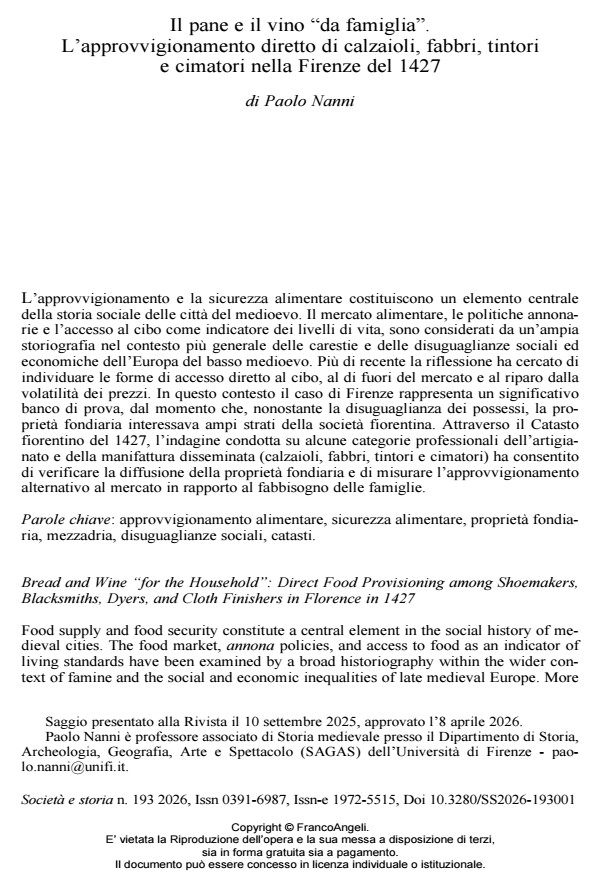
Food supply and food security constitute a central element in the social history of medieval cities. The food market, annona policies, and access to food as an indicator of living standards have been examined by a broad historiography within the wider context of famine and the social and economic inequalities of late medieval Europe. More recently, scholarship has sought to identify forms of direct access to food outside the market and sheltered from price volatility. In this context, the case of Florence provides a significant testing ground, since despite pronounced inequalities in wealth, landownership involved broad segments of Florentine society. Drawing on the Florentine Catasto of 1427, an investigation of selected occupational groups in artisanal production and dispersed manufacturing (shoemakers, blacksmiths, dyers, and cloth finishers) has made it possible to assess the diffusion of landownership and to measure nonmarket forms of food supply in relation to household needs.
Keywords: food provisioning, food security, landownership, sharecropping, social inequalities, cadastral records.
- Albini G. (2016), Poveri e povertà nel medioevo, Roma, Carocci.
- Bardet J.P. e Dupâquier J. (a cura di) (1997), Histoire des populations de l’Europe, I, Des origines aux prémices de la révolution démographique, Paris, Fayard.
- Benito i Monclus P. (2011), Famines sans frontières en Occident avant la conjoncture de 1300: à propos d’une enquête en cours, in Les disettes dans la conjoncture de 1300 en Méditerranée occidentale, a cura di M. Bourin, F. Menant, J. Drendel, Roma, École Française de Rome, pp. 4879.
- Benito i Monclús P. (2013), De Labrousse a Sen. Modelos de causalidad y paradigmas interpretativos de las crisis alimentarias preindustriales, in Crisis alimentaria en la Edad Media. Modelos, explicaciones y representaciones, a cura di P. Benito i Monclús, Lleida, Editorial Milenio, pp. 1532.
- Benito i Monclús P. (a cura di) (2013b), Crisis alimentaria en la Edad Media. Modelos, explicaciones y representaciones, Lleida, Editorial Milenio.
- Bezzina D. (2015), Artigiani a Genova nei secoli XIIXIII, Firenze, Florence University Press.
- Borghero F. e Tognetti S. (a cura di) (2024), Contadini e proprietari nelle grandi aziende agrarie toscane. Tardo Medioevo prima Età Moderna, Firenze, Olschki.
- Bourin M., Menant F. e Drendel J. (a cura di) (2011), Les disettes dans la conjoncture de 1300 en Méditerranée occidentale, Roma, École Française de Rome.
- Bourin M., Menant F. e To Figueras L., (a cura di) (2014), Dynamiques du monde rural dans la conjoncture de 1300, Roma, École Française de Rome.
- Camesasca G. (a cura di) (2021), «Poi che non vi posso vedere, faremo con lettera». Epistole di ser Lapo Mazzei a Francesco Datini (13901410), Roma, Istituto Storico Italiano per il Medioevo.
- Campbell B.M.S., Galloway J.A., Keene D. e Murphy M. (1993), A medieval capital and its grain supply: agrarian production and distribution in the London region c. 1300, London, Queen’s University of Belfast and the Centre for Metropolitan Research.
- Cardini F. (2025), Giovanni Cherubini nella medievistica fiorentina, in Giovanni Cherubini. Il profilo, gli studi, l’eredità intellettuale. Atti della Giornata di studio in memoria di Giovanni Cherubini (Firenze, 2 maggio 2022), a cura di P. Nanni e A. Zorzi, Firenze, Firenze University Press, pp. 2131.
- Carocci S. (2013), Il dibattito teorico sulla “Congiuntura del Trecento”, in «Archeologia Medievale», 43, pp. 1732.
- Cavaciocchi S. (a cura di) (1997), Alimentazione e nutrizione, secc. XIII–XVIII, Firenze, Le Monnier.
- Cherubini G. (1991), Scritti toscani. L’urbanesimo medievale e la mezzadria, Firenze, Salimbeni.
- Cherubini G. (1997), Artigiani e salariati nelle città italiane del tardo medioevo, in Id., Il lavoro, la taverna, la strada. Scorci di medioevo, Napoli, Liguori editore, pp. 3154.
- Cherubini G. (2012), L’approvvigionamento alimentare delle città toscane tra XII e XV secolo, in Id., Firenze e la Toscana. Scritti vari, Pisa, Pacini, pp. 3955.
- Cherubini G. (2021), Europa medievale: profilo geografico, demografico, agricolo e forestale del continente, in «Rivista di storia dell’agricoltura», 61, 1, pp. 524.
- Comba R. e Naso I. (a cura di) (1994), Demografia e società nell’Italia medievale, Cuneo, Società per gli Studi Storici della Provincia di Cuneo, 1994.
- Conti E. (1965), La formazione della struttura agraria moderna nel contado fiorentino, I, Le campagne dell’età precomunale, Roma, Istituto Storico Italiano per il Medioevo.
- Conti E. (1966), I catasti agrari della repubblica fiorentina e il catasto particellare toscano (secoli XIVXIX), Roma, Istituto Storico Italiano per il Medioevo.
- Conti E., Guidotti A. e Lunardi R. (1993), La civiltà fiorentina del Quattrocento, a cura di L. De Angelis, S. Raveggi, C. Piovanelli, P. Pirillo e F. Sznura, Firenze, Vallecchi.
- Cortonesi A. (2007), Soccide e altri affidamenti di bestiame nell’Italia medievale, in Contratti agrari e rapporti di lavoro nell’Europa medievale, a cura di A. Cortonesi, M. Montanari e A. Nelli, Bologna, Clueb, pp. 203223.
- Cortonesi A. (2023), Ruralità di una capitale. Paesaggi di coltivi e di acque nella Roma del tardo medioevo, in Paesaggi urbani e suburbani nella Roma dei secoli XIIIXVI, a cura di A. Cortonesi e S. Passigli, Roma, Roma nel Rinascimento, pp. 79134.
- Cristoferi D. (2020), “I nostri contadini solevano istare molto meglio per lo addrieto che ora”: mezzadria, proprietà cittadina e disuguaglianza economica in Toscana, sec. XVXVI, in Disuguaglianza economica nelle società preindustriali: cause ed effetti / Economic inequality in preindustrial societies: causes and effects, a cura di G. Nigro, Firenze, Firenze University Press, pp. 275299.
- Cristoferi D. (2025), Socioeconomic inequalities during the conjuncture of the fourteenth century: sources and methods, dynamics and representations (Italy and Europe, c. 1270c.1350). An outline, in Socioeconomic inequalities during the conjuncture of the fourteenth century: sources and methods, dynamics and representations (Italy and Europe, c. 1270c.1350). An outline, a cura di D. Cristoferi, Firenze, Firenze University Press, pp. 140.
- Cristoferi D. (a cura di) (2025b), SocioEconomic Inequalities during the Conjuncture of the Fourteenth Century. Sources and Methods, Dynamics and Representations (Italy and Europe, c. 1270 c. 1350), Firenze, Firenze University Press.
- Del Bo B.G.M. (2021), Allevamento dopo il “ribaltamento della congiuntura” fra prati irrigui e cereali. Il punto di vista della storiografia italiana sulla Lombardia e spunti comparativi, in «Rivista di storia dell’agricoltura», 41, 2, pp. 312.
- Dini B. (1984), I lavoratori dell’Arte della lana a Firenze nel XIV e XV secolo, in Artigiani e salariati. Il mondo del lavoro nell’Italia dei secoli XIIXV, Pistoia, Centro Italiano di Studi di Storia e d’Arte, pp. 2768.
- Epstein S.R. (2000), Freedom and Growth. The rise of states and markets in Europe, 13001750, LondonNew York, Routledge.
- Epstein S.R. (2002), Strutture di mercato, in Lo Stato territoriale fiorentino (secoli XIVXV). Ricerche, linguaggi, confronti, a cura di A. Zorzi e W.J. Connell, Pisa, Pacini, pp. 93134.
- Epstein S.R. (2006), I caratteri originali. L’economia, in L’Italia alla fine del medioevo: i caratteri originali nel quadro europeo, Vol. I, a cura di F. Salvestrini, Firenze, Firenze University Press, pp. 381431.
- Espeel S. e Geens S. (2020), Feeding inequalities: the role of economic inequalities and the urban market in late medieval food security. The case of fourteenthcentury Ghent, in Disuguaglianza economica nelle società preindustriali: cause ed effetti / Economic inequality in preindustrial societies: causes and effects, a cura di G. Nigro, Firenze, Firenze University Press, pp. 389428.
- Faugeron F. (2014), Nourrir la ville. Ravitaillement, marchés et métiers de l’alimentation à Venise dans les derniers siècle du Moyen Âge, Roma, École Française de Rome.
- Faugeron F. (a cura di) (2013), Capitolare degli Ufficiali al Formento (metà del sec. XIV), Roma, Viella.
- Feller L. (2025), Disuguaglianza, impoverimento e pauperismo nell’Occidente latino (secoli XIXIV), in Socioeconomic inequalities during the conjuncture of the fourteenth century: sources and methods, dynamics and representations (Italy and Europe, c. 1270c.1350). An outline, a cura di D. Cristoferi, Firenze, Firenze University Press, pp. 203222.
- Fiore A. e Poloni A. (2024), L’economia medievale. Un profilo storico (secoli VXV), Roma, Carocci
- Fochesato M. e Bettarini F. (2025), A new method of expanding the reconstruction of the occupational structure in Renaissance Florence: A preliminary investigation with insights into the economic impact of political and economic changes, in La mobilità sociale nelle società preindustriali: tendenze, cause ed effetti (secc. XIIIXVIII) / Social mobility in preindustrial societies: tendencies, causes and effects (13th18th centuries) a cura di A. Orlandi, Firenze, Firenze University Press, pp. 461475.
- Franceschi F. (1993), Oltre il «Tumulto». I lavoratori fiorentini dell’Arte della Lana fra Tre e Quattrocento, Firenze, Olschki.
- Franceschi F. (2012), «... e seremo tutti ricchi». Lavoro, mobilità sociale e conflitti nelle città dell’Italia medievale, Pisa, Pacini.
- Franceschi F. (2017a), Il mondo della produzione urbana: artigiani, salariati, corporazioni, in Storia del lavoro in Italia, II, Il medioevo. Dalla dipendenza personale al lavoro contrattato, a cura di F. Franceschi, Roma, Castelvecchi, pp. 364420.
- Franceschi F. (2017b), La crescita economica dell’Occidente medievale: un tema storico non ancora esaurito. Introduzione, in La crescita economica dell’Occidente medievale: un tema storico non ancora esaurito, Roma, Viella, pp. 124.
- Franceschi F. (2020), Forme di assistenza ai “poveri laboriosi” nell’Italia dei secoli XIV e XV, in Alle origini del welfare: radici medievali e moderne della cultura europea dell’assistenza, a cura di G. Piccinni, Roma, Viella, pp. 351375.
- Franceschi F. e Molà L., (2012), Regional States and economic development, in The Italian Renaissance State, a cura di A. Gamberini, I. Lazzarini, Cambridge, Cambridge University Press, pp. 444466.
- Franceschi F. e Taddei I. (2012), Le città italiane nel Medioevo. XIIXIV secolo, Bologna, il Mulino.
- FranklinLyons A. (2013), Modern Famine Theory and the Study of PreModern Famines, in Crisis alimentaria en la Edad Media. Modelos, explicaciones y representaciones, a cura di P. Benito i Monclús P., Lleida, Editorial Milenio, pp. 3345.
- Ginatempo M. e Sandri L. (1990), L’Italia delle città. Il popolamento urbano tra Medioevo e Rinascimento (secoli XIIIXVI), Firenze, Le Lettere.
- Goldthwaite R.A. (2013), L’economia della Firenze rinascimentale, Bologna, Il Mulino. Goodson C. (2021), Cultivating the City in Early Medieval Italy, Cambridge, Cambridge University Press.
- Grohmann A. (1981), Città e territorio tra medioevo ed età moderna (Perugia, secc. XIIIXVI), La città, Perugia, Volumnia, 1981.
- Harsch M. (2025), La teinture et les matières tinctoriales à la fin du Moyen Âge, Roma, Viella.
- Herlihy D. e KlapischZuber Ch. (1988), I toscani e le loro famiglie. Uno studio sul catasto fiorentino del 1427, Bologna, il Mulino.
- La Roncière Ch. M. de (1982), Prix et salaires à Florence au XIVe siècle (12801380), Roma, École Française de Rome.
- La Roncière Ch. M. de (2005), Firenze e le sue campagne nel Trecento. Mercanti, produzione, traffici, Firenze, Olschki.
- Lanconelli A. e Leggio T. (2015), Paesaggi urbani e spazi rurali dell’Italia centrale (Lazio, Umbria, Abruzzo, secc. XIIIXV), in I paesaggi agrari d’Europa (secoli XIIIXV), Roma, Viella, pp. 587625.
- Luongo A. (2022), La Peste Nera. Contagio, crisi e nuovi equilibri nell’Italia del Trecento, Roma, Carocci.
- Luongo A. e Nanni P. (2020), Prato, i Pratesi e gli enti assistenziali. Ricerche sugli Ospedali e sui Ceppi tra XIII e XV secolo, Pisa, Pacini.
- Magni S.G. (2015), Politica degli approvvigionamenti e controllo del commercio dei cereali nell’Italia dei comuni nel XIII e XIV secolo: alcune questioni preliminari, in «Mélanges de l’École française de Rome – Moyen Âge», 127, 1, pp. 121.
- Magni S.G. (2018), Agenti ed emissari nelle politiche per gli approvvigionamenti cerealicoli delle città comunali nel Trecento: i casi di Firenze e Pisa, in Políticas contra el hambre y la carestía en la Europa medieval, a cura di L. Palermo, A. Fara, P. Benito i Monclús, Lleida, Editorial Milenio, pp. 209218.
- Mazzei L. (1880), Le lettere di un notaro a un mercante del secolo XIV, a cura di C. Guasti, 2 voll., Firenze, Le Monnier.
- Melis F. (1962), Aspetti della vita economica medievale (studi nell’archivio Datini di Prato), Siena, Monte dei Paschi.
- Mucciarelli R., Piccinni G. e Pinto G. (a cura di) (2009), La costruzione del dominio cittadino sulle campagne. Italia centrosettentrionale, secoli XIIXIV, Siena, Protagon. Muzzi O. e Nenci M.D. (1988), Il contratto di mezzadria nella Toscana Medievale, II, Contado di Firenze, secolo XIII, Firenze, Olschki.
- Nanni P. (1992), Lorenzo agricoltore. Sulla proprietà fondiaria dei Medici nella seconda metà del Quattrocento, Firenze, Accademia dei Georgofili.
- Nanni P. (2010a), Ragionare tra mercanti. Per una rilettura della personalità di Francesco di Marco Datini (1335ca1410), Pisa, Pacini.
- Nanni P. (2010b), Agricoltura e agricoltori nelle terre di Francesco di Marco Datini (XIVXV secolo), in «Rivista di storia dell’agricoltura», 50, 2, pp. 333: 30
- Nanni P. (2012), Uomini nelle campagne pratesi. Francesco di Marco Datini e i lavoratori della terra, in Id., Uomini nelle campagne. Agricoltura ed economie rurali in Toscana (secoli (XIVXIX), Firenze, Le Lettere, pp. 1541.
- Nanni P. (2015), Spazi verdi urbani e campagne periurbane nell’Italia settentrionale e in Toscana, in I paesaggi agrari d’Europa (secoli XIIIXV), Roma, Viella, pp. 537585.
- Nanni P. (2022), Campagne dopo il 1348. Note sull’agricoltura italiana negli anni dopo la peste, in «Rivista di storia dell’agricoltura», 62, 1, pp. 522.
- Nanni P. (2024), Contadini su terre dei Medici. Mezzadria e allevamento nel Mugello (secolo XV), in Contadini e proprietari nelle grandi aziende agrarie toscane. Tardo Medioevo prima Età Moderna, a cura di F. Borghero e S. Tognetti, Firenze, Olschki, pp. 123152.
- Nigro G. (a cura di) (2010), Francesco di Marco Datini. L’uomo il mercante, Firenze, Firenze University Press.
- Nigro G. (a cura di) (2020), Disuguaglianza economica nelle società preindustriali: cause ed effetti / Economic inequality in preindustrial societies: causes and effects, Firenze, Firenze University Press.
- Palermo L. (2012), Scarsità di risorse e storia economica: il dibattito sulla carestia, in «Popolazione e Storia», 13, 1, pp. 5177.
- Palermo L. (2013), Di fronte alla crisi: l’economia e il linguaggio della carestia nelle fonti medievali, in Crisis alimentaria en la Edad Media. Modelos, explicaciones y representaciones, a cura di P. Benito i Monclús, Lleida, Editorial Milenio, pp. 4767. Palermo L. (2015), Il principio dell’entitlement approach di Sen e l’analisi delle carestie medievali, in «Moia la carestia». La scarsità alimentare in età preindustriale,
- a cura di M. Vaquero Piñeiro e M. L. Ferrari, Bologna, Il Mulino, pp. 2136.
- Palermo L. (2018), Politiche contro la carestia e ciclo economico in Europa tra XIII e XIV secolo, in Políticas contra el hambre y la carestía en la Europa medieval, a cura di L. Palermo, A. Fara, P. Benito i Monclús, Lleida, Editorial Milenio, pp. 1533.
- Palermo L. (2020), Agricoltura, pandemia e ciclo economico, in «Rivista di storia dell’agricoltura», 60, 2, pp. 1122.
- Palermo L. (2025), La specificità dell’agricoltura nelle analisi della crisi economica basso medievale, in «Rivista di storia dell’agricoltura», 65, 1, pp. 109120.
- Palermo L., Fara A., Benito i Monclús P. (a cura di) (2018), Políticas contra el hambre y la carestía en la Europa medieval, Lleida, Editorial Milenio.
- Pazzagli R. (2020), Una nuova centralità per le campagne. La storia dell’agricoltura di fronte alla pandemia, in «Rivista di storia dell’agricoltura», 60, 2, pp. 310.
- Piccinni G. (1982), «Seminare, fruttare, raccogliere». Mezzadri e salariati sulle terre di Monte Oliveto Maggiore (13741430), Milano, Feltrinelli.
- Piccinni G. (1992), Il contratto di mezzadria nella Toscana Medievale, III, Contado di Siena, 13491518, Firenze, Olschki
- Piccinni G. (2002), La proprietà della terra, i percettori dei prodotti e della rendita, in Storia dell’agricoltura italiana, II, Medioevo ed età moderna, a cura di G. Pinto, C. Poni e U. Tucci, Firenze, Accademia dei GeorgofiliPolistampa, pp. 145168.
- Piccinni G. (2017), All’apogeo: quale società? Uguaglianze e diseguaglianze nell’Italia medievale, in La crescita economica dell’Occidente medievale: un tema storico non ancora esaurito, Roma, Viella, pp. 383407.
- Piccinni G. (2018), Siena, il grano di Maremma e quello dell’ospedale. I provvedimenti economici del 1382, in Políticas contra el hambre y la carestía en la Europa medieval, a cura di L. Palermo, A. Fara, P. Benito i Monclús, Lleida, Editorial Milenio, pp. 219234.
- Piccinni G. (2020), Introduzione. I volti dell’iniziativa assistenziale, in Alle origini del welfare. Radici medievali e moderne della cultura europea dell’assistenza, a cura di G. Piccinni, Roma, Viella, pp. 1134.
- Piccinni G. (2025), Quando nessun “mestiere” è per sempre. Esempi di mobilità e trasmissione orizzontale del “saper fare” nel mondo contadino, «Rivista di storia dell’agricoltura», 65, 1, pp. 3558.
- Pinelli (2013), “Demo a’ poveri per rimosina per l’ampre di Dio”: effetti economici e sociali delle distribuzioni di pane e farina a Prato nel XIV secolo, in Assistenza e solidarietà in Europa. Secc. XIIIXVIII, a cura di F. Ammannati, Firenze, Firenze University Press, pp. 437.
- Pinto G. (1974), Il Libro del Biadaiolo. Carestie e annona a Firenze dalla metà del ’200 al 1348, Firenze, Olschki.
- Pinto G. (1996a), Dalla tarda antichità alla metà del XVI secolo, in L. Del Panta, M. Livi Bacci, G. Pinto e E. Sonnino, La popolazione italiana dal Medioevo a oggi, RomaBari, Laterza, pp. 1571.
- Pinto G. (1996b), L’annona: aspetti e problemi dell’approvvigionamento urbano fra XIII e XV secolo, in Id., Città e spazi economici nell’Italia comunale, Bologna, Clueb, pp. 7796.
- Pinto G. (2002), Campagne e paesaggi toscani del Medioevo, Firenze, Nardini.
- Pinto G. (2008a), Alimentazione e livelli di vita. Considerazioni sulle fonti documentarie, in Id., Il lavoro, la povertà, l’assistenza, Roma, Viella, pp. 7192.
- Pinto G. (2008b), Le città italiane di fronte alle grandi carestie trecentesche: percezione della risi e politiche annonarie, in Id., Il lavoro, la povertà, l’assistenza, Roma, Viella, pp. 147161.
- Pinto G. (2008c), Approvvigionamento e mercato dei prodotti alimentari (secolo XIV), in Id., Il lavoro, la povertà, l’assistenza, Roma, Viella, pp. 5977.
- Pinto G. (2012), L’allevamento del bestiame in Toscana (secoli XIIIXV), in Uomini, paesaggi, storie. Studi di storia medievale per Giovanni Cherubini, a cura di D. Balestracci, A. Barlucchi, F. Franceschi, P. Nanni, G. Piccinni e A. Zorzi, Siena, Salvietti&Barabuffi, vol. I, pp. 467488.
- Pinto G. (2016), Approvvigionamento e mercato dei prodotti alimentari, in Id., Firenze medievale e dintorni, Roma, Viella, pp. 5977.
- Pinto G. (2018), “Ut in civitate copia victualium habeatur”. Le città, i territori, le produzioni agricole (Italia, secoli XIIIXV), in Políticas contra el hambre y la carestía en la Europa medieval, a cura di L. Palermo, A. Fara, P. Benito i Monclús, Lleida, Editorial Milenio, pp. 193207.
- Pinto G. (2024), «La fatica dei contadini» e la costruzione del ‘bel paesaggio toscano’ (secoli XIVXVI), in Contadini e comunità. Costruzione e difesa del territorio (secoli XIIIXVIII), a cura di F. Cazzola, M. Provasi, R. Rinaldi, Bologna, Clueb, pp. 113129.
- Pinto G. e Pirillo P. (1987), Il contratto di mezzadria nella Toscana Medievale, I, Contado di Siena. Sec. XIII1348, Firenze, Olschki
- Pirillo P. (2015), Forme e strutture del popolamento nel contado fiorentino, III, Gli insediamenti al tempo del primo catasto (14271429), Firenze, Olschki.
- Pucci Donati F. (2015), Cereali e pane sul mercato urbano nel medioevo, in La civiltà del pane. Storia, tecniche e simboli dal Mediterraneo all’Atlantico, Spoleto, Centro Italiano di Studi sull’Alto Medioevo, pp. 117129.
- Pucci Donati F. (2025), Approvvigionamento cerealicolo alla città: Bologna sotto la signoria di Taddeo Pepoli, in «Rivista di storia dell’agricoltura», 65, 1, pp. 95107. Riera i Melis A. (a cura di) (2013), Crisis frumentàries, iniciatives privades i polítiques públiques de proveïment a les ciutats catalanes durant la baixa edat mitjana, Barcelona, Institut d’Estudis Catalans. Barcelona, Institut d’Estudis Catalans.
- Rombai L. (2002), Clima, suolo, ambiente, in Storia dell’agricoltura italiana, I, L’età antica, 1, Preistoria, a cura di G. Forni e A. Marcone, Firenze, Accademia dei GeorgofiliPolistampa, pp. XVIILXIV.
- Sen A.K. (1981), Poverty and Famines: an Essay on Entitlement and Deprivation, Oxford, Clarendon Press.
- Soens T. (2019), Urban Agriculture and Urban Food Provisioning in Pre1850 Europe: Towards a Research Agenda, in «Jahrbuch fu¨r Geschichte des ländlichen Raumes», 16, pp. 1328.
- Soens T. e Bruyet C. (2024), Alternative food supplies, alternative currencies? Food deliveries by tenant farmers in the Late Medieval Low Countries, in Mezzi di scambio non monetari. Merci e servizi come monete alternative nelle economie dei secoli XIIIXVIII / Alternative currencies. Commodities and services as exchange currencies in the monetarized economies of the 13th to 18th centuries, a cura di A. Orlandi, Firenze, Firenze University Press, pp. 475504.
- Stefani M. (2008), Cronaca fiorentina, a cura di N. Rodolico, Reggello, FirenzeLibri (ried. anast. da “Rerum Italicarum Scriptores”, 30).
- Tanzini L. (2023), La redazione statutaria del 1355: fonti, novità questioni, in Gli Statuti della Repubblica fiorentina del 1355 in volgare, I, Statuto del Podestà, a cura di F. Bambi, F. Salvestrini e L. Tanzini, Firenze, Olschki, pp. 79107.
- Thoen E. e van Cruyningen P. (a cura di) (2012), Food Supply, Demand and Trade. Aspects of the Economic Relationship between Town and Countryside (Middle Ages – 19th Century), Turnhout, Brepols.
- Tognetti S. (1995), Prezzi e salari nella Firenze tardomedievale: un profilo, in «Archivio Storico Italiano», 153, 2, pp. 263333.
- Villani G. (19901991), Nuova cronica, a cura di G. Porta, Parma, Guanda
Paolo Nanni, Il pane e il vino “da famiglia”. L’approvvigionamento diretto di calzaioli, fabbri, tintori e cimatori nella Firenze del 1427 in "SOCIETÀ E STORIA " 193/2026, pp 407-446, DOI: 10.3280/SS2026-193001