Donne, imprese e professioni in una prospettiva storica: il contributo degli studi di accounting e management
Journal title IMPRESE E STORIA
Author/s Francesca Picciaia
Publishing Year 2026 Issue 2024/50
Language Italian Pages 12 P. 144-155 File size 126 KB
DOI 10.3280/ISTO2024-050008
DOI is like a bar code for intellectual property: to have more infomation
click here
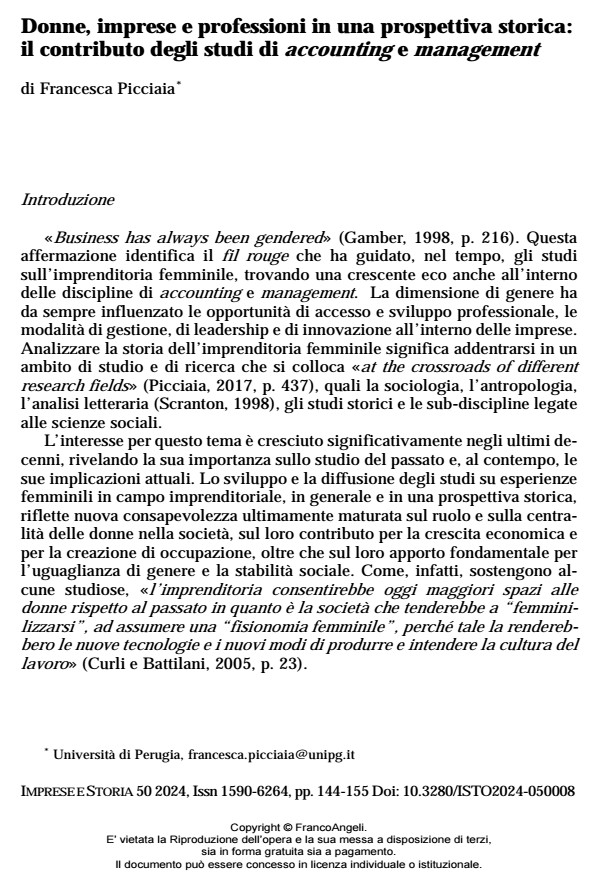
Below, you can see the article first page
If you want to buy this article in PDF format, you can do it, following the instructions to buy download credits
FrancoAngeli is member of Publishers International Linking Association, Inc (PILA), a not-for-profit association which run the CrossRef service enabling links to and from online scholarly content.
- Aston, J. (2016). Female entrepreneurship in nineteenth-century England. Springer.
- Aston, J., and Bishop, C. (2020). Female entrepreneurs in the long nineteenth century: A global perspective. Palgrave Macmillan.
- Beachy, R. (2006). Profit and propriety: Sophie Henschel and gender management in the German locomotive industry. Women, Business and Finance in Nineteenth-Century Europe: Rethinking Separate Spheres. Berg Publishers.
- Benenati, E. (1999), Cento anni di paternalismo aziendale, in Musso, S., a cura di, Tra fabbrica e società. Mondi operai nell’Italia del Novecento, Feltrinelli, Milano.
- Bennett, R.J., Smith, H., Lieshout, C. van, Montebruno, P., and Newton, G. (2021). The age of entrepreneurship: Business proprietors, self-employment and corporations since 1851. Routledge.
- Bowden, B. (2016). Editorial and note on the writing of management history. Journal of Management History, 22(2): 118-129.
- Broadbent, J. (1998), The gendered nature of ‘accounting logic’: Pointers to an accounting that encompasses multiple values. Critical Perspectives on Accounting, 9(3): 267-297.
- Carrera, N., Gutiérrez, I., and Carmona, S. (2001). Gender, the state and the audit profession: Evidence from Spain. European Accounting Review, 10(4): 803-815.
- Castagnoli, A. (2007). The female entrepreneur’s point of view and the Italian economy. Business and Economic History On Line, 5: 1-17.
- Castagnoli, A. (2013). L’imprenditoria femminile nell’Italia unita. Enciclopedia Italiana Treccani, 8: 401-416.
- Clark, J.P. (2013). Pomeroy v. Pomeroy: Beauty, modernity, and the female entrepreneur in fin-de-siècle London. Women’s History Review, 22(6): 877-903.
- Craig, B. (2016). Women and business since 1500: Invisible presences in Europe and North America? Palgrave Macmillan.
- Curli, B. (2002). Women entrepreneurs and Italian industrialization: Conjectures and avenues for research. Enterprise & Society, 3(4): 634-656.
- Curli, B., e Battilani, P. (2005). Donne imprenditrici nella storia dell’Umbria: Ipotesi e percorsi di ricerca. FrancoAngeli.
- De Bruin, A., Brush, C.G., and Welter, F. (2007). Advancing a framework for coherent research on women’s entrepreneurship. Entrepreneurship Theory and Practice, 31(3): 323-339.
- Doe, H. (2017). Gender and business. Women in business or businesswomen? An assessment of the history of entrepreneurial women. The Routledge Companion to Business History. Routledge.
- Du Rietz, A., and Henrekson, M. (2000). Testing the female underperformance hypothesis. Small Business Economics, 14: 1-10.
- Emery, M., Hooks, J., and Stewart, R. (2002). Born at the wrong time? An oral history of women professional accountants in New Zealand. Accounting History, 7(2): 7-34.
- Fillis, I. (2006), A biographical approach to researching entrepreneurship in the smaller firm. Management Decision, 44(2): 198-212.
- Francois, M. (2020). ‘Se mantiene de lavar’: The laundry business in Eighteenth- and Nineteenth-Century Mexico City. in J. Aston & C. Bishop (eds.), Female Entrepreneurs in the Long Nineteenth Century. Springer International Publishing.
- Froggett, L., and Chamberlayne, P. (2004). Narratives of social enterprise: From biography to practice and policy critique. Qualitative Social Work, 3(1),:61-77.
- Gamber, W. (1997). The female economy: The millinery and dressmaking trades, 1860-1930. University of Illinois Press.
- Gamber, W. (1998). A gendered enterprise: Placing Nineteenth-Century businesswomen in history. The Business History Review, 72(2): 188–217.
- Grant Thornton (2025), Women in business, Grant Thornton International Ltd.
- Hammond, T. (2003). History from accounting’s margins: International research on race and gender. Accounting History, 8(1): 9-24.
- Haynes, K. (2017). Accounting as gendering and gendered: A review of 25 years of critical accounting research on gender. Critical Perspectives on Accounting, 43,:110-124.
- Heilman, M. E. (1983). Sex bias in work settings: The lack of fit model. Research in Organizational Behavior, 5: 269-298.
- Ikin, C., Johns, L., and Hayes, C. (2012). Field, capital and habitus: An oral history of women in accounting in Australia during World War II. Accounting History, 17(2): 175-192.
- Kay, A.C. (2009). The foundations of female entrepreneurship: Enterprise, home and household in London, c. 1800 - 1870. Routledge.
- Kirkham, L.M., and Loft, A. (1993). Gender and the construction of the professional accountant. Accounting, Organizations and Society, 18(6): 507-558.
- Koellinger, P., Minniti, M., and Schade, C. (2013). Gender differences in entrepreneurial propensity. Oxford Bulletin of Economics and Statistics, 75(2): 213-234.
- Komori, N. (2007). The “hidden” history of accounting in Japan: A historical examination of the relationship between Japanese women and accounting. Accounting History, 12(3): 329-58.
- Langowitz, N., and Minniti, M. (2007). The entrepreneurial propensity of women. Entrepreneurship Theory and Practice, 31(3): 341-364.
- Lehman, C.R. (1992). “Herstory” in accounting: The first eighty years. Accounting, Organizations and Society, 17(3-4): 261-285.
- Lehman, C.R. (2012), We’ve come a long way! Maybe! Re-imagining gender and accounting, Accounting, Auditing & Accountability Journal, 25(2): 256-294.
- Lewis, S.I. (2009). Unexceptional women: Female proprietors in mid-nineteenth-century Albany, New York, 1830-1885. Ohio State University Press.
- Mary George, N., Parida, V., Lahti, T., and Wincent, J. (2016). A systematic literature review of entrepreneurial opportunity recognition: Insights on influencing factors. International Entrepreneurship and Management Journal, 12(2): 309-350.
- Muñoz, L.G., and Pérez, P.F. (2007). Female entrepreneurship in Spain during the Nineteenth and Twentieth centuries. The Business History Review, 81(3): 495-515.
- Parker, L.D. (2008). Strategic management and accounting processes: Acknowledging gender. Accounting, Auditing & Accountability Journal, 21(4): 611-631.
- Phillips, N. (2006). Women in business, 1700-1850. Boydell Press.
- Phipps, S.T.A. (2011). Mary, Mary, quite contrary: In a male-dominated field, women contributed by bringing a touch of spirituality to early management theory and practice. Journal of Management History, 17(3): 270–-81.
- Picciaia, F. (2017). “In spite of everything?” Female entrepreneurship from a historical perspective: The Italian businesswoman Luisa Spagnoli (1877-1935). Journal of Management History, 23(4): 436-451.
- Picciaia, F., Terzani, S., and Mari, L.M. (2023). The role of networks for women’s empowerment. The case of Industrie Femminili Italiane at the beginning of 20th century. Journal of Management History, 30(4): 595-614.
- Plitt, J.R. (2019). Martha Matilda Harper and the American dream: How one woman changed the face of modern business, Jade Publishing.
- Rico-Bonilla, C.O. (2020). Making women visible in the (accounting) history of Colombia. Accounting History Review, 30(2): 207-232.
- Schachter, H.L. (2022). Race, class, gender and social entrepreneurship: Extending the positionality of icons. Journal of Management History, 28(4): 476-490.
- Scranton, P. (1998). Introduction: Gender and business History. The Business History Review, 72(2): 185-187.
- Shinnar, R.S., Giacomin, O., and Janssen, F. (2012). Entrepreneurial perceptions and intentions: The role of gender and culture. Entrepreneurship Theory and Practice, 36(3): 465-493.
- Sparks, E. (2006). Capital intentions: Female proprietors in San Francisco, 1850-1920. University of North Carolina Press.
- Sparks, E. (2017). Boss Lady. How three women entrepreneurs built successful big businesses in the mid-twentieth century, University of North Carolina Press
- Spruill, W.G., and Wootton, C.W. (1995). The struggle of women in accounting: The case of Jennie Palen, pioneer accountant, historian and poet. Critical Perspectives on Accounting, 6(4): 371-389.
- Ul'janova, G.N. (2016). Female entrepreneurs in nineteenth-century Russia. Routledge.
- Vickery, A. (1993). Golden age to separate spheres? A review of the Cctegories and chronology of English women’s history. The Historical Journal, 36(2): 83-414.
- Virtanen, A. (2009). Accounting, gender and history: The life of Minna Canth. Accounting History, 14(1-2): 79-100.
- Walker, S.P. (1998). How to secure your husband’s esteem. Accounting and private patriarchy in the British middle class household during the Nineteenth century. Accounting, Organizations and Society, 23(5): 485-514.
- Walker, S.P. (2003). Professionalization or incarceration? Household engineering, accounting and the domestic ideal. Accounting, Organizations and Society, 28(7-8): 743-772.
- Walker, S.P. (2008). Accounting histories of women: Beyond recovery? Accounting, Auditing & Accountability Journal, 21(4): 580-610.
- Welter, F., and Smallbone, D. (2010). The embeddedness of women’s entrepreneurship in a transition context. in C. Brush, A. De Bruin, E. Gatewood, and C. Henry, Women entrepreneurs and the global environment for growth. Edward Elgar Publishing.
- Wootton, C.W., & Spruill, W.G. (1994). The role of women in major public accounting firms in the United States during World War II. Business and Economic History, 23(1): 241-252.
- World Economic Forum (2024), Global Gender Gap 2024. World Economic Forum.
Francesca Picciaia, Donne, imprese e professioni in una prospettiva storica: il contributo degli studi di accounting e management in "IMPRESE E STORIA" 50/2024, pp 144-155, DOI: 10.3280/ISTO2024-050008