Prospettive di genere nella storia economica quantitativa in Italia
Journal title IMPRESE E STORIA
Author/s Giuliana Freschi, Giacomo Gabbuti, Giulia Mancini
Publishing Year 2026 Issue 2024/50
Language Italian Pages 15 P. 174-188 File size 153 KB
DOI 10.3280/ISTO2024-050011
DOI is like a bar code for intellectual property: to have more infomation
click here
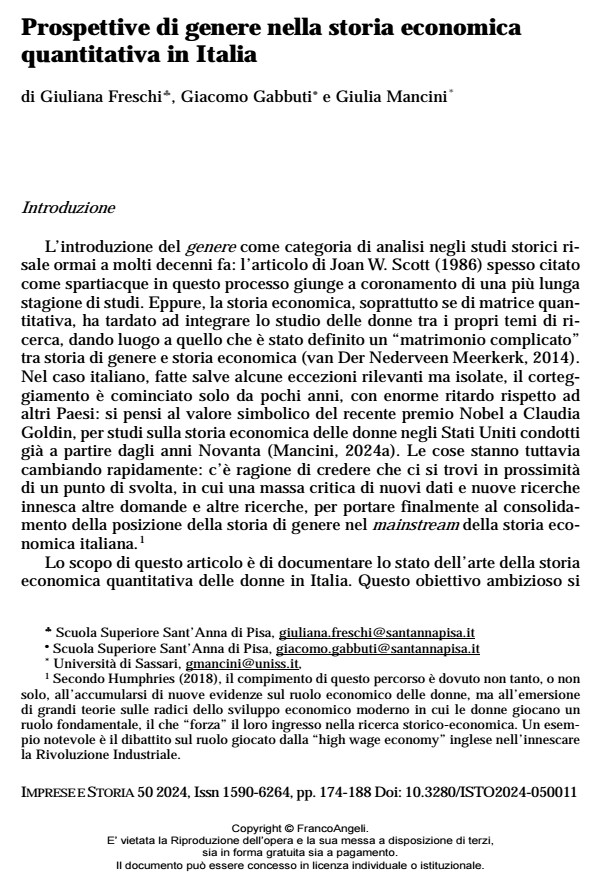
Below, you can see the article first page
If you want to buy this article in PDF format, you can do it, following the instructions to buy download credits
FrancoAngeli is member of Publishers International Linking Association, Inc (PILA), a not-for-profit association which run the CrossRef service enabling links to and from online scholarly content.
- A’Hearn, B., Mancini, G., e Vecchi, G. (a cura di) (mimeo) La tassa di famiglia e la vulnerabilità economica delle famiglie italiane.
- Barbiellini Amidei, F., Di Addario, S., Gomellini, M., e Piselli, P. (2023), Female labour force participation and fertility in Italian history, Centro Studi Lucca D’Agliano Development Studies Working papers, 484.
- Beltrán-Tapia, F., Cappelli, G. (2024), Missing girls in liberal Italy, 1861-1921, Economic History Review, 77(1), pp. 185–211.
- Bettio, F. (1985), The unremoved constraint: Job sex-typing and female participation 1880-1980, Studi Economici, 4(27).
- Bettio, F. (1988), The sexual division of labour: The Italian case. Clarendon Press, Oxford.
- Bettio, F. (2015), Ad un passo dalla parità? Mezzo secolo di differenziali salariali di genere, in S. Musso (Ed.), Storia del lavoro in Italia. Il Novecento, 2, pp. 232-253. Castelvecchi.
- Brea-Martinez, G. (2023), Materfamilias: the association of mother’s work on children’s absolute income mobility, Southern Sweden (1947–2015), European Review of Economic History, 27(1), pp. 1-23.
- Chiaiese, D., e Ciriotto, V. (2025), Italy in wide-angle: Workforce, emigration, population and GDP at the provincial level in Republican Italy (1951-1991), Rivista di Storia Economica / Italian Review of Economic History, Early Access, DOI: 10.1410/116410
- Chiaiese, D., Ciriotto, V. (2025), Nurturing the career. The impact of nursery schools on female labor participation in contemporary Italy. Evidence from Italy (1952-1991), mimeo.
- Daniele, V., and Malanima, P. (2011), Il divario nord-sud in Italia, 1861-2011, Rubbettino Editore.
- Delabastita, V., e Buyst, E. (2021), Intergenerational mobility of sons and daughters: evidence from nineteenth-century West Flanders, European Review of Economic History, 25(2), pp. 300-327.
- Di Addario, S., Gomellini, M., e Pinna, G. (2025), The Heritage of WWII on Women's Work: The Italian Case. Banca d’Italia, mimeo.
- Dribe, M., Eriksson, B., e Scalone, F. (2019), Migration, marriage and social mobility: Women in Sweden 1880–1900, Explorations in Economic History, 71, pp. 93-111.
- Espín-Sánchez, J. A., Gil-Guirado, S., e Vickers, C. (2022), La “Doña” è Mobile: The role of women in social mobility in a pre-modern economy, The Journal of Economic History, 82(1), pp. 1-41.
- Federico, G., Nuvolari, A., Ridolfi, L., Vasta, M. (2021), The race between the snail and the tortoise: Skill premium and early industrialization in Italy (1861-1913), Cliometrica, 15(1), pp. 1-42.
- Felice, E. (2005), Il valore aggiunto regionale. Una stima per il 1891 e per il 1911 e alcune elaborazioni di lungo periodo (1891-1971), Rivista Di Storia Economica, 21(3), pp. 273-314.
- Fenoaltea, S. (2003), Peeking Backward: Regional Aspects of Industrial Growth in Post-Unification Italy, Journal of Economic History, 63 (4), pp. 1059–1102.
- Freschi, G. (2023), A social elevator? Occupational mobility in Italy, 1950-1970, Rivista di Storia Economica, 39(2), pp. 131-62.
- Freschi, G. (2024), From the edge to the heart: Female employment in 19th-century Italy, in M. Mosca (Ed.), Women at Work in Italy (1750-1950), Their Economic Thought and Actions (Springer, 2024), pp. 73-97.
- Freschi, G., e Martínez, M. (2023), Intergenerational mobility in 19th-century Italy: A case study approach, Rivista di Storia Economica / Italian Review of Economic History, 1(34), pp. 1-34.
- Freschi, Beltrán Tapia, e Cappelli (2025), “Why did girls go missing? Determinants of missing girls in the Italian circondari, 1881-1911”, mimeo.
- Freschi, G., e Virgillito M.E. (2025), Early evidence of paid work in social reproduction: Wetnurses’ wages in Florence, 1632-1914, mimeo.
- Gabbuti, G. (2022), Those Who Were Better Off: Capital and Top Incomes in Fascist Italy, LEM Working Paper Series 2022/31.
- Gabbuti, G. (2023), Fiscal Sources and the Distribution of Income in Italy: The Italian Historical Taxpayers’ Database, Annals of the Fondazione Luigi Einaudi, 57 (1), pp. 107-150.
- Gabbuti, G., e Gòmez Leòn, M. (2024), Incomes and employment of Italian women, 1900-1950, in M. Mosca (Ed.), Women at Work in Italy (1750-1950), Their Economic Thought and Actions, Springer, 2024, pp. 131-55.
- Gabbuti, G., e Rappa, E. (2025), A Golden Age for All? Income Inequality and Social Classes in Italy, 1950–1973, mimeo.
- Goldin, C. (1990), Understanding the gender gap: an economic history of American women, New York: Oxford University Press.
- Goldin, C. (1995a), Cliometrics and the Nobel, Journal of Economic Perspectives, 9(2), pp. 191-208.
- Goldin, C. (1995b), The U-shaped female labor force function in economic development and economic history., in T.P. Schultz (Ed.), Investment in Women’s Human Capital and Economic Development, University of Chicago Press, Chicago, pp. 61-90.
- Goldin, C., e Olivetti, C. (2013), Shocking labor supply: A reassessment of the role of World War II on women's labor supply, American Economic Review, 103(3), pp. 257-262.
- Humphries, J. (2018), Women and children, in M. Blum, and C.L. Colvin (Eds.), An Economist’s Guide to Economic History, Palgrave Macmillan, London.
- Humphries, J. (2024), Careworn: the economic history of caring labor. The Journal of Economic History, 84(2), pp. 319-351.
- Humphries, J., e Sarasua, C. (2012). Off the Record: Reconstructing Women’s Labor Force Participation in the European Past, Feminist Economics, 18(4), pp. 39-67.
- Horrell, S., Humphries, J., e Weisdorf, J. (2022), Beyond the male breadwinner: Life-cycle living standards of intact and disrupted English working families, 1260–1850, The Economic History Review, 75(2), pp. 530 - 560.
- Humphries, J., e Weisdorf, J. (2019), Unreal wages? Real income and economic growth in England, 1260–1850, The Economic Journal, 129(623), pp. 2867-2887.
- Licini, S. (2020), Women, Business, and Finance in 19th Century Milan, Journal of Modern Accounting and Auditing, 16 (3), pp. 117-129
- Livi, R. (1897), Dello Sviluppo del Corpo (Statura e Perimetro Toracico) in Rapporto colle Professioni e colla Condizione Sociale, Roma.
- Mancini, G. (2018), Women’s labor force participation in Italy, 1861-2011, Rivista di Storia Economica, 34(1), pp. 3-68.
- Mancini, G. (2022), One hundred sixty years of gender inequality in Italy: A research agenda, Economia & Lavoro, Rivista di politica sindacale, sociologia e relazioni industriali, 2, pp. 65-80.
- Mancini, G. (2023), Gender discrimination and intra-household inequality in rural Italy, 1920s-1930s, Rivista di Storia Economica / Italian Review of Economic History, 39(3), pp. 265-286.
- Mancini, G. (2024a). Women, economic history, and the Nobel. Rivista di storia economica / Italian Review of Economic History, 40(1), pp. 115-124.
- Mancini, G. (2024b), Breadwinner, Bread Maker: The Gender Division of Labour in 1930s Rural Italy. European Review of Economic History, 28(1), pp. 51–66.
- Montessori, M. (1906), Caratteri Fisici delle Giovani Donne del Lazio, Atti della Società Romana di Antropologia, XII, pp. 37-120.
- Neef, T., e Robilliard, A-S. (2021), Half the sky? The Female Labor Income Share in a Global Perspective, World Inequality Lab Working Paper, 22.
- Olivetti, C., e Paserman, M. D. (2015), In the name of the son (and the daughter): Intergenerational mobility in the United States, 1850–1940, American Economic Review, 105(8), pp. 2695-2724.
- Panizza, P., Colombo, F., e Cozzani, M. (2025), The Great War and Female Labor Force Participation: Evidence from Italy, mimeo.
- Pescarolo, A. (2019), Il lavoro delle donne nell’Italia contemporanea, Viella, Roma.
- Pittaluga, R. (1913) Sull’accrescimento della statura nelle fanciulle mantovane, Atti della Società Romana di Antropologia, XVIII, pp. 439-433.
- Pittaluga, R. (1909). Studio antropometrico sulle donne della Lucchesia, Atti della Società Romana di Antropologia, XV, pp. 15-34.
- Pinnelli, Antonella, and Paola Mancini (1997), Gender mortality differences from birth to puberty in Italy 1887-1940, In C. Corsini and P. Viazzo (eds.), The decline of infant and child mortality. The European experience: 1750-1990, The Hague, Martinus Nijhoff Publishers, pp. 73-93.
- Raseri, E. (1879), Materiali per l’etnologia italiana, Annali di Statistica, 2.8, pp. 3-4.
- Ridolfi, L. (2023), Gender inequality in a transition economy: heights and sexual height dimorphism in Southwestern France, 1640-1850, Cliometrica, 18(1), pp. 37-102.
- Scott, J. W. (1986), Gender: A useful category of historical analysis, The American Historical Review 91(5), pp. 1053-1075.
- Schneider, E.B. (2016), Health, Gender and the Household: Children’s Growth in the Marcella Street Home, Boston, MA, and the Ashford School, London, UK, Research in Economic History, 32, pp. 277–361.
- Schneider, E.B. (2023), The Effect of Nutritional Status on Historical Infectious Disease Morbidity: Evidence from the London Foundling Hospital, 1892-1919, The History of the Family, 28 (2), pp. 198–228.
- van Nederveen Meerkerk, E. (2014). Gender and Economic History. The Story of a Complicated Marriage. TSEG - The Low Countries Journal of Social and Economic History, 11(2), 175-198.
- Waldenström, D. (2024), Richer and More Equal. A New History of Wealth in the West, Polity.
- Zamagni, V. (1987), A Century of Change: Trends in the Composition in the Italian Labour Force, 1881-1981, Historical Social Research 12(4), pp. 36-97
Giuliana Freschi, Giacomo Gabbuti, Giulia Mancini, Prospettive di genere nella storia economica quantitativa in Italia in "IMPRESE E STORIA" 50/2024, pp 174-188, DOI: 10.3280/ISTO2024-050011