Donne, genere e lavoro tra età moderna e prima industrializzazione: dibattito e prospettive
Journal title IMPRESE E STORIA
Author/s Cinzia Lorandini
Publishing Year 2026 Issue 2024/50
Language Italian Pages 14 P. 189-202 File size 103 KB
DOI 10.3280/ISTO2024-050012
DOI is like a bar code for intellectual property: to have more infomation
click here
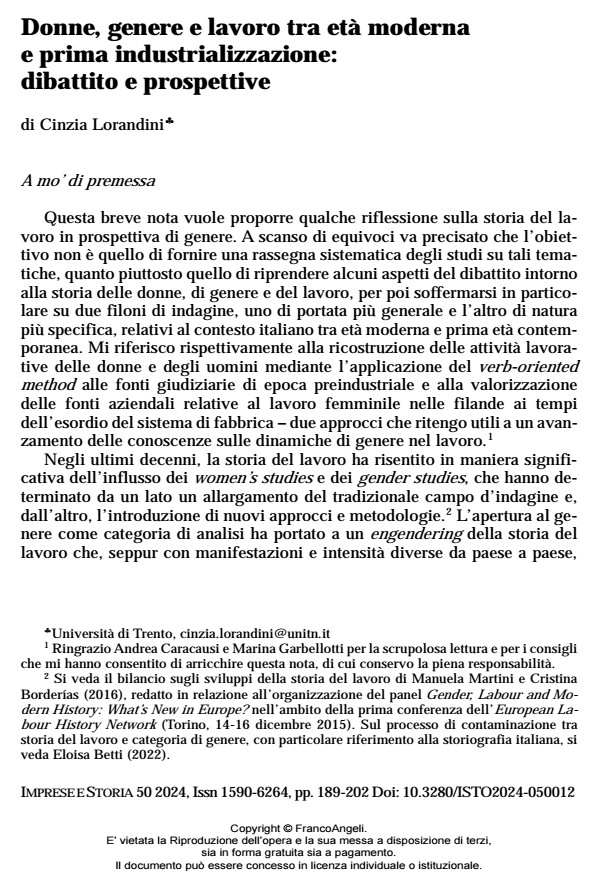
Below, you can see the article first page
If you want to buy this article in PDF format, you can do it, following the instructions to buy download credits
FrancoAngeli is member of Publishers International Linking Association, Inc (PILA), a not-for-profit association which run the CrossRef service enabling links to and from online scholarly content.
- Ågren M., editor (2017). Making a Living, Making a Difference: Gender and Work in Early Modern European Society. New York: Oxford University Press.
- Bellavitis A. (2016). Il lavoro delle donne nelle città dell’Europa moderna (Storia delle donne e di genere). Roma: Viella.
- Betti E. (2022). I gender labour studies tra contesto italiano e dimensione internazionale. Proposte e ricerche. Economia e società nella storia dell’Italia centrale, 45, 88: pp. 93-104. DOI: 10.48219/PR_0392179488_006
- Bettio F. (1988). The Sexual Division of Labour: The Italian Case. Oxford: Clarendon Press.
- Bof F. (2017). Sericoltura e setificio in Italia tra Otto e Novecento: una rassegna bibliografica. Storia economica, 2: 649-671.
- Borderías C. e Martini M. (2016). Introduzione. Per una nuova storia del lavoro: genere, economie, soggetti. Genesis 15, 2: 5-13. DOI: 10.23744/1001
- Caracausi A. (2014). Beaten Children and Women’s Work in Early Modern Italy. Past & Present, 222, 1: 95-128.
- Caracausi A. (2022). Capitalismo e lavoro nelle economie preindustriali: una lettura storiografica. Proposte e ricerche. Economia e società nella storia dell’Italia centrale, 45, 88: 15-40. DOI 10.48219/PR_0392179488_002.
- Carus A.W. and Ogilvie S. (2009). Turning qualitative into quantitative evidence: a well-used method made explicit. The Economic History Review, 62: 893-925.
- Cavaciocchi S., a cura di (1990). La donna nell’economia secc. XIII-XVIII, Atti della “Ventunesima Settimana di Studi” 10-15 aprile 1989. Firenze: Le Monnier, Istituto Internazionale di Storia economica “F. Datini” Prato.
- De Marchi E. (2009). Dai campi alle filande: famiglia, matrimonio e lavoro nella pianura dell’Olona, 1750-1850. Milano: Franco Angeli.
- De Vries J. (2008). The Industrious Revolution: Consumer Behavior and the Household Economy, 1650 to the Present. Cambridge: Cambridge University Press.
- Frader L. (2003). Labor History after the Gender Turn: Transatlantic Cross Currents and Research Agendas. International Labor and Working-Class History, 63: 21-31. DOI: 10.1017/S014754790300005X
- Frader L.L. and Rose S.O., editors (1996). Gender and Class in Modern Europe. Ithaca (NY): Cornell University.
- Freschi G. (2024). From the Edge to the Heart: Female Employment in Nineteenth-Century Italy. In: Mosca, M., editor, Women at Work in Italy (1750–1950) (Springer Studies in the History of Economic Thought). Cham: Springer.
- Goldin C. (1995). The U-Shaped Female Labor Force Function in Economic Development and Economic History. In: Investment in Women’s Human Capital and Economic Development. Chicago: University of Chicago Press.
- Groppi A., a cura di (1996). Il lavoro delle donne. Roma-Bari: Laterza.
- Hailwood M., Whittle J., Lindström J., Ling S. and Ågren M. (2025). Comparing the gender division of labour in early modern Sweden and England. Continuity and Change, published online, 1-29. DOI: 10.1017/S0268416025000104
- Humphries J. (2009). The Gender Gap in Wages: Productivity or Prejudice or Market Power in Pursuit of Profits. Social Science History, 33: 481-488. DOI: 10.1215/01455532-2009-011
- Humphries J., Sarasúa C. (2012). Off the Record: Reconstructing Women’s Labor Force Participation in the European Past. Feminist Economics, 18(4): 39-67. DOI: 10.1080/13545701.2012.746465
- Lanaro P. (2020). Le donne velere nell’Arsenale di Venezia: donne e lavoro operaio in una società preindustriale. In: Lanaro P. e Austruy C., a cura di, L’Arsenale di Venezia. Da grande complesso industriale a risorsa patrimoniale. Venezia: Marsilio.
- Lorandini C. (2025a, forthcoming). What’s Behind a Wage? Female Work in the Silk Spinning Mills of Nineteenth-Century Tyrol. In: Martini M., editor, Women in Textiles. Remunerations, Labour Relations and Gender in France, Western Europe, and Beyond during the Industrialization (18th-early 20th century). Turnhout: Brepols.
- Lorandini C. (2025b, forthcoming). Donne in filanda all’esordio del sistema di fabbrica: spunti e prospettive di ricerca a partire dal caso tirolese. Proposte e ricerche. Economia e società nella storia dell’Italia centrale 94, 1, a cura di Paola Lanaro.
- Maifreda G. (2010). La disciplina del lavoro. Operai, macchine e fabbriche nella storia italiana. Milano: Bruno Mondadori.
- Maifreda G., a cura di (2018). Storia del lavoro in Italia. L'Ottocento. Tradizione e modernità. Roma: Castelvecchi.
- Maifreda G. (2022). L’organizzazione del lavoro. Dalla rivoluzione industriale allo smart working. Milano-Torino: Pearson.
- Martini M., editor (2025, forthcoming). Women in Textiles. Remunerations, Labour Relations and Gender in France, Western Europe, and Beyond during the Industrialization (18th-early 20th century). Turnhout: Brepols.
- Mocarelli L. and Ongaro G. (2019). Work in Early Modern Italy 1500-1800 (Palgrave Studies in Economic History). Cham: Palgrave Macmillan.
- Ogilvie S. (2003). A Bitter Living: Women, Markets, and Social Capital in Early Modern Germany. Oxford: Oxford University Press.
- Ortaggi Cammarosano S. (1991). Labouring women in northern and central Italy in the nineteenth century. In: Davis J.A. and Ginsborg P., editors, Society and Politics in the Age of the Risorgimento: Essays in Honour of Denis Mack Smith. Cambridge: Cambridge University Press.
- Ortaggi Cammarosano S. (1999). Condizione femminile e industrializzazione tra Otto e Novecento. In: Musso S., a cura di, Tra fabbrica e società. Mondi operai nell’Italia del Novecento. Milano: Feltrinelli.
- Pescarolo A. (1996). Il lavoro e le risorse delle donne in età contemporanea. In: Groppi A., a cura di, Il lavoro delle donne. Roma-Bari: Laterza.
- Pescarolo A. (2004). Genere e famiglia in età contemporanea. In: Calvi G., a cura di, Innesti. Donne e genere nella storia sociale. Roma: Viella.
- Pescarolo A. (2019). Il lavoro delle donne nell’Italia contemporanea (Storia delle donne e di genere, 11). Roma: Viella.
- Pescarolo A. (2021). Il lavoro delle donne: dalla storia sociale alla storia di genere. Imprese e Storia, 44: 169-186, DOI: 10.3280/ISTO2021-044008
- Rollandi M.S. (1991). La filanda di Voltaggio e i Duchi di Galliera: dislocazione industriale e intervento padronale. In: Assereto G., Doria G., Massa Piergiovanni P., Saginati L., Tagliaferro L., a cura di, I Duchi di Galliera. Alta finanza, arte e filantropia tra Genova e l’Europa nell’Ottocento. Genova: Marietti, II.
- Salvatici S. (2020). Donne e lavoro nell’Italia contemporanea. Contemporanea, 23, 1: 149-159. DOI: 10.1409/96384
- Sarti R. (2018). Toiling Women, Non-working Housewives, and Lesser Citizens: Statistical and Legal Constructions of Female Work and Citizenship in Italy. In: Sarti R., Bellavitis A. and Martini M., editors, What Is Work? Gender at the Crossroads of Home, Family, and Business from the Early Modern Era to the Present. New York: Berghahn.
- Sarti R., Bellavitis A. and Martini M., editors (2018). What Is Work? Gender at the Crossroads of Home, Family, and Business from the Early Modern Era to the Present. New York: Berghahn.
- Sarti R., Zucca Micheletto B., Lanzinger M. and De Rosa M.R. (2022). About Capital Women by Jan Luiten Van Zanden, Tine De Moor and Sarah Carmichael. Quaderni storici, 3: 819-893. DOI: 10.1408/108123
- Scott J.W., Tilly L.A. (1975). Women’s Work and the Family in Nineteenth-Century Europe. Comparative Studies in Society and History, 17, 1: 36-64. DOI: 10.1017/S0010417500007635
- Scott J.W., Tilly L.A. (1978). Women, Work, and Family. New York: Holt, Rinehart and Winston; reprinted in 1989 by Routledge.
- Valsangiacomo N., Lorenzetti L., a cura di (2010). Donne e lavoro. Prospettive per una storia delle montagne europee XVIII-XX secc. Milano: Franco Angeli.
- Van Zanden J.L., De Moor T. and Carmichael S. (2019). Capital Women: The European Marriage Pattern, Female Empowerment and Economic Development in Western Europe, 1300-1800. Oxford: Oxford University Press.
- Whittle J. and Hailwood M. (2020). The Gender Division of Labour in Early Modern England. European History Review, 73, 1: 3-32.
- Zucca Micheletto Beatrice (2022). Storia del lavoro, storia delle donne e di genere. Percorsi storiografici per l’Europa preindustriale. Economia & lavoro, 2: 45-63. DOI: 10.7384/106072
Cinzia Lorandini, Donne, genere e lavoro tra età moderna e prima industrializzazione: dibattito e prospettive in "IMPRESE E STORIA" 50/2024, pp 189-202, DOI: 10.3280/ISTO2024-050012