Hybrid museum spaces: from landscape mediation to environmental integration
Journal title TERRITORIO
Author/s Stamatina Kousidi
Publishing Year 2026 Issue 2025/112-113
Language English Pages 10 P. 238-247 File size 639 KB
DOI 10.3280/TR2025-112023
DOI is like a bar code for intellectual property: to have more infomation
click here
Below, you can see the article first page
If you want to buy this article in PDF format, you can do it, following the instructions to buy download credits
FrancoAngeli is member of Publishers International Linking Association, Inc (PILA), a not-for-profit association which run the CrossRef service enabling links to and from online scholarly content.
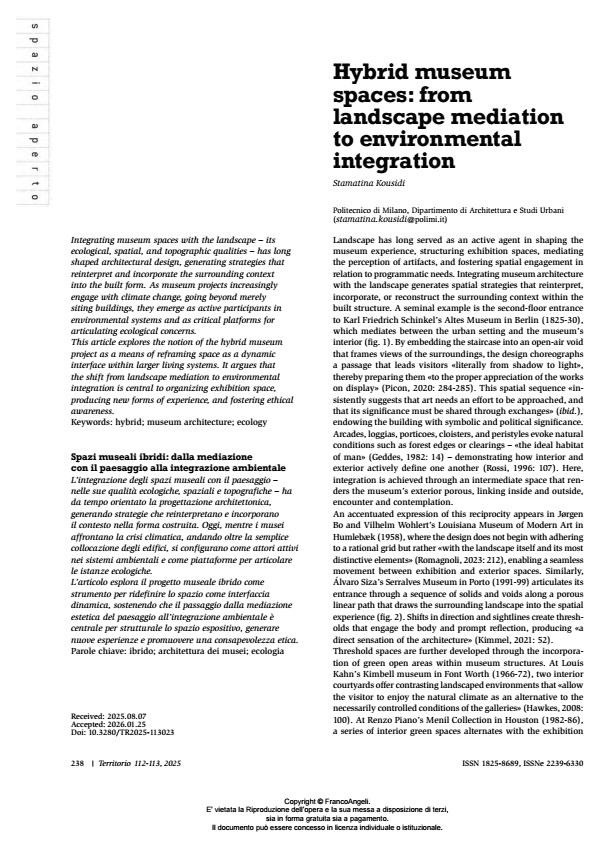
Integrating museum spaces with the landscape – its ecological, spatial, and topographic qualities – has long shaped architectural design, generating strategies that reinterpret and incorporate the surrounding context into the built form. As museum projects increasingly engage with climate change, going beyond merely siting buildings, they emerge as active participants in environmental systems and as critical platforms for articulating ecological concerns. This article explores the notion of the hybrid museum project as a means of reframing space as a dynamic interface within larger living systems. It argues that the shift from landscape mediation to environmental integration is central to organizing exhibition space, producing new forms of experience, and fostering ethical awareness.
Keywords: hybrid; museum architecture; ecology
- Allen S., McQuade M. (eds.), 2011, Landform Building: Architecture’s New Terrain. Zurich: Lars Müller.
- Assunto R., 1976, «Paesaggio, ambiente, territorio: un tentativo di precisazione concettuale». Bollettino del Centro Internazionale di Studi di Architettura Andrea Palladio, XVIII: 4548.
- AV Proyectos, 2018, «Glass Pavilion, Montréal (Canada)». Dossier Lacaton & Vassal, 85, 1617.
- Barrett J., McManus P., 2007, «Civilising Nature: Museums and the Environment». In: Birch G. (ed.), Water Wind Art and Debate. Sydney: University of Sydney Press, 319344.
- Beaumont E., 2020, «Dark ecology: Climate Museum in Lleida by Estudi d’Arquitectura Toni Gironès». The Architectural Review, 1470: 102111. Beneš M., 2022, «Hybridity in Landscape/Architecture». Keynote at DLA 2022 on June 9, 2022 at the GSD Harvard University.
- Berlanda T., 2014, Architectural Topographies: A Graphic Lexicon of How Buildings Touch the Ground. LondonNew York: Routledge.
- Cameron F., Hodge B., Salazar J.F., 2013, «Representing climate change in museum space and places». Wiley Interdisciplinary Reviews Climate Change 4,1: 921.
- Ciccarelli L., 2022, Renzo Piano: & Renzo Piano Building Workshop. FirenzeMilano: Giunti.
- Corbellini G., 2009, Bioreboot: The Architecture of R&sie{n}. New York: Princeton Architectural Press.
- Corner J., 2014, «Ecology and Landscape as Agents of Creativity». In: Corner, J., Bick Hirsch A. (eds.), The Landscape Imagination: Collected Essays of James Corner 19902010. New York: Princeton Architectural Press, 257281.
- Druot F., 2005, «Métamorphose de l’insectarium de Montréal. Concours pour la réhabilitation de l’insectarium du Jardin botanique: La précision scientifique, l’émotion, l’immersion». www.druot.net/insect13 (accesso: 2025.05.25).
- Forty A., 2000, «Nature». In: Forty A., Words and Buildings: A Vocabulary of Modern Architecture. London: Thames & Hudson, 220239.
- Frampton K., 1983, «Towards a Critical Regionalism: Six Points for an Architecture of Resistance». In: Foster H. (ed.), The AntiAesthetic: Essays on Postmodern Culture. Port Townsend, WA: Bay Press, 1630. Geddes R., 1982, «The Forest Edge». AD. Architectural Design Pro?le, 14: 223.
- Gissen D., 2009, Subnature. Architecture’s Other Environments. New York: Princeton Architectural Press.
- Greenberg S., 2005, «The vital museum». In: MacLeod S. (ed.), Reshaping Museum Space: Architecture, Design, Exhibitions. LondonNew York: Routledge, 226237.
- Hawkes D., 2008, The Environmental Imagination. Technics and Poetics of the Architectural Environment. LondonNew York: Routledge.
- Hennes T., 2007, «Hyperconnection: Natural History Museums, Knowledge, and the Evolving Ecology of Community». Curator, 50, 1: 87108. Hoffmann H.W., 2016, «The History and Theory of the Museum Building».
- In: Hoffmann H.W., Schittich C. (eds.), Museum Buildings: Construction and Design Manual. Berlin: DOM Publishers, 1041.
- Ingersoll R., 2007, «Critical Regionalism in Houston: A Case for the Menil Collection». In: Canizaro V.B. (ed.), Architectural Regionalism: Collected Writings on Place, Identity, Modernity, and Tradition. New York: Princeton Architectural Press, 386393.
- Irace F., 2011, David Chipper?eld. Milano: Electa.
- Kallipoliti L., 2024, Histories of Ecological Design: An Un?nished Cyclopedia. New YorkBarcelona: Actar.
- Kimmel L., 2021, Architecture of Threshold Spaces: A Critique of the Ideologies of Hyperconnectivity and Segregation in the SocioPolitical Context. LondonNew York: Routledge.
- Kousidi S. (ed.), 2024, Forest Architecture. In Search of the (Post)Modern Wilderness. Milano: Mimesis.
- Latour B., 1991, We Have Never Been Modern. Cambridge, MA: Harvard University Press.
- Leatherbarrow D., 2000, Uncommon Ground: Architecture, Technology, and Topography. Cambridge, MA: The MIT Press.
- Lindsay G. (ed.), 2020, Contemporary Museum Architecture and Design: Theory and Practice of Place. LondonNew York: Routledge.
- Luescher A., 2007, «A Unit of Luminous Flux: Mario Botta’s Centre Dürrenmatt Neuchâtel». The Journal of Architecture 12, 3: 239255. DOI: 10.1080/13602360701469929
- MacLeod S., Hourston Hanks L., Hale J. (eds.), 2012, Museum Making. Narratives, Architectures, Exhibitions. LondonNew York: Routledge. Manfredi M., Weiss M., 2008, «Conversation with Detlef Mertins». In
- Manfredi, M., Weiss, M., Surface/Subsurface. New York: Princeton Architectural Press, 7881.
- Marotta A., 2010, Atlante dei musei contemporanei. Milano: Skira. Marotta A., 2013, «Typology: Museums». The Architectural Review, 1391: 7585.
- Nesbitt K., 1996, Theorizing a New Agenda for Architecture: An Anthology of Architectural Theory 19651995. New York: Princeton Architectural Press.
- Pellegrino A., 2023, «Hybridism as a Dualistic View; or: A ‘Latourian’ Paradox». E|C Rivista dell’Associazione Italiana di Studi Semiotici XVII, 37: 157172.
- Picon A., 2020, «Architecture, Materiality, and Politics: Sensations, Symbols, Situations, and Decors». In: Bell D., Zacka B. (eds.), Political Theory and Architecture. London; Oxford: Bloomsbury, 277294.
- Pozzi C., 2003, Ibridazioni architettura/natura. Roma: Meltemi.
- Psarra S., 2009, Architecture and narrative. The formation of space and cultural meaning. LondonNew York: Routledge.
- QuesadaGarcía S., 2018, «Herzog & de Meuron: The (Renewed) Mimesis of Nature». RA. Revista de Arquitectura, 20: 284287.
- Quinz E., 2023, «Is the new environmental awareness emerging in museums?». Domus. www.domusweb.it/en/art/2023/06/20/isthenewenvironmentalawarenessemergininmuseums.html (accesso: 2025.05.25) Reed P., 2005, Groundswell: Constructing the Contemporary Landscape. New York: The Museum of Modern Art.
- Romagnoli E., 2023, «Jørgen Bo & Vilhelm Wohlert. Louisiana Museum, Humlebæk, Denmark». Firenze Architettura 12, 3: 210221.
- Rossi P.O., 1996, La costruzione del Progetto architettonico. Roma: Laterza. Ursprung P., 2007, «Nature and Architecture». In: Mateo J.L. (ed.), Natural Metaphor. An Anthology of Essays on Architecture and Nature. Barcelona: Actar, 1021.
- Yanni C., 2005, Nature’s Museums: Victorian science and the architecture of display. New York: Princeton Architectural Press.
Stamatina Kousidi , Hybrid museum spaces: from landscape mediation to environmental integration in "TERRITORIO" 112-113/2025, pp 238-247, DOI: 10.3280/TR2025-112023