Spessore, limiti, cavità
Journal title TERRITORIO
Author/s Marco Lucchini
Publishing Year 2026 Issue 2025/112-113
Language Italian Pages 12 P. 248-259 File size 461 KB
DOI 10.3280/TR2025-112024
DOI is like a bar code for intellectual property: to have more infomation
click here
Below, you can see the article first page
If you want to buy this article in PDF format, you can do it, following the instructions to buy download credits
FrancoAngeli is member of Publishers International Linking Association, Inc (PILA), a not-for-profit association which run the CrossRef service enabling links to and from online scholarly content.
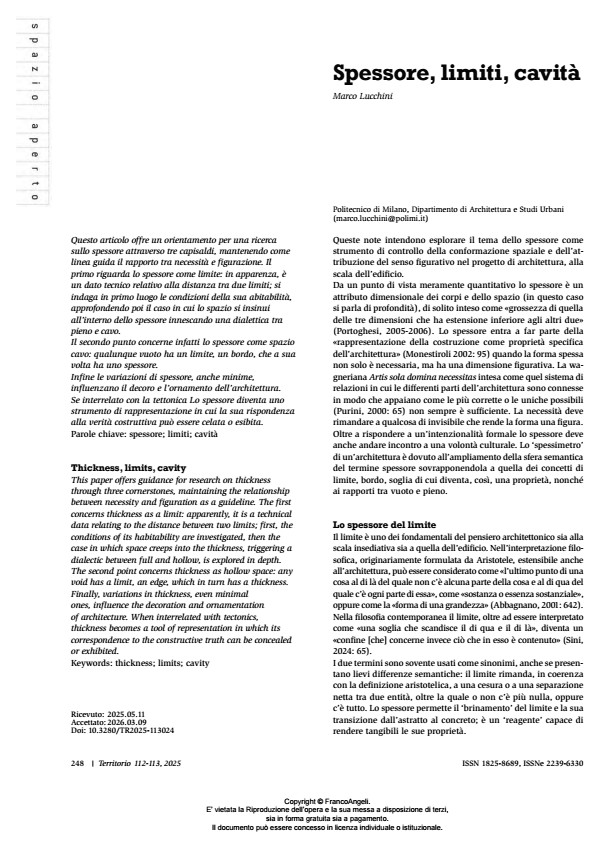
This paper offers guidance for research on thickness through three cornerstones, maintaining the relationship between necessity and figuration as a guideline. The first concerns thickness as a limit: apparently, it is a technical data relating to the distance between two limits; first, the conditions of its habitability are investigated, then the case in which space creeps into the thickness, triggering a dialectic between full and hollow, is explored in depth. The second point concerns thickness as hollow space: any void has a limit, an edge, which in turn has a thickness. Finally, variations in thickness, even minimal ones, influence the decoration and ornamentation of architecture. When interrelated with tectonics, thickness becomes a tool of representation in which its correspondence to the constructive truth can be concealed or exhibited.
Keywords: thickness; limits; cavity
- Abbagnano N., 2001, «Limite». Ad vocem: Dizionario di Filoso?a. Terza edizione aggiornata e ampliata da G. Fornero. Torino: Utet.
- Aguilar A., 2018, «Bronca la muralla». El País, 11 giugno 2006, https:// elpais.com/diario/2006/06/11/cultura/1149976808_850215.html (accesso: 2026.08.27).
- Ali A., Anas I., Ahmed E., 2024, «A Comprehensive Review and Recent Trends in Thermal Insulation Materials for Energy Conservation in Buildings». Sustainability 16, 20: 8782.
- Cacciatore F., 2008, Il muro come contenitore di luoghi. Forme strutturali cave nell’opera di Louis Kahn. Siracusa: LetteraVentidue.
- Campo Baeza A., 2018, Principia architectonica. Milano: Christian Marinotti.
- Cánovas A., Espegel C., DelaPuerta J.M., Martinez Arroyo C., Pemjan R., 2016, Vivienda colectiva en España 19922015. Valencia: General de Ediciones de Arquitectura.
- Cánovas A., Espegel C., DelaPuerta J.M., Martinez Arroyo C., Pemjan R., 2019, Vivienda colectiva en España. Siglo XX (19291992). Valencia: General de Ediciones de Arquitectura.
- Centellas M., Jordá C., Landrove S., eds., 2009, La vivienda moderna. Registro DOCOMOMO Ibérico 19251965. Barcellona: Fundación Caja de Arquitectos Fundación DOCOMOMO Ibérico.
- Choay F., 1986, La regola e il modello. Sulla teoria dell’architettura e dell’urbanistica. Roma: Officina.
- Corbellini G., 2022, «Hard Rock: Aurelio Galfetti, Castelgrande, Bellinzona, 19812000». Paesaggio Urbano. 22: 6175.
- Crotti S., 2000, Figure architettoniche: soglia. Milano: Unicopli. Deplazas A., Wieser C., 2005. «Solid and filigree construction». In: Depla zas A. (ed.), Constructing architecture. Materials, processes, structures. A handbook. BaselBostonBerlin: Birkhäuser, 1315.
- Di Domenico G., 1998, L’idea di recinto. Il recinto come essenza e forma primaria dell’architettura. Roma: Officina.
- Fehn S., 1992, «Come sono nate le nostre dimensioni». Area, 46: 45. Ferrari A., 2003, Le azioni del progetto. Mantova: Tre Lune.
- Frampton K., 1999, «Costruzioni pesanti e leggere. Riflessioni sul futuro della forma architettonica». Lotus, 99: 2431.
- Frommel C.L., 2009, Architettura del Rinascimento Italiano. Milano: Skira (ed. or. 2007, Architecture of the Italian Renaissance. London: Thames & Hudson).
- Grassi G., 2005. «La costruzione e i suoi elementi (il muro e la colonna)». In: Grassi G., Patetta L. (a cura di), Leon Battista Alberti Architetto. Firenze: Banca CR, 5577.
- H Arquitectes, 2023, «Linking EqualSize Rooms». a+t Generosity. The challenge of privacy in collective housing, 58: 106115.
- Habraken N.J., Boekholt J.Th., Dinjens P.J., Thijssen A.P.,1976, Variations: the systematic Design of supports. Cambridge, Massachusetts: MIT Press.
- Hernández Arteaga C.E., 2020, «Edificio Mediterráneo de Antonio Bonet y Josep Puig Torné». Rita 13: 128135.
- Jaen i Urban G., Lucchini M., 2023, BarcelonaMilan: arquitecturas modernas en contacto. Del fascismo a la democracia. Alacant: Publicacions Universitat Alacant.
- Jimenez Torrecilla A., 2006, «Intervención de la muralla Nazari y su entorno Granada». On Diseño, 277: 180191.
- Iodice F., 2015, Cavità e limite. Siracusa: LetteraVentidue.
- Iñiguez M., 2001, La columna y el muro. Fragmentos de un diálogo. Barcelona: Fundación Caja de Arquitectos.
- Langarita M., Navarro V., 2023, «Against Incontinence. An interview with Emilio Tunón and Carlos M. Albornoz». El Croquis 223: 729
- Leveratto J., 2025, A Romm of No One. Macerata: Quodlbet. Massarente A., 1997, Castelgrande a Bellinzona, Aurelio Galfetti. Firenze: Alinea.
- Monestiroli A., 2002, La metopa e il triglifo. Nove lezioni di architettura. RomaBari: Laterza.
- Mc Carter R., 2005. Louis Kahn. London: Phaidon.
- Obal L. 2023, «Vivienda de protección pública, un modelo alternativo. Una conversación con Cris Ballester Parets y Carles Oliver Barceló». El Croquis, 219: 636.
- Oliver C., Moyà X., 2023. «IBAVI, viviendas sociales en règimen de alquiler, Santa Eugènia Mallorca». Casabella, 952: 6877.
- Pasqui G., 1985, «Lo spessore dei confini». Frontiere della Psicoanalisi, 1: 117124.
- Pizza A., 1999, «La ricerca di un’architettura astratta. Alberto Campo Baeza». In: Alberto Campo Baeza. Progetti e costruzioni, Milano: Electa, 723.
- Portoghesi P., 20052006, «Spessore». Ad vocem: Dizionario enciclopedico di Urbanistica. Roma: Gangemi.
- Purini F., 2000, Comporre l’architettura. RomaBari: Laterza.
- Salatin F., 2017, «Volte, ‘cieli’ e caementa. La Basilica di Massenzio come fonte per gli architetti». Ædi?care, Revue internationale d’histoire de la construction, 1: 93116. Doi 10.15122/isbn.9782406070924.p.0093. Sini C., 2024, «Figure del limite: la soglia». Frontiere della psicoanalisi, 1: 6570. DOI: 10.48270/114038
- Spirito G., 2011, Forme del vuoto. Cavità concavità e fori nell’architettura contemporanea. Roma: Gangemi.
- Sekler E. 1975, «Structure, Construction, and Tectonics». Connection, 7: 211.
- Tafuri M., 1984, «Machine et mémoire. La città nell’opera di Le Corbusier». Casabella, 502: 4450
- Tuñon Arquitectos, 2020, «Casa de piedra, Sierrilla (Cáceres)». Arquitectura Viva Monografías, 277228: 3241.
- Tuñon Arquitectos, 2023, «Casa de piedra, en Cáceres». El Croquis, 223: 115135.
- WardPerkins B. J., 1989, Architettura romana, Milano: Electa (ed. or. Milano, 1974).
Marco Lucchini, Spessore, limiti, cavità in "TERRITORIO" 112-113/2025, pp 248-259, DOI: 10.3280/TR2025-112024