Housing policies and urban power: conflicts and redistributive processes in Boston
Journal title TERRITORIO
Author/s Anna Laura Palazzo
Publishing Year 2026 Issue 2025/112-113
Language Italian Pages 13 P. 260-272 File size 756 KB
DOI 10.3280/TR2025-112025
DOI is like a bar code for intellectual property: to have more infomation
click here
Below, you can see the article first page
If you want to buy this article in PDF format, you can do it, following the instructions to buy download credits
FrancoAngeli is member of Publishers International Linking Association, Inc (PILA), a not-for-profit association which run the CrossRef service enabling links to and from online scholarly content.
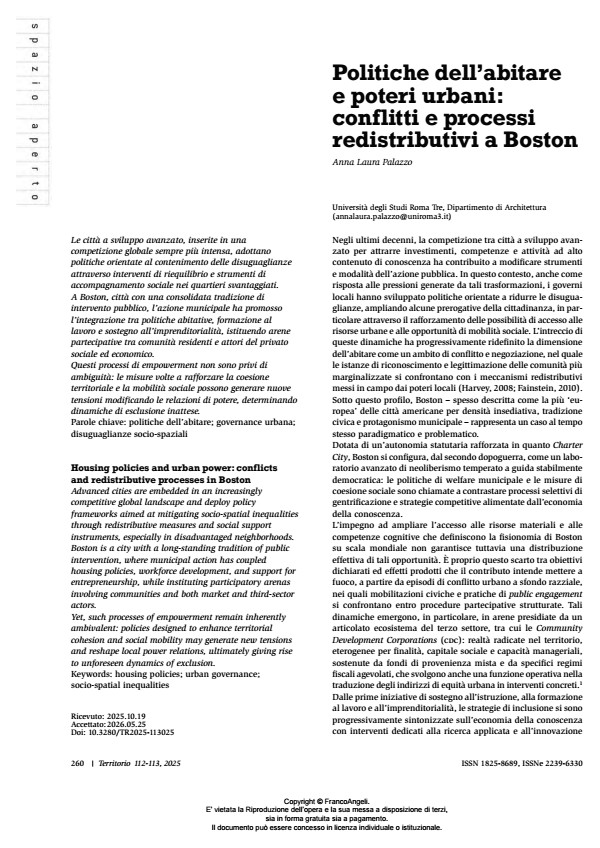
Advanced cities are embedded in an increasingly competitive global landscape and deploy policy frameworks aimed at mitigating sociospatial inequalities through redistributive measures and social support instruments, especially in disadvantaged neighborhoods. Boston is a city with a longstanding tradition of public intervention, where municipal action has coupled housing policies, workforce development, and support for entrepreneurship, while instituting participatory arenas involving communities and both market and thirdsector actors. Yet, such processes of empowerment remain inherently ambivalent: policies designed to enhance territorial cohesion and social mobility may generate new tensions and reshape local power relations, ultimately giving rise to unforeseen dynamics of exclusion.
Keywords: housing policies; urban governance; sociospatial inequalities
- Anguelovski I., 2014, Neighborhood as Refuge: Community Reconstruction, Place Remaking, and Environmental Justice in the City. MIT Press.
- Brenner N., Peck J., Theodore N., 2010. «Variegated Neoliberalization: Geographies, Modalities, Pathways». Global Networks, 10, 2: 182–222.
- DeFilippis J., Saegert S., 2012, «Communities Develop: The Question Is, How?». In: De Filippis J., Saegert S. (eds.), The Community Development Reader, 2nd ed.. New York: Routledge, 17.
- Fainstein S.S., 2010, The Just City. Ithaca: Cornell University Press. Glaeser, E.L., Resseger, M., Tobio, K., 2009, «Inequality in Cities». Journal of Regional Sciences, 49, 4: 617646.
- Harvey D., 2008, «The Right to the City». New Left Review, 53: 2340.
- Hay C., 2003, Political Analysis. A Critical Introduction. New York: MacMillan.
- Jessop B., 2001, «Institutional re(turns) and the strategicrelational approach». Environment and Planning A, 33, 7: 12131235.
- Katz B., Wagner J., 2014, The Rise of Innovation Districts: A New Geography of Innovation in America. Washington, DC: Brookings Institution Metropolitan Policy Program.
- Korngold G., 2022, Land Value Capture in the United States. Funding Infrastructure and Local Government Services. Lincoln Institute of Land Policy. Krigman J., 2010, «The Role of Community Development Corporations in Affordable Housing». Journal of Affordable Housing & Community Development Law, 19, 2: 231253.
- Levine J.R., 2021, Constructing community: Urban governance, development, and inequality in Boston. Princeton: Princeton University Press.
- Medoff P., Sklar H., 1994, Streets of Hope: The Fall and Rise of an Urban Neighborhood. Boston: South End Press.
- Reichman A., 2010, «Challenges for Nonprofit Organizations. Introduction: A Theoretical Framework. Civil Society and Challenges Faced by Nonprofits». New England Journal of Public Policy, 23,1, 310 http://scholarworks. umb.edu/nejpp/vol23/iss1/4 (accesso: 2026.04.10).
- Taylor E.A., 1995. «The Dudley Street Neighborhood Initiative and the Power of Eminent Domain». Boston College Law Review, 36: 10611087. Thompson M.M., et al., 2004, Building Bridges Between Community Based Organizations and Technology: Exploring Tools for Community Participation and Economic Development for the Dudley Street Neighborhood Initiative. New Orleans: University of New Orleans.
- Trillo C., 2018, «The Rise of the Cocreative Class: Sustainable InnovationLed Urban Regeneration». In: Calabrò F., Della Spina L., Bevilacqua
- C. (eds.). New Metropolitan Perspectives Local Knowledge and Innovation Dynamics Towards Territory Attractiveness Through the Implementation of Horizon/E2020/Agenda2030. London: Springer, 411421. DOI: 10.1007/9783319921020
Anna Laura Palazzo, Politiche dell’abitare e poteri urbani: conflitti e processi redistributivi a Boston in "TERRITORIO" 112-113/2025, pp 260-272, DOI: 10.3280/TR2025-112025