History of the City’s Merchant Railway Facilities: An Overview
Journal title STORIA URBANA
Author/s Luis Santos y Ganges, José Luis Lalana Soto
Publishing Year 2026 Issue 2026/183
Language Spanish Pages 28 P. 13-40 File size 2358 KB
DOI 10.3280/SU2026-183002
DOI is like a bar code for intellectual property: to have more infomation
click here
Below, you can see the article first page
If you want to buy this article in PDF format, you can do it, following the instructions to buy download credits
FrancoAngeli is member of Publishers International Linking Association, Inc (PILA), a not-for-profit association which run the CrossRef service enabling links to and from online scholarly content.
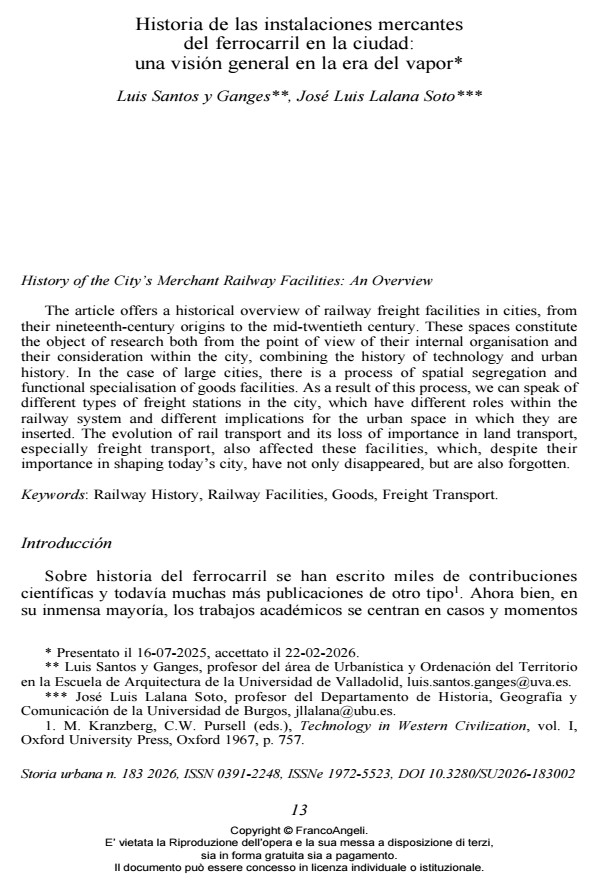
The article offers a historical overview of railway freight facilities in cities, from their nineteenth-century origins to the mid-twentieth century. These spaces constitute the object of research both from the point of view of their internal organisation and their consideration within the city, combining the history of technology and urban history. In the case of large cities, there is a process of spatial segregation and functional specialisation of goods facilities. As a result of this process, we can speak of different types of freight stations in the city, which have different roles within the railway system and different implications for the urban space in which they are inserted. The evolution of rail transport and its loss of importance in land transport, especially freight transport, also affected these facilities, which, despite their importance in shaping today’s city, have not only disappeared, but are also forgotten.
L’articolo offre una panoramica storica degli impianti ferroviari destinati al traf fico merci in ambito urbano, dalle origini ottocentesche fino alla metà del Novecento. Questi spazi sono analizzati sia nella loro organizzazione interna, sia nel loro inserimento nel contesto cittadino, coniugando storia della tecnica e storia urbana. Nel caso delle grandi città si assiste a un processo di segregazione spaziale e di specializzazione funzionale degli impianti merci. In esito a tale processo, è possibile distinguere diversi tipi di stazioni merci in ambito urbano, caratterizzate da ruoli differenti all’interno del sistema ferroviario e da effetti diversificati sullo spazio cittadino. L’evoluzione del trasporto ferroviario e la sua progressiva perdita di centralità nel complesso dei trasporti terrestri, in particolare nel segmento merci, hanno inciso anche su questi impianti che, pur avendo avuto un ruolo decisivo nel plasmare la città contemporanea, non solo sono in gran parte scomparsi, ma sono stati anche dimenticati.
Keywords: Railway History, Railway Facilities, Goods, Freight Transport.
Luis Santos y Ganges, José Luis Lalana Soto, Historia de las instalaciones mercantes del ferrocarril en la ciudad: una visión general en la era del vapor in "STORIA URBANA " 183/2026, pp 13-40, DOI: 10.3280/SU2026-183002