Language and Utopia in the Young Walter Benjamin.
Journal title RIVISTA DI STORIA DELLA FILOSOFIA
Author/s Massimo Locci
Publishing Year 2026 Issue 2026/2
Language Italian Pages 30 P. 294-323 File size 203 KB
DOI 10.3280/SF2026-002004
DOI is like a bar code for intellectual property: to have more infomation
click here
Below, you can see the article first page
If you want to buy this article in PDF format, you can do it, following the instructions to buy download credits
FrancoAngeli is member of Publishers International Linking Association, Inc (PILA), a not-for-profit association which run the CrossRef service enabling links to and from online scholarly content.
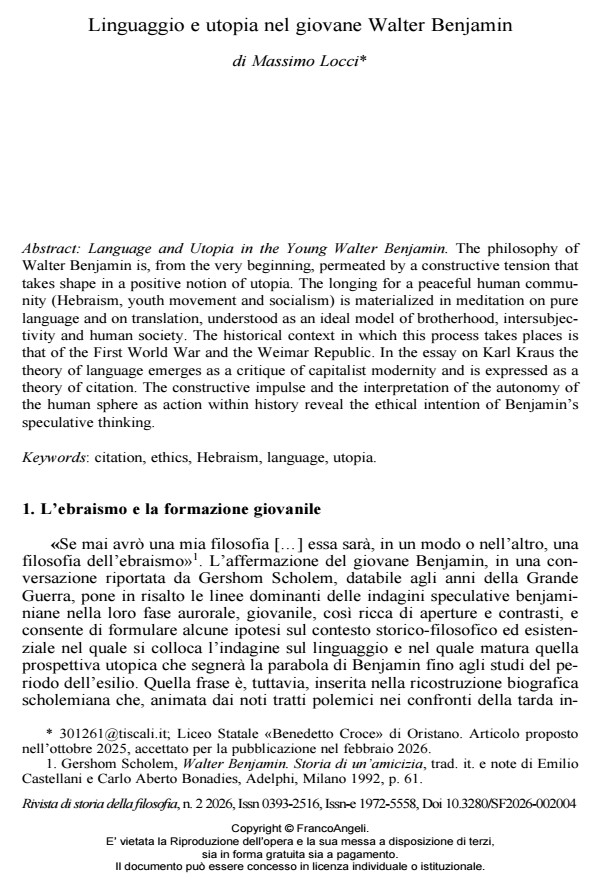
The philosophy of Walter Benjamin is, from the very beginning, permeated by a constructive tension that takes shape in a positive notion of utopia. The longing for a peaceful human community (Hebraism, youth movement and socialism) is materialized in meditation on pure language and on translation, understood as an ideal model of brotherhood, intersubjectivity and human society. The historical context in which this process takes places is that of the First World War and the Weimar Republic. In the essay on Karl Kraus the theory of language emerges as a critique of capitalist modernity and is expressed as a theory of citation. The constructive impulse and the interpretation of the autonomy of the human sphere as action within history reveal the ethical intention of Benjamin’s speculative thinking.
Keywords: citation, ethics, Hebraism, language, utopia.
Massimo Locci, Linguaggio e utopia nel giovane Walter Benjamin in "RIVISTA DI STORIA DELLA FILOSOFIA" 2/2026, pp 294-323, DOI: 10.3280/SF2026-002004