Economics and Democracy
Journal title PRISMA Economia - Società - Lavoro
Author/s Antonia Calafati
Publishing Year 2026 Issue 2026/1
Language Italian Pages 17 P. 15-31 File size 113 KB
DOI 10.3280/PRI2026-001002
DOI is like a bar code for intellectual property: to have more infomation
click here
Below, you can see the article first page
If you want to buy this article in PDF format, you can do it, following the instructions to buy download credits
FrancoAngeli is member of Publishers International Linking Association, Inc (PILA), a not-for-profit association which run the CrossRef service enabling links to and from online scholarly content.
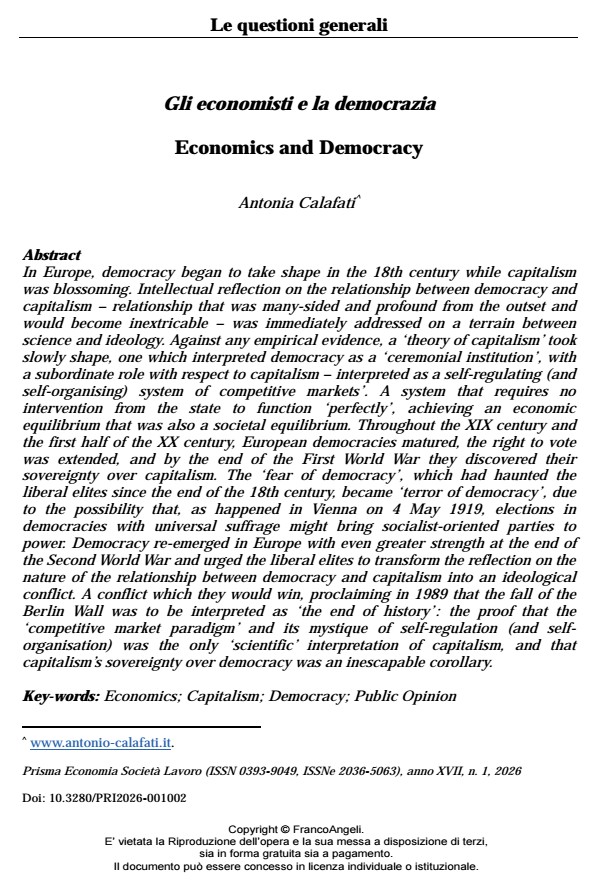
In Europe, democracy began to take shape in the 18th century while capitalism was blossoming. Intellectual reflection on the relationship between democracy and capitalism – relationship that was many-sided and profound from the outset and would become inextricable – was immediately addressed on a terrain between science and ideology. Against any empirical evidence, a ‘theory of capitalism’ took slowly shape, one which interpreted democracy as a ‘ceremonial institution’, with a subordinate role with respect to capitalism – interpreted as a self-regulating (and self-organising) system of competitive markets’. A system that requires no intervention from the state to function ‘perfectly’, achieving an economic equilibrium that was also a societal equilibrium. Throughout the XIX century and the first half of the XX century, European democracies matured, the right to vote was extended, and by the end of the First World War they discovered their sovereignty over capitalism. The ‘fear of democracy’, which had haunted the liberal elites since the end of the 18th century, became ‘terror of democracy’, due to the possibility that, as happened in Vienna on 4 May 1919, elections in democracies with universal suffrage might bring socialist-oriented parties to power. Democracy re-emerged in Europe with even greater strength at the end of the Second World War and urged the liberal elites to transform the reflection on the nature of the relationship between democracy and capitalism into an ideological conflict. A conflict which they would win, proclaiming in 1989 that the fall of the Berlin Wall was to be interpreted as ‘the end of history’: the proof that the ‘competitive market paradigm’ and its mystique of self-regulation (and self-organisation) was the only ‘scientific’ interpretation of capitalism, and that capitalism’s sovereignty over democracy was an inescapable corollary.
Keywords: Economics; Capitalism; Democracy; Public Opinion
- Beveridge W. (1942), Social Insurance and Allied Services. London: His Majesty’s Stationary Office.
- Blaug M. (1980), The Methodology of Economics. Or How Economists Explain. Cambridge: Cambridge University Press.
- Braudel F. (1981), La dinamica del capitalismo. Bologna: Il Mulino.
- Clark J. M. (1935), Economies of Planning Public Works. New York: Augustus M. Kelley, 1965
- Cockett R. (1994), Thinking the Unthinkable. Think-tanks and the Economic Counter-revolution, 1931-1983. HarperCollinsPublishers.
- Cockett R. (2023), Vienna: Yale University Press.
- Commons J. R. (1924), The Legal Foundation of Capitalism (i ed.). London: MacMillan.
- Commons J. R. (1950), The Economics of Collective Action. New York: MacMillan.
- Dolléans E. (1936), Storia del movimento operaio (1830-1871). Firenze: Sansoni,1968.
- Engels F. (1845), The Condition of the Working Class in England. London: Panther, 1969.
- Foot P. (2005), The Vote. How it was Won and how it was undermined. London: Verso.
- Friedman M. (1953), Essays in Positive Economics. Chicago: University of Chicago Press.
- Galgano F. (1980), Le istituzioni dell’economia capitalistica. Bologna: Zanichelli.
- Gruchy A. G. (1987), The Reconstruction of Economics. An Analysis of the Fundamentals of Institutional Economics. Westport (Connecticut): Greenwood Press.
- Habermas J. (19621°, 19902°), Storia e critica dell’opinione pubblica. Bari-Roma: Editori Laterza (2005).
- Hayek F. A. (1944), The Road to Serfdom. London: Routledge, 1986 (trad. it. La via della schiavitù, Rubbettino, 2011).
- Hayek F. A. (1982), Law, Legislation and Liberty. A new statement of the liberal principles of justice and political economy. London: Routledge.
- Hicks J. R. (1939), Value and capital : an inquiry into some fundamental principles of economic theory. Oxford: Oxford University Press, 1946 (2nd ed.).
- Hobsbawm E. (1962), The Age of Revolution. London: Abacus, 1977.
- Ingham G. (2008), Capitalism. Cambridge: Polity Press.
- Keynes J. M. (1936), The General Theory of Employment, Interest and Money. London: Macmillan & Co. (trad. it. Teoria Generale dell’occupazione dell’inteesse e della moneta, Torino: UTET, 1971).
- Kocka J. (2013), Geschichte der Kapitalismus. München: C.H Beck.
- Kuhn T. (1962), The Structure of Scientific Revolutions. Chicago: The University of Chicago Press (trad. It. La struttura delle rivoluzioni scientifiche, Torino: Einaudi 2009).
- Lasch C. (1995), The Revolts of the Elites and the Betrayal of Democracy. New York: W.W. Norton & Company.
- Lippmann W. (1922), The Public Opinion (1922 ed.). Blaacksbur VA: Wilder Publication, 1922 (ed. it. L’opinione pubblica, Roma: Donzelli, 2018).
- Mises L. (1949), The Human Actions: A Treatise on Economics. Milton Friedman (UK): Lightningsource.
- Mitchell W. C. (1941), Business Cycles and their Causes. Berkeley: University of California Press.
- Mitchell W. C. (1963), Types of Economic Theory (J. Dorfman Ed.). New York: A.M.Kelley.
- Moyn S. (2023), Liberalism Against iIself. New Haven: Yale Univcersity Press.
- Muller J. Z. (2002), The Mind and the Market. Capitalism in Modern European Thought. New York: Anchor Books.
- Negt O., & Kluge A. (1972), Öffentlichkeit und Erfahrung. Frankfurt a. M.: Suhrkamp.
- Nicholls A. J. (1994), Freedom with Responsability: The Social Market Economy in Germany 1918-1963. Oxford: Clarendon Press.
- North D. C. (1990), Institutions, Institutional Change and Economic Performances. Cambridge: Cambridge University Press.
- Offer A., & Söderberg G. (2016), The Nobel Factor. The Prize in Economics, Social Democracy, and the Market Turn. Princeton: Princeton University Press.
- Polanyi K. (1944), The Great Transformation. New York: Holt, Rinehart & Winston.
- Reich R. (2016), Saving Capitalism. London: Icon Book.
- Reich R. (2018), The Common Good. New York: Alfred A. Knopf.
- Rosenblatt H. (2018), The Lost History of Liberalism. Princeton: Princeton University Press.
- Samuelson P. A. (1947), Foundations of Economic Analysis. Cambridge, Mass.: Harvard University Press.
- Schumpeter J. A. (1939), Business Cycles. A Theoretical, Historical and Statistical Analysis of the Capitalist Process. New York: McGraw-Hill.
- Schumpeter J. A. (1942), Capitalism, Socialism and Democracy (19472, 19503 ed.). New York: Harper Perennial.
- Slobodian Q. (2018), Globalists. The End of the Empire and the Birth of Neoliberalism. Harvard: Harvard University Press.
- Spann O. (1930), Types of Economic Theory. London: George Allen & Unwin.
- Streek W. (2021), Zwischen Globalismus und Demokratie.Politische Ökonomie im ausgehenden Neoliberalismus. Frankfurt a.M.: Suhrkamp.
- Wolf M. (2023), The Crisis of Democrartic Capitalism. London: Allen Lane.
- Zimmermann C. (2000), Die Zeit der Metropolen. Urbanisierung und Großstadtentwicklung. Frankfurt a.M.: Fischer.
Antonia Calafati, Gli economisti e la democrazia in "PRISMA Economia - Società - Lavoro" 1/2026, pp 15-31, DOI: 10.3280/PRI2026-001002