The long night of the democratic elites and the new augmented powers
Journal title PRISMA Economia - Società - Lavoro
Author/s Carlo Carboni
Publishing Year 2026 Issue 2026/1
Language Italian Pages 8 P. 32-39 File size 98 KB
DOI 10.3280/PRI2026-001003
DOI is like a bar code for intellectual property: to have more infomation
click here
Below, you can see the article first page
If you want to buy this article in PDF format, you can do it, following the instructions to buy download credits
FrancoAngeli is member of Publishers International Linking Association, Inc (PILA), a not-for-profit association which run the CrossRef service enabling links to and from online scholarly content.
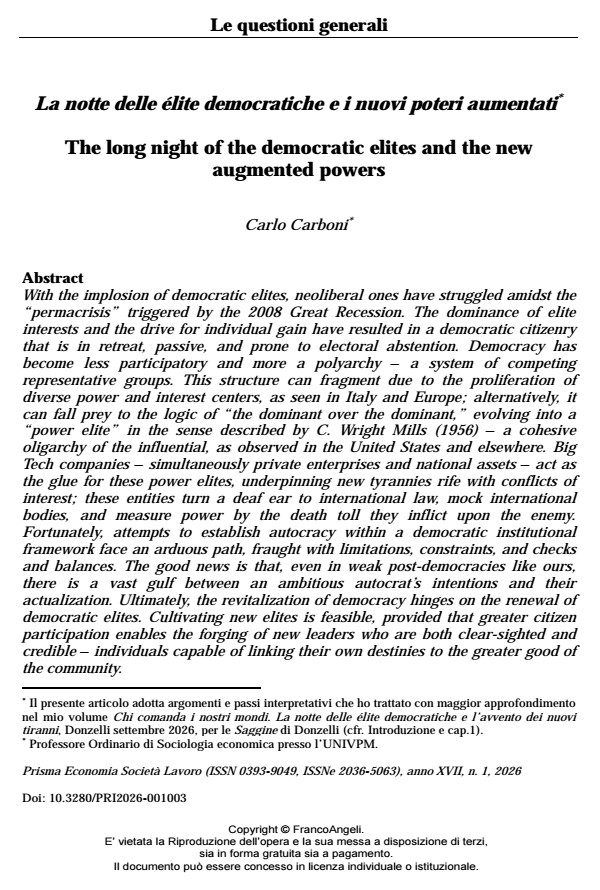
With the implosion of democratic elites, neoliberal ones have struggled amidst the “permacrisis” triggered by the 2008 Great Recession. The dominance of elite interests and the drive for individual gain have resulted in a democratic citizenry that is in retreat, passive, and prone to electoral abstention. Democracy has become less participatory and more a polyarchy ‒ a system of competing representative groups. This structure can fragment due to the proliferation of diverse power and interest centers, as seen in Italy and Europe; alternatively, it can fall prey to the logic of “the dominant over the dominant,” evolving into a “power elite” in the sense described by C. Wright Mills (1956) ‒ a cohesive oligarchy of the influential, as observed in the United States and elsewhere. Big Tech companies ‒ simultaneously private enterprises and national assets ‒ act as the glue for these power elites, underpinning new tyrannies rife with conflicts of interest; these entities turn a deaf ear to international law, mock international bodies, and measure power by the death toll they inflict upon the enemy. Fortunately, attempts to establish autocracy within a democratic institutional framework face an arduous path, fraught with limitations, constraints, and checks and balances. The good news is that, even in weak post-democracies like ours, there is a vast gulf between an ambitious autocrat’s intentions and their actualization. Ultimately, the revitalization of democracy hinges on the renewal of democratic elites. Cultivating new elites is feasible, provided that greater citizen participation enables the forging of new leaders who are both clear-sighted and credible ‒ individuals capable of linking their own destinies to the greater good of the community.
Keywords: the collapse of democratic elites, the crisis of neoliberal elites, new sovereignist tyrants, Oriental despotism, passive citizenship
- Bacharach S. (1967), The Theory of Democratic Elitism. A Critique, Little Brown, Boston (tr. Guida, Napoli 1974).
- Brown G., El-Erian M., Spence M. (2024), Permacrisis: A Plan to Fix a Fractured World, Penguin Random House Usa.
- Canetti E. (1981), Masse e potere, Adelphi, Milano.
- Carboni C. (2015), L’implosione delle élite. Leader contro in Italia e in Europa, Rubbettino, Soveria Mannelli.
- Carboni C., Busilacchi G., Ciommi M., Di Federico, R., Orazi F., Roscioli D., Sofritti F. (2024), The social immobility of the European power elite. A comparative analysis, RTSA, September.
- Crouch C. (2000), Postdemocrazia, Laterza, Roma-Bari 2005.
- Dahrendorf R. (1963), Classi e conflitto di classe nella società industriale, Laterza, Roma-Bari.
- Fukuyama F. (2023), Liberalism and Its Discontents, Profile Books Ltd, London.
- Hay C. (2007), Why we hate politics, Polity, Cambridge.
- Huntington S.P. (2002, ma 1996), The Clash of Civilizations and the Remaking of World Order, Simon and Schuster, London.
- Lasch C. (1995), La ribellione delle élite, Feltrinelli, Milano.
- Mannheim K. (1940), Man and Society in Age of Reconstruction, Routledge, Oxfordshire.
- Melograni P. (2019), Saggio sui potenti, Einaudi, Torino.
- Postman N. (1993), Technopoly. La resa della cultura alla tecnologia, Bollati Boringhieri, Torino.
- Schumpeter J. (1942), Capitalismo Socialismo Democrazia, Etas Kompass, Milano 1967.
- Streeck W. (2024), Globalismo e democrazia. L’economia politica del tardo neoliberismo, Feltrinelli, Milano.
- Weber M. (1997), La politica come professione, Armando Ed., Roma.
- Wittfogel K. A. (1981), Oriental Despotism: A Comparative Study of Total Power, Random House Inc, New York.
- Zakaria F. (1997), “The rise of illiberal democracies”, Foreign Affairs, Nov/Dec, 76.
- Zubhoff S. (2023), Il capitalismo della sorveglianza, LUISS University Press, Roma.
Carlo Carboni, La notte delle élite democratiche e i nuovi poteri aumentati in "PRISMA Economia - Società - Lavoro" 1/2026, pp 32-39, DOI: 10.3280/PRI2026-001003