Machine learning and Big Tech companies in the crisis of constitutional democracy: Mapping the issues
Journal title PRISMA Economia - Società - Lavoro
Author/s Federico Oliveri
Publishing Year 2026 Issue 2026/1
Language Italian Pages 22 P. 54-75 File size 154 KB
DOI 10.3280/PRI2026-001005
DOI is like a bar code for intellectual property: to have more infomation
click here
Below, you can see the article first page
If you want to buy this article in PDF format, you can do it, following the instructions to buy download credits
FrancoAngeli is member of Publishers International Linking Association, Inc (PILA), a not-for-profit association which run the CrossRef service enabling links to and from online scholarly content.
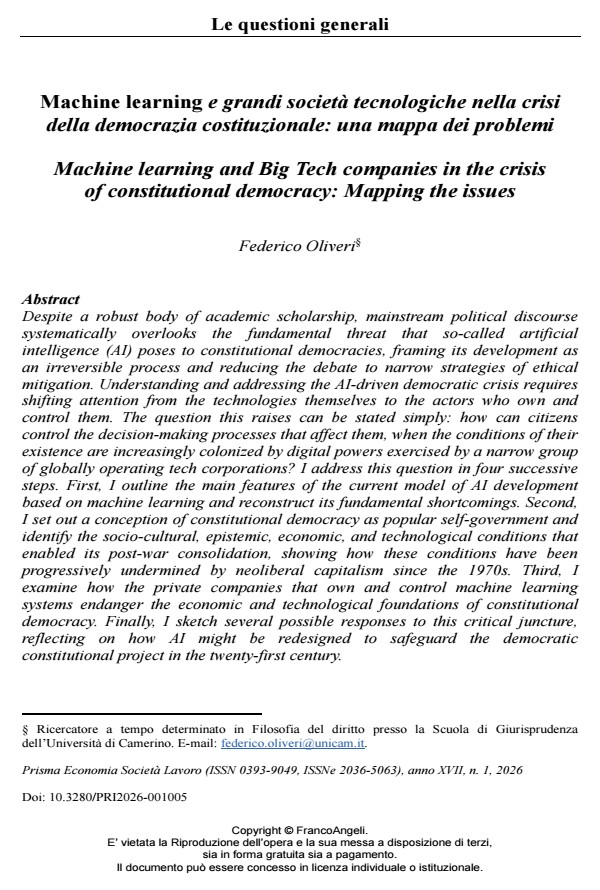
Despite a robust body of academic scholarship, mainstream political discourse systematically overlooks the fundamental threat that so-called artificial intelligence (AI) poses to constitutional democracies, framing its development as an irreversible process and reducing the debate to narrow strategies of ethical mitigation. Understanding and addressing the AI-driven democratic crisis requires shifting attention from the technologies themselves to the actors who own and control them. The question this raises can be stated simply: how can citizens control the decision-making processes that affect them, when the conditions of their existence are increasingly colonized by digital powers exercised by a narrow group of globally operating tech corporations? I address this question in four successive steps. First, I outline the main features of the current model of AI development based on machine learning and reconstruct its fundamental shortcomings. Second, I set out a conception of constitutional democracy as popular self government and identify the socio cultural, epistemic, economic, and technological conditions that enabled its post war consolidation, showing how these conditions have been progressively undermined by neoliberal capitalism since the 1970s. Third, I examine how the private companies that own and control machine learning systems endanger the economic and technological foundations of constitutional democracy. Finally, I sketch several possible responses to this critical juncture, reflecting on how AI might be redesigned to safeguard the democratic constitutional project in the twenty first century.
Keywords: Machine learning, Big Tech, Platform capitalism, Constitutional democracy, Digital Democratic Constitutionalism, Democratic AI.
- Aneesh A. (2009) “Global Labor: Algocratic Modes of Organization”, Sociological Theory, 27, pp. 347-370.
- Avi-Yonah R.S. (2024) “The Global Minimum Tax: A Critical Assessment of Pillar Two”, World Tax Journal, 16(2), pp. 145-168.
- Barocas S., Hardt M., Narayanan A. (2023) Fairness and Machine Learning: Limitations and Opportunities, MIT Press: Cambridge, MA.
- Benanti P. (2026) La nuova logica del dominio. Potere computazionale, democrazia e condizione umana, Laterza: Roma-Bari.
- Bender E.M., Hanna A. (2026) L’inganno dell'intelligenza artificiale. Come resistere a Big Tech e costruire il futuro che vogliamo (2025), Fazi Editore: Roma.
- Bobbio N. (1984) Il futuro della democrazia. Una difesa delle regole del gioco, Einaudi: Torino.
- Brancaccio E. (2022) Democrazia sotto assedio. La politica economica del nuovo capitalismo oligarchico. 50 brevi lezioni, Piemme: Segrate.
- Brancaccio E. (2025) Libercomunismo. Scienza dell’utopia, Feltrinelli: Milano.
- Burrell J. (2016) “How the Machine ‘Thinks’: Understanding Opacity in Machine Learning Algorithms”, Big Data & Society, 3(1), pp. 1-12.
- Canfora L. (2023) La democrazia. Storia di una ideologia (2004), Laterza: Roma-Bari.
- Casilli A.A. (2020) Schiavi del clic. Perché lavoriamo tutti per il nuovo capitalismo? (2019), Feltrinelli: Milano.
- Chomsky N., Herman E.S. (1998) La fabbrica del consenso. La politica e i mass media (1988), il Saggiatore: Milano.
- Cochrane T. (2021) “Hiding in the Eye of the Storm Cloud: How CLOUD Act Agreements Expand U.S. Extraterritorial Investigatory Powers”, Duke Journal of Comparative & International Law, 32(1), pp. 153-210.
- Crawford K. (2021) Atlas of AI: Power, Politics, and the Planetary Costs of Artificial Intelligence, Yale University Press: New York.
- Cristianini N. (2023) La scorciatoia. Come le macchine sono diventate intelligenti senza pensare in modo umano, il Mulino: Bologna.
- Crouch C. (2003) Postdemocrazia (2000), Laterza: Roma-Bari.
- Dal Lago A. (2017) Populismo digitale. La crisi, la rete e la nuova destra, Raffaello Cortina: Milano.
- Danaher J. (2016) “The Threat of Algocracy: Reality, Resistance and Accommodation”, Philosophy and Technology, 29, pp. 245-268.
- Di Cesare D. (2025) Tecnofascismo, Einaudi: Torino.
- Eubanks V. (2018) Automating Inequality: How High-Tech Tools Profile, Police, and Punish the Poor, Picador, St Martin’s Press: New York.
- Ferrajoli L. (2011) Poteri selvaggi. La crisi della democrazia italiana, Laterza: Roma-Bari.
- Ferrajoli L. (2021) La costruzione della democrazia. Teoria del garantismo costituzionale, Laterza: Roma-Bari.
- Ferrajoli L. (2022) Per una Costituzione della Terra. L’umanità al bivio, Feltrinelli: Milano.
- Goldman Sachs (2026) “US data center power demand projected to double by 2027”, 20 maggio. Disponibile su: https://www.goldmansachs.com/insights/articles/us-data-center-power-demand-projected-to-double-by-2027.
- Guarascio D. (2026) Imperialismo digitale. Economia e guerra ai tempi delle piattaforme e dell’IA, Laterza: Roma-Bari.
- Habermas J. (1974) Storia e critica dell’opinione pubblica (1962), Laterza: Roma-Bari.
- Habermas J. (2013) Fatti e norme. Contributi a una teoria discorsiva del diritto e della democrazia (1992), Laterza: Roma-Bari.
- Hao K. (2025) Empire of AI: Dreams and Nightmares in Sam Altman’s OpenAI, Penguin: London.
- Harrison B. (1994) Lean and Mean: The Changing Landscape of Corporate Power in the Age of Flexibility, Basic Books: New York.
- Huang L. et al. (2023) “A Survey on Hallucination in Large Language Models: Principles, Taxonomy, Challenges, and Open Questions”, arXiv [cs.CL]. Disponibile su: https://arxiv.org/abs/2311.05232.
- Hughes T.P. (1994), “Technological Momentum”, in M.R. Smith, L. Marx (a cura di), Does Technology Drive History? The Dilemma of Technological Determinism, MIT Press: Cambridge (MA), pp. 101-113.
- IEA (2025) Energy and AI, IEA: Paris. Disponibile su: https://www.iea.org/reports/energy-and-ai.
- LeCun Y., Bengio Y., Hinton G. (2015) “Deep Learning”, Nature, 521, pp. 436-444. Disponibile su: https://doi.org/10.1038/nature14539.
- Lessig L. (1999) Code and Other Laws of Cyberspace, Basic Books: New York.
- Luxemburg R. (1972) L’accumulazione del capitale (1915), Einaudi: Torino.
- Mattei U. (2025) La fine del diritto. La grande sostituzione tecnologica nell’era nuova, Feltrinelli: Milano.
- Marx K. (2018) Il Capitale. Critica dell’economia politica. Libro I (1867), Editori Riuniti: Roma.
- Mumford L. (1967) The Myth of the Machine. I: Technics and Human Development, Harcourt, Brace & World: New York.
- OECD (2019) Programme of Work to Develop a Consensus Solution to the Tax Challenges Arising from the Digitalisation of the Economy, OECD Publishing: Paris.
- Oliveri F. (2020) Conflitti di cittadinanza. Ju¨rgen Habermas e il problema del “soggetto rivoluzionario”, Mimesis: Udine-Milano.
- Oliveri F. (2025a) Machina mundi. Per una regolazione democratica dei poteri digitali, Mucchi: Modena.
- Oliveri F. (2025b) Il ruolo delle Big Tech nel genocidio di Gaza, Scienza&Pace Magazine, 4 settembre. Disponibile su: https://magazine.cisp.unipi.it/ruolo-big-tech-genocidio-di-gaza/.
- O’Neil C. (2017) Armi di distruzione matematica. Come i Big Data aumentano la disuguaglianza e minacciano la democrazia (2016), Bompiani: Milano.
- Pasquale F. (2021) Le nuove leggi della robotica. Difendere la competenza umana nell’era dell’intelligenza artificiale (2020), LUISS University Press: Roma.
- Pasquinelli M. (2025) L’occhio dell’algoritmo. Una storia sociale dell’intelligenza artificiale (2023), Carocci: Roma.
- Piore M.J., Sabel Ch. F. (1984) The Second Industrial Divide: Possibilities for Prosperity, Basic Books: New York.
- Pollicino O., Dunn P. (2024) Intelligenza artificiale e democrazia. Opportunità e rischi di disinformazione e discriminazione, Bocconi University Press: Milano.
- Quattrociocchi W., Capraro V., Perc M. (2025) “Epistemological Fault Lines Between Human and Artificial Intelligence”, arXiv [cs.CY]. Disponibile su: https://arxiv.org/abs/2512.19466.
- Rifkin J. (2002) Economia all’idrogeno: la creazione del Worldwide Energy Web e la redistribuzione del potere sulla terra, Mondadori: Milano.
- Santoni de Sio F., Mecacci G. (2021) “Four Responsibility Gaps with Artificial Intelligence: Why They Matter and How to Address Them”, Philosophy & Technology, 34, pp. 1057-1084.
- Schaake M. (2024) The Tech Coup: How to Save Democracy from Silicon Valley, Penguin: London.
- Srnicek N. (2017) Capitalismo digitale. Google, Facebook, Amazon e la nuova economia del web (2016), LUISS University Press: Roma.
- Stallman R.M. (2002) Free Software, Free Society: Selected Essays of Richard M. Stallman, GNU Press: Boston.
- Streeck W. (2013) Tempo guadagnato. La crisi rinviata del capitalismo democratico, Feltrinelli: Milano.
- Sunstein C.R. (2026) Manipolazione. Cos’è, perché è un problema e come difendersi (2025), Raffaello Cortina: Milano.
- Tafani D. (2023) “L’«etica» come specchietto per le allodole. Sistemi di intelligenza artificiale e violazioni dei diritti”, Bollettino telematico di filosofia politica. Disponibile su: https://commentbfp.sp.unipi.it/letica-come-specchietto-per-le-allodole/.
- Tafani D. (2024) “Omini di burro. Scuole e università al Paese dei Balocchi dell’IA generativa”, Bollettino telematico di filosofia politica. Disponibile su: https://btfp.sp.unipi.it/it/2024/10/omini-di-burro-scuole-e-universita-al-paese-dei-balocchi-dellia-generativa/.
- Tax Justice Network (2020) The State of Tax Justice 2020: Tax Justice in the time of COVID-19. Disponibile su: https://taxjustice.net/reports/the-state-of-tax-justice-2020/.
- Thiel P. (2014) “Competition Is for Losers”, Wall Street Journal, 12 settembre.
- Varoufakis Y. (2023), Tecnofeudalesimo. Cosa ha ucciso il capitalismo, La nave di Teseo: Milano.
- Vaswani A. et al. (2017) “Attention is all you need”, arXiv [cs.CL]. Disponibile su: https://arxiv.org/abs/1706.03762v7.
- Winner L. (1980) “Do Artifacts Have Politics?”, Daedalus, 109(1), pp. 121-136.
- Wu T. (2018) The Curse of Bigness. Antitrust in the New Gilded Age, Columbia Global Reports: New York.
- Zuboff S. (2019) Il capitalismo della sorveglianza. Il futuro dell’umanità nell’era dei nuovi poteri, LUISS University Press: Roma.
- Zuboff S. (2021) “The Coup We Are Not Talking About”, The New York Times, 29 gennaio 2021.
Federico Oliveri, Machine learning e grandi società tecnologiche nella crisi della democrazia costituzionale: una mappa dei problemi in "PRISMA Economia - Società - Lavoro" 1/2026, pp 54-75, DOI: 10.3280/PRI2026-001005