Health “inside”: training and collegiality as tools for promoting health in prison
Journal title PSICOLOGIA DELLA SALUTE
Author/s Anna Zunino, Elena Zini, Liliana Chiarlone, Massimo Di Bisceglie
Publishing Year 2026 Issue 2026/3
Language Italian Pages 13 P. 15-27 File size 136 KB
DOI 10.3280/PDS2026-003003
DOI is like a bar code for intellectual property: to have more infomation
click here
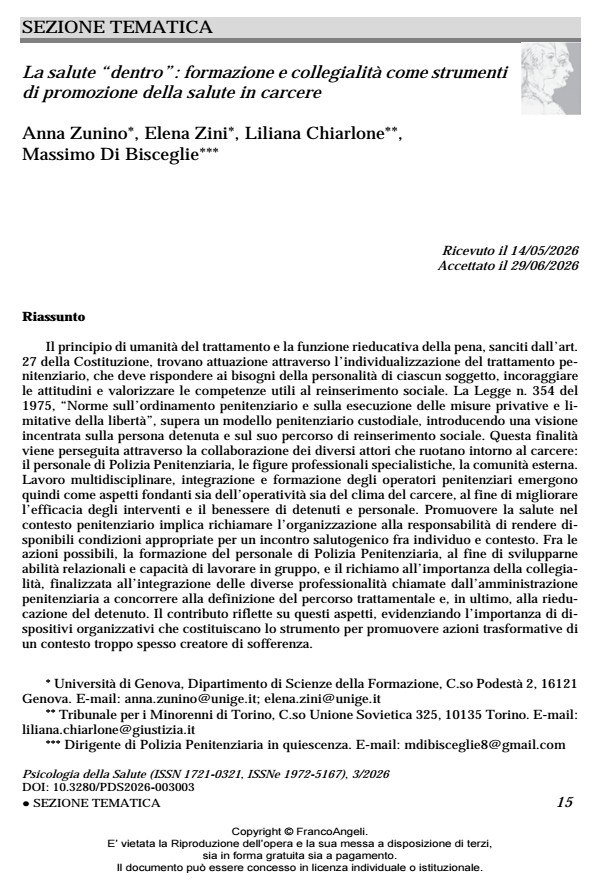
Below, you can see the article first page
If you want to buy this article in PDF format, you can do it, following the instructions to buy download credits
FrancoAngeli is member of Publishers International Linking Association, Inc (PILA), a not-for-profit association which run the CrossRef service enabling links to and from online scholarly content.
The principle of humanity and the rehabilitative function of punishment, as set out in Article 27 of the Italian Constitution, are put into practice through the individualisation of prison treatment, which must respond to the personal needs of everyone, encourage their aptitudes and develop the skills that may support social reintegration. Law No. 354 of 1975, ‘Provisions on the prison system and the execution of measures depriving or restricting liberty’, moves away from a custodial prison model by introducing an approach centered on the prisoner and their path to social reintegration. This objective is pursued through collaboration between the various stakeholders involved in the prison system, including prison officers, specialist professionals and the wider community. Multidisciplinary work, collegial approach and training prison staff are key features of both operational practice and the prison climate, improving the effectiveness of interventions and the well-being of both prisoners and staff. Promoting health within the prison setting involves holding the organisation accountable for ensuring that appropriate conditions are in place to facilitate a health-promoting interaction between the individual and their environment. Possible measures include training prison staff to develop their interpersonal skills and ability to work in a team, and emphasising the importance of collaboration, with a view to integrating the various professional roles called upon by the prison service to contribute to the development of the treatment programme and, ultimately, to the rehabilitation of the prisoner. This contribution reflects on these aspects, highlighting the importance of organisational arrangements that serve as a means of promoting transformative action within a context that all too often causes suffering.
Keywords: prison, rehabilitation, training, collegiality, prison officers, health promotion.
- Antigone (2026). Tutto chiuso. XXII Rapporto di Antigone sulle condizioni di detenzione [Completely Closed. Antigone’s 22nd Report on Detention Conditions]. Retrieved from: https://www.rapportoantigone.it/ventiduesimo-rapporto-sulle-condizioni-di-detenzione/
- Baudino M. (2014). La polizia penitenziaria tra sovraffollamento carcerario e burnout: il dibattito interno [Prison officers caught between prison overcrowding and burnout: the internal debate]. Rivista di Criminologia, Vittimologia e Sicurezza, 8: 2.
- Boudoukha A.H., Emin Altintas E., Rusinek S., Fantini-Hauwel C., & Hautekeete M. (2013). Inmates-to-Staff Assaults, PTSD and Burnout: Profiles of Risk and Vulnerability. Journal of Interpersonal Violence, 28(11): 2332-2350. DOI: 10.1177/088626051247531
- Braibanti P. (2013). La Sanità Penitenziaria: prospettive di progettazione integrata e organizzazione coordinata degli interventi di tutela e promozione della salute in carcere [Healthcare in prison: prospects for integrated planning and coordinated organisation of health protection and promotion initiatives in prisons]. Università degli Studi di Bergamo, 5 aprile 2013.
- Braibanti P. (2015). Ripensare la salute [Rethinking Psychology]. Milano: FrancoAngeli.
- Braibanti P. (2026). Se non ora, quando? Manifesto per la psicologia di territorio e il welfare della presenza [If not now, when? A manifesto for territory psychology and the welfare of presence]. Aprile 2026.
- Brend D. M., Herttalampi M., & Sprang G. (2025). Correctional officer experiences of moral distress, trauma-informed organizational practices, and structural stigma. Traumatology, 31(4): 634-644.
- Corleone F., Anastasia S, Fiorentini L., Perduca M., & Cianchella M. (a cura di) (2026). E non sono pazzi - Diciassettesimo Libro Bianco sulle Droghe [And they’re not mad – The 17th White Paper on Drugs]. Retrieved from: https://www.fuoriluogo.it/mappamondo/e-non-sono-pazzi-xvii-libro-bianco-sulle-droghe/
- Costa V., Monteiro S., Cunha A.I., Pereira H., & Esgalhado G. (2024). Job stress and burnout among prison staff: a systematic literature review. Journal of Criminal Psychology, 14(2): 196-212. DOI: 10.1108/JCP-10-2023-0067/FULL/PDF
- Costituzione della Repubblica Italiana [The Constitution of the Italian Republic]. (1948).
- D’Angelo C., Gozzoli C., Gazzaroli D., & Mezzanotte D. (2018) Experiences and consequences on prison police’s well-being. WORLD FUTURES, 74 (6): 360-378. DOI: 10.1080/02604027.2018.144590
- DPR 29 aprile 1976, n. 431. Approvazione del regolamento di esecuzione della legge 26 luglio 1975, n. 354, recante norme sull’ordinamento penitenziario e sulle misure privative e limitative della libertà [Approval of the implementing regulation for Law No. 354 of 26 July 1975, containing rules on the prison system and on measures involving deprivation or restriction of liberty].
- Gadamer H.G. (1994). Dove si nasconde la salute [Where health lies hidden]. Milano: Cortina
- Garante Nazionale dei diritti delle Persone private della Libertà personale (GNPL) (2025). Report. Un’analisi dei decessi in carcere [Report. An analysis of deaths in prison]. Retrieved from: www.garantenazionaleprivatiliberta.it/gnpl/page/it/analisi_dei_decessi_in_ carcere_anno2025?contentId=APR37837#allegati
- Kelly D., & Potter J. (2023). Professional boundary violations in prisons: a scoping review of the literature”. Journal of Criminal Psychology, 13(3): 190-208. DOI: 10.1108/JCP-04-2022-0012
- Konyk K., & Ricciardelli R. (2023). Tough lessons: Pathways toward correctional officer resilience and growth. Traumatology, 29(3): 340-351.
- Legge 26 luglio 1975, n. 354. Norme sull’ordinamento penitenziario e sulla esecuzione delle misure privative e limitative della libertà [Regulations on the prison system and the execution of measures involving deprivation or restriction of liberty].
- Legge 15 dicembre 1990, n. 395. Ordinamento del Corpo di Polizia Penitenziaria [Regulations of the Prison Staff].
- Maculan A., & Rodelli M. (2023). Prison officers and esprit de corps. Ingroup and outgroup relationships in prison. Punishment & Society, 25(4): 1023-1041. DOI: 10.1177/1462474522112925
- McKenzie G., & Wright K. A. (2024). The effects of peer inclusion in the design and implementation of university prison programming: A participatory action research, randomized vignette study. Psychiatric Rehabilitation Journal, 47(1): 30-36.
- Marinucci M., Tortù I., Traversa T., Pancani L., & Riva P. (2025). Transforming prison culture: supportive norms enhance prison officers’ well-being and prosociality toward detained people. Journal of Criminal Psychology, 15(7): 15-30. DOI: 10.1108/JCP-12-2024-014
- Meringolo P. (a cura di) (2001). Il lavoro di comunità nel sistema penale [Community work in the penal system]. Milano: FrancoAngeli.
- Ministero della Giustizia (2025). Linee guida – Azioni di supporto psicologico rivolte al personale di Polizia penitenziaria [Psychological support initiatives for prison staff]. Retrieved from: https://www.giustizia.it/giustizia/page/it/pubblicazioni_studi_ricerche_testo_selezionato?contentId=SPS1486109
- Ministero della Giustizia (2026) Osservazione e trattamento [Observation and Treatment]. Retrieved from: https://www.giustizia.it/giustizia/page/it/itinerari_a_tema_osservazione_trattamento_in_carcere
- Patrizi P. (a cura di) (2024). La giustizia riparativa. Psicologia e diritto per il benessere di persone e comunità [Restorative justice: psychology and law for the well-being of individuals and communities]. Roma: Carocci.
- Rania N., Migliorini L., & Coppola, I. (2020). A qualitative study of Organizational and Psychosocial Factors in the Burnout of Italian Correctional Officers. The Prison Journal, 100(6), 747-768. DOI: 10.1177/003288552096824
- Ricks E. P., & Eno Louden J. (2015). The relationship between officer orientation and supervision strategies in community corrections. Law and Human Behavior, 39(2): 130-141.
- Saita E. (2015). Istituzioni penitenziarie: processi trasformativi e benessere [Prison institutions: processes of transformation and well-being]. Narrare i Gruppi [Narrate the Groups], 10(3): 227-231.
- Santorso S. (2021). Rehabilitation and dynamic security in the Italian prison: challenges in transforming prison officers’ roles. British Journal of Criminology, 61: 1557-1574.
- UN (2015). United Nations Standard Minimum Rules for the Treatment of Prisoners (the Nelson Mandela Rules). Resolution adopted by the General Assembly on 17 December 2015, 70/175.
- UN (2021). United Nations System Common Position on Incarceration. United Nations.
- UNODC (2024). Prison Matters 2024: Global Prison Population and Trends; A Focus on Rehabilitation. United Nations.
- Valera P., Malarkey S., Owens M., Sinangil N., Bhakta S., & Chung T. (2024). Remote mental health first aid training for correctional officers: A pilot study. Psychological Services, 21(2): 328-336.
- Voller F., Silvestri C., Martino G., Fanti E., Bazzerla G., Ferrari F., Grignani M., Libianchi S., Pagano A.M., Scarpa F., Cristina Stasi C., & Di Fiandra T. (2016). Health conditions of inmates in Italy. BMC Public Health, 16:1162.
- WHO (1946). Constitution of the World Health Organization (Off. Rec. Wld Hlth Org., 2, 100).
- WHO (2019). Status report on prison health in the WHO European Region. Copenhagen: WHO Regional Office for Europe. Licence: CC BY-NC-SA 3.0 IGO.
- WHO (2021). The WHO Prison Health Framework: a framework for assessment of prison health system performance. Copenhagen: WHO Regional Office for Europe. Licence: CC BY-NC-SA 3.0 IGO.
- WHO (2024). The Amsterdam conclusions: mental health and well-being in prisons and other detention centres – Amsterdam, Netherlands (Kingdom of the), 18-19 April 2024. Copenhagen: WHO Regional Office for Europe; 2025. Licence: CC BY-NC-SA 3.0 IGO.
Anna Zunino, Elena Zini, Liliana Chiarlone, Massimo Di Bisceglie, La salute “dentro”: formazione e collegialità come strumenti di promozione della salute in carcere in "PSICOLOGIA DELLA SALUTE" 3/2026, pp 15-27, DOI: 10.3280/PDS2026-003003