Beyond the walls. Parenting as a salutogenic resource between the prison institution and the community
Journal title PSICOLOGIA DELLA SALUTE
Author/s Alessia Liga, Daniela Scarpetta, Cinzia Gabrielli
Publishing Year 2026 Issue 2026/3
Language Italian Pages 14 P. 42-55 File size 118 KB
DOI 10.3280/PDS2026-003005
DOI is like a bar code for intellectual property: to have more infomation
click here
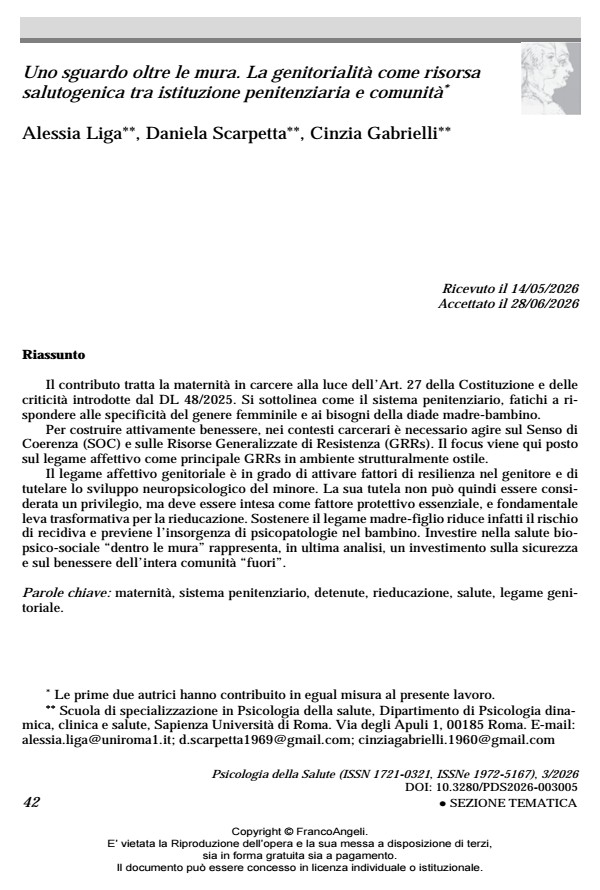
Below, you can see the article first page
If you want to buy this article in PDF format, you can do it, following the instructions to buy download credits
FrancoAngeli is member of Publishers International Linking Association, Inc (PILA), a not-for-profit association which run the CrossRef service enabling links to and from online scholarly content.
This paper explores motherhood in prison through the lens of Article 27 of the Italian Constitution and the critical issues introduced by DL 48/2025. It emphasizes how the penitentiary system struggles to address female gender specificities and the needs of the mother-child dyad. To actively foster well-being in correctional settings, it is necessary to intervene on the Sense of Coherence (SOC) and Generalized Resistance Resources (GRRs). The focus here is placed on the affective bond as the primary GRR in a structurally hostile environment. The parental affective bond can activate resilience factors in the parent and safeguard the neuropsychological development of the minor. Safeguarding this bond should not, therefore, be considered a privilege; rather, it must be understood as an essential protective factor and a fundamental transformative lever for rehabilitation. Indeed, supporting the mother-child tie reduces the risk of recidivism and prevents the onset of psychopathology in the child. Ultimately, investing in bio-psycho-social health “inside the walls” represents an investment in the safety and well-being of the entire community “outside”.
Keywords: Motherhood; Prison system; Incarcerated women; Rehabilitation; Health; Parental bond.
- Allegranti D. (2026, 21 giugno). Madri e figli in carcere. Norme da cambiare. La Nazione. Retrieved from: https://www.lanazione.it/pecore-elettriche/madri-e-figli-in-carcere-norme-da-cambiare-o8y2q8ah
- Antonovsky A. (1979). Health, stress, and coping. San Francisco: Jossey-Bass.
- Antonovsky A. (1987). Unraveling the mystery of health: How people manage stress and stay well. San Francisco: Jossey-Bass.
- Ainsworth M.D.S. (2006). Modelli di attaccamento e sviluppo della personalità. Scritti scelti (D. Sarracino, Trad.). Milano: Raffaello Cortina.
- Associazione Antigone (2026). Tutto chiuso: XXII Rapporto sulle condizioni di detenzione. Associazione Antigone ONLUS. https://www.rapportoantigone.it/.
- Associazione Antigone (2024). Nodo alla gola: Ventesimo rapporto sulle condizioni di detenzione. https://www.rapportoantigone.it/ventesimo-rapporto-sulle-condizioni-di-detenzione/
- Bion W.R. (1962). Learning from experience. London: William Heinemann Medical Books.
- Boss P. (2006). Loss, trauma, and resilience: Therapeutic work with ambiguous loss. New York, NY: W. W. Norton & Company.
- Bouregba A. (2011). Quando il genitore è in carcere, l’impatto sul bambino (Quaderno n. 1). Milano: Bambinisenzasbarre.
- Bowlby J. (1944). Forty-four juvenile thieves: Their characters and home-life. International Journal of Psycho-Analysis, 25: 19-53, 107-128.
- Bowlby J. (1969). Attaccamento e perdita: Vol. 1. L’attaccamento alla madre. Torino: Boringhieri.
- Bowlby J. (1988). Una base sicura: Applicazioni cliniche della teoria dell’attaccamento. Milano: Raffaello Cortina.
- Bronfenbrenner U. (1979). The ecology of human development: Experiments by nature and design. Cambridge, MA: Harvard University Press.
- Bruni, A. (a cura di). (2013). Psicologi “dietro” le sbarre. Appunti di psicologia penitenziaria. Macerata: Edizioni Simple.
- Bruner J.S. (1992). La ricerca del significato. Per una psicologia culturale (E. d’Erme, Trad.). Torino: Bollati Boringhieri. (Opera originale pubblicata 1990).
- Buffa P. (2015). Umanizzare il carcere. Diritti, resistenze, contraddizioni ed opportunità: un percorso finalizzato alla restituzione della dignità ai detenuti. Roma: Laurus Robuffo.
- Cassidy J., Ziv Y., Stupica B., Sherman L.J., Butler H., Karfgin A., Cooper G., Hoffman K., & Powell, B. (2010). Enhancing the mother-infant relationship in secure accommodation: An attachment-based intervention for incarcerated mothers and their infants. Attachment & Human Development, 12(6): 571-593. DOI: 10.1080/14616734.2010.50198
- Cattarin C. (2012). Maternità in carcere. Aspetti legislativi, psicologici e strategici. Padova: UPSEL Domeneghini.
- Cattarin M. (2012). Maternità ristretta e tutela dei minori: Gli Istituti a Custodia Attenuata (ICAM). Rassegna Penitenziaria e Criminologica, 16(2): 45-68.
- Chiusaroli D. (2024). Dalla fragilità sociale alla resilienza: Il metodo autobiografico per una genitorialità responsiva. Rivista Italiana di Educazione Familiare, 25(2): 41-52.
- Ciuffoletti S. (2014). Le politiche legislative sulla detenzione femminile in Italia. Tra effettività e propaganda. Studi sulla questione criminale, IX, 3: 47-71.
- Clark A., Lancellotta L., & Kennedy T.D. (2025). Parenting interventions for incarcerated mothers. Frontiers in Psychiatry, 16: 1658663.
- Colarieti G. (2025, 5 novembre). Decreto Sicurezza 2025: novità sul rinvio della pena alle madri detenute. GiuridicaMente. https://www.giuridicamente.com/l/decreto-sicurezza-2025-rinvio-pena-madri-detenute/
- Colla E. (2024). Donne detenute con figli in carcere: Dalla genitorialità nell’istituzione totale alla responsività di servizi alternativi. Rivista Italiana di Educazione Familiare, 25(2): 79-91.
- Decreto Legge 11 aprile 2025, n. 48 (2025). Disposizioni urgenti in materia di sicurezza urbana, ordinamento penitenziario e tutela della maternità recante modifiche agli articoli 146 e 147 del codice penale. Gazzetta Ufficiale della Repubblica Italiana.
- Demetrio D. (1996). Raccontarsi. L’autobiografia come cura di sé. Raffaello Cortina Editore.
- Duwe G., & Clark V. (2013). Blessed be the social tie that binds: The effects of prison visitation on offender recidivism. Criminal Justice Policy Review, 24(3): 271-296. DOI: 10.1177/088740341142972
- Farrington D.P. (2003). Key results from the first forty years of the Cambridge Study in Delinquent Development. In: Thornberry T.P., & Krohn M.D. (Eds.). Taking stock of delinquency: An overview of findings from contemporary longitudinal studies (pp. 137-183). New York: Kluwer Academic/Plenum Publishers.
- Fava F. (2017). In campo aperto. L’antropologo nei legami del mondo. Milano: Meltemi.
- Goshin L.S., Byrne M.W., & Blanchard-Lewis B. (2014). Preschool outcomes of children who lived as infants in a prison nursery. The Prison Journal, 94: 139-158. DOI: 10.1177/003288551452469
- Gunnar M.R., & Quevedo K.M. (2007). Early care experiences and HPA axis regulation in children: A mechanism for later trauma vulnerability. In: de Kloet R., Oitzl M., & Vermetten E. (Eds.). Stress hormones and post traumatic stress disorder: Basic studies and clinical perspectives. Progress in Brain Research, Vol. 167 (pp. 137-149). Amsterdam: Elsevier.
- Hagan J., & Foster H. (2012). Children of the American prison generation: Student and school consequences of parental incarceration. Law & Society Review, 46(1): 37-69.
- Holt M. (2017). The importance of family contact for children of incarcerated parents. Child and Family Social Work, 22(S1): 54-63.
- Hostinar C.E., Sullivan R.M., & Gunnar M.R. (2014). Psychobiological mechanisms underlying the social buffering of the hypothalamic-pituitary-adrenocortical axis: A review of animal models and human studies across development. Psychological Bulletin, 140(1): 256-282.
- Jones A., Gallagher B., Manby M., Robertson O., Schützwohl M., Berman A. H., Hirschfield A., Ayre E., Urban M., Sharratt K., & Christmann K. (2013). Children of prisoners: Interventions and mitigations to strengthen mental health. COPING Project. https://childrenofprisoners.eu/wp-content/uploads/2019/02/COPINGFinal.pdf
- Kennedy S.C., Mennicke A.M., & Allen C. (2020). ‘I took care of my kids’: Mothering while incarcerated. Health & Justice, 8(1): Articolo 12.
- Iasevoli C. (2025). Il decreto sicurezza n. 48 del 2025 e le disposizioni in materia di ordinamento penitenziario. Archivio Penale, 77(3): 1-18.
- Il Dubbio (2026, 19 giugno). Infanzia reclusa, fallimento finale delle nostre carceri: Parla Susanna Marietti. Il Dubbio News. https://www.ildubbio.news/
- Li L., Xiao J., Zhao W., Zheng Q., Huang X., Shan X., Ming Y., Wang P., Wu Z., Chen H., Menon V., & Duan X. (2025). Mother-child dyadic interactions shape the developing social brain and Theory of Mind in young children. eLife, 14: e103017.
- Lombroso C., & Ferrero G. (1893). La donna criminale.
- Lorenzetti A. (2020). La Corte costituzionale e il percorso di progressiva tutela alla madre detenuta nel suo rapporto con la prole. Note a margine della sentenza n. 18 del 2020. Osservatorio AIC, (3): 632-649.
- Martín Quintana J.C., & Pellegrino G. (2020). Quando si è genitori in carcere. Quali sono le paure e le sfide perché la genitorialità non si interrompa. L’integrazione scolastica e sociale, 19(2): 63-74. DOI: 10.14605/ISS192200
- Masten A.S. (2014). Ordinary magic: Resilience in development. New York: Guilford Press.
- Mazzotta, R. (2019). Genitorialità in carcere e tutela dei figli minori dei detenuti: Profili psicologici e clinici. Rivista di Criminologia e Diritto, 5(2): 112-129.
- McAdams D.P. (2013). The redemptive self: Stories Americans live by (Revised and expanded ed.). New York: Oxford University Press.
- Merhi D., Demou E., & Niedzwiedz C. (2024). Mental health and behavioral interventions for children and adolescents with incarcerated parents: A systematic review. Journal of Child and Family Studies, 33(2): 582-593.
- Mignosi E. (2012). Il corpo e la mente: Prospettive educative e contesti di crescita. Milano: Franco Angeli.
- Mitchell M.M., Spooner K., Jia D., & Zhang Y. (2016). The effect of prison visitation on reentry success: A meta-analysis. Journal of Criminal Justice, 47: 74-83.
- Murray J., & Farrington D.P. (2005). Parental imprisonment: Effects on boys’ antisocial behaviour and delinquency through the life-course. Journal of Child Psychology and Psychiatry, 46(12): 1269-1278.
- Murray, J., Farrington, D. P., & Sekol, I. (2012). Children’s antisocial behavior, mental health, drug use, and educational performance after parental incarceration: A systematic review and meta-analysis. Psychological Bulletin, 138(2): 175-210.
- Murray L. et al. (2010). Attachment and mental health in incarcerated mothers. Journal of Child and Family Studies, 19(2): 154-165.
- Paone F. (2020). Valorizzare le competenze genitoriali pagina dopo pagina. Education Sciences & Society - Open Access, 11(2).
- Paradiso L. (2024). Trasformazioni identitarie nella transizione alla maternità, nelle situazioni di fragilità esistenziale: Il parto in anonimato e il sostegno alla genitorialità nelle comunità mamma-bambino. Rivista Italiana di Educazione Familiare, 25(2): 53-64.
- Poehlmann J., Dallaire D., Loper A.B., & Shear L.D. (2010). Children’s contact with their incarcerated parents: Research findings and recommendations. American Psychologist, 65(6): 575-598.
- Poehlmann J. (2005). Incarcerated Mothers’ Contact with Children, Perceived Family Relationships, and Depressive Symptoms. Journal of Family Psychology, 19(3): 350-357. DOI: 10.1037/0893-3200.19.3.35
- Prakash P., Khurana P., Gupta M., & Madabushi J.S. (2024). Behind prison walls: Critical overview of the mental health trajectories of children living with incarcerated mothers. Cureus, 16(8): Articolo e66935.
- Ronconi S., & Zuffa G. (2014). Recluse: Lo sguardo della differenza femminile sul carcere. Roma: Ediesse.
- Saita E., Bosoni M.L., & Tramontano M. (2022). D3.2: Genitorialità e affetti alla prova della detenzione: Un’indagine empirica. Milano: Università Cattolica del Sacro Cuore.
- Save the Children Italia (2025). Decreto Sicurezza 2025: Le novità della legge e le sfide per i diritti dei minori. Save the Children Blog. https://www.savethechildren.it/blog-notizie/decreto-sicurezza-2025-le-novita-della-legge-e-le-sfide-i-diritti-dei-minori
- Schmid V. (2007). Salute e nascita: La salutogenesi in gravidanza. Urra.
- Serragiotto S. (2015, 7 marzo). La genitorialità in carcere [Presentazione di una relazione]. Convegno “La psicologia penitenziaria tra interventi attuali e prospettive future”, Ordine degli Psicologi dell’Emilia-Romagna, Bologna, Italia. https://www.ordinepsicologier.it/public/genpags/bigs/Lagenitorialitincarcerediapositiveserragiotto.pdf
- Silva C., Lopez A.G., Zizioli E. (2024). Genitorialità responsiva in contesti di fragilità sociale. Rivista Italiana di Educazione Familiare, 25(2): 5-12.
- Smorti A. (1994). Il pensiero narrativo: Costruzione di storie e sviluppo della conoscenza sociale. Firenze: Giunti.
- Taylor J., Majeed T., Remond M., Bagade T., Edwards L., & Sullivan E. (2024). Are custodial-based mothers and children’s units evaluated, effective and aligned with a human rights-based approach? A systematic review of the evidence. EClinicalMedicine, 69: Articolo 102496.
- Tronick E. (2007). The neurobehavioral and social emotional development of infants and children. New York: W. W. Norton & Company.
- Tuerk E.H., & Loper A. (2006), Contact between incarcerated mothers and their children: Assessing parenting stress. Journal of Offender Rehabilitation, 43 (1): 23-43.
- Winnicott D.W. (1965). Sviluppo affettivo e ambiente. Roma: Armando.
- Zizioli E., & Meta C. (2024). La maternità alla prova del carcere: Traiettorie di ricerca. Rivista Italiana di Educazione Familiare, 25(2): 13-24.
Alessia Liga, Daniela Scarpetta, Cinzia Gabrielli, Uno sguardo oltre le mura. La genitorialità come risorsa salutogenica tra istituzione penitenziaria e comunità in "PSICOLOGIA DELLA SALUTE" 3/2026, pp 42-55, DOI: 10.3280/PDS2026-003005