Psychological Well-Being in the Mining Workforce: A Systematic Review
Journal title PSICOLOGIA DELLA SALUTE
Author/s Ruggero Andrisano-Ruggieri, Stefania Mazza, Sergio Miranda, João Santos Baptista, Oktay Sahbaz
Publishing Year 2026 Issue 2026/3
Language English Pages 31 P. 92-122 File size 360 KB
DOI 10.3280/PDS2026-003008
DOI is like a bar code for intellectual property: to have more infomation
click here
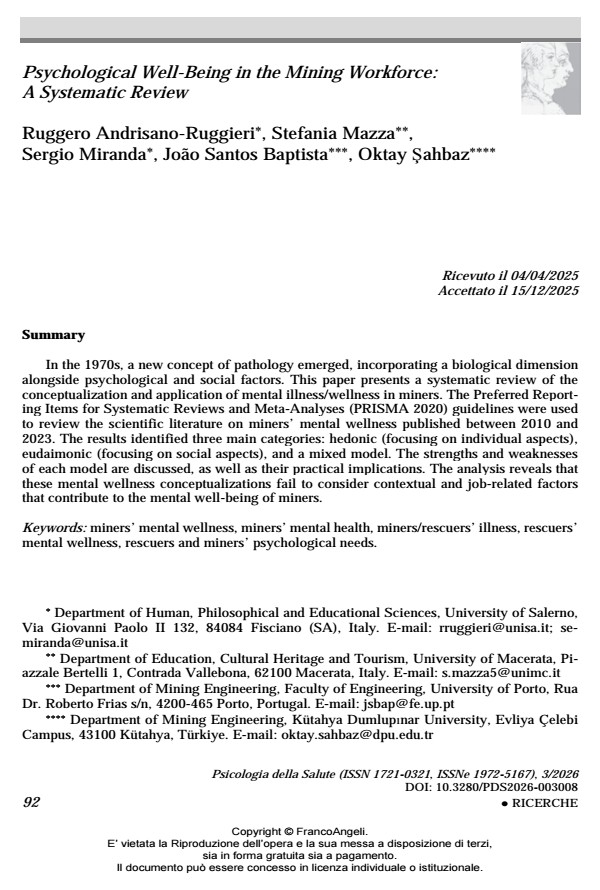
Below, you can see the article first page
If you want to buy this article in PDF format, you can do it, following the instructions to buy download credits
FrancoAngeli is member of Publishers International Linking Association, Inc (PILA), a not-for-profit association which run the CrossRef service enabling links to and from online scholarly content.
In the 1970s, a new concept of pathology emerged, incorporating a biological dimension alongside psychological and social factors. This paper presents a systematic review of the conceptualization and application of mental illness/wellness in miners. The Preferred Reporting Items for Systematic Reviews and Meta-Analyses (PRISMA 2020) guidelines were used to review the scientific literature on miners’ mental wellness published between 2010 and 2023. The results identified three main categories: hedonic (focusing on individual aspects), eudaimonic (focusing on social aspects), and a mixed model. The strengths and weaknesses of each model are discussed, as well as their practical implications. The analysis reveals that these mental wellness conceptualizations fail to consider contextual and job-related factors that contribute to the mental well-being of miners.
Keywords: miners’ mental wellness, miners’ mental health, miners/rescuers’ illness, rescuers’ mental wellness, rescuers and miners’ psychological needs.
- Ryan R.M. & Deci E.L. (2001). On Happiness and Human Potentials: A Review of Research on Hedonic and Eudaimonic Well-Being. Annual Review of Psychology, 52: 141-166.
- Andrisano Ruggieri R., Pozzi M., & Ripamonti S. (2014). Italian Family Business Cultures Involved in the Generational Change. Europe’s Journal of Psychology, 10(1): 79-103.
- Andrisano Ruggieri R., Capunzo M., Crescenzo P., Savastano R., Truda G., Boccia G., & Pennisi M. (2016). Inconsistency of sentinel events and no gender difference in the measurement of work-related stress. SAGE Open, 6(1): 1-13. DOI: 10.1177/215824401662952
- Andrisano Ruggieri R., Crescenzo P., Capunzo M., De Caro F., Savastano R., Pennisi M., & Boccia G. (2017). Understanding the relationship between Sentinel Events and Sourcesof Work Related Stress for prevention programmes. An Italian survey. Giornale Italiano di Medicina del Lavoro ed Ergonomia, 38(2): 39-41.
- Andrisano Ruggieri R., Crescenzo P., Iervolino A., Mossi P., & Boccia G. (2018). Predictability of big five traits in high schoolteacher burnout. Detailed study through the disillusionment dimension. Journal Epidemiology Biostatistics and Public Health, 15: 129231-129237. DOI: 10.2427/1292
- Andrisano Ruggieri R., & Venuleo C. (2019). Clocks, Watch or Something Else? In Ordinary Things and Their Extraordinary Meanings. In: Marsico G., & Tateo G. (Eds.). Annals of Cultural Psychology: Exploring the Frontiers of Mind and Society (pp. 157-182). Charlotte, NC: Information Age Publishing.
- Andrisano Ruggieri R., Iervolino A., Mossi P., Santoro E., & Boccia G. (2020). Instability of Personality Traits of Teachers in Risk Conditions due to Work-Related Stress. Behavioral Sciences, 10: 91-104.
- Asare-Doku W., Rich J., Kelly B., & James C. (2020). Mental health interventions in the mining industry: a narrative review. Mental Health Review Journal, 25(2): 153-167. DOI: 10.1108/MHRJ-10-2019-003
- Asare B.Y.A., Kwasnicka D., & Powell D. (2021). Robinson, S. Health and well-being of rotation workers in the mining, offshore oil and gas, and construction industry: a systematic review. BMJ Glob. Health, 6.
- Asare-Doku W., Rich J., Kelly B., & James C. (2022). Amponsah-Tawiah, K. “Mental health is not our core business”: A qualitative study of mental health supports in the Ghanaian mining industry. Safety Science, 145.
- Bialecki M., & Burzynski M. (2012). Snowballing as a technique for gathering bibliographic data in research on innovation. Management & Education, 1(2): 101-108.
- Blascovich J., & Mendes W. B. (2000). Challenge and threat appraisals: The role of affective cues. In: Forgas J.P. (Ed.), Feeling and thinking: The role of affect in social cognition (pp. 59-82). Cambridge: Cambridge University Press.
- Bryman A. (2012). Social research methods. Oxford: Oxford University Press.
- Cesaro M., Andrisano Ruggieri R., & Pecoraro N. (2010). Meaning systems. Their practical implications due to a recursive function between action and thought. In: Salvatore S., Valsiner J., Travers S.J., & Gennaro A. (Eds.). Yearbook of Idiographic Science. Vol. 3 (pp. 129-135). Roma: Firera & Liuzzo Group.
- Charika Wickramarathne P.D.V., Phuoc J.C., & Albattat A.R.S. (2020). A review of wellness dimension models: for the advancement of the society. European Journal of Social Science, 5(1): 185-198.
- Considine R., Tynan R., James C., Wiggers J., Lewin T., Inder K., Perkins D., Handley T., & Kelly B. (2017). The Contribution of Individual, Social and Work Characteristics to Employee Mental Health in a Coal Mining Industry Population. PLOS ONE, 12(1).
- Diener E., Suh E.M., Lucas R.E., & Smith H.L. (1999). Subjective well-being: Three decades of progress. Psychological Bulletin, 125(2): 276-302. DOI: 10.1037/0033-2909.125.2.27
- Costa P.T. Jr, & McCrae R.R. (1992). Revised NEO Personality Inventory (NEO-PI-R) and NEO Five-Factor Inventory (NEO-FFI) Professional Manual. Odessa, FL: Psychological Assessment Resources.
- Dunaeva V. (2018). New Approaches in Social Well-Being studies. PEOPLE: International Journal of Social Science, 4(3): 566-573.
- Dunn H.L. (1961). High Level Wellness. Arlington, VA: R.W. Beatty.
- Engel G.L. (1977). The need for a new medical model: a challenge for biomedicine. Science, 8(196): 129-136.
- Fair S.E. (2009). Wellness and Physical Therapy. Sudbury, MA: Jones & Bartlett Publishers, p. 9.
- Gardner B., Alfrey K.L., Vandelanotte C., & Rebar A.L. (2018). Mental health and well-being concerns of fly-in fly-out workers and their partners in Australia: a qualitative study. BMJ Open, 8(3): e019516.
- Green B.N., Johnson C.D., & Adams A. (2006). Writing narrative literature reviews for peer-reviewed journals: Secrets of the trade. Journal of Chiropractic Medicine, 5(3): 101-117.
- Jackson L., van de Vijver F., & Burckard A. (2011). Adverse Acculturation Conditions and Well-Being of Mine Employees in the North-West Province. Journal of Psychology in Africa, 21(3): 385-396. DOI: 10.1080/14330237.2011.1082047
- Joaquim A.C., Lopes M., Stangherlin L., Castro K., Bisognin Ceretta L., Cassiano Longen W., Ferraz F., & Schweigert Perry I.D. (2018). Mental health in underground coal miners. Archives of Environmental & Occupational Health, 73(6): 334-343. DOI: 10.1080/19338244.2017.141132
- Keyes C.L.M. (1998). Social Well-Being. Social Psychology Quarterly, 61(2): 121-140. DOI: 10.2307/278706
- Keyes C.L.M. (2002). The Mental Health Continuum: From Languishing to Flourishing in Life. Journal of Health and Social Behavior, 43(2): 207-222. DOI: 10.2307/309019
- Keyes C.L.M., & Saphiro A.D. (2004). Social well-being in the United States: A descriptive epidemiology. In: Brim O. & Ryff C. (Eds.). How healthy are we: A national study of well-being at midlife (pp. 350-373). Chicago: University of Chicago Press.
- Kowalski-Trakofler K.M., & Vaught C. (2012). Psycho-Social Issues in Mine Emergencies: The Impact on the Individual, the Organization and the Community. Minerals, 2(2): 129-168.
- Lambert, L., Passmore, H.-A., & Holder, M. D. (2015). Foundational frameworks of positive psychology: Mapping well-being orientations. Canadian Psychology, 56(3), 311-321.
- Lamers S.M.A., Westerhof G.J., Kovács V., & Bohlmeijer E.T. (2012). Differential relationships in the association of the big five personality traits with positive mental health and psychopathology. Journal of Research in Personality, 46(5): 517-524.
- Lazarus R.S. (1991). Emotion and adaptation. New York: Oxford University Press.
- Lazarus R.S., & Folkman S. (1984). Stress, appraisal, and coping. New York: Springer Publishing Company.
- Li J.Z., Zhang Y.-P., Wang X.-J., Feng G.-R., Zhang B.-S., Wang T.-R., Liu X.-G., & Qu J.J. (2017). Relationship Research between Subjective Well-being and Unsafe Behaviour of Coal Miners. Eurasia Journal of Mathematics, Science and Technology Education, 13(11): 7215-7221.
- Liu L., Wang L., & Chen J. (2014). Prevalence and Associated Factors of Depressive Symptoms among Chinese Underground Coal Miners. BioMed Research International, 2014(1): 987305. DOI: 10.1155/2014/98730
- Liu L., Wen F., Xu X., & Wang L. (2015). Effective resources for improving mental health among Chinese underground coal miners: Perceived organizational support and psychological capital. The Journal of Occupational Health, 57: 58-68.
- Manic S., Janjic V., Dejanovic S.D., Aleksic A., Aleksic Z., Jaredic B., & Krkic M. (2017). Burnout, Depression and Proactive Coping in Underground Coal Miners in Serbia - Pilot Project. Serb. Journal of Experimental and Clinical Cancer Research, 18(1): 45-52.
- Mclean K.N. (2012). Mental health and well-being in resident mine workers: Out of the fly-in fly-out box. Australian Journal of Rural Health, 20: 126-130.
- Miller J.W. (2005). Wellness: The History and Development of a Concept. Spektrum Freizeit, 1: 84-102.
- Misan G.M., & Rudnik E. (2015). The pros and cons of long-distance commuting: comments from South Australian mining and resource workers. Journal of Economic and Social Policy, 17(1).
- Moher D., Liberati A., Tetzlaff J., Altman D.G., & PRISMA Group (2009). Preferred reporting items for systematic reviews and meta-analyses: the PRISMA statement. PLoS medicine, 6(7): e1000097.
- Page M.J., McKenzie J.E., Bossuyt P.M., Boutron I., Hoffmann T.C., Mulrow C.D., Shamseer L., Tetzlaff J.M., Akl E.A., Brennan S E., Chou R., Glanville J., Grimshaw J.M., Hróbjartsson A., Lalu M.M., Li T., Loder E.W., Mayo-Wilson E., McDonald S., . . . Moher D. (2021). The PRISMA 2020 statement: An updated guideline for reporting systematic reviews. BMJ, 372, Article n. 71.
- Nakamura J., & Csikszentmihalyi M. (2014). The Concept of Flow. In Flow and the foundations of Positive Psychology (pp. 239-263). Dordrecht, Netherlands: Springer.
- Plomin R., & Nesselroade J.R. (1990). Behavioural genetics and personality change. Journal of Personality, 58(1): 191-220.
- Ryan R.M., & Deci E.L. (2000). Self-determination theory and the facilitation of intrinsic motivation, social development, and well-being. American Psychology, 55(1): 68-78.
- Ryan R.M., & Deci E.L. (2020). Intrinsic and extrinsic motivation from a self-determination theory perspective: Definitions, theory, practices, and future directions. Contemporary Educational Psychology, 61.
- Ryan R.M., & Deci E.L. (2022). Self-Determination Theory. In F. Maggino (Ed.) Encyclopedia of Quality of Life and Well-Being Research (pp. 1-7). Cham, Switzerland: Springer.
- Ryff C.D. (1989). Happiness is everything, or is it? Explorations on the meaning of psychological well-being. Journal of Personality and Social Psychology, 57(6): 1069-1081. DOI: 10.1037/0022-3514.57.6.106
- Ryff C.D. (2014). Psychological well-being revisited: advances in the science and practice of eudaimonia. Psychotherapy and Psychosomatics, 83(1): 10-28. DOI: 10.1159/00035326
- Ryff C.D. (2017). Eudaimonic well-being, inequality, and health: Recent findings and future directions. International Economic Review, 64(2): 159-178.
- Salas M.L., Quezada S., Basagoitia A., Fernandez T., Herrera R., Parra M., Moraga Muñoz D., Weigl M., & Radon K. (2015). Working Conditions, Workplace Violence, and Psychological Distress in Andean Miners: A Cross-sectional Study Across Three Countries. Annals of Global Health, 81(4): 465-474.
- Salvatore S., & Scotto di Carlo M. (2012). L’intervento psicologico per la scuola. Modelli, metodi, strumenti. Roma: Firera & Liuzzo Publishing.
- Schein E.H. (1984). Coming to a new awareness of organizational culture. Sloan Management Review, 25(2): 3-16.
- Schein E.H. (1987). Defining organizational culture. In: Shafritz J.M., Ott J.S. & Jang Y.S. (Eds.) (2nd ed.), Classics of organizational theory (pp. 381-396). Chicago: The Dorsey Press.
- Schnipke J.L., & Scrams D.J. (1997). Linking research and practice: A meta-analytic review of the effectiveness of the DARE program. Evaluation Review, 21(3): 309-337.
- Seligman M.E.P. (1975). Helplessness: On depression, development, and death. San Francisco: W.H. Freeman.
- Seligman M.E.P., & Csikszentmihalyi M. (2000). Positive psychology: An introduction. American Psychologist, 55(1): 5-1. DOI: 10.1037/0003-066X.55.1.
- Seligman M.E.P. (2002). Authentic Happiness: Using the New Positive Psychology to Realize Your Potential for Lasting Fulfillment. New York: Free Press.
- Seligman M.E.P. (2008). Positive Psychology: An Introduction. In: Lopez S.J., & Snyder C.R. (Eds.). The Oxford Handbook of Positive Psychology (pp. 3-12). New York: Oxford University Press.
- Seligman M.E.P. (2011). What Is Well-Being? In: Flourish: A visionary new understanding of happiness and well-being (pp. 5-28). New York: Free Press.
- Strümpfer D.J.W., Eiselen R.J., Meiring D., & Phalatse J.S. (2010). Validating Measures of Psychological Well-being by Contrasting Samples Employed in Hazardous and Less Hazardous Work. Journal of Psychology in Africa, 20(1): 23-31. DOI: 10.1080/14330237.2010.1082033
- Torkington A.M., Larkins S., & Gupta T.S. (2011). The psychosocial impacts of fly-in fly-out and drive-in drive-out mining on mining employees: A qualitative study. Australian Journal of Rural Health, 19(3): 135-141.
- Travis J.W. (n.d.). The Wellspring. https://www.thewellspring.com/wellspring/introduction-to-wellness/357/key-concept-1-the-illnesswellness-continuum.cfm.html (accessed on 15 February 2024).
- Turner R., & Rubin M. (2022). Issues affecting mental health at a fly-in-fly-out mine site: A subjective impact ratings approach. Journal of Applied Social Psychology, 52(11): 1045-1116.
- Tynan R.J., Considine R., Rich J.L., Skehan J., Wiggers J., Lewin T.J., James C., Inder K., Baker A.L., Kay-Lambkin F., Perkins D., & Kelly B.J. (2016). Help-seeking for mental health problems by employees in the Australian Mining Industry. BMC Health Services Research, 16(498).
- Tynan R.J., James C., Considine R., Skehan J., Gullestrup J., Lewin T.J., Wiggers J., & Kelly B.J. (2018). Feasibility and acceptability of strategies to address mental health and mental ill-health in the Australian coal mining industry. International Journal of Mental Health Systems, 12(66).
- Venuleo C., Salvatore G., Andrisano Ruggieri R., Marinaci T., Cozzolino M., & Salvatore S. (2020). Steps towards a unified theory of psychopathology: The Phase Space of Meaning model. Clinical Neuropsychiatry, 17: 236-252.
- Waterman A.S., Schwartz S.J., Zamboanga B.L., Ravert R.D., Williams M.K., Bede Agocha V., Kim S.Y., & Donnellan M.B. (2010). The Questionnaire for Eudaimonic Well-Being: Psychometric properties, demographic comparisons, and evidence of validity. Journal of Positive Psychology, 5(1): 41-61. DOI: 10.1080/1743976090343520
- Wohlin C. (2014). Guidelines for snowballing in systematic literature studies and a replication in software engineering. In Proceedings of the 18th International Conference on Evaluation and Assessment in Software Engineering (pp. 1-10). New York: Association for Computing Machinery.
- Yanyu G., & Jizu L. (2022). The effect of emotional intelligence on unsafe behaviour of miners: the role of emotional labour strategies and perceived organizational support. International Journal of Occupational Safety and Ergonomics, 29(2): 515-527. DOI: 10.1080/10803548.2022.205592
- Yu M., Quin W., & Li J. (2022). The influence of psychosocial safety climate on miners’ safety behaviour: A cross-level research. Safety Science, 150.
Ruggero Andrisano-Ruggieri, Stefania Mazza, Sergio Miranda, João Santos Baptista, Oktay Sahbaz, Psychological Well-Being in the Mining Workforce: A Systematic Review in "PSICOLOGIA DELLA SALUTE" 3/2026, pp 92-122, DOI: 10.3280/PDS2026-003008