Female ADHD and the Professional Context: A Narrative Literature Review
Journal title PSICOLOGIA DELLA SALUTE
Author/s Valentina Tirelli, Elisa Serafini, Maristella Scorza, Deborah Toscani
Publishing Year 2026 Issue 2026/3
Language Italian Pages 23 P. 123-145 File size 244 KB
DOI 10.3280/PDS2026-003009
DOI is like a bar code for intellectual property: to have more infomation
click here
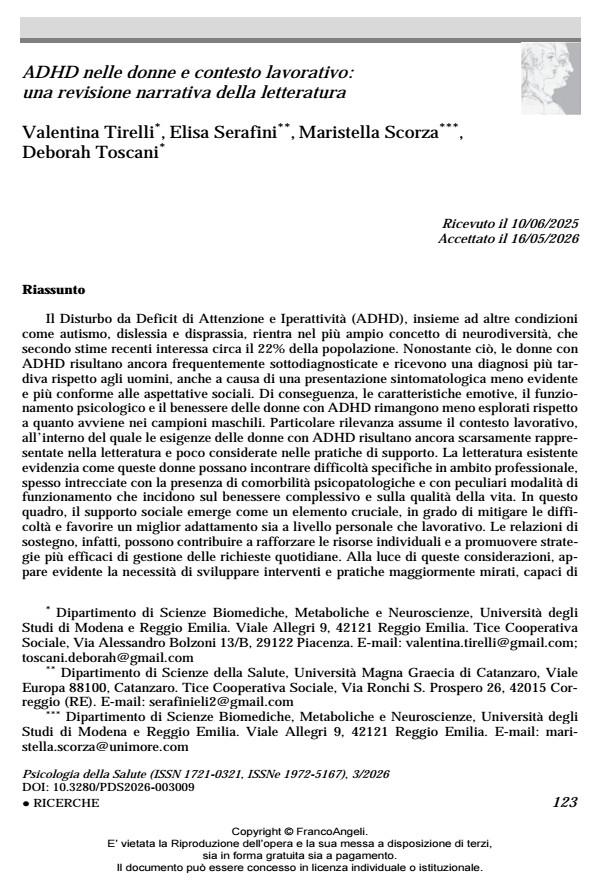
Below, you can see the article first page
If you want to buy this article in PDF format, you can do it, following the instructions to buy download credits
FrancoAngeli is member of Publishers International Linking Association, Inc (PILA), a not-for-profit association which run the CrossRef service enabling links to and from online scholarly content.
Attention-Deficit Hyperactivity Disorder (ADHD), together with other conditions such as autism, dyslexia, and dyspraxia, falls within the broader concept of neurodiversity, which recent estimates suggest affects approximately 22% of the population. Despite this, women with ADHD remain frequently underdiagnosed and tend to receive a diagnosis later than men, partly due to a less overt symptom presentation that is often more aligned with social expectations. Consequently, the emotional characteristics, psychological functioning, and overall well-being of women with ADHD remain less explored compared to male samples. Particular attention should be given to the workplace context, where the needs of women with ADHD are still underrepresented in the literature and insufficiently addressed in support practices. Existing research highlights that these women may encounter specific professional challenges, often intertwined with the presence of psychopathological comorbidities and distinct patterns of functioning that can negatively impact overall well-being and quality of life. Within this framework, social support emerges as a crucial factor in mitigating difficulties and promoting better adjustment at both personal and occupational levels. Supportive relationships can strengthen individual resources and foster more effective strategies for managing daily demands. In light of these considerations, there is a clear need to develop more targeted interventions and practices that address the specific needs of women with ADHD. A multidimensional approach, encompassing psychological, social, and occupational aspects, is essential to enhance psychological well-being, support adaptive functioning, and enable these women to fully realize their potential.
Keywords: ADHD, Women, Workplace inclusion, Comorbidity.
- Ahlberg R., Du Rietz E., Ahnemark E., Andersson L.M., Werner-Kiechle T., Lichtenstein P., … & Garcia-Argibay M. (2023). Real-life instability in ADHD from young to middle adulthood: a nationwide register-based study of social and occupational problems. BMC psychiatry, 23(1): 336.
- American Psychiatric Association (2013). Diagnostic and statistical manual of mental disorders (5th ed.). Arlington, VA: American Psychiatric Publishing.
- Anker E., Bendiksen B., & Heir T. (2018). Comorbid psychiatric disorders in a clinical sample of adults with ADHD, and associations with education, work and social characteristics: a cross-sectional study. BMJ open, 8(3): e019700.
- Anker E., Halmøy A., & Heir T. (2019). Work participation in ADHD and associations with social characteristics, education, lifetime depression, and ADHD symptom severity. ADHD Attention Deficit and Hyperactivity Disorders, 11: 159-165.
- Attoe D.E., & Climie E.A. (2023). Miss. Diagnosis: A systematic review of ADHD in adult women. Journal of attention disorders, 27(7): 645-657. DOI: 10.1177/1087054723116153
- Babinski D.E., Neely K.A., Ba D.M., & Liu G. (2020). Depression and suicidal behavior in young adult men and women with ADHD: evidence from claims data. The Journal of clinical psychiatry, 81(6): 19m13130.
- Babinski D.E., Pelham Jr W.E., Molina B.S., Gnagy E.M., Waschbusch D.A., Yu J., ... & Karch K.M. (2011). Late adolescent and young adult outcomes of girls diagnosed with ADHD in childhood: An exploratory investigation. Journal of Attention Disorders, 15(3): 204-214. DOI: 10.1177/1087054710361586
- Babinski D.E., Pelham Jr W.E., Molina B.S., Waschbusch D.A., Gnagy E.M., Yu J., ... & Biswas A. (2011). Women with childhood ADHD: Comparisons by diagnostic group and gender. Journal of psychopathology and behavioral assessment, 33(4): 420-429.
- Barkley R.A. (2015). Educational, occupational, dating and marital, and financial impairments in adults with ADHD. In: Barkley R.A. (Ed.), Attention-deficit hyperactivity disorder: A handbook for diagnosis and treatment (4th ed., pp. 314-342). New York: The Guilford Press.
- Beaton D.M., Sirois F., & Milne E. (2022). Experiences of criticism in adults with ADHD: A qualitative study. Plos one, 17(2): e0263366.
- Bradley S., Parzych I., Platts J., & Powell L. (2025). Understanding and harnessing differences in women with ADHD: A qualitative study. Neurodiversity, 3: 27546330251317199. DOI: 10.1177/2754633025131719
- Chaulagain A., Lyhmann I., Halmøy A., Widding-Havneraas T., Nyttingnes O., Bjelland I., & Mykletun A. (2023). A systematic meta-review of systematic reviews on attention deficit hyperactivity disorder. European Psychiatry, 66(1): e90.
- Choi W.S., Woo Y.S., Wang S.M., Lim H.K., & Bahk W.M. (2022). The prevalence of psychiatric comorbidities in adult ADHD compared with non-ADHD populations: A systematic literature review. PloS one, 17(11): e0277175.
- Doyle N. (2020). Neurodiversity at work: a biopsychosocial model and the impact on working adults. British medical bulletin, 135(1): 108-125.
- Fredriksen M., Dahl A.A., Martinsen E.W., Klungsoyr O., Faraone S.V., & Peleikis D.E. (2014). Childhood and persistent ADHD symptoms associated with educational failure and long-term occupational disability in adult ADHD. ADHD Attention Deficit and Hyperactivity Disorders, 6: 87-99.
- Freichel R., Zink N., Chang F.Y., Vera J.D., Truong H., Michelini G., ... & Lenartowicz A. (2024). Alpha event-related decreases during encoding in adults with ADHD–An investigation of sustained attention and working memory processes. Behavioural brain research, 469: 115003.
- Hallowell E.M., & Ratey J.J. (2021). ADHD 2.0. New Science and Essential Strategies for Thriving with Distraction from Childhood through Adulthood. Ballantine Books.
- Helgesson M., Kjeldgård L., Björkenstam E., Rahman S., Gustafsson K., Taipale H., ... & Mittendorfer-Rutz E. (2023). Sustainable labour market participation among working young adults with diagnosed attention deficit/hyperactivity disorder (ADHD). SSM-Population Health, 23: 101444.
- Hinshaw S.P., Nguyen P.T., O’Grady S.M., & Rosenthal E.A. (2022). Annual Research Review: Attention-deficit/hyperactivity disorder in girls and women: underrepresentation, longitudinal processes, and key directions. Journal of Child Psychology and Psychiatry, 63(4): 484-496.
- Hinshaw S.P., Owens E.B., Zalecki C., Huggins S.P., Montenegro-Nevado A.J., Schrodek E., & Swanson E.N. (2012). Prospective follow-up of girls with attention-deficit/hyperactivity disorder into early adulthood: continuing impairment includes elevated risk for suicide attempts and self-injury. Journal of consulting and clinical psychology, 80(6), 1041.
- De Oliveira C., Saka M., Bone L., & Jacobs R. (2023). The Role of Mental Health on Workplace Productivity: A Critical Review of the Literature. Applied health economics and health policy, 21(2): 167-193.
- Kelly C.A., Kelly C., & Taylor R. (2024). Review of the psychosocial consequences of attention deficit hyperactivity disorder (ADHD) in females. European Journal of Medical and Health Sciences, 6(1): 10-20.
- Oroian B.A., Nechita P., Marusic R.I., Patra?cu C., & Szalontay A. (2023). Gender dynamics in ADHD: understanding ADHD in females from childhood to adulthood. Bulletin of Integrative Psychiatry, (4): 77.
- Rollnik-Sadowska E., & Grabinska V. (2024). Managing neurodiversity in workplaces: A review and future research agenda for sustainable human resource management. Sustainability, 16(15): 6594.
- Sang K.J., Richards J., & Marks A. (2016). Gender and disability in male-dominated occupations: A social relational model. Gender, Work & Organization, 23(6): 566-581.
- Schreuer N., & Dorot R. (2017). Experiences of employed women with attention deficit hyperactive disorder: A phenomenological study. Work, 56(3): 429-441. DOI: 10.3233/WOR-17250
- Singer J. (1999). Why can’t you be normal for once in your life? From a problem with no name to the emergence of a new category of difference. Disability discourse, 59-67.
- Sukhera J. (2022). Narrative reviews: Flexible, rigorous, and practical. Perspectives on Medical Education, 11(4): 242-245.
- Waite R., & Ivey N. (2009). Promoting culturally sensitive ADHD services for women: an individual example and a call to action. Journal of psychosocial nursing and mental health services, 47(4): 26-33. DOI: 10.3928/02793695-20090401-1
- Yoshida T., Eguchi E., Mashiko H., & Ohira T. (2021). Social Factors for Leading to Life Satisfaction among Residents with Developmental Disorders in Fukushima Prefecture. The Tohoku Journal of Experimental Medicine, 253(2): 113-123.
- Young S., Adamo N., Ásgeirsdóttir B.B., Branney P., Beckett M., Colley W., ... & Woodhouse E. (2020). Females with ADHD: An expert consensus statement taking a lifespan approach providing guidance for the identification and treatment of attention-deficit/hyperactivity disorder in girls and women. BMC psychiatry, 20: 1-27.
- Zaib M., Wang W., Hidellaarachchi D., & Siddiqui I.F. (2025). Invisible Load: Uncovering the Challenges of Neurodivergent Women in Software Engineering. arXiv preprint arXiv:2512.05350.
- Zastudil C., Smith IV D.H., Tohamy Y., Nasimova R., Montross G., & MacNeil S. (2025). Neurodiversity in computing education research: A systematic literature review. In Proceedings of the 30th ACM Conference on Innovation and Technology in Computer Science Education V. 1 (pp. 114-120).
Valentina Tirelli, Elisa Serafini, Maristella Scorza, Deborah Toscani, ADHD nelle donne e contesto lavorativo: una revisione narrativa della letteratura in "PSICOLOGIA DELLA SALUTE" 3/2026, pp 123-145, DOI: 10.3280/PDS2026-003009