Unity and Divergences in the Italian Resistance
Journal title VENTUNESIMO SECOLO
Author/s Tommaso Piffer
Publishing Year 2026 Issue 2026/58
Language Italian Pages 17 P. 167-183 File size 93 KB
DOI 10.3280/XXI2026-058009
DOI is like a bar code for intellectual property: to have more infomation
click here
Below, you can see the article first page
If you want to buy this article in PDF format, you can do it, following the instructions to buy download credits
FrancoAngeli is member of Publishers International Linking Association, Inc (PILA), a not-for-profit association which run the CrossRef service enabling links to and from online scholarly content.
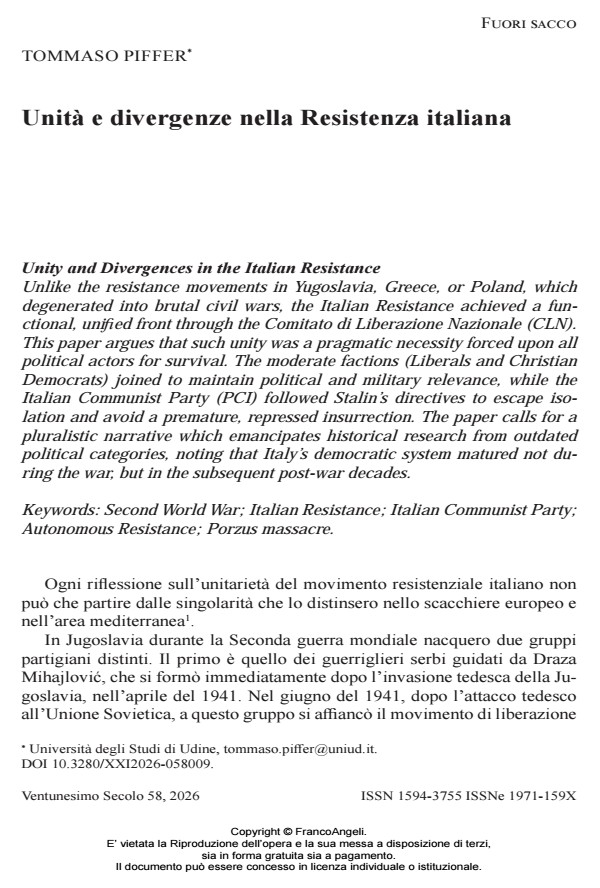
Unlike the resistance movements in Yugoslavia, Greece, or Poland, which degenerated into brutal civil wars, the Italian Resistance achieved a functional, unifi ed front through the Comitato di Liberazione Nazionale (CLN). This paper argues that such unity was a pragmatic necessity forced upon all political actors for survival. The moderate factions (Liberals and Christian Democrats) joined to maintain political and military relevance, while the Italian Communist Party (PCI) followed Stalin’s directives to escape isolation and avoid a premature, repressed insurrection. The paper calls for a pluralistic narrative which emancipates historical research from outdated political categories, noting that Italy’s democratic system matured not during the war, but in the subsequent post-war decades.
Keywords: Second World War; Italian Resistance; Italian Communist Party; Autonomous Resistance; Porzus massacre.
Tommaso Piffer, Unità e divergenze nella Resistenza italiana in "VENTUNESIMO SECOLO" 58/2026, pp 167-183, DOI: 10.3280/XXI2026-058009