Chatbots and mental health: Past, present, and future
Journal title PSICOTERAPIA E SCIENZE UMANE
Author/s Allen Frances
Publishing Year 2026 Issue 2026/4
Language Italian Pages 12 P. 669-680 File size 353 KB
DOI 10.3280/PU2026-004002
DOI is like a bar code for intellectual property: to have more infomation
click here
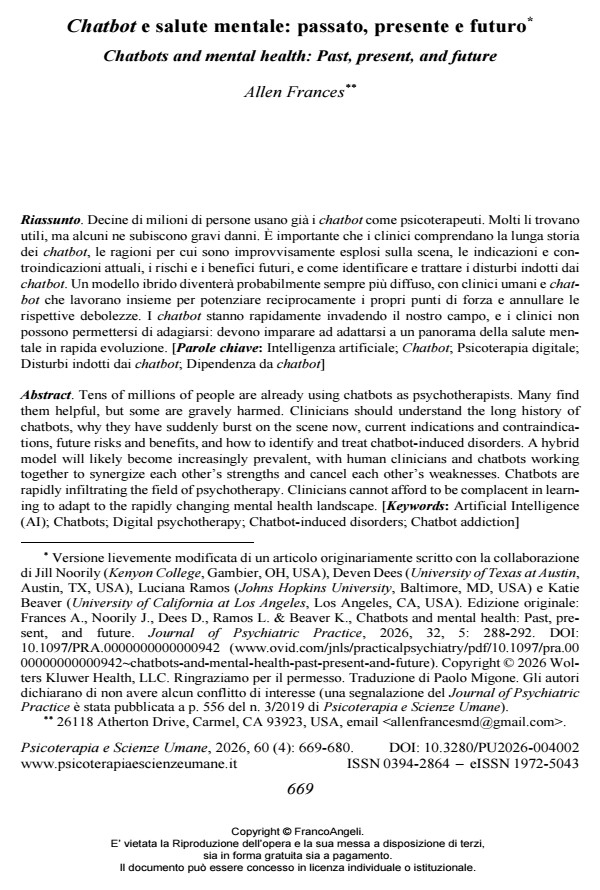
Below, you can see the article first page
If you want to buy this article in PDF format, you can do it, following the instructions to buy download credits
FrancoAngeli is member of Publishers International Linking Association, Inc (PILA), a not-for-profit association which run the CrossRef service enabling links to and from online scholarly content.
Tens of millions of people are already using chatbots as psychotherapists. Many find them helpful, but some are gravely harmed. Clinicians should understand the long history of chatbots, why they have suddenly burst on the scene now, current indications and contraindications, future risks and benefits, and how to identify and treat chatbot-induced disorders. A hybrid model will likely become increasingly prevalent, with human clinicians and chatbots working together to synergize each other’s strengths and cancel each other’s weaknesses. Chatbots are rapidly infiltrating the field of psychotherapy. Clinicians cannot afford to be complacent in learning to adapt to the rapidly changing mental health landscape.
Keywords: Artificial Intelligence (AI); Chatbots; Digital psychotherapy; Chatbot-induced disorders; Chatbot addiction
- Goethe J.W. von (1797). Der Zauberlehrling. Tübingen: J.G. Cotta (trad. it.: L’apprendista stregone. Roma: Salerno, 1993; Roma: Donzelli, 2017).
- Anonimo (1875). The Gingerbread Boy. St. Nicholas: Scribner’s Illustrated Magazine for Boys and Girls, 2, 7: 448-449 (trad. it.: L’omino di pan di zenzero. Legnano [MI]: GD Edizioni, 2003).
- Asimov I. (1950). I, Robot. New York: Gnome Press (trad. it.: Io, robot. Milano: Bompiani, 1963).
- Butler S. (1872). Erewhon, or Over the Range. London: Trübner & Co. (trad. it.: Erewhon, ovvero Dall’altra parte delle montagne. Milano: Monanni, 1928; Milano: Adeplhi, 1965; Torino: Einaudi 1970).
- Capek K. (1920). R.U.R. (Rossum’s Universal Robots). Praha: Aventinum (trad. it.: R.U.R. Rossum’s universal robots. Milano: Bevivino, 2006; Venezia: Marsilio, 2015).
- Cartesio R. (1630-33). L’Homme de René Descartes et un Traité de la formation du foetus du mesme autheur, avec les remarques de Louys de La Forge. Paris: Charles Angot, 1664 (trad. it.: L’uomo. Torino: Boringhieri, 1960).
- Collodi C. (1883). Le avventure di Pinocchio. Storia di un burattino. Illustrato da Enrico Mazzanti. Firenze: Felice Paggi Libraio Editore; Milano: Rizzoli, 2025.
- Frances A. (2026a). Warning: Chatbots will soon dominate psychotherapy. British Journal of Psychiatry, 228, 5: 474-478.
- Frances A. (2026b). Clinician’s Survival Guide to the Chatbot Revolution. New York: Guilford (trad. it.: Milano: Raffaello Cortina, 2027, in preparazione).
- Frances A., Morozov E. & Migone P. (2025). Webinar: Intelligenza artificiale (28 maggio 2025): www.youtube.com/watch?v=ZLMegx1fVzc.
- Garland A., regista (2014). Ex Machina. London: Film4.
- Goldstein B.J. & Benson B.V. (2025). The era of A.I. propaganda has arrived, and America must act. New York Times: www.nytimes.com/2025/08/05/opinion/china-ai-propaganda.html.
- Heaven W.D. (2023). Geoffrey Hinton tells us why he’s now scared of the tech he helped build. MIT Technology Review, May 2, 2023: www.technologyreview.com/2023/05/02/1072528/geoffrey-hinton-google-why-scared-ai.
- Hoffmann E.T.A. (1817). Der Sandmann. In: Nachtstücke. Berlin: Realschulbuchhandlung, 1817, Vol. 1, pp. 1-63 (trad. it.: L’uomo della sabbia. In: Magris C., a cura di, Racconti notturni. Torino: Einaudi, 1994, pp. 19-52).
- Jones C.R. & Bergen B.K. (2025). Large language models pass the Turing test. arXiv, 2503.23674.
- Jonze S., regista (2013). Lei. Los Angeles, CA: Annapurna Pictures.
- Jordan J.M. (2019). The Czech play that gave us the word “robot”. MIT Press Reader: https://thereader.mitpress.mit.edu/origin-word-robot-rur.
- Kapach A. (2023). Olympian God Hephaestus: https://mythopedia.com/topics/hephaestus.
- Kubrick S., regista (1968). 2001: Odissea nello spazio. Culver City, CA: Metro-Goldwyn-Mayer.
- Lang F., regista (1927). Metropolis. Berlin: Universum-Film.
- Montero A., Montalvo J., Kearney A., Valdes I., Kirzinger A. & Hamel L. (2026). KFF tracking poll on health information and trust: use of AI for health information and advice. KFF: www.kff.org/public-opinion/kff-tracking-poll-on-health-information-and-trust-use-of-ai-for-health-information-and-advice.
- OpenAI (2015). Introducing OpenAI: https://openai.com/index/introducing-openai.
- OpenAI (2026). OpenAI raccoglie 122 miliardi di dollari per accelerare la prossima fase dell’IA: https://openai.com/index/accelerating-the-next-phase-ai.
- Raitano L., Smith G. & Welsh B. (2026). AI boom sparks rally, frenzy, and fear. Reuters: www.reuters.com/data/ai-boom-sparks-rally-frenzy-fear-2026-06-10.
- Samatas Y. (2010). The myth of Pygmalion and Galatea: www.greekmyths-greekmythology.com/myth-of-pygmalion-and-galatea.
- Samatas Y. (2025). Talos, The bronze automaton of Crete: www.greekmyths-greekmythology.com/talos-crete.
- Schrader M., regista (2021). I Am Your Man. Hamburg, D: Letterbox Filmproduktion.
- Shannonhouse L., Zhai Y., Gutierrez P. & Lin Y. (2026). Generative AI and exacerbated suicide risk among vulnerable populations. The Lancet Regional Health - Americas, 59: 101528.
- Shaw G.B. (1913). Pygmalion. London: Penguin (trad. it.: Pigmalione. Milano: Mondadori, 1928).
- Shelley M.W. (1818). Frankenstein; or, The Modern Prometheus (3 volumi). London: Lackington, Hughes, Harding, Mavor, & Jones (trad. it.: Frankenstein, ovvero Il Prometeo moderno. Roma: Donatello De Luigi, 1944).
- Sun Y., Sheng D., Zhou Z. & Wu Y. (2024). AI hallucination: Towards a comprehensive classification of distorted information in artificial intelligence-generated content. Humanities and Social Sciences Communications, 11, 1: 1278.
- Turing A.M. (1936). On computable numbers, with an application to the Entscheidungsproblem. Proceedings of the London Mathematical Society, 1937 (2nd series), 42, 1: 230-265.
- Turing A.M. (1950). Computing machinery and intelligence. Mind, 59, 236: 433-460.
- Umbrex (2026). Referral engagement rate analysis. In: The Ultimate Guide to Marketing Analysis, https://umbrex.com/resources/ultimate-guide-to-company-analysis/ultimate-guide-to-marketing-analysis/referral-engagement-rate-analysis.
- UniSalute (2026). Osservatorio Sanità: https://blogunisalute.it/wp-content/uploads/2026/08/Osservatorio-Sanita-UniSalute_Salute-e-AI_MI.pdf.
- Vaswani A., Shazeer N., Parmar N., Uszkoreit J., Jones L., Gomez A.N., Kaiser L. & Polosukhin I. (2017). Attention is all you need. In: Guyon I., Luxburg U., Bengio S., Wallach H., Fergus R., Vishwanathan S. & Garnett R., editors, Advances in Neural Information Processing Systems 30 (NIPS 2017). Red Hook, NY: Curran Associates, 2017, pp. 5998-6008.
- Vishwanath K., Alyakin A., Ghosh M. et al. (2026). General-purpose large language models outperform specialized clinical AI tools on medical benchmarks. Nature Medicine, 32: 2405-2409.
- von Neumann J. (1966). Theory of Self-Reproducing Automata. Urbana, IL: University of Illinois Press.
- Weizenbaum J. (1976). Computer Power and Human Reason: From Judgment to Calculation. San Francisco, CA: W.H. Freeman (trad. it.: Il potere del computer e la ragione umana. I limiti dell’intelligenza artificiale. Torino: Edizioni Gruppo Abele, 1987).
- Williams B. (2021). Daedalus. The Great Greek inventor: www.thecollector.com/daedalus-greek-inventor-facts.
Allen Frances, Chatbot e salute mentale: passato, presente e futuro in "PSICOTERAPIA E SCIENZE UMANE" 4/2026, pp 669-680, DOI: 10.3280/PU2026-004002