Comprensione compressa. Tempo dell’interpretazione e riconoscimento nelle interazioni contemporanee
Journal title SOCIOLOGIA E RICERCA SOCIALE
Author/s Angelo Falzarano
Publishing Year 2026 Issue 2026/139
Language Italian Pages 19 P. 5-23 File size 215 KB
DOI 10.3280/SR2026-139001
DOI is like a bar code for intellectual property: to have more infomation
click here
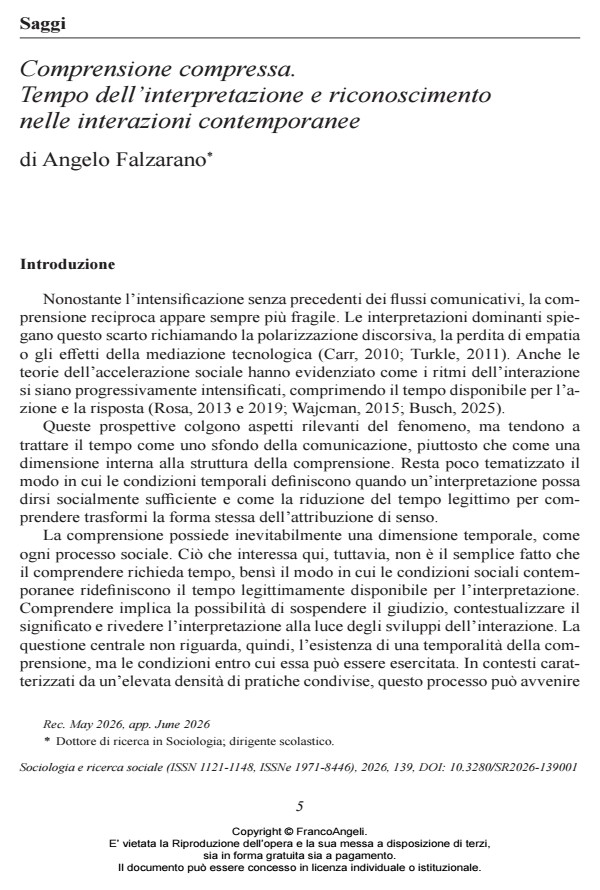
Below, you can see the article first page
If you want to buy this article in PDF format, you can do it, following the instructions to buy download credits
FrancoAngeli is member of Publishers International Linking Association, Inc (PILA), a not-for-profit association which run the CrossRef service enabling links to and from online scholarly content.
Contemporary communication intensifies exchanges without necessarily increasing understanding. This article examines this discrepancy from a temporal perspective, treating time as an internal dimension of interpretive processes. Functional differentiation and the acceleration of communicative rhythms increase the interpretive work required while reducing the time socially considered legitimate for carrying it out. A distinction is drawn between the compression of understanding, defined as the narrowing of the time available to interpret and revise meaning, and compressed understanding, understood as a mode of meaning attribution in which interpretation stabilizes prematurely under the normative pressure to respond promptly. The concept is particularly relevant in organizational and digital contexts characterized by high expectations of responsiveness. Under these conditions, opportunities for contextualization and the revision of meaning are reduced, affecting the revisability of meaning and the pragmatic conditions of recognition.
- Z. Bauman (2000), Liquid modernity, Cambridge, Polity Press.
- F. Busch (2025), «Texting in time: Approaching time and temporalities of smartphonebased interactions», Language & Communication, 100, pp. 196211,
- N. Carr (2010), The shallows: What the internet is doing to our brains, New York, W.W. Norton & Company.
- M. Castells (1996), The rise of the network society, Oxford, Blackwell Publishers.
- M. Dingemanse, S.G. Roberts, J. Baranova, J. Blythe, P. Drew, S. Floyd, R.S. Gisladottir, K.H. Kendrick, S.C. Levinson, E. Manrique, G. Rossi, N.J. Enfield (2015), «Universal principles in the repair of communication problems», PlosOne, 10, 9, e0136100, https://doi. org/10.1371/journal.pone.0136100.
- É. Durkheim (1893/1984), The division of labor in society, ed. by S. Lukes, New York, Free Press.
- H. Garfinkel (1967), Studies in ethnomethodology, Englewood Cliffs, PrenticeHall.
- E. Goffman (1967), Interaction ritual: Essays in facetoface behaviour, Chicago, Aldine Publishing Company.
- J. Habermas (1981), Theorie des kommunikativen Handelns, Frankfurt am Main, Suhrkamp, 2 vols.
- M. Hayashi, G. Raymond, J. Sidnell (eds.) (2013), Conversational repair and human understanding, Cambridge, Cambridge University Press.
- J. Heritage (1984), Garfinkel and ethnomethodology, Cambridge, Polity Press.
- A. Honneth (1995), The struggle for recognition: The moral grammar of social conflicts, Cambridge, Polity Press.
- C. Kitzinger (2013), Repair, in J. Sidnell, T. Stivers (eds.), The handbook of conversation analysis, Hoboken, WileyBlackwell.
- E. Koskinen, A. Laitinen, M. Stevanovic (2024), «Recognition in interaction: Theoretical and empirical observations», Frontiers in Sociology, 8, article 1223203,
- J. Leppäkumpu, A. Sivunen (2024), «Navigating connectivity expectations and worklife boundaries through sensemaking in global teams», Journal of Applied Communication Research, 52, 6, pp. 72242, DOI: 10.1080/00909882.2024.2404050
- N. Luhmann (1997), Die Gesellschaft der Gesellschaft, Frankfurt am Main, Suhrkamp, 2 Bde.
- M. Polanyi (1966), The tacit dimension, Chicago, University of Chicago Press.
- H. Rosa (2013), Social acceleration: A new theory of modernity, New York, Columbia University Press.
- H. Rosa (2019), Resonance: A sociology of our relationship to the world, Cambridge, Polity Press.
- H. Sacks, E.A. Schegloff, G. Jefferson (1974), «A simplest systematics for the organization of turntaking for conversation», Language, 50, 4, pp. 696735.
- E.A. Schegloff, G. Jefferson, H. Sacks (1977), «The preference for selfcorrection in the organization of repair in conversation», Language, 53, 2, pp. 36182.
- A. Schutz (1967), The phenomenology of the social world, Evanston, Northwestern University Press.
- S. Sharma (2014), In the meantime: Temporality and cultural politics, Durham, Duke University Press.
- S.L. Star, J.R. Griesemer (1989), «Institutional ecology, “translations” and boundary objects: Amateurs and professionals in Berkeley’s Museum of Vertebrate Zoology, 19071939», Social Studies of Science, 19, 3, pp. 387420.
- S. Turkle (2011), Alone together: Why we expect more from technology and less from each other, New York, Basic Books.
- J. Wajcman (2015), Pressed for time: The acceleration of life in digital capitalism, Chicago, University of Chicago Press.
- M. Weber (1922/1978), Economy and society: An outline of interpretive sociology, ed. by G. Roth, C. Wittich, Los Angeles, University of California Press.
- L. Wittgenstein (1953), Philosophical investigations, Oxford, Basil Blackwell.
Angelo Falzarano, Comprensione compressa. Tempo dell’interpretazione e riconoscimento nelle interazioni contemporanee in "SOCIOLOGIA E RICERCA SOCIALE " 139/2026, pp 5-23, DOI: 10.3280/SR2026-139001