Bridging pharmacological complexity and psychosocial determinants of inhaler adherence in moderate-to-severe asthma: A cross-sectional analysis of key factors
Titolo Rivista PSICOLOGIA DELLA SALUTE
Autori/Curatori Dilara Usta, Caterina Bosio, Lorenza De Martinis, Alessio Piraino, Gherardo Siscaro, Simona Barbaglia, Filomena Bugliaro, Guendalina Graffigna
Pubblicazione Online First 30/09/2026 Fascicolo 2026/Online First
Lingua Inglese Numero pagine 21 P. 1-21 Dimensione file 297 KB
DOI 10.3280/pds2026-20460
Il DOI è il codice a barre della proprietà intellettuale: per saperne di più
clicca qui
Qui sotto puoi vedere in anteprima la prima pagina di questo articolo.
Se questo articolo ti interessa, lo puoi acquistare (e scaricare in formato pdf) seguendo le facili indicazioni per acquistare il download credit. Acquista Download Credits per scaricare questo Articolo in formato PDF
FrancoAngeli è membro della Publishers International Linking Association, Inc (PILA), associazione indipendente e non profit per facilitare (attraverso i servizi tecnologici implementati da CrossRef.org) l’accesso degli studiosi ai contenuti digitali nelle pubblicazioni professionali e scientifiche.
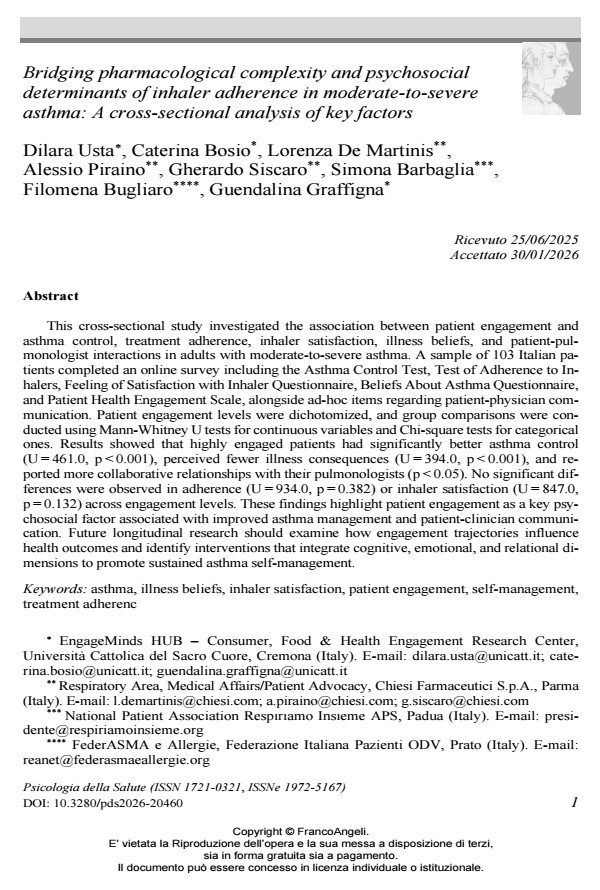
This cross-sectional study investigated the association between patient engagement and asthma control, treatment adherence, inhaler satisfaction, illness beliefs, and patient-pul-monologist interactions in adults with moderate-to-severe asthma. A sample of 103 Italian pa-tients completed an online survey including the Asthma Control Test, Test of Adherence to In-halers, Feeling of Satisfaction with Inhaler Questionnaire, Beliefs About Asthma Questionnaire, and Patient Health Engagement Scale, alongside ad-hoc items regarding patient-physician com-munication. Patient engagement levels were dichotomized, and group comparisons were con-ducted using Mann-Whitney U tests for continuous variables and Chi-square tests for categorical ones. Results showed that highly engaged patients had significantly better asthma control (U = 461.0, p < 0.001), perceived fewer illness consequences (U = 394.0, p < 0.001), and re-ported more collaborative relationships with their pulmonologists (p < 0.05). No significant dif-ferences were observed in adherence (U = 934.0, p = 0.382) or inhaler satisfaction (U = 847.0, p = 0.132) across engagement levels. These findings highlight patient engagement as a key psy-chosocial factor associated with improved asthma management and patient-clinician communi-cation. Future longitudinal research should examine how engagement trajectories influence health outcomes and identify interventions that integrate cognitive, emotional, and relational di-mensions to promote sustained asthma self-management.
Questo studio trasversale ha indagato l’associazione tra il patient engagement e il controllo dell’asma, l’aderenza al trattamento, la soddisfazione nei confronti dell’inalatore, le credenze di malattia e la qualità delle interazioni paziente-pneumologo in adulti con asma moderata-severa. Un campione di 103 pazienti italiani ha completato un questionario online che includeva l’Asthma Control Test (ACT), il Test of Adherence to Inhalers (TAI), il Feeling of Satisfaction with Inhaler Questionnaire (FSIQ), il Beliefs About Asthma Questionnaire (BAQ) e la Patient Health Engagement Scale (PHE-s), oltre a item ad hoc sulla comunicazione medico-paziente. I livelli di patient engagement sono stati dicotomizzati e i gruppi confrontati mediante test U di Mann-Whitney per le variabili continue e test χ² per quelle categoriali. I risultati hanno mostrato che i pazienti con elevato engagement presentavano un controllo dell’asma significativamente migliore (U = 461.0; p < 0.001), percepivano minori conseguenze della malattia (U = 394.0; p < 0.001) e riportavano relazioni più collaborative con il proprio pneumologo (p < 0,05). Non sono emerse differenze significative tra i livelli di engagement in termini di aderenza al trattamento (U = 934.0; p = 0.382) né di soddisfazione nei confronti dell’inalatore (U = 847.0; p = 0.132). Nel complesso, questi risultati evidenziano il patient engagement come fattore psicosociale chiave associato a una migliore gestione dell’asma e a una comunicazione più efficace tra pa-zienti e clinici. Studi longitudinali futuri dovrebbero esaminare in che modo le traiettorie di en-gagement influenzino gli esiti di salute e identificare interventi che integrino dimensioni cogni-tive, emotive e relazionali al fine di promuovere un’autogestione dell’asma stabile nel tempo.
Parole chiave:asma, credenze sulla malattia, soddisfazione relativa all'inalatore, coinvolgi-mento del paziente, autogestione, aderenza al trattamento
- Aboumatar H., Pitts S., Sharma R., Das A., Smith B. M., Day J., Holzhauer K., Yang S., Bass E.
- B. and Bennett W. L. (2022). Patient engagement strategies for adults with chronic conditions: An evidence map. Systematic Reviews, 11(1), 39.
- Ali A. M. and Young H. N. (2022). Relationships between key functions of patient-provider communication, trust, and motivation across white, African American, and Hispanic/La-tino patients with asthma. Health Communication, 37(4), 450–456. DOI: 10.1080/10410236.2020.1848758
- Alqarni A. A., Aldhahir A. M., Siraj R. A., Alqahtani J. S., Alghamdi D. A., Alghamdi S. K., Alamoudi A. A., Mohtaseb M. A., Majrshi M. and AlGarni A. A. (2024). Asthma medi-cation adherence, control, and psychological symptoms: A cross-sectional study. BMC Pulmonary Medicine, 24(1), 189.
- Global Initiative for Asthma (2019). Global strategy for asthma management and prevention 2017. Global Initiative for Asthma. Retrieved from: https://ginasthma.org/wp-content/up-loads/2017/02/wmsGINA-2017-main-report-final_V2.pdf
- Asthma Society of Ireland (2024). Towards optimal severe asthma care: Research report on the challenges experienced by patients and stakeholders’ recommendations on improving severe asthma services.
- Barello S., Anderson G., Bosio C., Lane D. A., Leo D. G., Lobban T. C. A., Trevisan C. and Graffigna G. (2024). Patient engagement in multimorbidity: A systematic review of pa-tient-reported outcome measures. Frontiers in Psychology, 15, 1345117.
- Barello S., Palamenghi L. and Graffigna G. (2020). The mediating role of the patient health engagement model on the relationship between patient perceived autonomy supportive healthcare climate and health literacy skills. International Journal of Environmental Re-search and Public Health, 17(5), 1741.
- Bonini M., Barbaglia S., Camiciottoli G., Del Giacco S., Di Marco F., Matucci A., Micheletto C., Papi A., Pasqualetti P. and Pelaia G. (2024). Asthma remission one, none and one-hundred thousand: The relevance of the patient’s view. Journal of Asthma, 61(11), 1535–1544. DOI: 10.1080/02770903.2024.2366523
- Bouloukaki I., Spanias C., Ierodiakonou D., Tzanakis N., Williams S. and Tsiligianni I. (2024). Primary healthcare professionals’ perceptions, attitudes and ideas regarding asthma management in Greece: A mixed-method study. European Journal of General Practice, 30(1), 2418301. DOI: 10.1080/13814788.2024.2418301
- Bukstein D. A., Guerra Jr D. G., Huwe T. and Davis R. A. (2020). A review of shared deci-sion-making: A call to arms for health care professionals. Annals of Allergy, Asthma & Immunology, 125(3), 273–279.
- Bukstein D. and Ledford D. K. (2019). Shared decision-making and strategies to optimize adherence in older asthmatics. In: Epstein T. E. G. and Nyenhuis S. M., editors, Treatment of Asthma in Older Adults: A Comprehensive, Evidence-Based Guide, Switzerland: Springer Nature, pp. 79–100.
- Busby J., Matthews J. G., Chaudhuri R., Pavord I. D., Hardman T. C., Arron J. R., Bradding P., Brightling C. E., Choy D. F. and Cowan D. C. (2022). Factors affecting adherence with treatment advice in a clinical trial of patients with severe asthma. European Respiratory Journal, 59(4), 2100768. DOI: 10.1183/13993003.00768-2021
- Busse W. W., Abbott C. B., Germain G., Laliberté F., MacKnight S. D., Jung Y., Duh M. S. and Averell C. M. (2022). Adherence and persistence to single-inhaler versus multiple-inhaler triple therapy for asthma management. The Journal of Allergy and Clinical Immu-nology: In Practice, 10(11), 2904–2913.
- Cai Q., Jin M., Li X., Zhang J., Xu Q., Ye L. and Lyu Q. (2023). Effect of illness perceptions on asthma control and quality of life amongst adult outpatients with asthma in China. BMC Psychology, 11(1), 68.
- Cameron L. D., Fleszar-Pavlovic S., Khachikian T., Hamilton K., Hagger M. S., Hankonen
- N. and Lintunen T. (2020). Changing behavior using the common-sense model of self-regulation. In Hagger M. S., Cameron L. D., Hamilton K., Hankonen N. and Lintunen T., editors, The Handbook of Behavior Change. Cambridge: Cambridge University Press, pp. 60–76. DOI: 10.1017/9781108677318.005
- Cengiz D. and Korkmaz F. (2023). Effectiveness of a nurse-led personalized patient engage-ment program to promote type 2 diabetes self-management: A randomized controlled trial. Nursing & Health Sciences, 25(4), 571–584.
- Chakaya J. and Aït-Khaled N. (2022). Global Asthma Report 2022: A wake-up call to enhance care and treatment for asthma globally. The International Journal of Tuberculosis and Lung Disease, 26(11), 999–1000.
- Chan A. H. Y., Katzer C. B., Pike J., Small M. and Horne R. (2023). Medication beliefs, adherence, and outcomes in people with asthma: The importance of treatment beliefs in understanding inhaled corticosteroid nonadherence - a retrospective analysis of a real-world data set. Journal of Allergy and Clinical Immunology: Global, 2(1), 51–60.
- Cohen, Jacob. (1992). Statistical Power Analysis. Current Directions in Psychological Science, 1(3), 98–101.
- Contoli M., Barile S., Nudo E., Guastalla D., andnhalers: A multinational survey. Journal of Asthma, 59(7), 1473–1483. DOI: 10.1080/02770903.2021.1923739
- Deniz S., Akbolat M., Çimen M. and Ünal Ö. (2021). The mediating role of shared decision-making in the effect of the patient–physician relationship on compliance with treatment. Journal of Patient Experience, 8, 23743735211018064. DOI: 10.1177/23743735211018066
- DeRosa A. P., Grell Y., Razon D., Komsany A., Pinheiro L. C., Martinez J. and Phillips E. (2022). Decision-making support among racial and ethnic minorities diagnosed with breast or prostate cancer: A systematic review of the literature. Patient Education and Counseling, 105(5), 1057–1065.
- Fan Q., Ong A. S. E., Koh M. S. and Doshi K. (2021). The mediating role of trust in physician and self-efficacy in understanding medication adherence in severe asthma. Respiratory Medicine, 190, 106673.
- Faul F., Erdfelder E., Buchner A. and Lang A.-G. (2009). Statistical power analyses using G* Power 3.1: Tests for correlation and regression analyses. Behavior Research Methods, 41(4), 1149–1160. DOI: 10.3758/BRM.41.4.1149
- Garcia K. A., Wippold G. M., Goodrum N. M., Williams M. M. and Kloos B. (2025). Bridging health self-efficacy and patient engagement with patient-centered culturally sensitive health care for Black American adults. Journal of Community Psychology, 53(1), e23147.
- Graffigna G. and Barello S. (2018a). Patient Health Engagement (PHE) model in enhanced recovery after surgery (ERAS): Monitoring patients’ engagement and psychological re-silience in minimally invasive thoracic surgery. Journal of Thoracic Disease, 10(Suppl 4), S517.
- Graffigna G. and Barello S. (2018b). Spotlight on the Patient Health Engagement model (PHE model): A psychosocial theory to understand people’s meaningful engagement in their own health care. Patient Preference and Adherence, 12, 1261–1271. equation model. PloS One, 12(6), e0179865.
- Graffigna G., Barello S., Bonanomi A. and Lozza E. (2015). Measuring patient engagement: development and psychometric properties of the Patient Health Engagement (PHE) Scale. Frontiers in Psychology, 6, 274.
- Han Y.-Y., Gutwein A., Apter A. and Celedón J. C. (2024). Health literacy and asthma: An update. Journal of Allergy and Clinical Immunology, 153(5), 1241–1251.
- Higgins T., Larson E. and Schnall R. (2017). Unraveling the meaning of patient engagement: A concept analysis. Patient Education and Counseling, 100(1), 30–36.
- Hoque F. (2023). Shared decision making: A win-win situation for both patients and physi-cians. American Journal of Hospital Medicine, 7(2).
- Hoque F. and Nayak R. (2025). Focused overview of the 2024 global initiative for asthma guidelines. APIK Journal of Internal Medicine, 13(1), 4–12.
- Jessop D. C. and Rutter D. R. (2003). Adherence to asthma medication: The role of illness representations. Psychology and Health, 18(5), 595–612. DOI: 10.1080/0887044031000097009
- Kollin S. R., Clayton C. K., Green V. A. and Lee A. A. (2024). Emotion regulation among adults with asthma: Links with short-acting inhaler medication overuse and utilization of acute medical care. Journal of Asthma, 62(3), 1–11. DOI: 10.1080/02770903.2024.2409997
- Korwin A., Black H., Perez L., Morales K. H., Klusaritz H., Han X., Huang J., Rogers M., Ndicu G. and Apter A. J. (2017). Exploring patient engagement: A qualitative analysis of low-income urban participants in asthma research. The Journal of Allergy and Clinical Immunology: In Practice, 5(6), 1625–1631.
- Leventhal H., Phillips L. A. and Burns E. (2016). The common-sense model of self-regulation (CSM): A dynamic framework for understanding illness self-management. Journal of Be-havioral Medicine, 39, 935–946.
- Lim G. N., Allen J. C., Tiew P. Y., Chen W. and Koh M. S. (2023). Healthcare utilization and health-related quality of life of severe asthma patients in Singapore. Journal of Asthma, 60(5), 969–980. DOI: 10.1080/02770903.2022.2114086
- Lipschitz J. M., Pike C. K., Hogan T. P., Murphy S. A. and Burdick K. E. (2023). The en-gagement problem: a review of engagement with digital mental health interventions and recommendations for a path forward. Current Treatment Options in Psychiatry, 10(3), 119–135.
- Louis G., Voz B., Guillaume M., Kirkove D. and Pétré B. (2023). The use of patient-reported outcome measures by healthcare professionals in specialized asthma management centers in French-speaking Belgium: A mixed-methods study. Clinical and Translational Allergy, 13(5), e12248.
- Lycett H., Wildman E., Raebel E. M., Sherlock J.-P., Kenny T. and Chan A. H. Y. (2018). Treatment perceptions in patients with asthma: Synthesis of factors influencing adher-ence. Respiratory Medicine, 141, 180–189.
- Ma J., Sun X., Wang X., Liu B. and Shi K. (2023). Factors affecting patient adherence to inhalation therapy: An application of SEIPS model 2.0. Patient Preference and Adher-ence, 17, 531–545. DOI: 10.2147/PPA.S395327
- Nathan R. A., Sorkness C. A., Kosinski M., Schatz M., Li J. T., Marcus P., Murray J. J. and Pendergraft T. B. (2004). Development of the asthma control test: A survey for assessing asthma control. Journal of Allergy and Clinical Immunology, 113(1), 59–65.
- Oppenheimer J., Kerstjens H. A., Boulet L.-P., Hanania N. A., Kerwin E., Moore A., Nathan
- R. A., Peachey G., Pizzichini E. and Slade D. (2024). Characterization of moderate and severe asthma exacerbations in the CAPTAIN study. The Journal of Allergy and Clinical Immunology: In Practice, 12(9), 2372–2380.
- Pagnini F., Volpato E., Dell’Orto S., Cavalera C., Spina M. and Banfi P. (2021). Illness ex-pectations assessment in people with asthma: A tool for explicit and implicit beliefs. Jour-nal of Asthma and Allergy, 14, 449–455. DOI: 10.2147/JAA.S307763
- Plaza V., Fernández-Rodríguez C., Melero C., Cosío B. G., Entrenas L. M., De Llano L. P., Gutiérrez-Pereyra F., Tarragona E., Palomino R. and López-Viña A. (2016). Validation of the ‘Test of the Adherence to Inhalers’(TAI) for asthma and COPD patients. Journal of Aerosol Medicine and Pulmonary Drug Delivery, 29(2), 142–152.
- Rasulnia M., Burton B. S., Ginter R. P., Wang T. Y., Pleasants R. A., Green C. L. and Lugogo
- N. (2018). Assessing the impact of a remote digital coaching engagement program on patient-reported outcomes in asthma. Journal of Asthma, 55(7), 795–800. DOI: 10.1080/02770903.2017.1362430
- Seret J., Gooset F., Durieux V., Lecocq D. and Pirson M. (2019). What means a quality pro-fessional–patient relationship from the asthmatic patients’ perspective? A narrative re-view of their needs and expectations. Patient Preference and Adherence, 13, 1951–1960. DOI: 10.2147/PPA.S213545
- Shahunja K. M., Sly P. D., Begum T., Biswas T. and Mamun A. (2022). Family, neighborhood and psychosocial environmental factors and their associations with asthma in Australia: A systematic review and meta-analysis. Journal of Asthma, 59(12), 2539–2552. DOI: 10.1080/02770903.2021.2018707
- Shayo G. A., Omary A. and Mugusi F. (2022). Inhaler non-adherence, associated factors and asthma control among asthma patients in a tertiary level hospital in Tanzania. East African Health Research Journal, 6(1), 78–85.
- Tomisa G., Horváth A., Sánta B., Keglevich A. and Tamási L. (2021). Epidemiology of comorbidities and their association with asthma control. Allergy, Asthma & Clinical Im-munology, 17, 1–14.
- Tordera M. P., Viejo J. L., Sanchos J., Badia X., Cobos N., Picado C., Sobradillo V., del Río
- J. M. G., Duce F. and Cabrera L. M. (2008). Assessment of patient satisfaction and pref-erences with inhalers in asthma with the FSI-10 Questionnaire. Archivos de Bron-coneumología, 44(7), 346–352.
- Ulrich L., Welty M., Henderson A. and Allen E. (2022). Quality improvement approach to increasing respiratory therapist driven teach back style asthma education. Journal of Asthma, 59(4), 823–828. DOI: 10.1080/02770903.2020.1870131
- Wall Emerson R. (2023). Regression and effect size. Journal of Visual Impairment & Blind-ness, 117(2), 191-192. DOI: 10.1177/0145482X23116659
- Wenzel S. E. (2021). Severe adult asthmas: Integrating clinical features, biology, and thera-peutics to improve outcomes. American Journal of Respiratory and Critical Care Medi-cine, 203(7), 809–821.
- World Health Organization. (2025). Asthma. Retrieved from: https://www.who.int/news-room/fact-sheets/detail/asthma.
- Young H. N., Len-Rios M. E., Brown R., Moreno M. M. and Cox E. (2017). How does patient-provider communication influence adherence to asthma medications? Patient Education and Counseling, 100(4), 696–702.
- Zaeh S. E., Ramsey R., Bender B., Hommel K., Mosnaim G. and Rand C. (2022). The impact of adherence and health literacy on difficult-to-control asthma. The Journal of Allergy and Clinical Immunology: In Practice, 10(2), 386–394.
Dilara Usta, Caterina Bosio, Lorenza De Martinis, Alessio Piraino, Gherardo Siscaro, Simona Barbaglia, Filomena Bugliaro, Guendalina Graffigna, Bridging pharmacological complexity and psychosocial determinants of inhaler adherence in moderate-to-severe asthma: A cross-sectional analysis of key factors in "PSICOLOGIA DELLA SALUTE" Online First/2026, pp 1-21, DOI: 10.3280/pds2026-20460