C’era una volta la TPO: la resistibile ascesa della finanziarizzazione nel calcio
Titolo Rivista IMPRESE E STORIA
Autori/Curatori Pippo Russo
Anno di pubblicazione 2026 Fascicolo 2024/50
Lingua Italiano Numero pagine 27 P. 79-105 Dimensione file 249 KB
DOI 10.3280/ISTO2024-050004
Il DOI è il codice a barre della proprietà intellettuale: per saperne di più
clicca qui
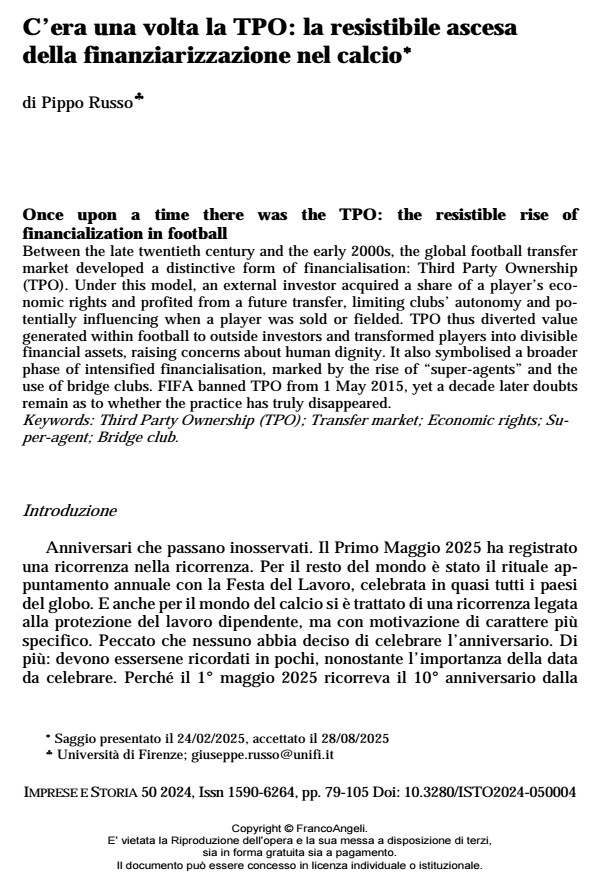
Qui sotto puoi vedere in anteprima la prima pagina di questo articolo.
Se questo articolo ti interessa, lo puoi acquistare (e scaricare in formato pdf) seguendo le facili indicazioni per acquistare il download credit. Acquista Download Credits per scaricare questo Articolo in formato PDF
FrancoAngeli è membro della Publishers International Linking Association, Inc (PILA), associazione indipendente e non profit per facilitare (attraverso i servizi tecnologici implementati da CrossRef.org) l’accesso degli studiosi ai contenuti digitali nelle pubblicazioni professionali e scientifiche.
Between the late twentieth century and the early 2000s, the global football transfer market developed a distinctive form of financialisation: Third Party Ownership (TPO). Under this model, an external investor acquired a share of a player’s economic rights and profited from a future transfer, limiting clubs’ autonomy and potentially influencing when a player was sold or fielded. TPO thus diverted value generated within football to outside investors and transformed players into divisible financial assets, raising concerns about human dignity. It also symbolised a broader phase of intensified financialisation, marked by the rise of “super-agents” and the use of bridge clubs. FIFA banned TPO from 1 May 2015, yet a decade later doubts remain as to whether the practice has truly disappeared.
Parole chiave:Third Party Ownership (TPO); Transfer market; Economic rights; Super-agent; Bridge club.
- Lombardi, R., Manfredi S., Nappo F. (2014). Third party Ownership in the field of professional football: a critical perspective, Business Systems Review, 3:32-47.
- Russo, P. (2014). Gol di rapina: Il lato oscuro del calcio globale. Oligarchi, fondi d’investimento, agenti monopolisti: come l’economia parallela sta divorando l’ex gioco più bello del mondo, Firenze: Clichy.
- Russo, P. (2016). M. L’Orgia del Potere. Controstoria di Jorge Mendes, il Padrone del Calcio Globale, Firenze: Clichy.
- Russo, P. (2017), A Orgia do Poder, Lisboa: Planeta.
- Russo, P. (2018). Soldi e Pallone. Come è Cambiato il Calciomercato, Milano, Meltemi, 2018.
Pippo Russo, C’era una volta la TPO: la resistibile ascesa della finanziarizzazione nel calcio in "IMPRESE E STORIA" 50/2024, pp 79-105, DOI: 10.3280/ISTO2024-050004