The regulation of citizenship through social work exploitation: The Italian reception system between control and resistance
Titolo Rivista MONDI MIGRANTI
Autori/Curatori Luca Villaggi
Anno di pubblicazione 2026 Fascicolo 2026/2
Lingua Inglese Numero pagine 17 P. 94-110 Dimensione file 136 KB
DOI 10.3280/MM2026-002006
Il DOI è il codice a barre della proprietà intellettuale: per saperne di più
clicca qui
Qui sotto puoi vedere in anteprima la prima pagina di questo articolo.
Se questo articolo ti interessa, lo puoi acquistare (e scaricare in formato pdf) seguendo le facili indicazioni per acquistare il download credit. Acquista Download Credits per scaricare questo Articolo in formato PDF
FrancoAngeli è membro della Publishers International Linking Association, Inc (PILA), associazione indipendente e non profit per facilitare (attraverso i servizi tecnologici implementati da CrossRef.org) l’accesso degli studiosi ai contenuti digitali nelle pubblicazioni professionali e scientifiche.
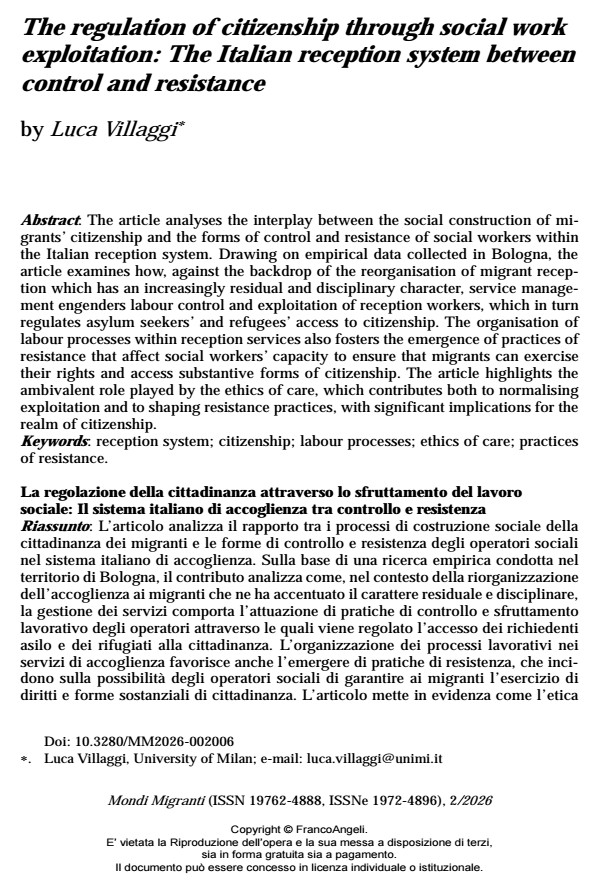
The article analyses the interplay between the social construction of migrants’ citizenship and the forms of control and resistance of social workers within the Italian reception system. Drawing on empirical data collected in Bologna, the article examines how, against the backdrop of the reorganisation of migrant reception which has an increasingly residual and disciplinary character, service management engenders labour control and exploitation of reception workers, which in turn regulates asylum seekers’ and refugees’ access to citizenship. The organisation of labour processes within reception services also fosters the emergence of practices of resistance that affect social workers’ capacity to ensure that migrants can exercise their rights and access substantive forms of citizenship. The article highlights the ambivalent role played by the ethics of care, which contributes both to normalising exploitation and to shaping resistance practices, with significant implications for the realm of citizenship.
L’articolo analizza il rapporto tra i processi di costruzione sociale della cittadinanza dei migranti e le forme di controllo e resistenza degli operatori sociali nel sistema italiano di accoglienza. Sulla base di una ricerca empirica condotta nel territorio di Bologna, il contributo analizza come, nel contesto della riorganizzazione dell’accoglienza ai migranti che ne ha accentuato il carattere residuale e disciplinare, la gestione dei servizi comporta l’attuazione di pratiche di controllo e sfruttamento lavorativo degli operatori attraverso le quali viene regolato l’accesso dei richiedenti asilo e dei rifugiati alla cittadinanza. L’organizzazione dei processi lavorativi nei servizi di accoglienza favorisce anche l’emergere di pratiche di resistenza, che inci¬dono sulla possibilità degli operatori sociali di garantire ai migranti l’esercizio di diritti e forme sostanziali di cittadinanza. L’articolo mette in evidenza come l’etica della cura contribuisca sia a normalizzare le forme di sfruttamento sia a influenzare le pratiche di resistenza, con implicazioni rilevanti per la sfera della cittadinanza.
Parole chiave:sistema di accoglienza; cittadinanza; processi lavorativi; etica della cura; pratiche di resistenza.
- Ackroyd S. and Thompson P. (1999). Organizational Misbehaviour. London: Sage.
- Accorinti M. and Spinelli E. (2019). L’attività degli operatori sociali tra aiuto e controllo nel nuovo sistema di accoglienza. Rivista delle Politiche Sociali, 2-3: 103-120.
- Acocella I. (2022). The evolution of the Italian reception system for asylum seekers into a “non-place” for “non-subjects”. Mondi Migranti, 1: 201-225; DOI: 10.3280/MM2022-001011/
- Alberti G. and Sacchetto D. (2024). The Politics of Migrant Labour: Exit, Voice, and Social Reproduction. Bristol: Bristol University Press.
- Atzeni M. (2010). Workplace Conflict. Mobilization and Solidarity in Argentina. London: Palgrave Macmillan.
- Bagnardi F. and Maccarrone V. (2023). Labour Process Theory: Taking stock and looking ahead. Sociologia del Lavoro, 167: 33-55; DOI: 10.3280/SL2023-167002/
- Baines D. (2004). Caring for nothing: Work organization and unwaged labour in social services. Work, Employment and Society, 18, 2: 267-295; DOI: 10.1177/09500172004042770/
- Biffi D. (2025). Auto-etnografia dell’accoglienza. Lavorare nei servizi per richie-denti asilo e rifugiati. Bergamo: Edizioni Junior.
- Biffi D. (2017). Fra controllo e abbandono: etnografia di un centro di accoglienza. In: Marchetti C. and Pinelli B., eds., Confini d’Europa. Modelli di controllo e inclusioni informali. Milano: Raffaello Cortina Editore.
- Bloemraad I. (2018). Theorising the power of citizenship as claims-making. Journal of Ethnic and Migration Studies, 44, 1: 4-26; DOI: 10.1080/1369183X.2018.1396108/
- Busso S. and Dagnes J. (2020). The non-profit paradox after the 2008 financial crisis: How to survive within a changing scenario. In: Barbera F. and Jones I., eds., The Foundational Economy and Citizenship: Comparative Perspectives on Civil Repair. Bristol: Bristol University Press.
- Busso S. and Lanunziata S. (2016). Il valore del lavoro sociale. Meccanismi estrattivi e rappresentazioni del non profit. Sociologia del Lavoro, 142: 62-79; DOI: 10.3280/SL2016-142004/
- Campesi G. (2018). Between containment, confinement and dispersal: the evolution of the Italian reception system before and after the ‘refugee Crisis’. Journal of Modern Italian Studies, 23, 4: 490-506; DOI: 10.1080/1354571X.2018.1501995/
- Carbone V., Gargiulo E. and Russo Spena M., eds. (2018). I confini dell’inclusione. La civic integration tra selezione e disciplinamento dei corpi migranti. Roma: DeriveApprodi.
- Caselli D., Giullari B. and Whitfield D. (2019). A job like any other? Working in the social sector between transformations of work and the crisis of welfare. Sociologia del Lavoro, 155: 33-53; DOI: 10.3280/SL2019-155002/
- Castellini V. (2021). Spaces of Social Recomposition: Resisting Meaningful Work in Social Cooperatives in Italy. Antipode, 53, 6: 1661-1681;
- Cruikshank B. (1999). The Will to Empower: Democratic Citizens and Other Sub-jects. Ithaca: Cornell University Press.
- de Koning A. and Ruijtenberg W. (2022). Welfare, social citizenship, and the spectre of inequality in Amsterdam. Ethnography, 23, 3: 335-357; DOI: 10.1177/1466138119892017/
- de Koning A., Ruijtenberg W., Chakkour S., Botton L., Vollebergh A. and Marchesi M. (2024). Migrants, welfare and social citizenship in postcolonial Europe. Journal of Ethnic and Migration Studies, 50, 2: 423-441; DOI: 10.1080/1369183X.2023.2248398/
- Della Puppa F. and Sanò G., eds. (2021). Stuck and Exploited. Refugees and Asylum Seekers in Italy Between Exclusion, Discrimination and Struggles. Venezia: Edizioni Ca’ Foscari.
- Dubois V. (2024). Tra standardizzazione e discrezione. Le pratiche giuridiche degli ispettori delle frodi sociali nell’era della condizionalità. Cartografie sociali. Rivista di sociologia e scienze umane, 18: 45-64.
- Dubois V. (2010). The Bureaucrat and the Poor: Encounters in French Welfare Offices. Abingdon: Routledge.
- Edwards R. (1979). Contested Terrain. The Transformation of the Workplace in the Twentieth Century. New York: Basic Books.
- Evans T. and Harris J. (2004). Street-level bureaucracy, social work and the (exag-gerated) death of discretion. British Journal of Social Work, 34, 6: 871-895;
- Fabini G., Firouzi Tabar O. and Vianello F., eds. (2019). Lungo i confini dell’acco-glienza. Migranti e territori tra resistenze e dispositivi di controllo. Roma: Manifestolibri.
- Farris S.R. (2025). Towards a critique of care fetishism: Social reproduction femin-ism and the ethics of care. Feminist Theory: 1-22; DOI: 10.1177/14647001251376299/
- Farris S.R. and Marchetti S. (2017). From the commodification to the corporatiza-tion of care: European perspectives and debates. Social Politics, 24, 2: 109-131;
- Fassin D. (2005). Compassion and Repression: The Moral Economy of Immigration Policies in France. Cultural Anthropology, 20, 3: 362-387;
- Fullin G. and Gaspani F. (2023). Emozioni ed estetica nelle attività a servizio del cliente. Una mappa per la sociologia del lavoro. Rassegna Italiana di Sociologia, 64, 3: 547-570; https://dx.doi.org/10.1423/106578/.
- Greer I. and Umney C. (2022). Marketization: How Capitalist Exchange Disciplines Workers and Subverts Democracy. London: Bloomsbury Academic.
- Hirschman A.O. (1970). Exit, Voice, and Loyalty: Responses to Decline in Firms, Organizations, and States. Cambridge, MA: Harvard University Press.
- Isin E.F. (2008). Theorizing Acts of Citizenship. In: Isin E.F. and Nielsen G.M., eds., Acts of Citizenship. London: Zed Books.
- Isin E.F. (2017). Performative Citizenship. In: Shachar A., Bauböck R., Bloemraad I. and Vink M., eds., The Oxford Handbook of Citizenship. Oxford: Oxford University Press.
- Lens V. (2008). Welfare and work sanctions: Examining discretion on the front lines. Social Service Review, 82, 2: 197-222; DOI: 10.1086/589706
- Lewicki A. (2022). The material effects of Whiteness: Institutional racism in the German welfare state. The Sociological Review, 70, 5: 916-934; DOI: 10.1177/00380261221108596/
- Lipsky M. (1980). Street-Level Bureaucracy: Dilemmas of the Individual in Public Services. New York: Russell Sage Foundation.
- Manocchi M. (2014). Richiedenti asilo e rifugiati: processi di etichettamento e pra¬tiche di resistenza. Rassegna Italiana di Sociologia, 55, 2: 385-409; DOI: 10.1423/77309/
- Mezzadra S. and Neilson B. (2013). Border as Method, Or, the Multiplication of Labor. Durham, NC: Duke University Press.
- Muehlebach A. (2012). The Moral Neoliberal: Welfare and Citizenship in Italy. Chicago, IL: University of Chicago Press.
- Murgia A. and Poggio B. (2012). La trappola della passione. Esperienze di precarietà dei giovani highly skilled in Italia, Spagna e Regno Unito. In: Cordella G. and Masi S.E., eds., Condizione giovanile e nuovi rischi sociali. Quali politiche? Roma: Carocci.
- Ong A. (2003). Buddha Is Hiding: Refugees, Citizenship, the New America. Berke-ley, CA: University of California Press.
- Prior D. and Barnes M. (2011). Subverting social policy on the front line: Agencies of resistance in the delivery of services. Social Policy & Administration, 45, 3: 264-279;
- Smith C. (2015). Continuity and Change in Labor Process Analysis Forty Years after Labor and Monopoly Capital. Labor Studies Journal, 40, 3: 222-242; DOI: 10.1177/0160449X15607154/
- Soss J., Fording R. C. and Schram S. F. (2011). Disciplining the Poor. Neoliberal Paternalism and the Persistent Power of Race. Chicago, IL: University of Chi-cago Press.
- Szabó I.G. (2025). The Transformation of Discontent: Labor Protest in Healthcare and Education Across Europe. Abingdon: Routledge.
- Thompson P. (1990). Crawling from the Wreckage: The Labour Process and the Politics of Production. In: Knights D. and Willmott H., eds., Labour Process Theory. London: Macmillan Press.
- Turner B.S. (2024). The Rise and Fall of Citizenship. New York: Routledge.
- Zhang C. and Lillie N. (2015). Industrial citizenship, cosmopolitanism and European integration. European Journal of Social Theory, 18, 1: 93-111; DOI: 10.1177/1368431014553756/
Luca Villaggi, The regulation of citizenship through social work exploitation: The Italian reception system between control and resistance in "MONDI MIGRANTI" 2/2026, pp 94-110, DOI: 10.3280/MM2026-002006