Legame genitoriale, capacità di resistere alla pressione dei pari e guida pericolosa durante la transizione tra adolescenza e prima età adulta
Titolo Rivista RICERCHE DI PSICOLOGIA
Autori/Curatori Martina Smorti, Silvia Guarnieri
Anno di pubblicazione 2013 Fascicolo 2012/1
Lingua Italiano Numero pagine 21 P. 11-31 Dimensione file 673 KB
DOI 10.3280/RIP2012-001002
Il DOI è il codice a barre della proprietà intellettuale: per saperne di più
clicca qui
Qui sotto puoi vedere in anteprima la prima pagina di questo articolo.
Se questo articolo ti interessa, lo puoi acquistare (e scaricare in formato pdf) seguendo le facili indicazioni per acquistare il download credit. Acquista Download Credits per scaricare questo Articolo in formato PDF
FrancoAngeli è membro della Publishers International Linking Association, Inc (PILA), associazione indipendente e non profit per facilitare (attraverso i servizi tecnologici implementati da CrossRef.org) l’accesso degli studiosi ai contenuti digitali nelle pubblicazioni professionali e scientifiche.
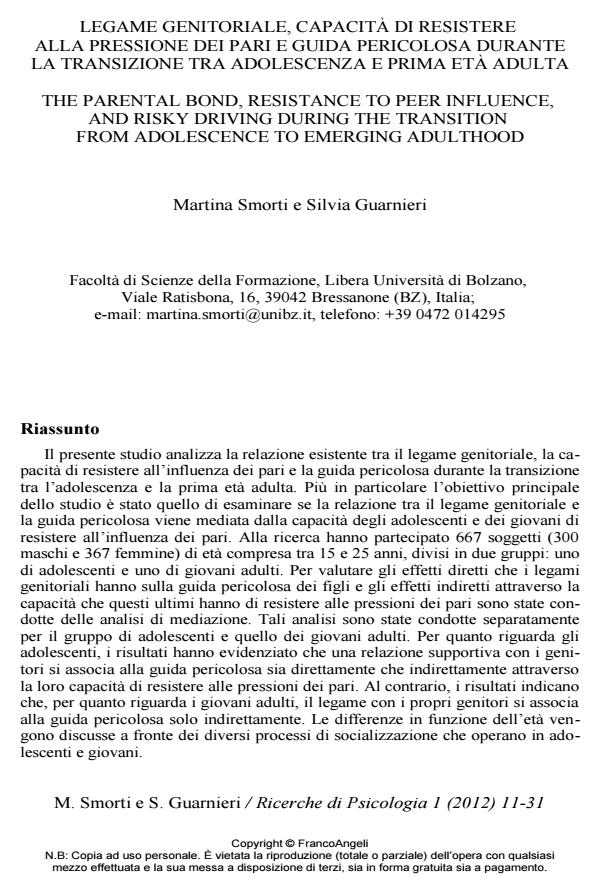
Il presente studio analizza la relazione esistente tra il legame genitoriale, la capacita di resistere all’influenza dei pari e la guida pericolosa durante la transizione tra l’adolescenza e la prima eta adulta. Piu in particolare l’obiettivo principale dello studio e stato quello di esaminare se la relazione tra il legame genitoriale e la guida pericolosa viene mediata dalla capacita degli adolescenti e dei giovani di resistere all’influenza dei pari. Alla ricerca hanno partecipato 667 soggetti (300 maschi e 367 femmine) di eta compresa tra 15 e 25 anni, divisi in due gruppi: uno di adolescenti e uno di giovani adulti. Per valutare gli effetti diretti che i legami genitoriali hanno sulla guida pericolosa dei figli e gli effetti indiretti attraverso la capacita che questi ultimi hanno di resistere alle pressioni dei pari sono state condotte delle analisi di mediazione. Tali analisi sono state condotte separatamente per il gruppo di adolescenti e quello dei giovani adulti. Per quanto riguarda gli adolescenti, i risultati hanno evidenziato che una relazione supportiva con i genitori si associa alla guida pericolosa sia direttamente che indirettamente attraverso la loro capacita di resistere alle pressioni dei pari. Al contrario, i risultati indicano che, per quanto riguarda i giovani adulti, il legame con i propri genitori si associa alla guida pericolosa solo indirettamente. Le differenze in funzione dell’eta vengono discusse a fronte dei diversi processi di socializzazione che operano in adolescenti e giovani.
Parole chiave:Legame genitoriale, influenza dei pari, guida pericolosa, differenze di eta
- Shope, J.T., Waller, P.F., Raghunathan, T.E., & Patil, S.M. (2001). Adolescent antecedents of high-risk driving behavior into young adulthood: substance use and parental influences. Accident Analysis & Prevention, 33(5), 649-658. DOI: 10.1016/S0001-4575(00)00079-8
- Simons-Morton, B.G. (2007). Parent involvement in novice teen driving: rationale, evidence of effects, and potential for enhancing graduated driver licensing effectiveness. Journal of Safety Research, 38, 193-202. DOI: 10.1016/j.jsr.2007.02.007
- Simons-Morton, B., Lerner, N., & Singer, J. (2005). The observed effects of teenage passengers on the risky driving behavior of teenage drivers. Accident Analysis and Prevention, 37, 973-982. DOI: 10.1016/j.aap.2005.04.014
- Simons-Morton, B.G., Quimet, M.C., & Catalano, R.F. (2008). Parenting and the young driver problem. American Journal of Prevention Medicine, 35(3), 294- 303. DOI: 10.1016/j.amepre.2008.06.018
- Smorti, A., Bacchereti, A., Smorti, M., & Tani, F. (2010). Stili di monitoring genitoriale, strategie di coping e capacità di resilienza degli adolescenti, Rassegna di Psicologia, 1, 63-78
- Smorti, M., Benvenuti, P., & Pazzagli, A. (2010). Fattori di rischio e di protezione nel consumo di alcolici e di sostanze degli adolescenti. Psicologia Clinica dello Sviluppo, 1, 55- 78.
- Smorti, M., Guarnieri, S., & Ingoglia, S. (in press). The parental bond, resistance to peer influence, and risky driving in adolescence. Trasportation Research Part F Traffic Psychology and Behaviour
- Smorti, M., Vanni, D., Benvenuti, P., & Pazzagli, A. (2009). Caratteristiche depressive, strategie di coping e ambiente familiare in adolescenza. Psicologia della Salute, 3, 37-53. DOI: 10.3280/PDS2009-003003
- Steinberg, L. (2001). We know some things: Parent–adolescent relationships in retrospect and prospect. Journal of Research on Adolescence, 11, 1-19. DOI: 10.1111/1532-7795.00001
- Steinberg, L., & Silverberg, S.B. (1986). The Vicissitudes of Autonomy in Early Adolescence. Child Development, 57, 841-851. DOI: 10.2307/1130361
- Taubman - Ben-Ari, O. (2011). The contribution of perceived parental and familial characteristics to attitudes toward accompanied driving among young drivers. Accident Analysis and Prevention, 43, 1720-1729. DOI: 10.1016/j.aap.2011.04.001
- Taubman - Ben-Ari, O., & Katz - Ben-Ami, L. (2012). The contribution of family climate for road safety and social environment to the reported driving behavior of young drivers. Accident Analysis & Prevention, 47, 1-10. DOI: 10.1016/j.aap.2012.01.003
- Williams A.F. (2003). Teenage Drivers: Patterns of Risk, Journal of Safety Research, 34, 5-15. DOI: 10.1016/S0022-4375(02)00075-0
- Beck, K.H., Boyle, J.R., & Boekeloo, B.O. (2004). Parental monitoring and adolescent drinking: results of a 12- month follow-up. American Journal of Health Behavior, 28(3), 272-279. DOI: 10.5993/AJHB.28.3.8
- Bonino, S., Cattelino, E., & Ciairano, S. (2005). Adolescents and risk. Behaviors, functions and protective factors. New York: Springer Verlag
- Bonaiuto, M., Perucchini, P., & Pierro, A. (1997). L’adolescente e i membri significativi della sua rete sociale [The adolescent and significant members of his social network]. Età Evolutiva, 57, 40-56.
- Broman, C.L., Reckase, M.D., & Freedman-Doan, C.R. (2006). The Role of Parenting in Drug Use Among Black, Latino and White Adolescents. Journal of Ethnicity in Substance Abuse, 5(1), 39-50. DOI: 10.1300/J233v05n01_03
- Brown, B. (2004). Adolescents’ relationships with peers. In R. Lerner & L. Steinberg (Eds.), Handbook of adolescent psychology (pp. 363-394). New York: Wiley.
- Brown, B.B., Clasen, D.R., & Eicher, S.A. (1986). Perceptions of peer pressure, peer conformity dispositions, and self-reported behavior among adolescents. Developmental Psychology, 22, 521-530. DOI: 10.1037/0012-1649.22.4.521
- Burt, C.H., Simons, R.L., & Simons, L.G. (2006). A longitudinal test of the effects of parenting and the stability of self control: Negative evidence for the general theory of crime. Criminology, 44(2), 353-396. DOI: 10.1111/j.1745-9125.2006.00052.x
- Bucx, F., & van Wel, F. (2008). Parental bond and life coure transitions from adolescence to young adulthood. Adolescence, 43, 169, 71-88.
- Caprara, G. V., & Scabini, E. (2000). La costruzione dell’identita nell’adolescenza. Il ruolo delle variabili familiari e delle convinzioni di efficacia personale. In G.V. Caprara e A. Fonzi (a cura di), L’età sospesa (pp. 59-89). Firenze: Giunti.
- Carra, E., & Marta, E. (1995). Relazioni familiari e adolescenza. Milano: FrancoAngeli.
- Cattelino, E., Calandri, E., & Bonino, S. (2001). Il contributo della struttura e del funzionamento della famiglia nella promozione del benessere di adolescenti di diverse fasce di eta. Età Evolutiva, 69, 49-60.
- Cauffman, E., & Steinberg, L. (2000). Researching adolescents’ judgment and culpability. In T. Grisso & R.G. Schwartz (Eds.), Youth on trial: A developmental perspective on juvenile justice (pp. 325-343). Chicago: The University of Chicago.
- Chassin, L., Hussong, A., Barrera, M., Molina, B., Trim, R., & Ritter, J. (2004). Adolescent substance use. In R. Lerner and L. Steinberg (Eds.), Handbook of adolescent psychology (pp. 665-696). New York: Wiley
- Cox, M.F. (2007). Maternal demandingness and responsiveness as predictors of adolescent abstinence. Journal of Pediatric Nursing, 22(3), 197-205. DOI: 10.1016/j.pedn.2006.08.005
- Day, R.D., & Padilla-Walker, L.M. (2009). Mother and father connectedness and involvement during early adolescence. Journal of Family Psychology,23(6), 900-904. DOI: 10.1037/a0016438
- DeVore, E.R.M.D., & Ginsburg, K.R.M.D. (2005). The Protective Effects of Good Parenting on Adolescents. Postgraduate Obstetrics and Gynecology, 25(25), 1-5.
- Dielman, T.E., Butchart, A.T., & Shope, J.T. (1993). Structural equation model tests of patterns of family interaction, peer alcohol use, and intrapersonal predictors of adolescent alcohol use and misuse. Journal of Drug Education, 23, 273-316. DOI: 10.2190/8YXM-K9GB-B8FD-82NQ
- Fromme, K. (2006). Parenting and other influences on the alcohol use and emotional adjustment of children, adolescents, and emerging adults. Psychology of Addictive Behaviors, 20(2), 138-9. DOI: 10.1037/0893-164X.20.2.138
- Allen, J., Boykin, K., & Bell, K. (2000, March). Autonomy in discussions vs. autonomy in decision making as predictors of developing close friendship competence. Paper presented at the Biennial Meetings of the Society for Research on Adolescence, Chicago, IL.
- Arnett, J. J. (2007). The Myth of Peer Influence in Adolescent Smoking Initiation. Health Education & Behavior, 34(4), 594-607. DOI: 10.1177/1090198105285330
- Bandura, A., Barbaranelli, C., Caprara, G.V., & Pastorelli, C. (1996). Multifaceted impact of self-efficacy beliefs on academic functioning. Child Development, 67, 1206-1222. DOI: 10.2307/1131888
- Barbaranelli, C. (2007). Analisi dei dati. Tecniche multivariate per la ricerca psicologica e sociale [Data analyses. Multivariate techniques for psychological and social research]. 2nd Ed. Milano: LED.
- Barber, B. K. (1996). Parental psychological control: Revisit-ing a neglected construct. Child Development, 67, 3296-3319. DOI: 10.2307/1131780
- Barber, B.K., & Harmon, E.L. (2002). Violating the self: Pa-rental psychological control of children and adolescents. In B.K. Barber (Ed.), Intrusive parenting: How psychological control affects children and adolescents (pp. 15-52), American Psychological Association, Washington, DC. DOI: 10.1037/10422-000
- Baron, R.M., & Kenny, D.A. (1986). The moderator-mediator variable distinction in social psychological research: Conceptual, strategic and statistical considerations. Journal of Personality and Social Psychology, 51, 1173-1182. DOI: 10.1037/0022-3514.51.6.1173
- Baumrind, D. (1991). The influence of parenting style on adolescent competence and substance use. Journal of Early Adolescence, 11(1), 56-95. DOI: 10.1177/0272431691111004
- Furman,W., & Buhrmester, D. (1992). Age and sex differences in perceptions of networks of personal relationships. Child Development, 63, 103-115. DOI: 10.2307/1130905
- Galambos, N.L., Barker, E.T., & Almeida, D.M. (2003). Parents do matter: Trajectories of change in externalising and internalizing problems in early adolescence. Child Development, 74, 578-594. DOI: 10.1111/1467-8624.7402017
- Gardner, M., & Steinberg, L. (2005). Peer influence on risk taking, risk preference, and risky decision making in adolescence and adulthood: an experimental study. Developmental Psychology, 41, 625-635. DOI: 10.1037/0012-1649.41.4.625
- Ginsburg, K.R., Durbin, D.R., Garcia-Espana, J.F., Kalicka, E.A., & Winston, F.K. (2009). Associations Between Parenting Styles and Teen Driving, Safety- Related Behaviors and Attitudes. Pediatrics, 124(4), 1040-1051. DOI: 10.1542/peds.2008-3037
- Gray, M.R., & Steinberg, L. (1999). Unpacking authoritative parenting: Reassessing a multidimensional construct. Journal of Marriage and the Family, 61, 574-587. DOI: 10.2307/353561
- Guarnieri, S., & Tani, F. (2011). Social networks and life satisfaction in emerging adulthood. Journal of Developmental Psychology, 99, 34-52.
- Haggerty, K., Skinner, M., MacKenzie, E., & Catalano, R. F. (2007). A randomized trial of parents who care: effects on key outcomes at 24-month follow-up. Prevention Science, 8(4), 249-260. DOI: 10.1007/s11121-007-0077-2
- Hartos, J.L., Eitel, P., Haynie, D.L., & Simons-Morton, B.G. (2000). Can I take the car? Relations among parenting practices and adolescent problem-driving practices. Journal of Adolescent Research, 15(3), 352-367. DOI: 10.1177/0743558400153003
- Hartos, J., Eitel, P., & Simons-Morton, B. (2002). Parenting practices and adolescent risky driving: a three month prospective study. Health Education & Behavior, 29(2), 194-206. DOI: 10.1177/1090198102029002005
- Holmbeck, G. (1996). A model of familial relational transformations during the transition to adolescence: parent–adolescent conflict and adaptation. In J. Graber, J. Brooks-Gunn, & A. Petersen (Eds.), Transitions Through Adolescence: Interpersonal Domains and Context (pp. 167–199). Mahwah,NJ: Erlbaum
- Jaccard, J., Blanton, H., & Dodge, T. (2005). Peer influences on risk behavior: an analysis of the effects of a close friend. Developmental Psychology, 41(1), 135-147. DOI: 10.1037/0012-1649.41.1.135
- Jessor, R., Donovan, J.E., & Costa, F.M. (1992). Health behavior questionnaire. High school form. University of Colorado, Colorado
- Knafo, A., & Schwartz, S. H. (2003). Parenting and adolescents’ accuracy in perceiving parental values. Child Development, 74, 595-611. DOI: 10.1111/1467-8624.7402018
- Laible, D.J., & Carlo, G. (2004). The differential relations of maternal and paternal support and control to adolescent social competence, self-Worth, and sympathy. Journal of Adolescent Research, 19(6), 759-782. DOI: 10.1177/0743558403260094
- Larson, R., & Richards, M.H. (1991). Daily companionship in late childhood and early adolescence: changing developmental contexts. Child Development, 62, 284-300. DOI: 10.2307/1131003
- Larson, R., Richards, M., Moneta, G., Holmbeck, G., & Duckett, E. (1996). Changes in adolescents’ daily interactions with their families from ages 10-18: disengagement and transformation. Developmental Psychology, 32,744-754. DOI: 10.1037/0012-1649.32.4.744
- Lashbrook, J.T. (2000). Fitting in: exploring the emotional dimension of adolescent peer pressure. Adolescence, 35, 747-757.
- Li, C., Pentz, M.A., & Chou, C-P. (2002). Parental substance use as a modifier of adolescent substance use risk. Addiction, 97, 1537-1550. DOI: 10.1046/j.1360-0443.2002.00238.x
- Lotan, T., & Toledo, T. (2007). Driving Patterns of Young Drivers within a Graduated Driver Licensing System. Annual Meeting of the Transportation Research Board, Washington, DC.
- Malagoli-Togliatti, M., & Ardone, R. (1993). Adolescenti e genitori. Roma: La Nuova Italia Scientifica
- Marshal M. P., & Chassin, L. (2000). Peer influence on adolescent alcohol use: The moderating role of parental support and discipline. Applied Developmental Science, 4, 80-88. DOI: 10.1207/S1532480XADS0402_3
- Meeus, W., Iedemab, J., Maassena, G. & Engels, R. (2005). Separation–individuation revisited: on the interplay of parent–adolescent relations, identity and emotional adjustment in adolescence. Journal of Adolescence, 28, 89-106. DOI: 10.1016/j.adolescence.2004.07.003
- Mounts, N.S., & Steinberg, L. (1995). An Ecological Analysis of Peer Influence on Adolescent Grade Point Average and Drug Use. Developmental Psychology, 31(6), 915-922. DOI: 10.1037/0012-1649.31.6.915
- Meeus, W., Raaijmakers, Q., & Vollebergh, W. (1992). Political intolerance and youth centrism in adolescence: an overview of Dutch research and some recent longitudinal findings. In G. Breakwell (Ed.), Social Psychology of Political and Economic Cognition (pp. 97-120). London: Academic Press
- Nijhof, K.S., & Engles, R.C.M.E. (2007). Parenting style, coping strategies, and the expression of homesickness. Journal of Adolescence, 30, 709-720. DOI: 10.1016/j.adolescence.2006.11.009
- Parker, G. (1989). The parental bonding instrument: psychometric properties reviewed. Psychiatric Developments, 4, 317-335
- Parker, G., Tupling, H., & Brown, L.B. (1979). A parental bonding instrument. British Journal of Medical Psychology, 52, 1-10. DOI: 10.1111/j.2044-8341.1979.tb02487.x
- Pastorelli, C., & Picconi, L. (2001). Autoefficacia scolastica, sociale e regolatoria. In G.V. Caprara (Ed.), La valutazione dell’autoefficacia (pp.87-104.) Trento: Erickson.
- Patock-Peckham, J.A., & Morgan-Lopez, A.A. (2006). College Drinking Behaviors: Mediational Links Between Parenting Styles, Impulse Control, and Alcohol- Related Outcomes. Psychology of Addictive Behaviors, 20(2), 117-25. DOI: 10.1037/0893-164X.20.2.117
- Pocaterra, R., & Colombo, S. (2007). Ragazzi al volante: l’influenza del gruppo dei coetanei sui comportamenti di guida. Milano: Mondadori
- Roche, K.M., Ahmed, S., & Blum, R.W. (2008). Enduring consequences of parenting for risk behaviors from adolescence into early adulthood. Social Science & Medicine, 66, 2023-2034. DOI: 10.1016/j.socscimed.2008.01.009
- Rollins, B.C., & Thomas, D.L. (1979). Parental support, power and control techniques in the socialization of children. In W. R. Burne, R. Hill, F. I. Nye, & I.L. Reiss (Eds.), Contemporay theories about the family: Research-based theory (pp. 317-364). New York: Free Press
- Savin-Williams, R.C., & Berndt, T.J. (1990). Friendships and Peer Relations during Adolescence. In S. S. Feldman & G.R. Elliott (Eds.), At the Threshold: The Developing Adolescent (pp. 207-277). Cambridge, MA: Harvard University Press.
- Shope, J.T., Raghunathan, T.E., & Patil, S.M. (2003). Examining trajectories of adolescent risk factors as predictors of subsequent high-risk driving behavior. Journal of Adolescent Health, 32, 214-224. DOI: 10.1016/S1054-139X(02)00424-X
Martina Smorti, Silvia Guarnieri, Legame genitoriale, capacità di resistere alla pressione dei pari e guida pericolosa durante la transizione tra adolescenza e prima età adulta in "RICERCHE DI PSICOLOGIA " 1/2012, pp 11-31, DOI: 10.3280/RIP2012-001002