Amori on line. Incontrarsi, frequentarsi e lasciarsi con la mediazione della Rete Internet
Titolo Rivista SALUTE E SOCIETÀ
Autori/Curatori Laura Arosio
Anno di pubblicazione 2013 Fascicolo 2013/2
Lingua Italiano Numero pagine 27 P. 77-103 Dimensione file 144 KB
DOI 10.3280/SES2013-002005
Il DOI è il codice a barre della proprietà intellettuale: per saperne di più
clicca qui
Qui sotto puoi vedere in anteprima la prima pagina di questo articolo.
Se questo articolo ti interessa, lo puoi acquistare (e scaricare in formato pdf) seguendo le facili indicazioni per acquistare il download credit. Acquista Download Credits per scaricare questo Articolo in formato PDF
FrancoAngeli è membro della Publishers International Linking Association, Inc (PILA), associazione indipendente e non profit per facilitare (attraverso i servizi tecnologici implementati da CrossRef.org) l’accesso degli studiosi ai contenuti digitali nelle pubblicazioni professionali e scientifiche.
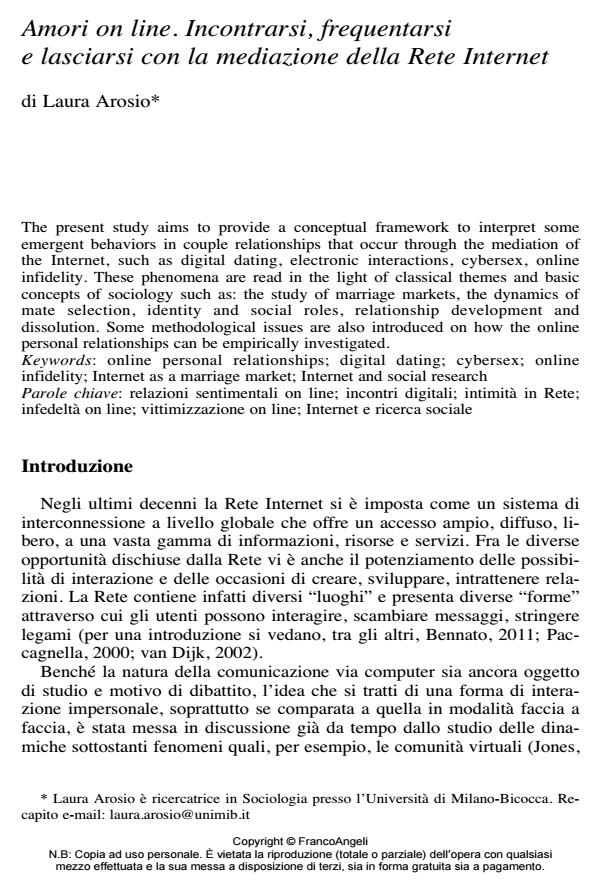
The present study aims to provide a conceptual framework to interpret some emergent behaviors in couple relationships that occur through the mediation of the Internet, such as digital dating, electronic interactions, cybersex, online infidelity. These phenomena are read in the light of classical themes and basic concepts of sociology such as: the study of marriage markets, the dynamics of mate selection, identity and social roles, relationship development and dissolution. Some methodological issues are also introduced on how the online personal relationships can be empirically investigated.
Parole chiave:Relazioni sentimentali on line; incontri digitali; intimità in Rete; infedeltà on line; vittimizzazione on line; Internet e ricerca sociale
- Ben-Ze’ev A. (2004). Love online: Emotions on the Internet. New York: Cambridge University Press DOI: 10.1017/CBO9780511489785
- Cantelmi T. e Carpino V. (2005). Tradimento on line. Limite reale e virtuale dell’amore. Milano: FrancoAngeli
- Capecchi S. e Ruspini E., a cura di (2009). Media, corpi, sessualità. Dai corpi esibiti al cybersex. Milano: FrancoAngeli.
- Chenault B.G. (1998). Developing personal and emotional relationships via computer- mediated communication. CMC Magazine, testo disponibile al sito: www.december.com/cmc/mag/1998/may/chenault.html.
- Chesebro J.W. (1985). Computer-mediated interpersonal communication. In: Ruben B.D., a cura di, Information and Behavior. New Brunswick, NJ: Transaction
- Cipolla C., a cura di (1998). Il ciclo metodologico della ricerca sociale. Bologna: il Mulino
- Cooper A. (1998). Sexuality and the Internet: Surfing into the new millennium. CyberPsychology & Behavior, 1 (2): 181-187 DOI: 10.1089/cpb.1998.1.187
- Cooper A. e Sportolari L. (1997). Romance in cyberspace: Understanding online attraction. Journal of Sex Education and Therapy, 22 (1): 7-14.
- Cooper A., Boies S., Maheu M. e Greenfield D. (2000). Sexuality and the Internet: The next sexual revolution. In: Muscarella, F. e Szuchman, L., a cura di, Psychological Perspectives on Human Sexuality: A Research Based Approach. New York: John Wiley and Sons
- Coupland J. (1996). Discourses of the commodified self. Discourse and Society, 7: 187-207 DOI: 10.1177/0957926596007002003
- De Lillo A., Arosio L., de Luca S., Ruspini E. e Sala E. (2010). L’osservazione. In: de Lillo A., a cura di, Il mondo della ricerca qualitativa. Torino: Utet: 35-76.
- Dibbell J. (1993). A rape in cyberspace. The Village Voice, 21 december 1993
- Di Maggio P., Hargittai E., Russell-Neuman W. e Robinson J.P. (2001). The social implications of the Internet. Annual Review of Sociology, 27: 307-336 DOI: 10.1146/annurev.soc.27.1.307
- Dutton W. E. (1996). Information and Communication Technologies: Visions and Realities. Oxford: Oxford University Press
- Ellison N., Heino R. e Gibbs J. (2006). Managing impressions online: Self-presentation processes in the online dating environment. Journal of Computer- Mediated Communication, 11 (2), testo disponibile al sito: http://jcmc.indiana. edu/vol11/issue2/ellison.html DOI: 10.1111/j.1083-6101.2006.00020.x
- Fiore A.R.T. (2010). Self-presentation, Interpersonal Perception, and Partner Selection in Computer-mediated Relationship Formation, Dissertation Thesis, University of California, Berkeley, testo disponibile al sito: www.msu.edu/~atf/papers/Andrew_Fiore_dissertation.pdf.
- Gibbs J.L., Ellison N.B. e Heino R.D. (2006). Self-presentation in online personals: The role of anticipated future interaction, self-disclosure, and perceived success in Internet dating. Communication Research, 33 (2): 1-26 DOI: 10.1177/0093650205285368
- Giddens A. (1991). Modernity and self identity. Self and Society in the Late Modern Age. Cambridge: Polity Press
- Giddens A. (1992). The Transformation of Intimacy. Cambridge: Polity Press. (trad. it. La trasformazione dell’intimità: sessualità, amore ed erotismo nelle società moderne. il Mulino: Bologna, 1995).
- Glass S.P. e Wright T.L. (1992). Justifications for extramarital relationships: The association between attitudes, behaviors, and gender. Journal of Sex Research, 29: 361-387 DOI: 10.1080/00224499209551654
- Goffman E. (1959). The presentation of self in everyday life. University of Edinburgh Social Sciences Research Centre: Anchor Books Edition
- Spears R. e Lea M (1992). Social influence and the influence of the social in computer-mediated communication. In Lea M., a cura di, Contexts of computer- mediated communication. Hemel-Hempstead: Harvester Wheatsheaf
- Sprecher S., Schwartz P., Harvey J. e Hatfield E. (2008). Thebusinessoflove.com: Relationship Initiation at Internet MatchMaking Services. In: Sprecher S., Wenzel A. e Harvey J., a cura di, The Handbook of relationship initiation. Hillsdale, N.J.: Erlbaum
- Stevenson B. e Wolfers J. (2007). Marriage and divorce: changes and their driving forces. Journal of Economic Perspectives, 21 (2): 27-52 DOI: 10.3386/w12944
- Stoll C. (1995). Silicon Snake Oil: Second Thoughts on the Information Highway. New York: Anchor Books
- Turkle S. (1996). Virtuality and its discontents: searching for community in cyberspace. The American Prospect, 24: 50-57.
- Underwood H. e Findlay B. (2004). Internet relationships and their impact on primary relationships. Behavior Change, 21 (2):127-140 DOI: 10.1375/bech.21.2.127.55422
- Utz S. (2000). Social information processing in MUDs: The development of friendships in virtual worlds. Journal of Online Behavior, 1 (1), testo disponibile al sito: www.behavior.net/JOB/v1n1/utz.html
- Van Dijk J. (2002). Sociologia dei nuovi media. Bologna: il Mulino
- Vozar M. (2011). Marriage dot EU: the effect of Internet usage on marriage hazard, CERGE-EI Working Paper Series, 444, testo disponibile al sito: www.cerge-ei.cz/pdf/wp/Wp444.pdf
- Wall D., a cura di (2001). Crime and the Internet: Cybercrimes and Cyber Fears. New York: Routledge.
- Walther J.B. (1993). Impression development in computer-mediated interaction. Western Journal of Communication, 57: 381-399 DOI: 10.1080/10570319309374463
- Walther J.B. (1996). Computer-mediated communication: Impersonal, interpersonal, and hyperpersonal interaction. Communication Research, 23: 3-43 DOI: 10.1177/009365096023001001
- Walther J.B. e Tidwell L.C. (1995). Nonverbal cues in computer-mediated communication, and the effects of chronemics on relational communication. Journal of Organizational Computing, 5 (4), 355-378 DOI: 10.1080/10919399509540258
- Waskul D.D., a cura di (2004). Net.SeXXX: Readings on Sex, Pornography, and the Internet. New York: Peter Lang
- Whitty M.T. (2003). Pushing the wrong buttons: men’s and women’s attitudes towards online and offline infidelity. CyberPsychology & Behavior, 6 (6): 569-579 DOI: 10.1089/109493103322725342
- Whitty M.T. (2004). Shopping for love on the Internet: men and women’s experiences of using an Australian Internet dating site, Communication Research in the Public Interest. New Orleans: ICA.
- Williams M. (1996). Intimacy and the Internet. Contemporary Sexuality, 30 (9): 1-11.
- Woolgar S. (1996). Technologies as cultural artifacts. In: Dutton W., a cura di, Information and Communication Technologies: Visions and Realities. Oxford: Oxford University Press
- Wysocki D.K. (1996). Somewhere Over the Modem: Interpersonal Relationships Over Computer Bulletin Boards. Santa Barbara: University of California
- Wysocki D.K. (1998). Let your fingers do the talking: sex on an adult chat-line. Sexualities, 1: 425-452 DOI: 10.1177/136346098001004003
- Young K. (1999). The evaluation and treatment of Internet addiction. In: Vande- Creek L. e Thomas L., a cura di, Innovations in clinical practice: A source book. Sarasota, FL: Professional Resource Press
- Young K.S., Griffin-Shelley E., Cooper A., O’Mara J. e Buchanan J. (2000). Online infidelity: A new dimension in couple relationships with implications for evaluation and treatment. Sexual Addiction & Compulsivity: The Journal of Treatment & Prevention, 7 (1): 59-74
- Young M.E. e Long L.L. (1998). Counseling and Therapy for Couples. Pacific Grove, CA: Brooks/Cole Publishing Company
- Goffman E. (1983). The interaction order. American Sociological Review, 48: 1- 17 DOI: 10.2307/2095141
- Gottlieb L. (2006). How do I love thee? The Atlantic Monthly: 58-70
- Hardey M. (2002). Life beyond the screen: embodiment and identity through the Internet. The Sociological Review, 50: 570-585 DOI: 10.1111/1467-954X.00399
- Hertlein K.M. e Sendak S. (2007). Love Bytes: Intimacy in Computer-Mediated Relationships, testo disponibile al sito: www.inter-disciplinary.net/ptb/persons/ pil/pil1/hertleinsendak%20paper.pdf.
- Heim M. (1992). The erotic ontology of cyberspace. In: Benedict M., a cura di, Cyberspace, First Steps. Cambridge: MIT Press
- Hellerstein J.E. (1985). The social use of electronic communication at a major university. Computers and the Social Sciences, 1 (3): 191-197.
- Hine C., a cura di (2005). Virtual Methods. Issues in Social Research on the Internet. Oxford-New York: Berg
- Hine C. (2008). The Internet and research methods. In: Gilbert N., a cura di, Researching Social Life. London: Sage
- Jagger E. (1998). Marketing the self buying an other dating in a postmodern consumer society. Sociology, 32 (4): 795-814 DOI: 10.1177/0038038598032004009
- Jerin R. e Dolinsky B. (2001). You’ve got mail! You don’t want it: cyber-victimization and on-line dating. Journal of Criminal Justice and Popular Culture, 9 (1): 15-21, testo disponibile al sito: www.albany.edu/scj/jcjpc/vol9is1/ jerin.pdf.
- Jones S., a cura di (1995). Cybersociety: Computer-mediated Communication and Community. Thousand Oaks, CA: Sage
- Jones S., a cura di (1998). Doing Internet Research: Critical Issues and Methods for Examining the Net. London: Sage DOI: 10.1108/10662249810231069
- Jones W.H. e Burdette M.P. (1994). Betrayal in relationships. In: Weber A.L. e Harvey J.H., a cura di, Perspectives on close relationships. Boston, MA: Allyn & Bacon.
- Kalmijn M. (1998). Intermarriage and homogamy: causes, patterns, trends. Annual Review of Sociology, 24: 395-421 DOI: 10.1146/annurev.soc.24.1.395
- Katz J. e Aspden P. (1997). A nation of strangers: Patterns of friendship and involvement in Internet users. Communication of the ACM, 40 (12): 81-86 DOI: 10.1145/265563.265575
- Kendall T.D. (2010). The relationship between Internet access and divorce rate. Journal of Family and Economic Issues, 2: 1-12
- Kiesler S. (1984). Computer mediation of conversation. American Psychologist, 39: 1123-1134 DOI: 10.1037/0003-066X.39.10.1123
- Kiesler S., Siegel J. e McGuire T. W. (1984). Social psychological aspects of computer-mediated communication. American Psychologist, 39 (10): 1123- 1134 DOI: 10.1037/0003-066X.39.10.1123
- Kim J.Y. (2000). Social interaction in computer-mediated communication. Bulletin of the American Society for Information Science, 26: 15-17 DOI: 10.1002/bult.153
- Lea M. e Spears R. (1995). Love at first byte? Building personal relationships over computer networks. In: Wood J.T. e Duck S., a cura di, Understudied Relationships: Off the Beaten Track. Thousand Oaks, CA: Sage
- Lee R.M. (2000). Unobtrusive Methods in Social Research. Open University Press
- Leiblum S.R. (2001). Women sex and the Internet. Sexual and Relationship Therapy, 16: 389-405 DOI: 10.1080/14681990126954
- MacKenzie D.A. e Wajcman J. (1985). The Social Shaping of Technology. Maidenhead, UK: Open University Press
- MacKinnon R.C. (1992). Searching for the Leviathan in Usenet. Master’s thesis, San Jose State University
- Mann C., Stuart F. (2000). Internet Communication and Qualitative Research. London: Sage
- Maheu M. e Subotnik R.B. (2001). Infidelity and the Internet: Virtual Relationship and Real Betrayal. New York: Sourcebooks.
- Mantovani F. (2001). Cyber-attraction: the emergence of computer-mediated communication in the development of interpersonal relationships. In Anolli L., Ciceri R. e Riva G., a cura di, Say not to Say: New Perspectives on Miscommunication. IOS Press.
- Ahuvia A.C. e Adelman M.B. (1992). Formal intermediaries in the marriage market: A typology and review. Journal of Marriage and the Family, 54: 452- 463 DOI: 10.2307/353076
- Arosio L. (2006). La diversità crea fragilità? Un approfondimento sulle cause dell’instabilità coniugale. Rassegna Italiana di Sociologia, 3: 441-464.
- Arosio L. (2008). Sociologia del matrimonio. Roma: Carocci
- Arosio L. (2010a). L’uso dei documenti. In: de Lillo A., a cura di, Il mondo della ricerca qualitativa. Torino: Utet: 145-182.
- Arosio L. (2010b). Personal documents on the Internet: what’s new and what’s old. Journal of Comparative Research in Anthropology and Sociology, 1 (2): 23-38, testo disponibile al sito: http://doctorat.sas.unibuc.ro/wp-content/ uploads/2010/11/Issue2_LauraArosio_Documents.pdf.
- Arosio L. (2012). Antichi strumenti per moderne navigazioni: una riflessione sulla sociologia che fa uso di Internet. In: Cipolla C., de Lillo A. e Ruspini E., a cura di, Il sociologo le sirene e gli avatar. Milano: FrancoAngeli: 17-32
- Baker A. (1998). Cyberspace couples finding romance online then meeting for the first time in real life. CMC Magazine, testo disponibile al sito: www.december. com/cmc/mag/1998/jul/baker.html.
- Baker A. (2002). What makes an online relationship successful? Clues from couples who met in cyberspace. CyberPsychology & Behavior, 5 (4): 363-375 DOI: 10.1089/109493102760275617
- Bargh J.A., McKenna K.Y. e Fitzsimons G.M. (2002). Can you see the real me? Activation and expression of the “true self” on the Internet. Journal of Social Issues, 58 (1): 33-48 DOI: 10.1111/1540-4560.00247
- Bauman Z. (1993). Postmodern Ethics. Cambridge: Polity
- Bauman Z. (2003). Liquid Love: On the Frailty of Human Bonds. Cambridge: Polity Press. (trad. it.: Amore liquido. Sulla fragilità dei legami affettivi. Roma- Bari: Laterza, 2004).
- Beck U., Beck-Gernsheim E. (1990). Das ganz normale Chaos der Liebe. Frankfurt: Suhrkamp (trad. it.: Il normale caos dell’amore. Torino: Bollati Boringhieri, 1996).
- Bennato D. (2011). Sociologia dei media digitali. Relazioni sociali e processi comunicativi del web partecipativo. Roma Bari: Laterza
- Benshop A. (2003). Cyberstalking: menaced on the Internet. Sociosite, testo disponibile al sito: www.sociosite.org/cyberstalking_en.php
- Benschop A. (1997). NetLove and CyberSex The (im)possibilities of bodiless intimacy. Sociosite, testo disponibile al sito: www.sociosite.org/love.php.
- Matheson K. (1991). Social cues in computer-mediated communication: gender makes a difference. Computers in Human Behavior, 7: 137-145 DOI: 10.1016/0747-5632(91)90003-J
- McLaughlin M., Osbourne K. e Ellison N. (1997). Virtual community in a telepresence environment. In: Jones S., a cura di, Virtual Culture: Identity and Communication in Cybersociety. Thousand Oaks, CA: Sage
- Merkle E. e Richardson R. (2000). Digital dating and virtual relating: Conceptualizing computer mediated romantic relationships. Family Relations, 49 (2): 187-192 DOI: 10.1111/j.1741-3729.2000.00187.x
- Mileham B.L.A. (2007). Online infidelity in Internet chat rooms: an ethnographic exploration. Computers in Human Behavior, 23: 11-31 DOI: 10.1016/j.chb.2004.03.033
- Norris P. (2001). Digital divide. Cambridge: Cambridge University Press
- Oldenburg R. (1989). The Great Good Place: Cafes, Coffee Shops, Community Centers, Beauty Parlors, General Stores, Bars, Hangouts, and How They Get You Through the Day. New York: Paragon House
- Paccagnella L. (1997). Getting the seats of your pants dirty: strategies for ethnographic research on virtual communities. Journal of Computer Mediated Communication, 3 (1), testo disponibile al sito: http://jcmc.indiana.edu/vol3/ issue1/paccagnella.html
- Paccagnella L. (2000). La comunicazione al computer. Bologna: il Mulino
- Parks M.R. e Floyd K. (1996). Making friends in cyberspace. Journal of Communication, 46 (1): 80-97 DOI: 10.1111/j.1460-2466.1996.tb01462.x
- Parsi M.R. (2000). Chat ti amo. Firenze: Giunti
- Rheingold H. (1993). The virtual community: Homesteading on the electronic frontier. Reading, Massachusetts: Addison-Wesley
- Rice R.E. e Love G. (1987). Electronic emotion: socioemotional content in a computer-mediated communication network. Communication Research, 14 (1): 85-108 DOI: 10.1177/009365087014001005
- Roberts L.D. (2009). Cyber-victimisation. In Luppicini R. e Adell R., a cura di, Handbook of Research on Technoethics. Hershey USA: Information Science Reference
- Rowe N.C. (2005). Types of online deception. In: Dasgupta S., a cura di, Encyclopedia of Virtual Communities and Technologies, Hershey, PA: The Idea Group DOI: 10.4018/978-1-59140-563-4.ch064
- Sartori L. (2006). Il divario digitale. Bologna: il Mulino.
- Schnarch D. (1997). Sex, intimacy, and the Internet. Journal of Sex Education and Therapy, 22: 15-20
- Schneider J.P. (2000). Effects of cybersex addiction on the family: Results of a survey. Sexual Addiction & Compulsivity, 7 (1-2): 31-58
- Shaughnessy K., Byers E.S. e Walsh L. (2011). Online sexual activity experience in heterosexual students: Gender similarities and differences. Archives of Sexual Behavior, 40: 419-427 DOI: 10.1007/s10508-010-9629-9
- Shaughnessy K. (2012). In focus: sexuality on the Internet. In: Hyde J.S., DeLamater J.D. e Byers E.S., a cura di, Understanding human sexuality. Toronto: McGraw-Hill Ryerson.
- Skopek J. e Schulz F., Blossfeld H.P. (2010). Who contacts whom? Educational homophily in online mate selection. European Sociological Review, 27 (2): 180-195 DOI: 10.1093/esr/jcp068
- Smith M.A. (1992). Voices from the WELL: The Logic of the Virtual Commons. Master’s thesis, University of California, Los Angeles
- Sobotka T. e Toulemon L. (2008). Changing family and partnership behaviour: Common trends and persistent diversity across Europe. Demographic Research, 19 (6): 85-138 DOI: 10.4054/DemRes.2008.19.6
Laura Arosio, Amori on line. Incontrarsi, frequentarsi e lasciarsi con la mediazione della Rete Internet in "SALUTE E SOCIETÀ" 2/2013, pp 77-103, DOI: 10.3280/SES2013-002005