Manifattura e nuova imprenditorialità in veneto
Titolo Rivista ECONOMIA E SOCIETÀ REGIONALE
Autori/Curatori Anastasia Bruno, Andrea Furlan, Serafino Pitingaro
Anno di pubblicazione 2015 Fascicolo 2015/1
Lingua Italiano Numero pagine 23 P. 102-124 Dimensione file 308 KB
DOI 10.3280/ES2015-001009
Il DOI è il codice a barre della proprietà intellettuale: per saperne di più
clicca qui
Qui sotto puoi vedere in anteprima la prima pagina di questo articolo.
Se questo articolo ti interessa, lo puoi acquistare (e scaricare in formato pdf) seguendo le facili indicazioni per acquistare il download credit. Acquista Download Credits per scaricare questo Articolo in formato PDF
FrancoAngeli è membro della Publishers International Linking Association, Inc (PILA), associazione indipendente e non profit per facilitare (attraverso i servizi tecnologici implementati da CrossRef.org) l’accesso degli studiosi ai contenuti digitali nelle pubblicazioni professionali e scientifiche.
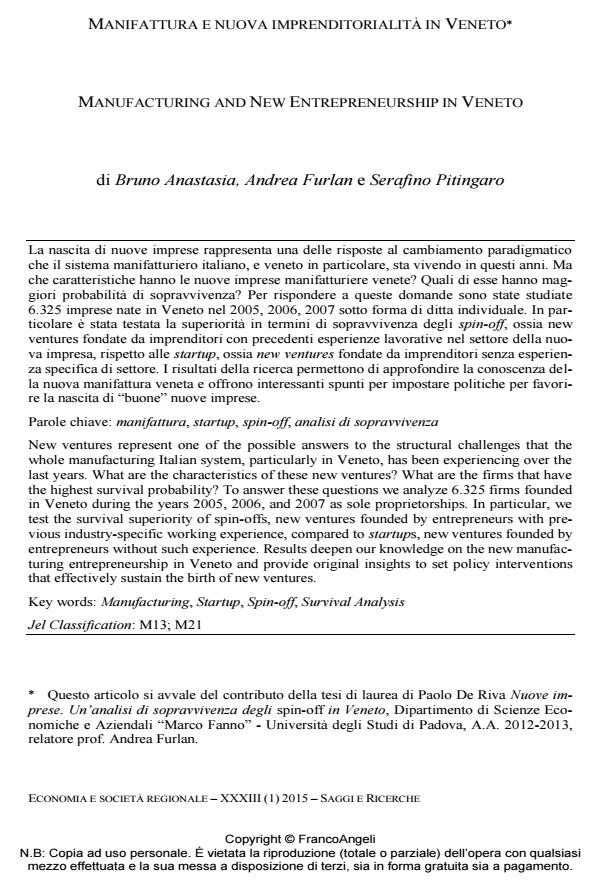
La nascita di nuove imprese rappresenta una delle risposte al cambiamento paradigmatico che il sistema manifatturiero italiano, e veneto in particolare, sta vivendo in questi anni. Ma che caratteristiche hanno le nuove imprese manifatturiere venete? Quali di esse hanno maggiori probabilità di sopravvivenza? Per rispondere a queste domande sono state studiate 6.325 imprese nate in Veneto nel 2005, 2006, 2007 sotto forma di ditta individuale. In particolare è stata testata la superiorità in termini di sopravvivenza degli spin-off, ossia new ventures fondate da imprenditori con precedenti esperienze lavorative nel settore della nuova impresa, rispetto alle startup, ossia new ventures fondate da imprenditori senza esperienza specifica di settore. I risultati della ricerca permettono di approfondire la conoscenza della nuova manifattura veneta e offrono interessanti spunti per impostare politiche per favorire la nascita di "buone" nuove imprese.
Parole chiave:Manifattura, startup, spin-off, analisi di sopravvivenza
Jel codes:M13; M21
- Agarwal R., Echambi R., Franco A.M. e Sarkar M. (2004). Knowledge transfer through inheritance: Spinout generation, development, and survival. Academy of Management Journal, 47(4): 501-522, DOI: 10.2307/20159599
- Anastasia B. e Occari F. (2012). La “creazione” di nuove imprese: note su alcune questioni di misura e di merito. Economia e società regionale,116(2): 105-110, DOI: 10.3280/ES2012-002009
- Boyer T. e Bòazy R. (2013). Born to be alive: the servival of innovative and noninnovative French micro-strat-ups. Small Business Economics, 42: 669-683, DOI: 10.1007/s11187-013-9522-8
- Brüdel J., Preisendörfer P. e Ziegler R. (1992). Survival chances of newly founded business organizations. American Sociological Review, 57(2): 227-242, DOI: 10.2307/2096207
- Carroll G.R. e Hannan M.T. (2000). The Demography of Corporations and Industries. Princeton (NJ): Princeton Press.
- Cooper A.C., Woo C. e Dunkelberg W.C. (1989). Entrepreneurship and initial size of the firm. Journal of Business Venturing, 4: 317-32, DOI: 10.1016/0883-9026(89)90004-9
- Dahl M.S. e Reichstein T. (2007). Are you experienced? Prior experience and the survival of new organizations. Industry and Innovation, 14(5): 497-511, DOI: 10.1080/13662710701711414
- Delmar F. e Shane S. (2006). Does experience matter? The effect of founding team experience on the survival and sales of newly founded ventures. Strategic Organization, 4(3): 215-247, DOI: 10.1177/1476127006066596
- Dencker J.C., Marc G. e Sonali K.S. (2009). Pre-Entry Knowledge, Learning, and the Survival of New Firms. Organization Science, 20(3): 516-53, DOI: 10.1287/orsc.1080.0387
- Di Maria E. e De Marchi V. (2008). Immigrazione ed imprenditorialità in Veneto. Mestre: Veneto Lavoro.
- Eriksson T. e Kuhn J.M. (2006). Firm spin-offs in Denmark, 1981-2000 – Patterns of entry and exit. International Journal of Industrial Organization, 24: 1021-1040, DOI: 10.1016/j.ijindorg.2005.11.008
- Folta T.B., Delmar F. e Melillo F. (2012). Endogeneity in Startup Size. Selection Effects among Types of Entrants. Working Paper. Academy of Management Proceedings, DOI: 10.5465/AMBPP.2012.231
- Folta T.B., Delmar F. e Wennberg K. (2010). Hybrid Entrepreneurship. Management Science, 56(2): 253-269, DOI: 10.1287/mnsc.1090.1094
- Furlan A. e Grandinetti R. (2012). La sopravvivenza delle nuove imprese: un’indagine in Veneto. Economia e società regionale, 115(1): 88-100, DOI: 10.3280/ES2012-001005
- Furlan A. e Grandinetti R. (2014). Spinoff performance in the startup phase: A conceptual framework. Journal of Small Business and Enterprise Development, 21(3): 528-544, DOI: 10.1108/JSBED-04-2014-0055
- Furlan A., Grandinetti R. e Camuffo A. (2007a). How do Subcontractors Evolve?. International Journal of Operations and Production Management, 27(1): 69-89, DOI: 10.1108/01443570710714547
- Furlan A., Romano V., Camuffo A. e Vinelli A. (2007b). Routes Towards Supplier and Production Network Internationalization. International Journal of Operations and Production Management, 27(4): 371-387, DOI: 10.1108/01443570710736967
- Geroski P.A. (1995). What do we know about entry?. International Journal of Industrial Organization, 13: 421-440, DOI: 10.1016/0167-7187(95)00498-X
- Geroski P.A., Mata J. e Portugal P. (2010). Founding conditions and the survival of new firms. Strategic Management Journal, 31: 510-529, DOI: 10.1002/smj.823
- Gimeno J., Folta T., Cooper A. e Woo C. (1997). Survival of the fittest? Entrepreneurial human capital and the persistence of underperforming firms. Administrative Science Quarterly, 42: 750-783.
- Helfat C.E. e Lieberman M.B. (2002). The birth of capabilities: market entry and the importance of pre-history. Industrial and Corporate Change, 11(4): 725-760, DOI: 10.1093/icc/11.4.725
- Irpet (2013), a cura di. Prato. Il ruolo economico della comunità cinese. Firenze. Khessina O.M. e Carroll G.R. (2008). Product Demography of De Novo and De Alio Firms in the optical disk drive industry, 1983-1999. Organization Science, 19(1): 25-38, DOI: 10.1287/orsc.1070.0301
- Klepper S. (2001). Employee startups in high-tech industries. Industrial and Corporate Change,10(3): 639-674, DOI: 10.1093/icc/10.3.639
- Klepper S. (2007). Disagreements, Spinoffs, and the Evolution of Detroit as the Capital of the U.S. Automobile Industry. Management Science, 53(4): 616-631, DOI: 10.1287/mnsc.1060.0683
- Klepper S. (2009). Spinoffs: A review and synthesis. European Management Review, 6(3): 159-171, DOI: 10.1057/emr.2009.18.MaurielloD.,PitingaroS.eScaccabarozziS.(2012).Enterprisecreationecicl
- economico: caratteristiche e motivazioni dei neoimprenditori. Economia e società regionale, 115(1): 24.42, DOI: 10.3280/ES2012-001002
- Riva E. e Lucchini M. (2013). Demografia e sopravvivenza delle imprese straniere. In: Camera Di Commercio Di Milano - C.D.C.D.M., a cura di. Milano produttiva. 23° Rapporto della Camera di Commercio di Milano. Milano: Guerini & Associati.
- Santarelli E. e Vivarelli M. (2007). Entrepreneurship and the process of firms’ entry, survival and growth. Industrial and Corporate Change, 16(3): 455-488, DOI: 10.1093/icc/dtm010
- Stinchcombe A. L. (1965). Social structures and organizations. In: James G. March, a cura di. Handbook of Organizations. Chicago: Rand McNally: 142-193.
Anastasia Bruno, Andrea Furlan, Serafino Pitingaro, Manifattura e nuova imprenditorialità in veneto in "ECONOMIA E SOCIETÀ REGIONALE " 1/2015, pp 102-124, DOI: 10.3280/ES2015-001009