La comunicazione istituzionale nelle organizzazioni pubbliche: opportunità e criticità connesse con il corporate brand orientation
Titolo Rivista RIVISTA TRIMESTRALE DI SCIENZA DELL’AMMINISTRAZIONE
Autori/Curatori Gabriella Levanti
Anno di pubblicazione 2015 Fascicolo 2015/3
Lingua Italiano Numero pagine 14 P. 53-66 Dimensione file 111 KB
DOI 10.3280/SA2015-003004
Il DOI è il codice a barre della proprietà intellettuale: per saperne di più
clicca qui
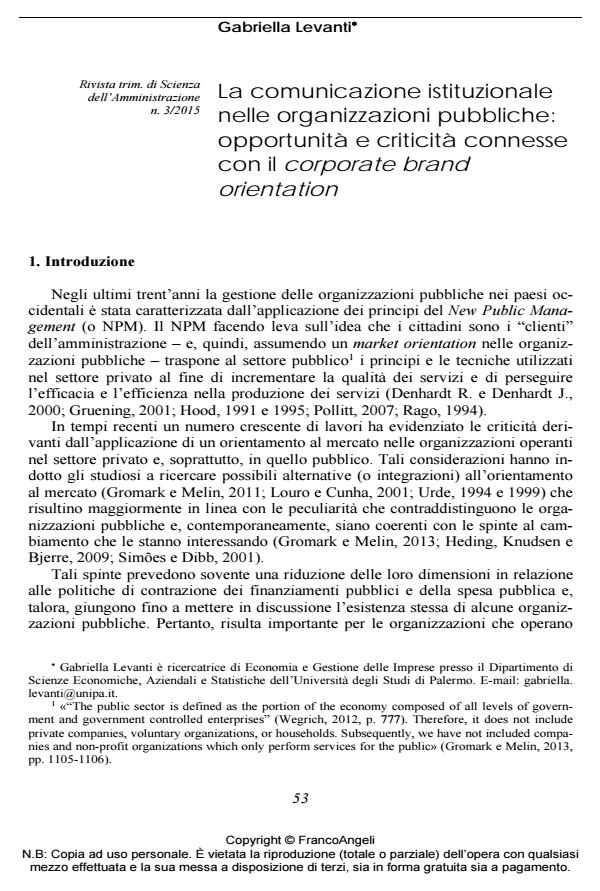
Qui sotto puoi vedere in anteprima la prima pagina di questo articolo.
Se questo articolo ti interessa, lo puoi acquistare (e scaricare in formato pdf) seguendo le facili indicazioni per acquistare il download credit. Acquista Download Credits per scaricare questo Articolo in formato PDF
FrancoAngeli è membro della Publishers International Linking Association, Inc (PILA), associazione indipendente e non profit per facilitare (attraverso i servizi tecnologici implementati da CrossRef.org) l’accesso degli studiosi ai contenuti digitali nelle pubblicazioni professionali e scientifiche.
Negli ultimi trent’anni la gestione delle organizzazioni pubbliche è stata caratterizzata dall’applicazione dei principi del New Public Management (o NPM). Il NPM facendo leva sull’idea che i cittadini sono i "clienti" dell’amministrazione, traspone al settore pubblico i principi e le tecniche utilizzati nel settore privato al fine di incrementarne le performance. Il presente lavoro, dopo aver analizzato i limiti derivanti dall’applicazione di un market orientation nelle organizzazioni pubbliche, evidenzia come il corporate brand orientation rappresenti, in forza di una visione olistica e bilanciata dell’organizzazione, un’alternativa maggiormente coerente con le peculiarità delle organizzazioni pubbliche. In particolare, il lavoro mette in luce le opportunità derivanti dalla creazione di public corporate brand forti. Successivamente, si sofferma sulle criticità che contraddistinguono la gestione della comunicazione istituzionale e del corporate branding nelle organizzazioni pubbliche. Parole chiave: comunicazione istituzionale - corporate brand - organizzazioni pubbliche
Parole chiave:Corporate communication - corporate brand - public sector
- Hood C. (1991). A public management for all seasons? Public Administration, 69: 3-19. DOI: 10.1111/j.1467-9299.1991.tb00779.x
- Hood C. (1995). The “new public management” in the 1980s: Variations on a theme. Accounting, Organizations and Society, 20: 93-109. DOI: 10.1016/0361-3682(93)E0001-W
- Illia L., Schmid E., Fischbach I., Hangartner R., Rivola R. (2004). An issues management perspective on corporate identity: The case of a regulatory agency. Corporate Reputation Review, 7, 1: 10-21. DOI: 10.1057/palgrave.crr.1540208
- Ind N. (1997). The corporate brand. Houndmills: Macmillan.
- Ind N. (2003). A brand of enlightenment. In: Ind N. (Ed.). Beyond branding: How the new values of transparency and integrity are changing the world of brands. London: Kogan Page.
- Jaworski B., Kohli A.K., Sahay A. (2000). Market-driven versus driving markets. Journal of the Academy of Marketing Science, 28: 45-54. DOI: 10.1177/0092070300281005
- Judson K., Gorchels L., Aurand T. (2006). Building a university brand from within. Journal of Marketing for Higher Education, 16, 1: 97-114 DOI: 10.1300/J050v16n01_05
- Korunka C., Scharitzer D., Carayon P., Hoonakker P., Sonnek A., Sainfort F. (2007). Customer orientation among employees in public administration: A transnational, longitudinal study. Applied Ergonomics, 38: 307-315. DOI: 10.1016/j.apergo.2006.04.019
- Kohli A.K., Jaworski B.J. (1990). Market orientation: The construct, research propositions, and managerial implications Journal of Marketing, 54, 2: 1-18. DOI: 10.2307/1251866
- Liao M.N., Foreman S., Sargeant A. (2001). Market versus societal orientation in the non-profit context. International Journal of Nonprofit and Voluntary Sector Marketing, 6: 254-268. DOI: 10.1002/nvsm.151
- Louro M., Cunha P. (2001). Brand management paradigms. Journal of Marketing Management, 17: 849-875. DOI: 10.1362/026725701323366845
- Massey J.E. (2001). Managing organizational legitimacy: Communication strategies for organizations in crisis. Journal of Business Communication, 38: 153-182. DOI: 10.1177/002194360103800202
- Mintzberg H. (1996). Managing government governing management. Harvard Business Review, 74: 75-83.
- Park C.W., Jaworski B.J., MacInnis D.J. (1986). Strategic brand concept-image management. Journal of Marketing, 50, 4: 135-45. DOI: 10.2307/1251291
- Pollitt C. (2007). The new public management: An overview of its current status. Revista Administraţie şi Management Public, 8: 110-115. Pratt M.G., Foreman P.O. (2000). Classifying managerial responses to multiple organizational identities. Academy of Management Review, 25, 1: 18-42. DOI: 10.5465/AMR.2000.2791601
- Pratt M.G., Rafaeli A. (1997). Organizational dress as a symbol of multilayered social identities. Academy of Management Journal, 40, 4: 862-98. DOI: 10.5465/AMR.2000.2791601.RagoW.V.(1994).AdaptingTotalQualityManagement(TQM)togovernment:Anotherpointofview.PublicAdministrationReview,54,1:61-64.DOI:10.2307/976499
- Rainey H.G. (2003). Understanding and managing public organizations. San Francisco, CA: Jossey-Bass.
- Simȏes C., Dibb S. (2001). Rethinking the brand concept: New brand orientation. Corporate Communications: An International Journal, 6: 217-224. DOI: 10.1108/13563280110409854
- Slater S.F., Narver J.C. (1996). Competitive strategy in the market-focused business. Journal of Market Focused-Management, 1: 159-174. DOI: 10.1007/BF00128688
- Tarnovskaya V. (2007). The mechanism of market driving with a corporate brand: the case of a global retailer. Lund: Lund Business Press.
- Urde M. (1994). Brand orientation – a strategy for survival. Journal of Consumer Marketing, 11, 3: 18-32. DOI: 10.1108/07363769410065445
- Urde M. (1999). Brand orientation: A mindset for building brands into strategic resources. Journal of Marketing Management, 15: 117-133. DOI: 10.1362/026725799784870504
- Urde M., Baumgarth C., Merrilees B. (2013). Brand orientation and market orientation – From alternatives to synergy. Journal of Business Research, 66: 13-20. DOI: 10.1016/j.jbusres.2011.07.018
- Van Riel C.B.M., Balmer J.M.T. (1997). Corporate identity: The concept, its measurement and management, European Journal of Marketing, 31, 5/6: 340-355. DOI: 10.1108/eb060635
- Wæraas A. (2008). Can public sector organizations be coherent corporate brands? Marketing Theory, 8, 2: 205-221. DOI: 10.1177/1470593108093325
- Wæraas A. (2010). Communicating identity: The use of core value statements in regulative institutions. Administration & Society, 42: 526-549. DOI: 10.1177/0095399710377435
- Wæraas A. (2014). Beauty from within: What bureaucracies stand for. American Review of Public Administration, 44, 6: 675-692. DOI: 10.1177/0275074013480843
- Wæraas A., Solbakk M.N. (2009). Defining essence of a university: Lessons from higher education branding. Higher Education, 57: 449-462. DOI: 10.1007/s10734-008-9155-z
- Whelan S., Davies G., Walsh M., Bourke R. (2010). Public sector corporate branding and customer orientation. Journal of Business Research, 63: 1164-1171. DOI: 10.1016/j.jbusres.2009.10.013
- Aaker D.A. (1991). Managing brand equity. New York: Free Press.
- Aaker D.A., Joachimsthaler E. (2000). Brand leadership. New York: Free Press.
- Aberbach J.D., Christensen T. (2007). The challenges of modernizing tax administration. Public Policy and Administration, 22, 2: 155-182. DOI: 10.1177/0952076707071501
- Albert S., Whetten C. (1985). Organizational identity. Research in Organizational Behavior, 7: 263-295.
- Antorini Y.M., Schultz M. (2005). Corporate Branding and the Conformity Trap. In: Schultz M., Antorini
- Y.M., Csaba F.F. (Eds.). Corporate branding. Purpose/People/Processes. Copenhagen: Copenhagen Business School Press.
- Argenti P.A., Druckenmiller B. (2004). Reputation and the corporate brand. Corporate Reputation Review, 6: 368-374. DOI: 10.1057/palgrave.crr.1540005
- Argenti P.A., Foreman J. (2002). The power of corporate communication (3rd edn.). New York: McGraw-Hill.
- Balmer J.M.T. (2001). Corporate identity, corporate branding and corporate marketing. Seeing through the fog. European Journal of Marketing, 35, 3/4: 248-291. DOI: 10.1108/03090560110694763
- Balmer J.M.T., Greyser S. (2002). Managing the multiple identities of the corporation. California Management Review, 44, 3: 72-86. DOI: 10.2307/41166133
- Brewer B. (2007). Citizen or customer? Complaints handling in the public sector. International Review of Administrative Sciences, 73: 549-556. DOI: 10.1177/0020852307083457
- Brickson S. (2000). The impact of identity orientation on individual and organizational outcomes in demographically diverse settings. Academy of Management Journal, 25, 1: 82-101. DOI: 10.5465/AMR.2000.2791604
- Brunsson N. (1989). The organization of hypocrisy: Talk, decisions and actions in organizations. Chichester: Wiley.
- Brunsson N., Sahlin-Andersson K. (2000). Constructing organizations: The example of public sector reform. Organization Studies, 21: 721-746. DOI: 10.1177/0170840600214003
- Button J.E., Dukerich J.M. (1991). Keeping an eye on the mirror: Image and identity in organizational adaptation. Academy of Management Journal, 34: 517-554. DOI: 10.2307/256405
- Byrkjeflot S., Angell S.I. (2007). Dressing up hospital as corporate brands? The expansion and managerialization
- of communication in Norwegian hospitals. In: Kjær P., Slaatta T. (Eds.). The mediaembedded firm. Copenhagen: Copenhagen University Press.
- Cable D.M., Graham M.E. (2000). The determinants of job seekers’ reputation perceptions. Journal of Organizational Behavior, 21: 929-947. DOI: 10.1002/1099-1379(200012)21:8<929::AID-JOB63>3.0.CO;2-O
- Caruana A., Ramaseshan B., Ewing M.T. (1999). Market orientation and performance in the public sector: The role of organizational commitment. Journal of Global Marketing, 12, 3: 59-79. DOI: 10.1300/J042v12n03_05
- Christensen L.T., Torp S., Firat F. (2005). Integrated marketing communication and postmodernity: An odd couple? Corporate Communications: An International Journal, 10, 2: 156-167. DOI: 10.1108/13563280510596961
- Christensen T., Lægreid P., Roness P.G., Røvi K.A. (Eds.) (2007). Organization theory and the public sector. Instrument, culture and myth. Oxford: Routledge.
- Denhardt R., Denhardt J. (2000). The new public service: Serving rather than steering. Public Administration
- Review, 60: 549-559. DOI: 10.1111/0033-3352.00117.DeshpandéR.,FarleyJ.U.(1997).Measuringmarketorientation:Generalizationandsynthesis.JournalofMarket-FocusedManagement,2:213-232.DOI:10.1023/A:1009719615327
- Deshpandé R., Farley J.U., Webster F.E. Jr. (1993). Corporate culture, customer orientation, and innovativeness in Japanese firms: A quadrad analysis. Journal of Marketing, 57, 1: 23-37. DOI: 10.2307/1252055
- Eisenberg E. (1984). Ambiguity as strategy in organizational communication. Communication Monographs, 51: 227-242. DOI: 10.1080/03637758409390197
- Fombrun C.J. (1996) Reputation: Realizing value from the corporate image. Boston, MA: Harvard Business School Press.
- Fombrun C., Van Riel C. (2004) Fame and fortune: How successful companies build winning reputations. Upper Saddle River, NJ: Prentice Hall.
- Gromark J., Melin F. (2011). The underlying dimensions of brand orientation and its impact on financial performance. Journal of Brand Management, 18: 394-410. DOI: 10.1057/bm.2010.52
- Gromark J., Melin F. (2013). From market orientation to brand orientation in the public sector. Journal of Marketing Management, 29, 9-10: 1099-1123. DOI: 10.1080/0267257X.2013.812134
- Gruening G. (2001). Origin and theoretical basis of new public management. International Public Management Journal, 4, 1: 1-25. DOI: 10.1016/S1096-7494(01)00041-1
- Heding T., Knudsen C.F., Bjerre M. (2009). Brand management: Research, theory and practice. New York, NY: Routledge.
- Herrbach O., Mignonac K. (2004). How organisational image affects employee attitudes. Human Resource Management Journal, 14, 4: 76-88. DOI: 10.1111/j.1748-8583.2004.tb00134.x
Gabriella Levanti, La comunicazione istituzionale nelle organizzazioni pubbliche: opportunità e criticità connesse con il corporate brand orientation in "RIVISTA TRIMESTRALE DI SCIENZA DELL’AMMINISTRAZIONE" 3/2015, pp 53-66, DOI: 10.3280/SA2015-003004