Fattori di rischio e fattori di protezione nella genitorialità adottiva
Titolo Rivista QUADERNI DI PSICOTERAPIA COGNITIVA
Autori/Curatori Federica Russo, Anna Torre, Diana La Rocca, Valeria Semeraro, Rosaria Monfregola, Lorenza Isola
Anno di pubblicazione 2019 Fascicolo 2018/43
Lingua Italiano Numero pagine 23 P. 74-96 Dimensione file 85 KB
DOI 10.3280/QPC2018-043005
Il DOI è il codice a barre della proprietà intellettuale: per saperne di più
clicca qui
Qui sotto puoi vedere in anteprima la prima pagina di questo articolo.
Se questo articolo ti interessa, lo puoi acquistare (e scaricare in formato pdf) seguendo le facili indicazioni per acquistare il download credit. Acquista Download Credits per scaricare questo Articolo in formato PDF
FrancoAngeli è membro della Publishers International Linking Association, Inc (PILA), associazione indipendente e non profit per facilitare (attraverso i servizi tecnologici implementati da CrossRef.org) l’accesso degli studiosi ai contenuti digitali nelle pubblicazioni professionali e scientifiche.
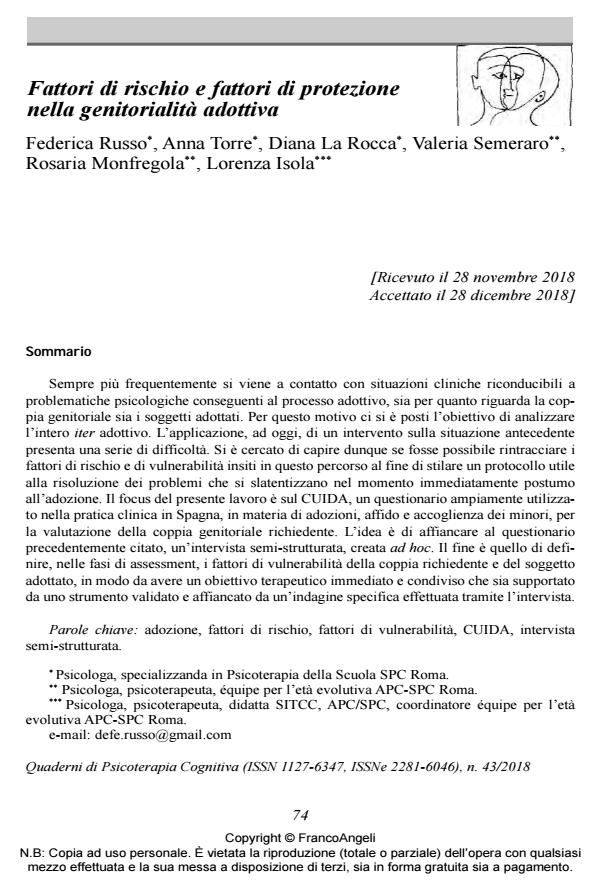
Sempre più frequentemente si viene a contatto con situazioni cliniche riconducibili a problematiche psicologiche conseguenti al processo adottivo, sia per quanto riguarda la coppia genitoriale sia i soggetti adottati. Per questo motivo ci si è posti l’obiettivo di analizzare l’intero iter adottivo. L’applicazione, ad oggi, di un intervento sulla situazione antecedente presenta una serie di difficoltà. Si è cercato di capire dunque se fosse possibile rintracciare i fattori di rischio e di vulnerabilità insiti in questo percorso al fine di stilare un protocollo utile alla risoluzione dei problemi che si slatentizzano nel momento immediatamente postumo all’adozione. Il focus del presente lavoro è sul CUIDA, un questionario ampiamente utilizzato nella pratica clinica in Spagna, in materia di adozioni, affido e accoglienza dei minori, per la valutazione della coppia genitoriale richiedente. L’idea è di affiancare al questionario precedentemente citato, un’intervista semi-strutturata, creata ad hoc. Il fine è quello di definire, nelle fasi di assessment, i fattori di vulnerabilità della coppia richiedente e del soggetto adottato, in modo da avere un obiettivo terapeutico immediato e condiviso che sia supportato da uno strumento validato e affiancato da un’indagine specifica effettuata tramite l’intervista.
Parole chiave:Adozione, fattori di rischio, fattori di vulnerabilità, CUIDA, intervista semi-strutturata.
- Van Egeren L.A. (2003). Prebirth predictors of coparenting experiences in early infancy. Infant Mental Health Journal, 24(3): 278-295.
- Van IJzendoorn M.H., Juffer F. (2006). The Emanuel Miller Memorial Lecture 2006: Adoption as intervention. Meta-analytic evidence for massive catch-up and plasticity in physical, socio-emotional, and cognitive development. Journal of Child Psychology and Psychiatry, 47(12): 1228-1245.
- Foli K.J., Southb S.C., Limc E., Jarnecke A. (2016) Post-adoption Depression: Parental Classes of Depressive Symptoms Across Time. J. Affect. Disord., 200: 293-302.
- Frigerio A., Cattaneo C., Cataldo M., Schiatti A., Molteni M., Battaglia M. (2004). Behavioral and emotional problems among Italian children and adolescents aged 4 to 18 years as reported by parents and teachers. European Journal of Psychological Assessment, 20: 124-133. DOI: 10.1027/1015-5759.20.2.12
- Giannini M., Rusignuolo I., Berretti F. (2010). CUIDA. Questionario per la valutazione dei richiedenti l’adozione, gli assistenti, i tutori e i mediatori. Firenze: Giunti O.S.
- Goodman R. (1999). The extended version of the Strenghts and Difficulties Questionnaire as a guide to child psychiatric caseness and consequent burden. Journal of Child Psychology and Psychiatry, 40(5): 791-799. DOI: 10.1111/1469-7610.0049
- Ingersoll B.D. (1997). Psychiatric disorders among adopted children: A review and commentary. Adoption Quarterly, 1: 57-73.
- Judge S.L. (2003). Determinants of parental stress in families adopting children from Eastern Europe. Family Relations, 52: 241-248. https://www.jstor.org/stable/3700275
- Judge S.L. (2004). The impact of early instituzionalization on child and families outcomes. Adoption Quarterly, 7: 31-48. DOI: 10.1177/016502540607149
- Juffer F., Van Ijzendoorn M. (2005). Behavior problems and mental healthreferrals of international adoptees: a meta-analysis. JAMA: Journal of the American Medical Association, 293: 2501-2515.
- Larsson B., Frisk M. (1999). Social competence and emotional/behaviour problems in 6-16-year-old Swedish school children. European Child & Adolescent Psy-chiatry, 8: 24-33.
- Leung P., Erich S., Kanenberg H. (2005). A comparison of family functioning in gay/lesbian, heterosexual and special needs adoptions. Children and Youth Services Review, 27: 1031-1044.
- Leve L.D., Scaramella L.V., Fagot B.L. (2001). Infant temperament, pleasure in parenting and marital happiness in adoptive families. Infant Mental Health Journal, 22: 545-558.
- Levi-Shiff R., Goldshimdt I., Har-Even D. (1991). Transition to parenthood in ado-ptive families. Developmental Psychology, 27: 131-140. DOI: 10.1037/0012-1649.27.1.13
- Mainemer H., Gilman L.C., Ames E.W. (1998). Parenting stress in famiglie ado-pting children from Romanian orphanages. Journal of Family Issues, 19(2): 164-180. -- http://www.fiuc.org/bdf/pdf/redif_10_-_articulos_-_articles1.pdf
- McDonald T.P., Lieberman A.A., Partridge S., Hornby H. (1991). Assessing the role of agency services in reducing adoption disruptions. Children and Youth Services Review, 13(5): 425-438. DOI: 10.1016/0190-7409(95)00058-
- McHale J. (1995). Co-parenting and triadic interactions during infancy: The roles of marital distress and child gender. Developmental Psychology, 31: 985-996. DOI: 10.1037/0012-1649.31.6.98
- McHale J.P., Kuersten-Hogan R., Rao N. (2004). Growing points for coparenting theory and research. Journal of Adult Development, 11(3): 221-234.
- McKay K., Ross L.E., Goldberg A.E. (2010), Adaptation to Parenthood During the Post- Adoption Period: A Review of the Literature. Adoption Quarterly, 13: 125-144. DOI: 10.1080/10926755.2010.48104
- Niemann S., Weiss S. (2012). Factors affecting attachment in International adoptees at 6 months post-adoption. Children and Youth Services Review, 34(1): 205-212.
- Vadilonga F. (2010). Curare l’adozione. Modelli di intervento e presa in carico della crisi adottiva. Milano: Raffaello Cortina.
- Pace G.S., Zavattini G.C. (2010). Adoption and attachment theory: the attachment models of adoptive mothers and the revision of attachment patterns of their late-adopted children. Child: Care, Health and Development, 37(1): 82-88. -- https://pdfs.semanticscholar.org/7acc/da6ab370fb2a149f416b3e542ccd3960cc65.pdf
- Palacios J., Roman M., Moreno C., Leon E. (2009). Family context for emotional recovery in internationally adopted children. International Social Work, 52: 609-620. DOI: 10.1177/0020872809337679
- Palacios J., Sànchez-Sandoval Y. (2006). Stress in parents of adopted children. International Journal of Behavioral Development, 30: 481-487. DOI: 10.1177/016502540607149
- Quinton D., Rushton A., Dance C., Mayers D. (1998). Joining new families: A study of adoption and fostering in middle childhood. Chichester: Wiley.
- Rijik C.H., Hoksbergen R.A., ter Laak J.J., van Dijkum C., Robbroeckx L.H.M. (2006). Parents who adopt deprived children have a difficult task. Adoption Quarterly, 9(2-3): 37-61. https://link.springer.com/article/10.1007/s12144-017-9657-x
- Rogge R.D., Bradbury T.N. (1999). Till violence does us part: The differing roles of communication and aggression in predicting adverse marital outcomes. Journal of Consulting and Clinical Psychology, 67: 340-351. DOI: 10.1037//0022-006X.67.3.34
- Rosenthal J.A., Groze V.K. (1992). Special-needs adoption: a follow-up study of intact families. New York: Praeger.
- Rosnati R., Montirosso D., Barni R. (2008). Italian International Adoptees at Home and at School: A Multi-Informant Assessment of Behavioral Problems. Journal of Family Psychology, 24(6): 783-786.
- Rushton A., Mayes D., Dance C., Quinton D. (2003). Parenting late-placed children: The development of new relationships and the challenge of behavioural problems. Clinical Child Psychology and Psychiatry, 8(3): 389-400. DOI: 10.1177/135910450300800300
- Rutter M., Sonuga-Barke E.J., Beckett C., Castle J., Kreppner J., Kumsta R. et al. (2010). Deprivation-specific psychological patterns: effects of institutional deprivation. Monographs of the Society for Research in Child Development, 75(1): 1-250. http://discovery.ucl.ac.uk/id/eprint/96522
- Salcuni S., Ceccato P., Di Riso D., Lis A. (2006). Diagnosi multi-prospettica di genitori in attesa di adozione. Rassegna di Psicologia, 23: 49-68. DOI: 10.1421/7790
- Santona A., Zavattini G.C. (2005). Partnering and parenting expectations in adoptive couplet. Sexual and Relationship Therapy, 20: 309-322. DOI: 10.1080/1468199050014200
- Santona A., Zavattini G.C. (a cura di) (2007). La relazione di coppia. Strumenti di valutazione. Roma: Borla.
- Scabini E., Cigoli V. (2000). Il famigliare, Legami, Simboli e Transizioni. Milano: Raffaello Cortina.
- Senecky Y. et al. (2009). Post-adoption depression among adoptive mothers. Journal of Affective Disorders, 115: 62-68.
- Skinner H.A., Steinhauer P.D., Santa-Barbara J. (1983). The Family Assessment Measure. Canadian Journal of Community Mental Health, 2: 91-105. DOI: 10.1177/10748407960020040
- Smith D.W., Brodzinsky D.M. (2002). Coping with birthparent loss in adopted children. Journal of Child Psychology and Psychiatry, 43(2): 213-223. DOI: 10.1111/1469-7610.0001
- Spanier G.B. (1976). Measuring diadic adjustment: new scales for assessing the quality of marriage and similar dyads. Journal of Marriage and Family, 38: 15-28. DOI: 10.2307/350547
- Steinhauer P.D., Santa Barbara J., Skinner H.A. (1984). The process model of family functioning. Canadian Journal of Psychiatry, 29: 77-88 92. DOI: 10.1177/07067437840290020
- Bruce J., Tarullo A.R., Gunnar M.R. (2009). Disinhibited social behavior among internationally adopted children. Development and Psychopathology, 21: 157-171. DOI: 10.1017/S095457940900010
- Calvo V. (2005). La prevenzione del disagio nell’adozione: Rassegna delle aree di possibile intervento post-adottivo. -- http://hdl.handle.net/11577/182245
- Camras L.A., Perlman S.B., Wismer Fries A.B., Pollak S.D. (2006). Post-institutionalized Chinese and Eastern European children: Heterogeneity in the development of emotion understanding. International Journal of Behavioral Development, 30(3): 193-199.
- Carr L., Iacoboni M., Debeau M.C., Mazziotta J.C., Lenzi G.L. (2003). Neural mechanisms of empathy in humans: A relay from neural systems for imitation to limbic areas. Proceedings of the National Academy of Sciences of the United States of America, 100: 5497-5502.
- Cassidy J., Shaver P.R. (2016). Handbook of Attachment. Third Edition. Theory, Research, and Clinical Applications. New York: Guilford Press (trad. it. a cura di De Bei F., Dazzi N. (2018). Manuale dell’Attaccamento. Teoria, Ricerca e Applicazioni Cliniche. Seconda Edizione. Addendum alla II edizione. Roma: Fioriti Editore).
- Cavanna D., Rosso A.M., Pace C.S. (2008). Stili di attaccamento e soddisfazione coniugale in un campione di coppie adottive. Rivista di Studi Familiari, 2: 95-114.
- Chisholm K. (1998). A three year follow-up of attachment and indiscriminate friendliness in children adopted from Romanian orphanages. Child Development, 69(4): 1092-1106. DOI: 10.2307/113236
- Cigoli V., Scabini E. (2006). Family Identity, Ties, Symbols and Transitions. Mahwah, NJ: Lawrence Erlbaum Associates.
- Crnic K., Acevedo M. (1995). Everyday stresses and parenting. In: Bornstein M.H. (ed.), Handbook of parenting, Hillsdale, NJ: Lawrence Erlbaum Associates, pp. 277-297. -- http://www.scielo.br/pdf/epsic/v8n3/19960.pdf
- Cyrulnik B. (1999). Il dolore meraviglioso. Diventare adulti sereni superando i traumi dell’infanzia (trad. it.: Milano: Frassinelli, 2000).
- Cowan C.P., Cowan P.A. (2000). When partners become parents: the big life change in couples. Mahwah, NJ: Lawrence Erlbaum Associates.
- Crowell J. (2003). Assessment of attachment security in a clinical setting: observations of parents and children. Journal of Developmental and Behavioral Pedia-trics, 24: 199-204. DOI: 10.1097/00004703-200306000-00012
- Dhami M.K., Mandel D.R., Sothmann K. (2007). An evaluation of post-adoption services. Children and Youth Services Review, 29: 162-179.
- Fahlberg V. (1997). Post adoption services. In Roszia S., Baran A., Coleman L. (eds.), Creating kinship. Portland: University of Southern Maine.
- Fava Vizziello G., Simonelli A. (2004). Adozione e Cambiamento. Torino: Bollati Boringhieri.
- Feeney J.A. (2003). The systemic nature of couple relationship: an attachment perspective. In Erdman P., Caffery T. (eds.), Attachment and family systems: conceptual, empirical and therapeutic relatedness. New York: Brunner/Mazel. -- https://www.redalyc.org/pdf/3589/358933579004.pdf
- Feeney J.A. (2004). Adult attachment and relationship functioning under stress-full confitions. Understanding partner’s responses to conflict and challenge. In Rholes W.S., Simpson J.A. (eds.), Adult attachment. Theory, research and clinical implications. New York, London: The Guilford Press, pp. 339-366. -- https://www.redalyc.org/pdf/3589/358933579004.pdf
- Foli K.J. (2010). Depression in adoptive parents: a model of understanding through grounded theory. Western Journal of Nurishing Research, 32(3): 379-400.
- Abidin R.R. (1990). Parenting Stress Index test maual (3rd ed.). Charlottesville: Pediatric Psychology Press. -- https://www.scirp.org/(S(351jmbntvnsjt1aadkposzje))/reference/ReferencesPapers.aspx?ReferenceID=276576
- Adler A. (1990). Il Senso della Vita. Novara: Istituto Geografico De Agostini.
- Ammaniti M., Candelori C., Pola M., Tambelli R. (1995). Maternità e gravidanza. Studio delle rappresentazioni materne. Milano: Raffaello Cortina.
- Attili G. (2004). Attaccamento e Amore. Bologna: Il Mulino.
- Bird G.W., Peterson R., Miller S. (2002). Factors Associated With Distress Among Support-Seeking Adoptive Parents. Family Relations, 51(3): 215.
- Bolwby J. (1988). Una base sicura (trad. it.: Milano: Raffaello Cortina, 1989).
- Brodzinsky D.M. (1990). Children’s Understanding of Adoption: Developmental and Clinical Implications. Professional Psychology Research and Practice, 42(2): 200-207.
Federica Russo, Anna Torre, Diana La Rocca, Valeria Semeraro, Rosaria Monfregola, Lorenza Isola, Fattori di rischio e fattori di protezione nella genitorialità adottiva in "QUADERNI DI PSICOTERAPIA COGNITIVA" 43/2018, pp 74-96, DOI: 10.3280/QPC2018-043005