Citizen engagement and the Covid-19 mask communication
Titolo Rivista SOCIOLOGIA DELLA COMUNICAZIONE
Autori/Curatori Vilma Luoma-aho, Maria-Jose Canel, Jana Bowden, Erika Ek, Viktoria Vainiomäki
Anno di pubblicazione 2021 Fascicolo 2021/61
Lingua Inglese Numero pagine 16 P. 20-35 Dimensione file 392 KB
DOI 10.3280/SC2021-061003
Il DOI è il codice a barre della proprietà intellettuale: per saperne di più
clicca qui
Qui sotto puoi vedere in anteprima la prima pagina di questo articolo.
Se questo articolo ti interessa, lo puoi acquistare (e scaricare in formato pdf) seguendo le facili indicazioni per acquistare il download credit. Acquista Download Credits per scaricare questo Articolo in formato PDF
FrancoAngeli è membro della Publishers International Linking Association, Inc (PILA), associazione indipendente e non profit per facilitare (attraverso i servizi tecnologici implementati da CrossRef.org) l’accesso degli studiosi ai contenuti digitali nelle pubblicazioni professionali e scientifiche.
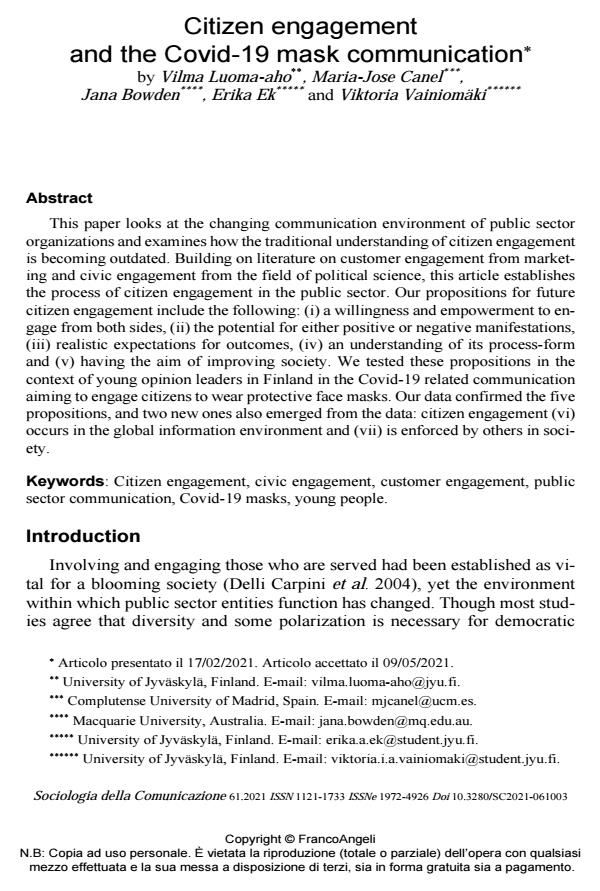
This paper looks at the changing communication environment of public sector organizations and examines how the traditional understanding of citizen engage-ment is becoming outdated. Building on literature on customer engagement from marketing and civic engagement from the field of political science, this article es-tablishes the process of citizen engagement in the public sector. Our propositions for future citizen engagement include the following: (i) a willingness and empow-erment to engage from both sides, (ii) the potential for either positive or negative manifestations, (iii) realistic expectations for outcomes, (iv) an understanding of its process-form and (v) having the aim of improving society. We tested these propo-sitions in the context of young opinion leaders in Finland in the Covid-19 related communication aiming to engage citizens to wear protective face masks. Our data confirmed the five propositions, and two new ones also emerged from the data: citizen engagement (vi) occurs in the global information environment and (vii) is enforced by others in society.
Parole chiave:Citizen engagement, civic engagement, customer engagement, public sector communication, Covid-19 masks, young people
- Marlowe, H. (2005), Public engagement: Theory and practice. Unpublished manuscript, -- http://analyticaconsulting.co/wp-content/uploads/2012/02/Public-engagement-theory-and-practice.pdf
- Papacharissi, Z. (2014), On networked publics and private spheres in social media, in J. Hunsinger, T. Senft (Eds.), The social media handbook, Routledge, New York.
- Sashi, C. (2012), Customer engagement, buyer-seller relationships, and social media. in «Management Decision», vol. 50 (2), 253-272. DOI: 10.1108/0025174121120355
- Sloterdijk, P. (2011), Bubbles, spheres I, MIT Press, Cambridge, MA.
- Taylor, M., Kent, M. (2014), Dialogic engagement: Clarifying foundational concepts, in «Journal of Public Relations Research», vol. 25 (5), 384-398. DOI: 10.1080/1062726X.2014.95610
- Testa, C. (2012), Is polarization bad?
- Thijs, N. (2011), Measure to improve: Improving public sector performance by using citizen-user satisfaction information. (). EUPAN / EIPA, Brussels, -- http://www.eupan.eu/files/repository/20111230120429_Measure_to__Improve.pdf
- van Dijk, R., Van Dick, R. (2009), Navigating organizational change: Change leaders, employee resistance, and work-based identities, in «Journal of Change Management», vol. 9 (2), 143-163. DOI: 10.1080/1469701090287908
- van Doorn, J., Lemon, K. N., Mittal, V., Nass, S., Pick, D., Pirner, P., Verhoef, P. C. (2010), Customer engagement behavior: Theoretical foundations and research directions, in «Journal of Service Research», vol. 13 (3), 253-266. DOI: 10.1177/109467051037559
- Weber, M. (1946) Max Weber: Essays in Sociology, Oxford University Press, Oxford.
- Adler, R. P., Goggin, J. (2005), What do we mean by “Civic engagement”?, in «Journal of Transformative Education», vol. 3 (3), 236-253.
- Amnå, E., Ekman, J. (2014), Standby citizens: Diverse faces of political passivity, in «European Political Science Review», vol. 6 (2), 261-281. DOI: 10.1017/S175577391300009
- Arnstein, S. R. (2019), A ladder of citizen participation, in «Journal of the American Planning Association», vol. 85 (1), 24-34. DOI: 10.1080/01944363.2018.155938
- Bole, B. E., Gordon, M. (2009), E pluribus unum: Fostering a new era of citizenship by teaching civic engagement and healthy civic discourse, in «Journal of Public Affairs», vol. 9 (4), 273-287.
- Bourgon, J. (2011), A new synthesis of public administration: Serving in the 21st century, McGill Queen’s Press, MQUP, Washington DC.
- Bowden, J. (2009), Customer engagement: A framework for assessing customer-brand relationships: The case of the restaurant industry, in «Journal of Hospitality Marketing & Management», vol. 18 (6), 574-596. DOI: 10.1080/1936862090302498
- Brodie, R. J., Ilic, A., Biljana, J., Hollebeek, L. (2011), Consumer engagement in a virtual brand community: An exploratory analysis, «Journal of Business Research», (1).
- Canel, M., Luoma-aho, V. (2019), Public sector communication. closing gaps between public sector organizations and citizens, Wiley, Boston.
- Capozzi, L., Zipfel, L. (2012), The conversation age: The opportunity for public relations, in «Corp Comm: An Int Jnl», vol. 17 (3), 336-349. DOI: 10.1108/1356328121125356
- Castells, M. (2009), Communication power, Oxford University Press, Oxford.
- Cavaye, J. (2004), Changing the Way Governments Works: New Interests ‐ New Arrangements, Department for Victorian Communities, Victoria.
- Chandler, J. D., Lusch, R. F. (2015), Service systems, in «Journal of Service Research», vol. 18 (1), 6-22. DOI: 10.1177/109467051453770
- Chen, Q., Min, C., Zhang, W., Wang, G., Ma, X., Evans, R. (2020), Unpacking the black box: How to promote citizen engagement through government social media during the COVID-19 crisis, Computers in Human Behavior.
- Cooper, T. L. (2005), Civic engagement in the twenty-first century: Toward a scholarly and practical agenda, in «Public Administration Review», vol. 65 (5), 534-535.
- Dahlgren, P. (2005), The internet, public spheres, and political communication: Dispersion and deliberation, in «Political Communication», vol. 22 (2), 147-162. DOI: 10.1080/1058460059093316
- Dahlgren, P. (2015), Probing the EU public sphere: Participation and civic cultures, in «Quaderni di Sociologia», 68, pp. 5-21.
- Delli Carpini, M., Cook, F., Jacobs, L. (2004), Public deliberation, discursive participation, and citizen engagement, in «Annual Review of Political Science», 7, pp. 315-344.
- de Jong, Menno D. T., Neulen, S., Jansma, S. R. (2019), Citizens’ intentions to partic-ipate in governmental co-creation initiatives: Comparing three co-creation configurations, in «Government Information Quarterly», vol. 36 (3), 490-500.
- Gaventa, J., Barrett, G. (2010), So what difference does it make? mapping the outcomes of citizen engagement, (No. Working paper Volume 2010 Number 347), Development Research Center and Institute for Development Studies, Sussex, UK.
- Hollebeek, L. (2011), Exploring customer brand engagement: Definition and themes, in «Journal of Strategic Marketing», vol. 19 (7), 555-573. DOI: 10.1080/0965254X.2011.59949
- Hollebeek, L. D., Chen, T. (2014), Exploring positively- versus negatively-valenced brand engagement: A conceptual model, in «Journal of Product and Brand Management», vol. 23 (1), 62-74. DOI: 10.1108/JPBM-06-2013-033
- Imandin, L., Bisschoff, C., Botha, C. (2014), A model to measure employee engagement, in «Problems and Perspectives in Management», vol. 12 (4), 520-532.
- Johnston, K., Taylor, M. (2018), Engagement as communication - pathways, possibilities, and future directions, in K. Johnston, M. Taylor (Eds.), The handbook of communication engagement, Wiley Blackwell.
- Karahasanović, A., Hinkel, U., Sjøberg, D. K., Thomas, R. (2009), Comparing of feedback-collection and think-aloud methods in program comprehension studies, in «Behaviour & Information Technology», vol. 28 (2), 139-164. -- https://doiorg.ezproxy.jyu.fi/10.1080/01449290701682761
- Lay-Hwa Bowden, J., Luoma-aho, V., Naumann, K. (2016), Developing a spectrum of positive to negative citizen engagement, in R. J. Brodie, L. Hollebeek & J. Conduit (Eds.), Customer engagement contemporary issues and challenges, Routledge, London.
- Levine, P. (2007), The future of democracy: Developing the next generation of American citizens, Tufts University Press, Lebanon, New Hampshire.
- Lovari, A., D’Ambrosi, L., Bowen, S. (2020), Re-Connecting Voices. The (New) Strategic Role of Public Sector Communication After the Covid-19 crisis, in «Partecipazione e Conflitto», vol. 13 (2), 970-989.
- Lovari, A., Parisi, L. (2015), Listening to digital publics. investigating citizens voices and engagement within italian municipalities’ facebook pages, in «Public Relations Review», vol. 41 (2), 205-213.
- Luoma-aho, V., Canel, M-J. (2020) (Eds.), Handbook of Public Sector Communication, Wiley-Blackwell, New York.
- Luoma‐aho, V., Vos, M. (2010), Towards a more dynamic stakeholder model: Acknowledgg multiple issue arenas, in «Corp Comm: An Int Jnl», vol. 15 (3), 315-331. DOI: 10.1108/1356328101106815
- Towards a conversational public administration? Giulia Banfi, Marco Luca Pedroni, in RDBCI: Revista Digital de Biblioteconomia e Ciência da Informação /2025 pp.e026005
DOI: 10.20396/rdbci.v24i00.8680284
Vilma Luoma-aho, Maria-Jose Canel, Jana Bowden, Erika Ek, Viktoria Vainiomäki, Citizen engagement and the Covid-19 mask communication in "SOCIOLOGIA DELLA COMUNICAZIONE " 61/2021, pp 20-35, DOI: 10.3280/SC2021-061003