Technical and environmental cost-benefit analysis of strategies towards a green economy in the electricity sector in Libya
Titolo Rivista ECONOMICS AND POLICY OF ENERGY AND THE ENVIRONMENT
Autori/Curatori Yasser F. Nassar, Hala J. El-Khozondar, Mansour A. Salem, Abubaker Alatrash, Wael A. Salah, Mohammed J. Bashir, Mohamed H. Elnaggar
Anno di pubblicazione 2025 Fascicolo 2025/2
Lingua Inglese Numero pagine 35 P. 133-167 Dimensione file 1028 KB
DOI 10.3280/EFE2025-002007
Il DOI è il codice a barre della proprietà intellettuale: per saperne di più
clicca qui
Qui sotto puoi vedere in anteprima la prima pagina di questo articolo.
Se questo articolo ti interessa, lo puoi acquistare (e scaricare in formato pdf) seguendo le facili indicazioni per acquistare il download credit. Acquista Download Credits per scaricare questo Articolo in formato PDF
FrancoAngeli è membro della Publishers International Linking Association, Inc (PILA), associazione indipendente e non profit per facilitare (attraverso i servizi tecnologici implementati da CrossRef.org) l’accesso degli studiosi ai contenuti digitali nelle pubblicazioni professionali e scientifiche.
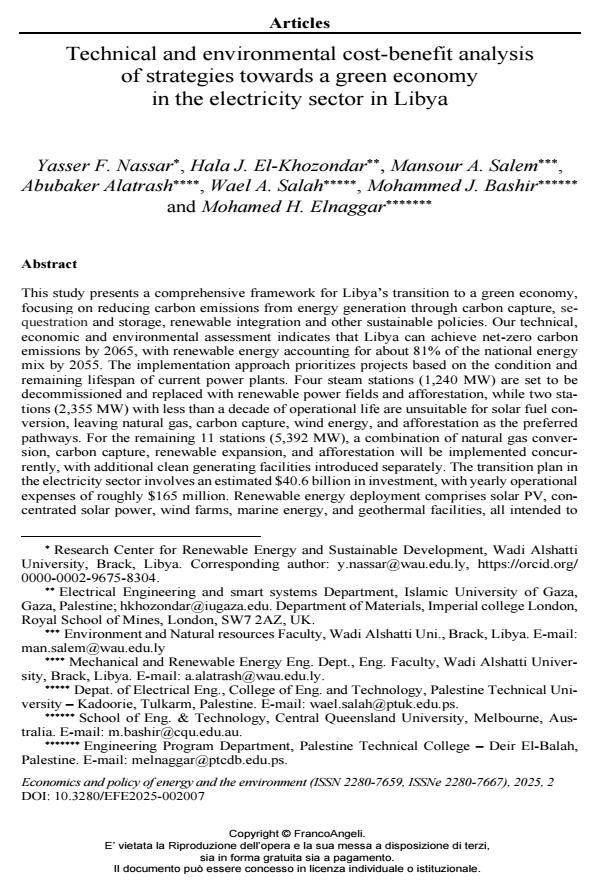
This study presents a comprehensive framework for Libya’s transition to a green economy, focusing on reducing carbon emissions from energy generation through carbon capture, sequestration and storage, renewable integration and other sustainable policies. Our technical, economic and environmental assessment indicates that Libya can achieve netzero carbon emissions by 2065, with renewable energy accounting for about 81% of the national energy mix by 2055. The implementation approach prioritizes projects based on the condition and remaining lifespan of current power plants. Four steam stations (1,240 MW) are set to be decommissioned and replaced with renewable power fields and afforestation, while two stations (2,355 MW) with less than a decade of operational life are unsuitable for solar fuel conversion, leaving natural gas, carbon capture, wind energy, and afforestation as the preferred pathways. For the remaining 11 stations (5,392 MW), a combination of natural gas conversion, carbon capture, renewable expansion, and afforestation will be implemented concurrently, with additional clean generating facilities introduced separately. The transition plan in the electricity sector involves an estimated $40.6 billion in investment, with yearly operational expenses of roughly $165 million. Renewable energy deployment comprises solar PV, concentrated solar power, wind farms, marine energy, and geothermal facilities, all intended to replace old units and meet future demand. Pilot projects like the Brack hybrid renewable station demonstrate that complete energy coverage may be achieved while lowering dependency on fossil fuels and CO2 emissions. Furthermore, largescale afforestation initiatives will help to reduce carbon emissions and ensure further environmental benefits, with return on investment through the sale of CO2 credits commencing within the first few years. Collectively, these policies provide a realistic route for Libya to develop a sustainable, diverse, and lowcarbon power industry.
Parole chiave:Green economy, energy industry, alternative and environmentally friendly energies, negative carbon emission systems, netzero carbon.
Jel codes:Q01, Q21, Q35, Q48, Q51
- [14] Z. Liu, Z. Deng, G. He et al. (2022). Challenges and opportunities for carbon neutrality in China. Nature Reviews Earth & Environment, 3, 141155.
- [1] U. E. Programme (2024). Green economy. [Online]. Available: https://www.unep.org/ regions/latinamericaandcaribbean/regionalinitiatives/promotingresourceefficiency/green.
- [2] K. Moumani (2023). Management of sustainable development in the light of Arab and international cooperation, a case study of the Arab vision of management of sustainable development. Wadi Alshatti University Journal of Pure and Applied Sciences, 1(1), 18.
- [3] N. Fathi, K. Aissa, S. Alsadi (2018). Air Pollution Sources in Libya. Research & Reviews: Journal of Ecology and Environmental Sciences, 6(1), 6379.
- [4] M. Andeef, Y. Nassar, H. Awad, H. ElKhozondar, M. Khaleel (2023). Transitioning to Solar Fuel Instead of Fossil Fuel in The Electricity Industry in Libya. International Journal of Electrical Engineering, 1(4), 3246.
- [5] H. Ritchie, P. Rosado (2020). Energy Mix. Our World In Data Organization. [Online]. Available: https://ourworldindata.org/energymix. [Accessed January 2024].
- [6] M. Khaleel et al. (2024). Evolution of emissions: The role of clean energy in sustainable development. Challenges in Sustainability, 12(2), 122135.
- [7] S. Budinis (2020). Going carbon negative: What are the technology options?. IEA, Paris.
- [8] IEA (2023). 28th United Nations Climate Change Conference (COP28) 30 November to 12 December 2023, Dubai, UAE. IEA. [Online]. Available: https://www.iea.org/ events/ieaatcop28.
- [9] National Oil Corporation (NOC) (2025). With NOC Participation, ‘Green Libya’ Team Confirms Implementation in April, News, 26 Jan. [Online]. Available: https://noc.ly/en/withnocparticipationgreenlibyateamconfirmsimplementationinapril/.
- [10] E. Hala et al. (2025). Economic and Environmental Implications of Solar Energy Street Lighting in Urban Regions: A Case Study. Wadi Alshatti University Journal of Pure and Applied Sciences, 3(1), 142151.
- [11] Q. Jiansheng et al. (2022). Analysis of International Carbon Neutralization Strategic Actions and Technology Layout and Enlightenment Suggestions to China. Bulletin of Chinese Academy of Sciences (Chinese Version), 37(4).
- [12] F. Wang, J. Harindintwali, Z. Yuan et al. (2021). Technologies and perspectives for achieving carbon neutrality. The Innovation, 2(4), 100180.
- [13] L. Chen, G. Msigwa, M. Yang et al. (2022). Strategies to achieve a carbon neutral society: a review. Environmental Chemistry Letters, 20, 22772310.
- [15] E. Loiseau, L. Saikku, R. Antikainen, N. Droste, B. Hansjürgens, K. Pitkänen, P. Leskinen, P. Kuikman, M. Thomsen (2016). Green economy and related concepts: An overview. Journal of Cleaner Production, 139, 361371.
- [16] M. Ringel, B. Schlomann, M. Krail, C. Rohde (2016). Towards a green economy in Germany? The role of energy efficiency policies. Applied Energy, 179, 12931303.
- [17] S. Akalibey, A. Ahenkan, K. Duho, T. Nyamekye, J. Schneider (2023). Drivers of green economy in an emerging market: Generic and sectorspecific insights. Journal of Cleaner Production, 425, 138857.
- [18] E. Ali, V. Anufriev, B. Amfo (2021). Green economy implementation in Ghana as a road map for a sustainable development drive: A review. Scientific African, 12, e00756.
- [19] Y. Lin, M. Mahmood, W. Meng, Q. Ali (2024). Green economy transition in Asia Pacific: A holistic assessment of renewable energy production. Journal of Cleaner Production, 437, 140648.
- [20] A. Sarhan (2023). Towards green economy in Egypt: decoupling economic growth and carbon emissions. Journal of Environmental Sciences, 52(3), 2368.
- [21] R. Nejad (2023). Renewable Energy Consumption and the Transition to a Green Economy in Egypt. Journal of World Sociopolitical Studies, 7(1), 147179.
- [22] J. Cohen, R. Helwa (2025). The green gold rush: Why renewable energy is Egypt’s next big opportunity. New Atlanticist, February, 3. https://www.atlanticcouncil.org/blogs/newatlanticist/thegreengoldrushwhyrenewableenergyisegyptsnextbigopportunity/.
- [23] R. Morrar (2025). Investment in Green Infrastructure and Adaptation with Climate Change in Palestine. International Scientific Symposium, Palestinian Economic Policy Research Institute (MAS), 114. https://mas.ps/cached_uploads/download/2024/ 12/02/paper61733151816.pdf.
- [24] United Nation (20142020). The green economy in Tunisia, an implementation tool of the new sustainable development strategy. https://archive.uneca.org/sites/default/files/uploadeddocuments/SROs/NA/AHEGMISDGE/egm_ge_tunisa_eng.pdf.
- [25] United Nation. The green economy in Algeria, an Opportunity to Diversify and Stimulate Domestic Production. https://archive.uneca.org/sites/default/files/uploadeddocuments/ SROs/NA/AHEGMISDGE/egm_ge_algeria.pdf.
- [26] I. D. Services, IEA, [Online]. Available: https://www.iea.org/countries/libya/energymix. [Accessed January 2024].
- [27] A. Makhzom, A. Eshdok, F. Yasser, S. Alsadi, T. Foqha, M. Salem, I. AlShareef, H. ElKhozondar (2023). Estimation of CO2 emission factor for Power Industry Sector in Libya. The 8th International Engineering Conference on Renewable Energy & Sustainability (ieCRES 2023). Gaza Strip – Palestine, May 89.
- [28] Y. Nassar, K. Aissa, S. Alsadi (2017). Estimation of Environmental Damage Costs from CO2e Emissions in Libya and the Revenue from Carbon Tax Implementation. Low Carbon Economy, 8, 118132.
- [29] https://www.spglobal.com/platts/PlattsContent/_assets/_images/blog/2020/01/20200129_ Libya_Map.jpg.
- [30] M. Inweer, N. Fathi (2025). Carbon Emissions Life Cycle Assessment of Cement Industry in Libya. Wadi Alshatti University Journal of Pure and Applied Sciences, 3(2), 162 173.
- [31] Wikipedia (2022). Libyan Airlines. [Online]. Available: https://en.wikipedia.org/wiki/ Libyan_Airlines.
- [32] A. Aqila, Y. Nassar, H. ElKhozondar, S. Suliman (2025). Design of Hybrid Renewable Energy System (PV/Wind/Battery) Under Real Climatic and Operational Conditions to Meet Full Load of the Residential Sector: A Case Study of a House in Samno Village – Southern Region of Libya. Wadi Alshatti University Journal of Pure and Applied Sciences, 3(1), 168181.
- [33] Aqila, A. H., Abubaker, A., Nassar, Y. (2025). Design of a Hybrid Renewable Energy System to Meet Housing Thermal Loads: Performance Evaluation Under Real Conditions of a House in Samno Region, Libya. Wadi Alshatti University Journal of Pure and Applied Sciences, 3(2), 179191.
- [34] A. Aqila (2025). RealTime Design and Analysis of a Hybrid Renewable Energy System (PV/Wind/Battery) for SelfConsumption Residential building. In Engineering for Palestine Conference, Palestine Polytechnic University, Hebron, Palestine, 2930 September 2025.
- [35] H. Zurqani, E. Mikhailova, C. Post, M. Schlautman, A. Elhawej (2019). A Review of Libyan Soil Databases for Use within an Ecosystem Services Framework. Land, 8(5), 82.
- [36] K. Iessa, Y. Fathi, M. Salem (2022). Quantities inventory of CO2 emitted from the energy industry sector in Libya: A case study. The International Scientific Symposium on Environmental Science. March 9th10th, TulkarmPalestine.
- [37] A Makhzom et al. (2023). Carbon Dioxide Life Cycle Assessment of the Energy Industry Sector in Libya: A Case Study. International Journal of Electrical Engineering and Sustainability (IJEES), 1(3), 145163.
- [38] Y. Nassar, M. Salem, H. ElKhozondar (2025). Estimation of CO2 Emissions from the Electric Power Industry Sector in Libya. Solar Energy and Sustainable Development Journal, 14(1), 4255.
- [39] E. Almhdi, G. Miskeen (2025). Power and Carbon Footprint Evaluation and Optimization in Transitioning Data Centres. Wadi Alshatti University Journal of Pure and Applied Sciences, 3(2), 221229.
- [39] A. Alatrash et al. (2025). Estimation of CO2 emission within Libya’s electricity gener ation sector. Next Research, 2(3), 100567.
- [40] E. R. Authority (2022). Power station and associated costs Benchmark reserve capacity price 2022.
- [41] EIA (2024). Capital Cost and Performance Characteristic Estimates for Utility Scale Electric Power Generating Technologies. U.S. Department of Energy, Washington.
- [42] Y. Chen, Y. Li, E. Tsoutsanis, M. Newby, X. Zhao (2022). Technoeconomic evaluation and optimization of CCGT power Plant: A multicriteria decision support system. Energy Conversion and Management, 237(6), 114107, 6.
- [43] EIA (2020). Cost and Performance Estimates for New UtilityScale Electric Power Generating Technologies. U.S. Energy Information Administration, an agency of the U.S. Department of Energy, Washington.
- [44] IRENA (2023). Renewable power generation costs in 2022. International Renewable Energy Agency, Abu Dhabi.
- [45] A. Tariq, S. Kazmi, M. Hassan, S. Ali, M. Anwar (2024). Analysis of fuel cell integration with hybrid microgrid systems for clean energy: A comparative review. International Journal of Hydrogen Energy, 52, 10051034.
- [46] L. Irlam (2017). Global costs of carbon capture and storage. Global CC Inctitute.
- [47] The ForesrLink (2022). https://theforestlink.com/2022/09/whyhowmuchdoesitcosttoplantatreeisthewrongquestion/#:~:text=This%20said%2C%20even%20a%20per%20 hectare%20cost,be%20between%20$4%2C000%20and%20$6%2C000%20per%20hectare.
- [48] P. Latocha (2012). Cost comparison – initial and maintenance costs of lawns and ground cover plants. Annals of Warsaw Agricultural UniversitySGGW, 23, 3942.
- [49] B. Romero, J. Perales, H. Pereira, M. Barbosa, J. Ruiz (2022). Technoeconomic assessment of microalgae production, harvesting and drying for food, feed, cosmetics, and agriculture. Science of The Total Environment, 837, 155742.
- [50] H. Hssam (2024). Quantity and cost of CO2 emissions de to petroleum and natural gas consumption. Seventh day magazine, Cairo.
- [51] I. Parry (2021). Finance & Development. International Monetary Fund, September. [Online]. Available: https://www.imf.org/en/Publications/fandd/issues/2021/09/fivethingstoknowaboutcarbonpricingparry. [Accessed Janary 2024].
- [52] T. Fisher (2024). The Political Economy of EPA’s Updated Social Cost of Carbon. CATO Institute.
- [53] A. Molocchi, G. Mela (2024). Social Cost of Carbon as an International Benchmark to Drive Countries’ Carbon Pricing during the Transition. Sustainability, 16, 8573.
- [54] J. Hala et al. (2025). Sustainable Street Lighting in Gaza: Solar Energy Solutions for Main Street. Energy, 360, 4, 100042.
- [55] A. Symons, L. Douglas (2023). High cost, low profitability and storage challenges: Is carbon capture a realistic climate solution?. Euronews.Green.
- [56] IEA (2023). The role of CCUS in lowcarbon power systems. IEA, Paris.
- [57] N. Bahman, M. AlKhalifa, S. Al Baharna, Z. Abdulmohsen, E. Khan (2023). Review of carbon capture and storage technologies in selected industries: potentials and challenges. Rev Environ Sci Biotechnol, 22, 451470.
- [58] Y. Nassar, H. Elkhozondar, A. Ahmed, A. Alsharif, M. Khaleel, R. ElKhozondar (2024). A new design for a builtin hybrid energy system, parabolic dish solar concentrator and bioenergy (PDSC/BG): A case studyLibya. Journal of Cleaner Production, 441, 140944.
- [59] B. Belgasim, Y. Aldali, M. Abdunnabi, G. Hashem, K. Hossin (2018). The potential of concentrating solar power (CSP) for electricity generation in Libya. Renewable and Sustainable Energy Reviews, 90, 115.
- [60] Y. Nassar, H. ElKhozondar, G. Ghaboun, M. Khaleel, Z. Yusupov, A. Ahmed, A. Alsharif (2023). Solar and wind atlas for Libya. International Journal of Electrical Engineering and Sustainability (IJEES), 1(3), 2743.
- [61] R. Elzer et al. (2024). Assessing the Viability of Solar and Wind Energy Technologies in SemiArid and Arid Regions: A Case Study of Libya’s Climatic Conditions. Applied Solar Energy, 60(1), 149170.
- [62] M. Abouqeelah et al. (2023). Simulating the Energy, Economic and Environmental Performance of Concentrating Solar Power Technologies Using SAM: Libya as a Case Study. Solar Energy and Sustainable Development Journal, 12(2), 123.
- [63] N. Blair et al. (2018). System Advisor Model (SAM) General Description (Version 2017.9.5), NREL/TP6A2070414. https://sam.nrel.gov/.
- [64] S. Jessop (2022). COP27. Reuters, 7 November. [Online]. https://www.reuters.com/ business/cop/exclusivecop27imfchiefsays70toncarbonpriceneededby203020221107/
- [65] T. Nguyen, H. Cao, N. Nguyen, T. Duong, T. Tran, H. Bui, T. Ho (2021). Comprehensive study on the amount of CO2 absorbed by vegetation: A case study in Ho Chi Minh city, Vietnam. E3S Web of ConferencesICECAE 2021.
- [66] V. Garlington (2023). Forest Carbon Credits Alternative Investment Opportunity. 19 November. [Online]. Available: https://www.linkedin.com/pulse/forestcarboncreditsalternativeinvestmentvictorgarlingtontai0c/.
- [67] T. Hartmann, M. Vöhringer, S. Mielke, E. Mannigel, S. Hörmann (2021). Investing in forest carbon projects: Guidelines for companies and private investors. Global nature Fund (GnF), Germany.
- [68] S. Mohammed et al. (2025). Exploring Promised Sites for Establishing Hydropower Energy Storage (PHES) Stations in Libya by Using the Geographic Information Systems (GIS). Wadi Alshatti University Journal of Pure and Applied Sciences, 3(1), 8594.
- [69] M. Salem, A. Elmabruk, M. Irhouma, I. Mangir (2025). Assessment of Wind Energy Potential in Western Mountain: Nalut and Yefren as Case Study. Wadi Alshatti University Journal of Pure and Applied Sciences, 3(1), 3542.
- [70] A. Elmabruk, M. Salem, M. Khaleel, A. Mansour (2025). Prediction of Wind Energy Potential in Tajoura and Mislata Cities. Wadi Alshatti University Journal of Pure and Applied Sciences, 3(2), 125131.
- [71] K. Amer et al. (2025). EconomicEnvironmentalEnergetic (3E) analysis of Photovoltaic Solar Energy Systems: Case Study of Mechanical & Renewable Energy Engineering Departments at Wadi AlShatti University. Wadi Alshatti University Journal of Pure and Applied Sciences, 3(1), 5158.
- [72] F. Nassar, M. Abdunnabi, M. Sbeta, A. Hafez, K. Ali, A. Hassan, B. Belgasim (2021). Dynamic analysis and sizing optimization of a pumped hydroelectric storageintegrated hybrid PV/Wind system: A case study. Energy Conversion and Management, 229, 113744.
- [73] S. Ahmad, A. Agrira, N. Fathi (2025). The Impact of Loss of Power Supply Probability on Design and Performance of Wind/ Pumped Hydropower Energy Storage Hybrid System. Wadi Alshatti University Journal of Pure and Applied Sciences, 3(2), 5262.
- [74] E. Salim, A. Abubaker, B. Ahmed, N. Fathi (2025). A Brief Overview of Hybrid Renewable Energy Systems and Analysis of Integration of Isolated Hybrid PV Solar System with Pumped Hydropower Storage for Brack city – Libya. Wadi Alshatti University Journal of Pure and Applied Sciences, 3(1), 152167.
- [75] M. AlMaghalseh (2025). The Environmental Impact and Societal Conditions of PV Power Plants: A Case Study of Jericho GatePalestine Stat Of. Wadi Alshatti University Journal of Pure and Applied Sciences, 3(2), 1631.
- [76] G. Lavidas, V. Venugopal (2017). Wave energy resource evaluation and characterisation for the Libyan Sea. International Journal of Marine Energy, 18, 114.
- [77] Y. Nassar (2015). Thermodynamic Analysis and Optimization Procedure for Domestic Solar Water Heating System. American Journal of Energy and Power Engineering, 2(6), 9299.
- [78] M. Nyasapoh et al. (2025). Navigating renewable energy transition challenges for a sustainable energy future in Ghana. Solar energy and sustainable development by Libyan center for solar energy research and studies, 14(10), 237257.
- [79] A. Asfour et al. (2024). Photovoltaic solar energy for street lighting: A case study at Kuwaiti Roundabout, Gaza Strip, Palestine. Power Eng. Eng. Thermophys, 3(2), 7791.
- [80] H. Jarallah et al. (2024). A Smart Energy Monitoring Using ESP32 Microcontroller, ePrime. Advances in Electrical Engineering, Electronics and Energy, 9, 100666, September.
- [81] M. Elnaggar et al. (2024). Assessing the Technoenviroeconomic Viability of Wind Farms to Address Electricity Shortages and Foster Sustainability in Palestine. Results in Engineering, 24, 103111.
- [82] F. ElBatta et al. (2021). Microgrid for remote area in Gaza Strip powered by solar energy and olive oil mill waste. 12th International Conference on Sustainable Energy & Environmental Protection (SEEP 2021), Vienna, Austria, 14th17th September.
- [83] N. Fathi et al. (2019). Numerical Analysis and Optimization of Area Contribution of The PV Cells in the PV/T FlatPlate Solar Air Heating Collector. Solar Energy Research Update, 6, 4350.
- [84] M. Elnaggar et al. (2025). Leverage Wind Energy for Electricity and Hydrogen Production: A Sustainable Solution and EcoFriendly Alternative Fuel. Advanced Energy & Sustainability Research.
- [85] M. Kabeyi, O. Olanrewaju (2022). Feasibility of Conversion from Diesel Engine to Natural Gas Power Plants. IECON 2022 – 48th Annual Conference of the IEEE Industrial Electronics Society. Brussels, Belgium, 17. DOI: 10.1109/IECON49645.2022.9968428
- [86] IEA. https://www.iea.org/energysystem/carboncaptureutilisationandstorage.
- [87] https://uslightenergy.com/howlongdoesittaketobuildasolarfarm/.
- [88] A. Shankar, A. Saxena, R. Mazumdar (2024). Concentrating Solar Power Plants with Storage: Deployment Essential Now. The Energy and Resources Institute, February. https://www.solarpaces.org/wpcontent/uploads/2024/02/IndiaConcentratingSolarPowerPlantswithStorageDeploymentEssentialNow.pdf.
- [89] D. Ahn et al. (2017). Comparative evaluation of different offshore wind turbine installation vessels for Korean westsouth wind farm. International Journal of Naval Architecture and Ocean Engineering, 9(1), 4554.
- [90] https://www.reddit.com/r/theydidthemath/comments/18l6c6p/how_much_area_and_time_ does_it_take_to_ plant/#:~:text=The%20typical%20time%20to%20plant%20a%20seedling,roughly%203%2D6%20years%20of%20daily%20tree%20planting.
- [91] S. Mohammed et al. (2023). Carbon and Energy Life Cycle Analysis of Wind Energy Industry in Libya. Solar Energy and Sustainable Development Journal, 12(1), 5069.
- [92] B. Ahmed et al. (2023). Atlas of solar (PV and CSP) and wind energy technologies in Libya. The North African Journal of Scientific Publishing (NAJSP), 1(4), 824.
- [93] Y. Fathi et al. (2022). Atlas of PV Solar Systems Across Libyan Territory. 2022 International Conference on Engineering & MIS (ICEMIS). Istanbul, Turkey, 16. DOI: 10.1109/ICEMIS56295.2022.9914355
- High-resolution assessment of the impact of geographic variations and roof parameters on PV performance in Ireland Aiza Ahmad, Niamh Power, Evan Finegan, in Solar Energy Advances 100150/2026 pp.100150
DOI: 10.1016/j.seja.2026.100150 - Performance evaluation of solar irradiance transposition models and seasonal tilt angle optimisation using long-term data in a semiarid climate Saaransh Choudhary, Shiv Lal, Sumit Verma, in Next Energy 100728/2026 pp.100728
DOI: 10.1016/j.nxener.2026.100728 - Multi-scenario optimization of future energy mix for strategic energy planning in Morocco Hamza El Hafdaoui, Mohammed Abbas Hattati, Nouriddine Houran, Oumaima Mahir, Abdelilah Rochd, in Renewable Energy Focus 100828/2026 pp.100828
DOI: 10.1016/j.ref.2026.100828 - Shifting carbon emission dominance across subway lifecycle phases: A refined subsystem-interaction assessment Jing Pu, Chen Cai, Shijun Chen, Ru Guo, Ruimin Lin, Xingyu Ding, Jia Liu, Kaiming Peng, Xiangfeng Huang, in Environmental Impact Assessment Review 108485/2026 pp.108485
DOI: 10.1016/j.eiar.2026.108485 - Large-scale substitution of natural gas with electrical counterparts in residential and commercial sector of a developing country Muhammad Junaid Khan Jadoon, Syed Ali Abbas Kazmi, Zafar A. Khan, Fahim Ahmed Ibupoto, in Renewable Energy Focus 100909/2026 pp.100909
DOI: 10.1016/j.ref.2026.100909 - Energy storage and flexibility sizing for renewable integration pathways:A multi-stage techno-economic optimisation framework Gergo Varhegyi, Mutasim Nour, in Renewable Energy Focus 100910/2026 pp.100910
DOI: 10.1016/j.ref.2026.100910 - AI for EV battery health: Statistical meta-analysis and Autonomous Intelligence Pyramid Subrahmanyam Tanala, Appalabathula Venkatesh, in Next Sustainability 100461/2026 pp.100461
DOI: 10.1016/j.nxsust.2026.100461 - Adaptive multi-operator differential evolution based on binary tree population for optimal power flow with stochastic wind and solar power Jinhan Yao, Xu Chen, Ye Yuan, in Renewable Energy Focus 100902/2026 pp.100902
DOI: 10.1016/j.ref.2026.100902 - Applying MO-Jaya and machine learning to evaluate mixed renewable energy schemes for rural electrification Belal A. M. Abuhamra, Ashley Olebogeng, in Environment, Development and Sustainability /2026
DOI: 10.1007/s10668-026-07678-7 - Energy balance and economic analysis of rural distributed generation systems using biogas Andriele Rimoldi, Samuel Nelson Melegari de Souza, Juliano de Souza, Doglas Bassegio, Joseane Bortolini, Michael Collin Vargas, in Waste Management & Research: The Journal for a Sustainable Circular Economy 0734242X261462307/2026
DOI: 10.1177/0734242X261462307 - Photovoltaic tilt optimization using physics-informed machine learning methods Ebrahim Sheykhi, Mutlu Yilmaz, Cihan Tunc, in Electric Power Systems Research 114281/2027 pp.114281
DOI: 10.1016/j.epsr.2026.114281 - Optimization of building thermal and electrical energy consumption through heat recovery from cryptocurrency miners Abolfazl Gargoori Motlagh, Matin Ahmadi Renani, Mehran Hajiaghapour-Moghimi, Mehdi Vakilian, Mehrdad Setayesh Nazar, in Next Energy 100771/2026 pp.100771
DOI: 10.1016/j.nxener.2026.100771 - Techno economic analysis of 60 MW wind power farm in Agadez and Tahoua regions for grid connected electricity production Ismaïlou Manzo, Abdou Latif Bonkaney, Acoucacar Ali, Saïdou Madougou, in The Engineering Economist /2026 pp.1
DOI: 10.1080/0013791X.2026.2677887 - Multi-algorithm optimization of hybrid biomass-wind-solar energy systems for sustainable regional power supply Moslema Hoque Oeishee, Munyem Ahammad Muyeed, A.S. Nazmul Huda, Shameem Hasan, Shameem Ahmad, in Energy Conversion and Management: X 102182/2026 pp.102182
DOI: 10.1016/j.ecmx.2026.102182 - Review on multi-source, multi-storage hybrid renewable energy systems in agricultural energy efficiency Ikram Beraoud, Mhamdi Hicham, Abdelkarim El Khantach, Reda Yaagoubi, Hakim Bennani, Jmili Mohammed, Guissi Khalid, in Results in Engineering 112306/2026 pp.112306
DOI: 10.1016/j.rineng.2026.112306 - Towards Resilient and Decarbonized Energy Systems: A Multi-Agent Approach to Microgrid Coordination Marcel García, Jose Aguilar, Donghui Shi, in Renewable Energy Focus 100874/2026 pp.100874
DOI: 10.1016/j.ref.2026.100874 - Defying Uncertainty: Reliable Barrier Coverage in Unstable Energy-Harvesting Networks Pei Xu, Shi-Long Han, Chih-Yung Chang, Diptendu Sinha Roy, in IEEE Sensors Journal /2026 pp.23439
DOI: 10.1109/JSEN.2026.3706080 - Aerodynamic loads on a rooftop PV tracker: SST–RANS analysis across a full tilt sweep Shchasiana Arhun, Dmitrij Bogdan, Andrii Avershyn, Alexey Voropay, Oleksandr Dziubenko, Andrii Hnatov, in Engineering Applications of Computational Fluid Mechanics 2654927/2026
DOI: 10.1080/19942060.2026.2654927 - Techno-economic and environmental feasibility of large-scale hybrid renewable energy system for coastal megaprojects: a case study of Ras El-Hekma, Egypt Ahmed Sobhy, Mona Mohamed, Ahmed Kalas, Medhat H. Elfar, in Scientific Reports 19376/2026
DOI: 10.1038/s41598-026-58436-8 - Risk prioritization in Libyan construction projects using FAHP: political and financial drivers in a fragile environment Ali Gassim Shetwan, Sassi Rekik, Delmaria Richards, Yasser Nassar, Athar Bahjat Abu Ajina, Johnson Herlich Roslee Mensah, in Discover Civil Engineering 31/2026
DOI: 10.1007/s44290-026-00419-9 - Synchronous condenser allocation for enhanced stability of renewable energy-dominated grids Dhanuja Lekshmi J, Chitaranjan Phurailatpam, Zakir H Rather, in Renewable Energy Focus 100906/2026 pp.100906
DOI: 10.1016/j.ref.2026.100906 - Analysis of a grid/wind/hydrogen hybrid energy system for producing electricity, vehicle fuel and freshwater for Gaza Strip-Palestine Hala J. El-Khozondar, Yasser F. Nassar, Rifa J. El-Khozondar, Mohamed Elnaggar, Wael A. Salah, Sassi Rekik, Monaem Elmnifi, Mohamed Khaleel, Llahm Omar Ben Dalla, in Fuel 140358/2027 pp.140358
DOI: 10.1016/j.fuel.2026.140358 - Carbon footprint life cycle assessment of cement industry in Libya Mohamed A. Inweer, Hassan A. Salem, Khalid A. Khalid, Yasser F. Nassar, Mansour A. Salem, Abdelsalam A. Akasha, Khaled A. Amer, Monaem Elmnifi, Sassi Rekik, Mohamed Khaleel, Hala J. El-Khozondar, in Discover Concrete and Cement 37/2025
DOI: 10.1007/s44416-025-00037-1 - Comparative performance analysis for solar tracking systems in mid-latitude climates: Insights from a one-year experimental study Ali Kibar, Ogan Karabaş, Mehmet Bayraktutar, Serkan Sezen, Engin Özdemir, Abdülvehhab Kazdaloğlu, Muzaffar Ali, Ahmet Çağlar, Kadri Süleyman Yiğit, in Proceedings of the Institution of Mechanical Engineers, Part C: Journal of Mechanical Engineering Science 09544062261470274/2026
DOI: 10.1177/09544062261470274 - Dynamic expert project assessment for green wind energy park investments via molecular fuzzy reinforcement learning decision-making technique Gang Kou, Serhat Yüksel, Hasan Dinçer, Merve Acar, Serkan Eti, Ümit Hacıoğlu, in International Journal of Electrical Power & Energy Systems 111835/2026 pp.111835
DOI: 10.1016/j.ijepes.2026.111835
Yasser F. Nassar, Hala J. El-Khozondar, Mansour A. Salem, Abubaker Alatrash, Wael A. Salah, Mohammed J. Bashir, Mohamed H. Elnaggar, Technical and environmental cost-benefit analysis of strategies towards a green economy in the electricity sector in Libya in "ECONOMICS AND POLICY OF ENERGY AND THE ENVIRONMENT" 2/2025, pp 133-167, DOI: 10.3280/EFE2025-002007