The role of attachment in the development of burden in caregivers of Alzheimer’s patients

Titolo Rivista PSICOLOGIA DELLA SALUTE
Autori/Curatori Chiara Adriana Ripamonti, Sabrina Agostina Amatucci, Stefano Taddei
Anno di pubblicazione 2026 Fascicolo 2026/1
Lingua Inglese Numero pagine 16 P. 123-138 Dimensione file 188 KB
DOI 10.3280/PDS2026-001008
Il DOI è il codice a barre della proprietà intellettuale: per saperne di più clicca qui

Qui sotto puoi vedere in anteprima la prima pagina di questo articolo.

Se questo articolo ti interessa, lo puoi acquistare (e scaricare in formato pdf) seguendo le facili indicazioni per acquistare il download credit. Acquista Download Credits per scaricare questo Articolo in formato PDF
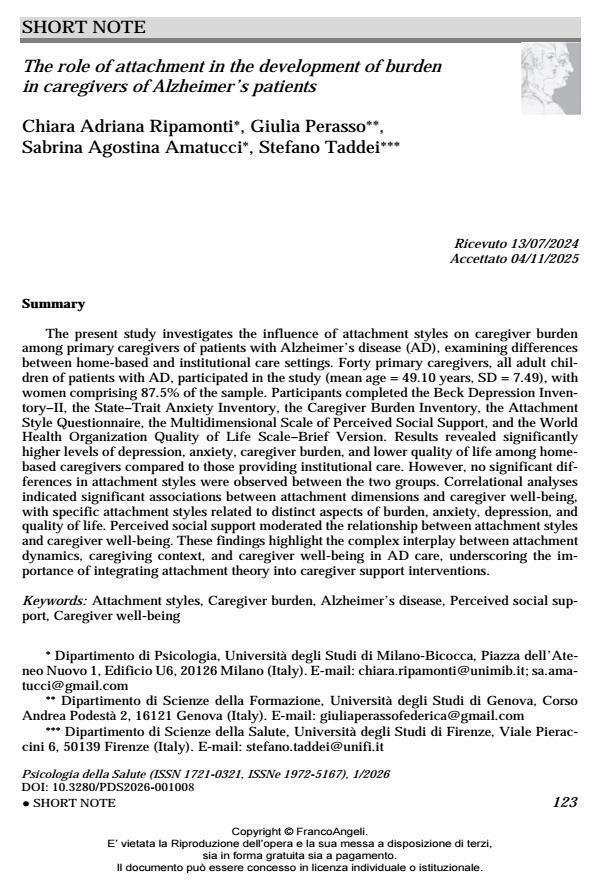
Anteprima articolo

FrancoAngeli è membro della Publishers International Linking Association, Inc (PILA), associazione indipendente e non profit per facilitare (attraverso i servizi tecnologici implementati da CrossRef.org) l’accesso degli studiosi ai contenuti digitali nelle pubblicazioni professionali e scientifiche.

The present study investigates the influence of attachment styles on caregiver burden among primary caregivers of patients with Alzheimer’s disease (AD), examining differences between home-based and institutional care settings. Forty primary caregivers, all adult children of patients with AD, participated in the study (mean age = 49.10 years, SD = 7.49), with women comprising 87.5% of the sample. Participants completed the Beck Depression Inventory–II, the State–Trait Anxiety Inventory, the Caregiver Burden Inventory, the Attachment Style Questionnaire, the Multidimensional Scale of Perceived Social Support, and the World Health Organization Quality of Life Scale–Brief Version. Results revealed significantly higher levels of depression, anxiety, caregiver burden, and lower quality of life among home-based caregivers compared to those providing institutional care. However, no significant differences in attachment styles were observed between the two groups. Correlational analyses indicated significant associations between attachment dimensions and caregiver well-being, with specific attachment styles related to distinct aspects of burden, anxiety, depression, and quality of life. Perceived social support moderated the relationship between attachment styles and caregiver well-being. These findings highlight the complex interplay between attachment dynamics, caregiving context, and caregiver well-being in AD care, underscoring the importance of integrating attachment theory into caregiver support interventions.

Lo studio indaga l’influenza degli stili di attaccamento sul carico dei caregiver primari dei pazienti affetti da malattia di Alzheimer (AD), esaminando le differenze tra i contesti di assistenza domiciliare e istituzionalizzata. Quaranta caregiver primari, tutti figli di pazienti affetti da AD, hanno partecipato, con un’età media di 49,10 anni (SD = 7,49), e l’87,5% erano donne. I partecipanti hanno completato valutazioni utilizzando il Beck Depression Inventory II, lo State-Trait Anxiety Inventory, il Caregiver Burden Inventory, l’Attachment Style Questionnaire, la Multidimensional Scale of Perceived Social Support e la World Health Organization Quality of Life Scale Brief Version. I risultati hanno rivelato livelli significativamente più elevati di depressione, ansia, carico e una minore qualità della vita tra i caregiver domiciliari rispetto a quelli che forniscono assistenza istituzionalizzata. Tuttavia, gli stili di attaccamento non differivano significativamente tra i gruppi. L’analisi delle correlazioni ha evidenziato relazioni significative tra le dimensioni dell’attaccamento e il benessere del caregiver, con stili di attaccamento specifici associati a diversi aspetti di carico, ansia, depressione e qualità della vita. Il supporto sociale percepito ha moderato la relazione tra gli stili di attaccamento e il benessere del caregiver. Questi risultati sottolineano l’interazione complessa tra dinamiche di attaccamento, contesto di cura e benessere del caregiver nell’assistenza agli AD, suggerendo l’importanza di integrare la teoria dell’attaccamento nelle strategie di supporto per i caregiver.

Parole chiave:stili di attaccamento, burden, malattia di Alzheimer, supporto sociale percepito, benessere del caregiver

  1. Pedrazza, M., & Boccato, G. (2010). Attachment style questionnaire: contributo alla validazione italiana. Ricerche di psicologia, 1: 9-26. DOI: 10.3280/RIP2010-00100
  2. Akbari, M., Alavi, M., Irajpour, A., & Maghsoudi, J. (2018). Challenges of family caregivers of patients with mental disorders in Iran: A narrative review. Iranian journal of nursing and midwifery research, 23(5): 329-337.
  3. Bagheriamiri, Z., Mirsepassi, Z., & Sayadi, L. (2024). Caregiver burden, attachment and cognitive emotion among the family caregivers of severe mental illness patients. BMC psychology, 12(1): 610.
  4. Bastawrous, M. (2013). Caregiver burden-a critical discussion. International Journal of Nursing Studies, 50(3): 431–441.
  5. Beck, A.T., Steer, R.A., & Brown, G.K. (1996). Manual for Beck Depression Inventory II (BDI-II). San Antonio, TX: Psychology Corporation.
  6. Brennan, K. A., Clark, C. L., & Shaver, P. R. (1998). Self-report measurement of adult attachment: An integrative overview. Attachment theory and close relationships, 46(1): 70-100.
  7. Cohen, C., Pushkar, D., Shulman, K., Wortley, J., McDonald, G., & Wargon, M. (1993). Factors Determining the Decision To Institutionalize Dementing Individuals:A Prospective Study. The Gerontologist. 33: 714-20.
  8. Crispi, E., Schiaffino, K., & Berman. W.H. (1997). The Contribution of Attachment to Burden in Adult Children of Institutionalized Parents with Dementia. The Gerontologist, 37(1): 52-60.
  9. Crowell, J. A., & Owens, G. (1996). Manual for the Current Relationship Interview and scoring system. Unpublished manuscript, State University of New York at Stony Brook.
  10. D’Onofrio, G., Sancarlo, D., Addante, F., Ciccone, F., Cascavilla, L., Paris, F., & Pilotto, A. (2015). Caregiver burden characterization in patients with Alzheimer’s disease or vascular dementia. International Journal of Geriatric Psychiatry, 30: 891–899.
  11. De Girolamo, G., Rucci, P., Scocco, P., Becchi, A., Coppa, F., D’Addario, A., ... & Marson, C. (2000). Quality of life assessment: validation of the Italian version of the WHOQOL-Brief. Epidemiology and Psychiatric Sciences, 9(1): 45-55. DOI: 10.1017/S1121189X0000774
  12. Dhouib, W., Ibrahim, B., Bannour, R., ben Cheikh, A., Bhiri, S., Ghali, H., Khefacha, S., Said Latiri, H., & Ben Rejeb, M. (2021). The burden of Alzheimer’s caregivers and social support in the tunisian family. European Journal of Public Health, 31.
  13. Dicken, C. (1963). Good impression, social desirability, and acquiescence as suppressor variables. Educational and Psychological Measurement, 23(4): 699-720. DOI: 10.1177/00131644630230040
  14. Di Fabio, A., & Palazzeschi, L. (2015). Multidimensional Scale of Perceived Social Support (MSPSS): un contributo alla validazione italiana [Multidimensional Scale of Perceived Social Support (MSPSS): A contribution to Italian validation]. Counseling: Giornale Italiano di Ricerca e Applicazioni, 8(3): 127–140.
  15. Edwards, H. B., Ijaz, S., Whiting, P. F., Leach, V., Richards, A., Cullum, S. J., Cheston, R. I., & Savovic, J. (2018). Quality of family relationships and outcomes of dementia: a systematic review. Bmj Open, 8(1): 015538.
  16. Faber, J., & Fonseca, L. M. (2014). How sample size influences research outcomes. Dental press journal of orthodontics, 19: 27-29.
  17. Feeney, J.A., Noller, P., & Hanrahan, M. (1994). Assessing adult attachment, in M.B. Sperling, W.H. Berman (a cura di), Attachment in adults: Clinical and Developmental Perspectives. New York: Guilford Press, pp. 128-154.
  18. George, C., & West, M. L. (2012). The adult attachment projective picture system: Attachment theory and assessment in adults. New York: Guilford Press.
  19. Ghisi, M., Sica, C. (2006). Le versioni italiane del Beck Anxiety Inventory e del Beck Depression Inventory-II: proprietà psicometriche e potere discriminante. In: Lange, M. A. (a cura di), Test psicologici all’avanguardia e ricerca sui test. Hauppauge, New York, USA: Nova Science Publishers (pp. 27-50).
  20. Karantzas, G. C., & Simpson, J. A. (2015). Attachment and aged care. In: Simpson, J. A. & Rholes W. S. (eds.). Attachment theory and research: New directions and emerging themes. New York, NY: Guilford Press (pp. 319-345).
  21. Karantzas, G. C., Romano, D., & Lee, J. (2019). Attachment and aged care: a systematic review of current research. Current opinion in psychology, 25: 37-46.
  22. Kim, S. K., Park, M., Lee, Y., Choi, S. H., Moon, S. Y., Seo, S. W., Park, K. W., Ku, B. D., Han, H. J., Park, K. H., Han, S.-H., Kim, E.-J., Lee, J.-H., Park, S. A., Shim, Y. S., Kim, J. H., Hong, C. H., Na, D. L., Ye, B. S., … Moon, Y. (2017). Influence of personality on depression, burden, and health-related quality of life in family caregivers of persons with dementia. International Psychogeriatrics, 29(2): 227–237. DOI: 10.1017/S1041610216001770
  23. Kokkonen, T.-M., Cheston, R. I. L., Dallos, R., & Smart, C. A. (2014). Attachment and coping of dementia care staff: the role of staff attachment style, geriatric nursing self-efficacy, and approaches to dementia in burnout. Dementia, 13(4): 544–568. DOI: 10.1177/1471301213479469
  24. Istat Noi Italia. La demografia dell’Europa (ed. 2020). https://www.istat.it/demografiadelleuropa/bloc-1c.html.
  25. Lancashire, L., Biggar, V., Comer, M., Frangiosa, T., Gage, A., Paulsen, R., ... & Wolfe, J. (2023). Caring for Dementia Caregivers: Understanding Caregiver Stress During the COVID-19 Pandemic. Gerontology and Geriatric Medicine, 9, DOI: 10.1177/2333721423118566
  26. Lee, J., Sohn, B. K., Lee, H., Seong, J.S., Park, S., & Lee, J. Y. (2018). Attachment style and filial obligation in the burden of caregivers of dementia patients. Archives of Gerontology and Geriatrics, 75: 104-111.
  27. Koç, M., Tel, H., & Karakülah, K. (2021). Determining care burden and psychiatric symptom level in caregiver of schizophrenia patient. Perspectives in Psychiatric Care, 57(2).
  28. Kuscu, M. K., Dural, U., Önen, P., Yasa, Y., Yayla, M., Basaran, G., ... & Bekiroglu, N. (2009). The association between individual attachment patterns, the perceived social support, and the psychological well-being of Turkish informal caregivers. Psycho-Oncology: Journal of the Psychological, Social and Behavioral Dimensions of Cancer, 18(9): 927-935.
  29. Main, M., Kaplan, N. & Cassidy, J. (1985). Security in infancy, childhood, and adulthood: A move to the representational level. In: Bretherton, I. & Waters, E. (eds.), Growing points of attachment theory and research. Monographs of the Society for Research in Child Development, Vol. 50, pp. 66-104.
  30. Markiewicz, D., Reis, M., & Gold, D. P. (1997). An exploration of attachment styles and personality traits in caregiving for dementia patients. The International Journal of Aging and Human Development, 45(2): 111-132. DOI: 10.2190/T4Q4-E8F0-JWT5-DBA
  31. Marvardi, M., Mattioli, P., Spazzafumo, L., Mastriforti, R., Rinaldi, P., Polidori, M. C., ... & Study Group on Brain Aging of the Italian Society of Gerontology and Geriatrics (2005). The Caregiver Burden Inventory in evaluating the burden of caregivers of elderly demented patients: results from a multicenter study. Aging clinical and experimental research, 17: 46-53.
  32. Nicholls, W., Hulbert-Williams, N., & Bramwell, R. (2014). The role of relationship attachment in psychological adjustment to cancer in patients and caregivers: a systematic review of the literature. Psycho-Oncology, 23(10): 1083-1095.
  33. Novak, M., & Guest, C. (1989). Application of a Multidimensional Caregiver Burden Inventory. The Gerontologist, 29 (6): 798-803.
  34. Pedrabissi, L. e Santinello, M. (1989) STAI State-Trait Anxiety Inventory Forma Y Manuale. Organizzazioni Speciali, Firenze.
  35. Ripamonti C.A., Sala F., Alessi C., Fumagalli B., Gatti M. (2015). Caregiving familiare e Malattia di Alzheimer. Effetti del luogo di cura sul benessere psico-fisico del caregiver. Giornale di Gerontologia, 63: 252-259.
  36. Smith, E. R., Perrin, P. B., Tyler, C. M., Lageman, S. K., & Villaseñor, T. (2019). Parkinson’s symptoms and caregiver burden and mental health: a cross-cultural mediational model. Behavioural Neurology, 2019(1): 1396572. DOI: 10.1155/2019/139657
  37. Spielberger, C.D., Gorsuch, R.L., & Lushene, R.E. (1970). Manual for the State-Trait Anxiety Inventory. Palo Alto: Consulting Psycologists Press.
  38. The WHOQOL Group (1998). The World Health Organization Quality of Life Assessment (WHOQOL): Development and general psychometric properties. Social Science and Medicine, 46(12): 1569-1585. DOI: 10.1016/S0277-9536(98)00009-
  39. The WHOQOL Group (1998b). Development of the World Health Organization WHOQOL-BRIEF quality of life assessment. Psychological Medicine, 28: 551-558. DOI: 10.1017/S003329179800666
  40. World Health Organization (2019). International Statistical Classification of Diseases and Related Health Problems 10th Revision. https://icd.who.int/browse10/2019/en.
  41. Xiaoyun, C., & Fenglan, L. (2020). The relationships among insecure attachment, social support, and psychological experiences in family caregivers of cancer inpatients. European Journal of Oncology Nursing, 44: 101691.
  42. Zimet, G. D., Dahlem, N. W., Zimet, S. G., & Farley, G. K. (1988). The Multidimensional Scale of Perceived Social Support. Journal of Personality Assessment, 52: 30-41.

Chiara Adriana Ripamonti, Sabrina Agostina Amatucci, Stefano Taddei, The role of attachment in the development of burden in caregivers of Alzheimer’s patients in "PSICOLOGIA DELLA SALUTE" 1/2026, pp 123-138, DOI: 10.3280/PDS2026-001008